

Last Tuesday, I was helping a friend set up an HVAC testing business when he asked me about handheld particle counters. He’d been researching for weeks and kept coming back to one model: the CEM DT-9880. “Everyone mentions it,” he said, “but nobody tells me if it’s actually worth the money or where to even get one in Pakistan.”
That conversation got me thinking. The CEM DT-9880 keeps popping up in cleanroom discussions, HVAC forums, and IAQ testing circles. But good, practical information about this specific unit? Surprisingly hard to find.
So if you’re trying to decide whether to buy CEM DT-9880 Particle Counter equipment for your facility, testing business, or cleanroom validation work, let’s have an honest conversation about what this thing actually does, what it costs, and whether it’s the right tool for your situation.
What Exactly Is the CEM DT-9880?
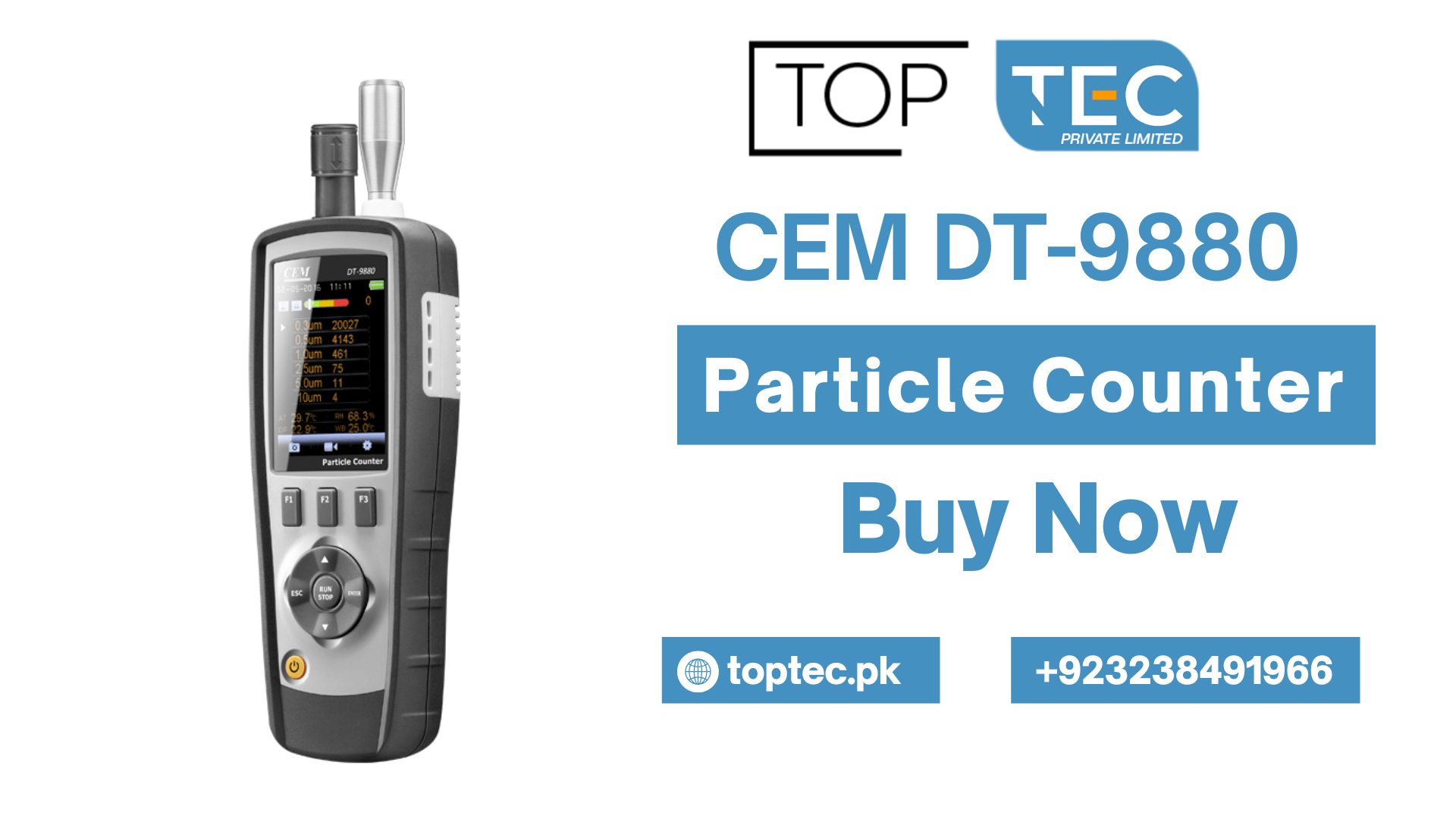
The CEM DT-9880 is a handheld laser particle counter designed for indoor air quality testing, cleanroom monitoring, and HVAC system evaluation. It’s portable, relatively affordable, and gives you real-time particle count data across six size channels.
CEM is a Chinese manufacturer that’s carved out a decent reputation in the environmental testing instrument market. They’re not Fluke or TSI, but they’re also not selling junk. Think of them as the solid middle ground—good enough for professional use without the premium brand tax.
The DT-9880 specifically targets professionals who need particle counting capability but don’t have the budget (or need) for top-tier laboratory-grade equipment. HVAC contractors, facility managers, cleanroom technicians, and environmental consultants make up most of the user base.
Breaking Down the Features That Actually Matter
Let’s talk about what the DT-9880 actually does, without the marketing fluff.
Particle Size Channels
The DT-9880 measures particles in six size ranges simultaneously:
- 0.3 µm
- 0.5 µm
- 1.0 µm
- 2.5 µm
- 5.0 µm
- 10.0 µm
This range covers most of what you care about for indoor air quality and cleanroom work. Those 0.3 and 0.5 micron channels are critical for ISO cleanroom classification. The larger channels (2.5, 5.0, 10.0) help with general air quality assessment and filter efficiency testing.
Real talk: The optical system on the DT-9880 isn’t as sophisticated as units costing three times as much. But for most field applications, it’s adequate. I’ve seen side-by-side comparisons with higher-end counters, and the DT-9880 generally tracks within acceptable margins for non-critical work.
Sampling Flow Rate
It pulls air at 2.83 liters per minute (0.1 cubic feet per minute). This is standard for handheld units.
Why does flow rate matter? Because particle count is expressed as particles per unit volume. If the flow rate is inaccurate or inconsistent, your counts are wrong. Period.
The DT-9880 has decent flow control, but—and this is important—it should be verified periodically if you’re doing work where accuracy matters. When you buy CEM DT-9880 Particle Counter equipment, also budget for occasional flow rate verification.
Data Logging and Storage
The unit can store up to 5,000 sample records internally. For most daily work, that’s plenty. You can download data via USB to a computer for analysis and reporting.
The included software is… functional. It’s not pretty, and the interface feels like it was designed in 2008, but it does the job. You can export to Excel or PDF, which is what most people need anyway.
Display and Interface
Color TFT display, 2.8 inches. It’s readable in most lighting conditions, though direct sunlight can be challenging.
The menu system is reasonably intuitive. I’ve watched people figure it out without reading the manual, which is more than I can say for some “professional” instruments I’ve used.
Battery Life
About 6-8 hours of continuous use on a full charge. That’s solid for field work. I know HVAC guys who run these all day doing filter testing without needing a mid-day recharge.
Charges via USB, which is convenient. No proprietary chargers to lose or replace.
Build Quality
The housing is plastic, but it feels sturdy enough. I wouldn’t drop it from shoulder height repeatedly, but it handles normal field use without drama.
There’s a basic carrying case included. It’s adequate—nothing fancy, but it protects the unit during transport.
Real-World Applications: What’s It Actually Good For?
Before you buy CEM DT-9880 Particle Counter equipment, make sure it matches your actual use case.
HVAC System Testing and Balancing
This is probably the most common application. HVAC contractors use the DT-9880 to:
- Verify filter efficiency before and after replacement
- Check for duct leakage
- Validate that HVAC improvements actually reduced particle levels
- Provide data for IAQ complaints
One HVAC contractor I know in Islamabad has three of these units. He told me: “For the price, they’re perfect for our work. We’re not certifying pharmaceutical cleanrooms. We’re showing building managers that their new filters actually work. The DT-9880 gives us credible data without breaking the bank.”
Cleanroom Classification (With Caveats)
Can you use the DT-9880 for cleanroom classification? Sort of.
For informal verification or pre-certification checks, it’s fine. You can get a general sense of whether your cleanroom is performing before bringing in the official certification team.
But for formal ISO 14644 classification? Most auditors want to see data from certified instruments with current calibration certificates. The DT-9880 typically doesn’t come with the documentation needed for regulatory compliance.
If you’re managing a pharmaceutical cleanroom or semiconductor fab, don’t buy CEM DT-9880 Particle Counter units as your primary classification tool. Use them for troubleshooting and maintenance monitoring, but invest in properly certified equipment for official classification work.
Indoor Air Quality Investigations
Environmental consultants use these for IAQ assessments all the time. When someone complains about poor air quality in an office building, the DT-9880 provides objective data about particle levels.
You can compare occupied vs. unoccupied spaces, test before and after ventilation system changes, and identify problem areas.
Construction and Renovation Monitoring
During construction or renovation near sensitive areas, the DT-9880 can monitor whether particle levels are being controlled. This is common in hospitals doing construction—you need to ensure construction dust isn’t infiltrating patient care areas.
Manufacturing Quality Control (General)
For non-cleanroom manufacturing where you still care about particulate contamination—paint booths, electronics assembly, food processing—the DT-9880 provides useful monitoring.
It’s not precision laboratory equipment, but it tells you if things are getting worse, staying stable, or improving.
Filter Testing and Maintenance
Testing HEPA filter integrity, checking for gaps around filter frames, verifying filter installation—all good applications for the DT-9880.
What It’s NOT Good For
Let’s be clear about limitations.
Not suitable for:
- Formal pharmaceutical cleanroom certification (unless accepted by your specific auditor—unlikely)
- Semiconductor fab classification
- Research requiring high precision and low uncertainty
- Any application where lives directly depend on the accuracy
- Environments with very high particle loads (it can saturate)
The DT-9880 is a field instrument. Treat it as such. If you need laboratory-grade precision and regulatory compliance, look elsewhere. If you need practical, affordable particle monitoring for routine work, it’s a solid choice.
Price Expectations: What Should You Actually Pay?
Here’s where things get interesting. Pricing for the DT-9880 varies wildly depending on where and how you buy.
General price ranges (2026 estimates):
Directly from international suppliers: $800-$1,200 USD
This doesn’t include shipping, customs, or import duties. By the time it lands in Pakistan, you’re looking at significantly more.
Through Pakistani distributors: PKR 180,000 – PKR 280,000
The spread depends on the distributor’s markup, what accessories are included, and whether they provide any local support.
Online marketplaces: Highly variable, often sketchy
I’ve seen listings from PKR 120,000 to PKR 350,000. The cheap ones are usually scams or refurbished units being sold as new. The expensive ones are just overpriced.
What should be included when you buy CEM DT-9880 Particle Counter:
- The main unit
- USB cable for charging and data transfer
- Carrying case
- User manual
- Software CD (or download link)
- Zero count filter (for verification)
- Calibration certificate (if it’s a reputable vendor)
Red flags that suggest you’re getting ripped off:
- Price significantly below market (too good to be true usually is)
- Vendor can’t provide a calibration certificate
- No mention of warranty
- Generic product photos (not actual unit photos)
- Vendor is vague about shipping time or stock availability
Smart buying tips:
When you buy CEM DT-9880 Particle Counter equipment, try to negotiate:
- Extended warranty (2 years instead of 1)
- Free calibration verification within the first year
- Extra zero count filters
- Spare battery (if available)
- Training on proper use
Some vendors will throw in these extras to win the sale. Others won’t budge. But it never hurts to ask.
Where to Actually Buy in Pakistan
This is the practical question everyone has. Where do you buy CEM DT-9880 Particle Counter units in Pakistan without getting scammed or overpaying?
Option 1: Authorized CEM Distributors
Check if there are official CEM distributors in Pakistan. As of early 2026, distribution presence is limited, but it’s growing.
Advantages:
- Genuine product guarantee
- Warranty support
- Usually includes calibration certificate
- Access to spare parts
Disadvantages:
- Often more expensive
- Limited stock sometimes
- May have to wait for shipments
Option 2: Scientific Equipment Suppliers
Several Pakistani companies import and sell environmental testing equipment. They might not be “authorized” distributors, but they’re legitimate businesses that stand behind what they sell.
Advantages:
- Established local presence
- Can inspect the unit before buying
- Local support if issues arise
- Often have other related equipment you might need
Disadvantages:
- Markup can be significant
- May not have latest models in stock
- Support quality varies
Option 3: International Purchase and Import
You can buy CEM DT-9880 Particle Counter equipment directly from international suppliers and handle importation yourself.
Advantages:
- Potentially lower unit price
- Access to latest models
- Can buy directly from CEM or large distributors
Disadvantages:
- Shipping costs
- Import duties and taxes (can be 25-40% of value)
- Customs hassle
- No local support
- Warranty claims are complicated
- Risk of damage during shipping
My take: Unless you’re buying multiple units and can absorb the complexity, buying locally (even with markup) usually makes more sense. The time, hassle, and risk of international purchase often outweigh the price savings.
Option 4: Used/Refurbished Market
There is a small market for used particle counters in Pakistan.
When it makes sense:
- Budget is extremely tight
- You’re okay with older technology
- You have expertise to evaluate the unit’s condition
- It’s for non-critical applications
Critical checks for used units:
- Request recent particle count data showing it actually works
- Verify flow rate (compare to another unit or use calibrated flow meter)
- Check for physical damage
- Get some kind of warranty or return period
- Verify the battery still holds charge
- Make sure you can get a zero count (filter inlet and verify zero particles detected)
I know a couple of HVAC contractors who bought used DT-9880 units and are happy with them. But I also know someone who bought a “like new” unit that was actually partially functional. Buyer beware.
Calibration and Maintenance Considerations
When you buy CEM DT-9880 Particle Counter equipment, the purchase is just the beginning. Keeping it accurate requires ongoing attention.
Calibration Requirements
Technically, particle counters should be calibrated annually. This ensures the size channels are accurate and the flow rate is correct.
Reality check: Full calibration for a unit like the DT-9880 can cost $200-$400 USD from a calibration house. That’s a significant percentage of the unit’s value.
Many users do performance verification rather than full calibration. This is less rigorous but catches major problems:
- Zero count check (filter the inlet and verify zero particles)
- Flow rate check (using a calibrated flow meter)
- Side-by-side comparison with another particle counter
Is this acceptable? Depends on your application. For informal monitoring and troubleshooting, probably yes. For anything requiring regulatory compliance, probably no.
Basic Maintenance
The DT-9880 doesn’t need much maintenance, but a few things help:
- Keep the inlet clean and free from dust buildup
- Store in the carrying case when not in use
- Don’t expose to extreme temperatures
- Verify zero count periodically
- Keep the battery charged (don’t let it sit dead for months)
Common Issues
Based on user reports, problems that crop up:
- Battery degradation after 2-3 years (may need replacement)
- Software compatibility issues with newer Windows versions
- Occasional flow rate drift
- Display screen scratches if not protected
None of these are showstoppers, but they’re worth knowing about.
Setting Up Your Testing Station: The TOPTEC Connection
Here’s something most people don’t think about when they buy CEM DT-9880 Particle Counter equipment: where are you actually going to use it?
If you’re purely doing field work, you just carry it around. No problem.
But if you’re doing regular testing, data analysis, or equipment maintenance, you need a proper workspace. And this is where I see people make expensive mistakes.
I’ve watched technicians work on wobbly desks, trying to calibrate or verify particle counters on surfaces that shake every time someone walks by. I’ve seen units damaged because they were stored on cheap furniture that couldn’t handle the weight or had surfaces that reacted with cleaning solvents.
This is exactly where TOPTEC PVT. LTD comes into the picture.
TOPTEC manufactures laboratory furniture in Pakistan specifically designed for technical work. When you’re setting up a testing station, equipment maintenance area, or small laboratory for your particle monitoring program, proper furniture makes a real difference.
Why TOPTEC for your particle counter workspace:
Stable Surfaces: Their benches are built for precision work. When you’re doing zero count verification or flow rate checks, you can’t have a surface that vibrates or wobbles. TOPTEC’s analytical benches provide the stability technical work requires.
Chemical-Resistant Countertops: Particle counters need periodic cleaning. Isopropyl alcohol, mild detergents, and other cleaning agents are common. Cheap furniture surfaces degrade quickly. TOPTEC’s countertops are manufactured to handle these without deteriorating.
Proper Storage Solutions: Where are you keeping your particle counter when it’s not in use? Where are the accessories, zero count filters, cables, and manuals? TOPTEC can integrate storage into your bench design—drawers, cabinets, shelving that actually makes sense for your workflow.
Ergonomic Design: If you’re regularly using the particle counter at a workstation—downloading data, analyzing results, preparing reports—proper bench height matters. TOPTEC designs furniture with Pakistani users in mind, not generic international standards that don’t fit local ergonomics.
Local Manufacturing Advantages: Because TOPTEC manufactures in Pakistan, you get:
- Faster delivery than imported furniture
- Ability to customize for your exact space
- Direct communication about what you need
- Reasonable pricing without import markups
- Local support if adjustments are needed
A testing service company in Karachi told me: “We bought three DT-9880 units and initially just stuck them on regular office desks. After we set up a proper testing station with a TOPTEC bench, the whole workflow improved. We can do our calibration checks properly, data analysis is more organized, and we’re not worried about damaging equipment on inadequate furniture.”
When you invest in equipment like the DT-9880, don’t undermine that investment with poor workspace infrastructure. The few extra thousand rupees spent on proper furniture from TOPTEC pays for itself in better work quality and equipment longevity.
Should You Buy the CEM DT-9880?
Let’s cut to the bottom line. Should you buy CEM DT-9880 Particle Counter equipment?
Buy it if:
- You need affordable, portable particle monitoring
- HVAC testing and IAQ work is your focus
- You’re okay with mid-range accuracy for field use
- Budget won’t stretch to premium brands
- You need something that’s reasonably intuitive to use
- Local support and calibration aren’t critical
Skip it if:
- You need certified equipment for regulatory compliance
- Pharmaceutical or semiconductor cleanroom work is your application
- Maximum precision is required
- You have budget for TSI, Lighthouse, or Particle Measuring Systems equipment
- You need extensive support and training
For most HVAC contractors, environmental consultants, and facility managers, the DT-9880 hits a sweet spot of capability and affordability. It’s not perfect, but it’s good enough for most real-world applications.
Alternatives Worth Considering
If you’re on the fence about whether to buy CEM DT-9880 Particle Counter units, here are alternatives at similar price points:
Temtop LKC-1000S: Similar capability, slightly different feature set. Some users prefer the interface.
Fluke 985: More expensive but significantly better build quality and support. If budget allows, it’s worth the upgrade.
Kanomax 3887: Japanese brand, excellent reputation, but considerably more expensive.
TSI AeroTrak 9306: The professional standard. About 3-4x the price of the DT-9880, but vastly better if you need regulatory compliance.
Each has trade-offs. For most people reading this, the DT-9880 offers the best balance of features, quality, and price.
Final Thoughts
The CEM DT-9880 isn’t going to win awards for cutting-edge technology or premium build quality. It’s not the tool you’d choose for critical pharmaceutical cleanroom certification or semiconductor manufacturing.
But here’s the thing: most people don’t need that level of capability. They need reliable, affordable particle counting for HVAC testing, IAQ investigations, and general cleanroom monitoring.
For those applications, when you buy CEM DT-9880 Particle Counter equipment from a reputable supplier, you’re getting a solid tool that does the job without breaking the bank.
Just make sure you:
- Buy from legitimate sources
- Understand its limitations
- Budget for periodic calibration or verification
- Set up a proper workspace (talk to TOPTEC about appropriate furniture)
- Don’t use it for applications beyond its capability
Your particle monitoring is only as good as your equipment and how you use it. The DT-9880 can be excellent value—if it’s the right tool for your specific needs.
