

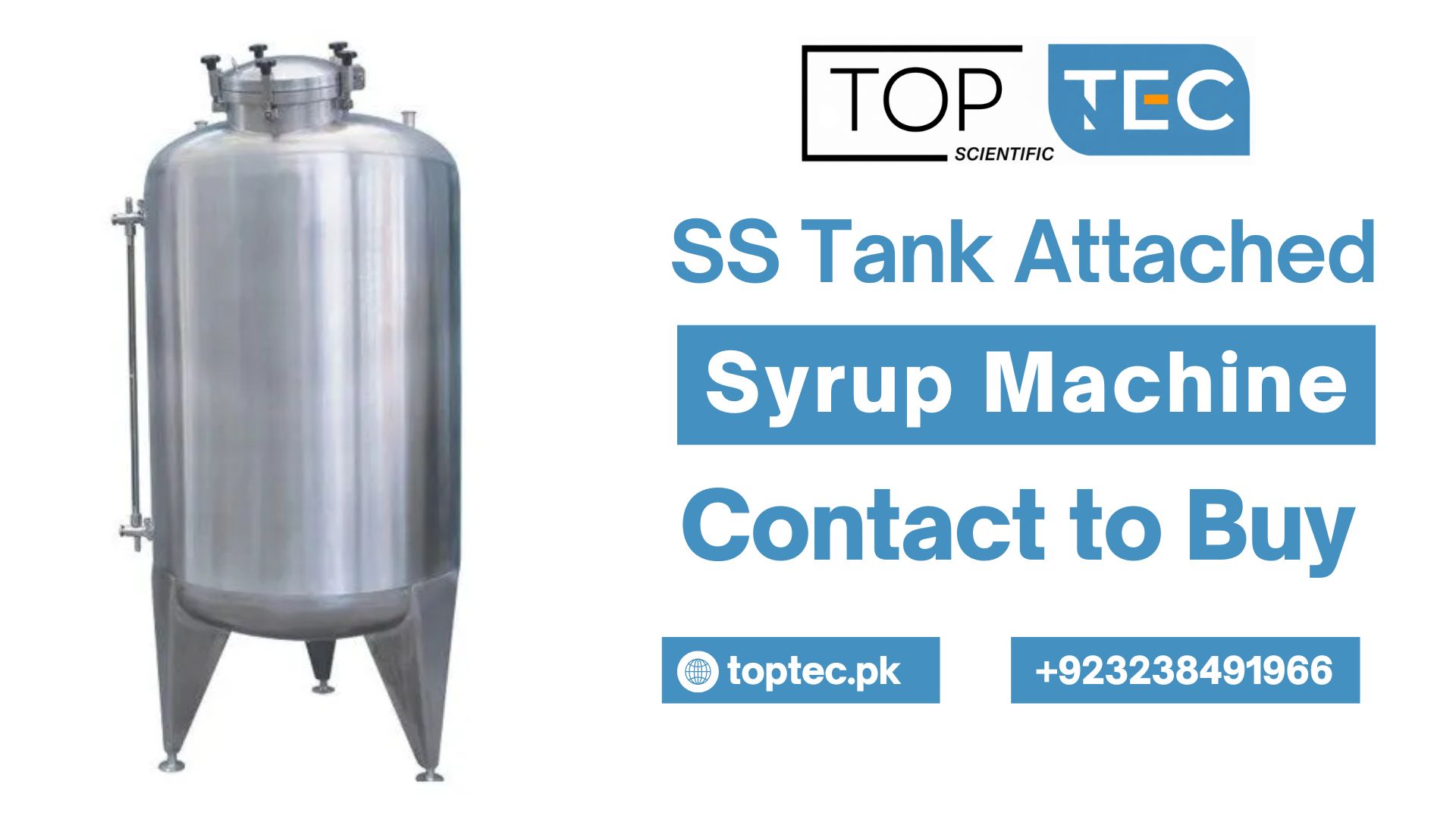
Discover high-quality SS tank attached syrup machines for pharmaceutical and food production. 50L to 20,000L jacketed tanks with cGMP design and agitators. Request a free quote from verified manufacturers today.
Walk into any pharmaceutical liquid manufacturing facility in Pakistan and one piece of equipment defines the entire production operation more than anything else.
It’s not the filling line. It’s not the labeling machine. It’s not even the water purification system, though that’s critically important. It’s the syrup preparation tank — the vessel where your pharmaceutical liquid formulation is actually created. Where APIs dissolve into solution. Where excipients blend uniformly. Where temperature is controlled to achieve the viscosity and clarity your product requires. Where the quality of everything downstream is fundamentally determined.
And specifically for pharmaceutical liquid manufacturing in Pakistan, the SS Syrup manufacturing tank — stainless steel, properly specified, GMP-designed — is the centerpiece of this operation. Get this right and your production runs smoothly, your batches release cleanly, and your DRAP inspections go without major findings. Get it wrong and you’re dealing with cleaning validation failures, corrosion problems, inconsistent product quality, and regulatory headaches that follow you from audit to audit.
This guide is written for pharmaceutical manufacturers in Pakistan who are seriously evaluating SS Tank Attached Syrup Machine systems — whether you’re setting up a new liquid manufacturing line, replacing aging equipment, or upgrading from basic mixing setups to proper GMP-compliant syrup preparation tank systems. We’ll cover what this equipment actually is, what specifications matter, what drives Stainless Steel Syrup Tank price in Pakistan, and how TOPTEC Scientific fits into this picture as a local manufacturer you can actually work with.
What Is a SS Tank Attached Syrup Machine — And Why Does the Integration Matter?
Let’s clarify the terminology first because it causes confusion.
When Pakistani pharmaceutical manufacturers talk about wanting to buy SS Tank Attached Syrup Machine equipment, they’re typically describing an integrated liquid manufacturing system — not just a standalone mixing tank. The “tank attached” description is meaningful — it refers to a manufacturing setup where the preparation vessel is integrated with associated equipment into a functional production unit.
A complete SS Syrup manufacturing tank system typically includes:
The Primary Preparation Vessel: The main stainless steel tank where the pharmaceutical syrup formulation is prepared. This is the heart of the system — the vessel where APIs, excipients, sweeteners, preservatives, and water are combined and processed into the finished formulation.
Heating and Cooling Jacket: Most pharmaceutical syrup preparations require temperature control. Dissolving sucrose requires heat. Some APIs have temperature-dependent solubility. Viscosity control during manufacturing often requires heating. Post-preparation cooling before filling is standard practice. The jacket system handles all of this.
Agitation System: The mixing mechanism inside the syrup preparation tank that creates the fluid motion needed for dissolution, blending, and uniform suspension of all formulation components.
Sugar Melting Vessel: Many pharmaceutical syrup manufacturing setups include a dedicated sugar melting tank — a smaller vessel where sucrose is dissolved in purified water to create a clear syrup base before transfer to the main preparation vessel. This is the “attached” element that creates the complete integrated system.
Vacuum System: Many pharmaceutical SS Syrup manufacturing tank systems incorporate vacuum capability to deaerate the syrup after preparation — removing dissolved air that would otherwise create clarity and stability problems — and to facilitate sugar dissolution by drawing hot syrup solution under reduced pressure.
Homogenizer or In-Line Mixer: For preparations requiring fine particle dispersion or emulsification, an in-line homogenizer or high-shear mixer may be integrated into the circulation loop connecting different vessels.
Transfer Pump and Pipework: The stainless steel pipework and pharmaceutical-grade pumps that move liquid between the sugar melting vessel, the main preparation vessel, and downstream to the filling line.
CIP System: Clean-in-place spray devices, connections, and associated controls that allow the complete internal surface of the vessel and connected pipework to be cleaned without disassembly.
Understanding this complete system picture is important when you’re evaluating Stainless Steel Syrup Tank price in Pakistan quotations — because what’s included in different suppliers’ quotations varies enormously, and apparent price differences often reflect scope differences as much as price differences.
The Pharmaceutical Syrup Manufacturing Process — Why Each Vessel Matters
To understand why proper syrup preparation tank specification matters so much, it helps to understand what actually happens during pharmaceutical syrup manufacturing.
Stage 1: Purified Water Preparation
Pharmaceutical syrups are prepared using purified water meeting pharmacopeial specifications — specifically USP Purified Water or equivalent. This water is typically heated before use for sugar dissolution. The water quality going into your syrup directly affects your finished product quality.
Stage 2: Sugar Dissolution
Sucrose — typically 60-70% w/v in standard pharmaceutical syrups — is dissolved in heated purified water to create a clear syrup base. This is where a dedicated sugar melting vessel in the integrated system provides real manufacturing efficiency. Sugar dissolution in a smaller, purpose-designed vessel with intense heating and agitation is faster and more complete than trying to dissolve large quantities of sugar directly in the main preparation tank.
Temperature management during sugar dissolution matters — excessive heat causes caramelization, browning the syrup and potentially creating degradation products. The SS Syrup manufacturing tank heating system must provide adequate heat without local overheating that causes this problem.
Stage 3: API and Excipient Addition
With the sugar base prepared, the API and other excipients — preservatives, flavoring agents, colorants, viscosity modifiers, pH adjusters — are added to the main preparation vessel. The order of addition, the temperature at the time of addition, and the agitation during and after each addition all affect dissolution completeness and formulation quality.
This is where agitation system design directly affects product quality. Inadequate agitation produces incomplete API dissolution — meaning your finished syrup doesn’t contain the stated dose uniformly throughout. Excessive agitation creates foaming that causes filling problems and may denature sensitive APIs.
Stage 4: Volume Adjustment
After all ingredients are dissolved and mixed, the batch is brought to final volume with purified water. This requires accurate level measurement in the syrup preparation tank — load cells for gravimetric volume measurement or properly calibrated volume markings are the pharmaceutical standard.
Stage 5: Quality Checks
Before the batch is cleared for filling, in-process testing verifies that the preparation meets specifications — pH, assay (API concentration), clarity, color, specific gravity. These tests happen while the batch is still in the preparation vessel, and the results determine whether filling proceeds or whether adjustments are needed.
Stage 6: Cooling and Transfer to Filling
Syrups are typically cooled to near room temperature before filling — hot syrup fills create closure sealing problems and volume measurement errors due to thermal expansion. Cooling through the jacket system, followed by gravity or pump-assisted transfer to the filling line, completes the preparation phase.
Understanding this complete sequence clarifies why the syrup preparation tank design — jacket performance, agitation effectiveness, level measurement accuracy, CIP capability — directly determines your manufacturing process reliability.
Stainless Steel Specification — Why SS316L Is the Only Acceptable Choice
When you see Stainless Steel Syrup Tank price in Pakistan quotations that vary significantly for apparently similar vessels, material specification is frequently the explanation.
SS316L — The Pharmaceutical Standard
SS316L is the required material for pharmaceutical syrup manufacturing vessel product-contact surfaces. The specification combines:
Molybdenum Content (2-3%): Absent from SS304, molybdenum dramatically improves resistance to pitting and crevice corrosion in chloride-containing environments. Pharmaceutical cleaning agents frequently contain chlorine compounds. Sucrose syrups can contain trace chlorides from water and ingredient sources. SS316L resists the corrosion that these exposures cause in SS304.
Low Carbon (L designation): Carbon content below 0.03% prevents sensitization during welding — the process where higher-carbon steels develop corrosion-susceptible zones at weld boundaries due to chromium carbide formation. In a syrup preparation tank with extensive internal welding, SS316L maintains corrosion resistance throughout the welded structure. SS316 (without the L) can develop sensitized zones at welds that become corrosion initiation points over time.
Surface Finish Preservation: SS316L maintains its surface finish quality over time better than SS304 in pharmaceutical manufacturing environments. The internal surface of your syrup preparation tank will look as good after five years of pharmaceutical use as it does when new — if it’s properly specified SS316L.
What “Stainless Steel” Without Specification Actually Means
Be cautious with suppliers who describe their SS Syrup manufacturing tank products simply as “stainless steel” without specifying the grade. This vagueness sometimes intentionally obscures the use of SS304 or even lower-grade materials for product-contact surfaces — a cost-saving measure that creates compliance and corrosion problems over time.
Always request material mill certificates confirming SS316L specification for product-contact surfaces. This documentation — not verbal assurance — is what GMP compliance and equipment qualification require.
Surface Finish Requirements
Beyond material grade, the internal surface finish of your syrup preparation tank affects cleanability and microbial harborage risk:
Ra 0.4µm (mechanically polished): Standard for most non-sterile pharmaceutical syrup manufacturing. Achievable through systematic mechanical polishing to appropriate grit sequence.
Electropolished to Ra ≤0.4µm: Provides smoother surface than mechanical polishing through controlled electrochemical metal removal. Simultaneously improves corrosion resistance by enriching the passive layer. Required for sterile manufacturing and increasingly preferred for non-sterile pharmaceutical liquid manufacturing.
The surface finish specification should be confirmed with profilometry measurements documented at defined locations on the vessel interior — not just described in words on a specification sheet.
Agitation System Design — The Technical Heart of Syrup Manufacturing
The agitation system in your syrup preparation tank determines mixing quality, dissolution efficiency, and ultimately the uniformity of your pharmaceutical formulation. This is the specification element that most directly affects your product quality.
Anchor Agitators for Pharmaceutical Syrups
Anchor agitators — with blades that sweep close to the vessel walls and bottom — are the most common configuration for pharmaceutical syrup manufacturing. They provide several advantages particularly relevant to syrup production:
Wall Scraping Action: The close wall clearance of anchor blades prevents API or excipient buildup on the vessel walls. Material that settles on the walls during addition gets swept back into the bulk liquid.
Effective Heat Transfer: The sweeping action across jacketed vessel walls improves heat transfer efficiency — helping the liquid reach and maintain target temperature more quickly and uniformly.
Low Shear Mixing: Pharmaceutical syrups often contain APIs and excipients that don’t benefit from high-shear mixing. The relatively gentle bulk flow of anchor agitation dissolves and blends ingredients without creating excessive foam or degrading sensitive components.
Appropriate for Viscous Formulations: As syrup viscosity increases — either from the sucrose content or from added viscosity modifiers — anchor agitators maintain effective mixing where propeller or turbine agitators would create a rotating mass without bulk mixing.
Additional Mixing Elements
Some SS Syrup manufacturing tank designs incorporate additional mixing elements alongside the anchor:
Disperser or High-Shear Impeller: For formulations requiring fine particle dispersion or emulsification, a high-shear impeller operating at higher speed than the anchor provides localized intense mixing. These are typically positioned centrally in the vessel, with the anchor sweeping the walls simultaneously.
Ribbon Agitators: Helical ribbons that provide additional axial mixing in addition to the circumferential mixing of a standard anchor. Useful for very viscous preparations where stratification is a concern.
Mechanical Seal vs. Magnetic Drive
The agitator shaft enters the vessel through a seal at the top (or bottom for bottom-drive configurations). The seal type affects contamination risk, maintenance requirements, and cost:
Mechanical Seals: Standard approach. Well-proven technology with defined maintenance requirements. The seal must be included in the cleaning validation protocol. Requires periodic replacement — typically annually or at defined service intervals.
Magnetic Drive: No shaft penetration through the vessel wall. Zero leakage, zero contamination risk at the agitator entry point. Preferred for GMP-sensitive applications. Higher initial cost but eliminates seal maintenance and contamination risk.
Variable Frequency Drive Control
Fixed-speed agitation is cheaper but limits your process flexibility. Variable frequency drive control of agitator speed allows you to:
- Mix at high speed initially for rapid dissolution
- Reduce speed during sensitive operations to minimize foaming
- Adjust mixing intensity for different formulations on the same equipment
- Control shear rate for emulsion or suspension preparations with particle size sensitivity
For a syrup preparation tank that will be used for multiple pharmaceutical syrup products, VFD agitation control is worth the investment.
Heating and Cooling Jacket Design for Syrup Manufacturing
Temperature control during pharmaceutical syrup manufacturing isn’t a luxury — it’s a process requirement for most formulations. The jacket system design determines how effectively and efficiently you can control temperature throughout the manufacturing process.
Jacket Configurations
Half-Pipe Jackets: A semi-circular pipe section welded to the vessel exterior in a spiral or ladder pattern. Good heat transfer characteristics with turbulent flow of heating/cooling medium. Common on medium to large pharmaceutical syrup tanks.
Dimple Jackets: A dimpled outer shell creating a thin, turbulent-flow jacket space. Excellent heat transfer efficiency for a given jacket volume. Common on smaller syrup preparation tank systems.
Full Shell Jackets: A complete outer cylindrical shell. Maximum jacket fluid volume, good temperature distribution. Often used on larger preparation vessels where temperature uniformity across a large surface area is important.
Heating Media Options
Steam: Efficient, high-temperature capable, rapid heating. Requires steam supply infrastructure. Common in established pharmaceutical manufacturing facilities.
Hot Water: More controlled temperature application than steam. Requires circulating water heating system (hot water generator or heat exchanger). Gentler heating appropriate for temperature-sensitive formulations.
Thermal Oil: For applications requiring very precise temperature control above 100°C. Less common in standard pharmaceutical syrup manufacturing.
Cooling Capability
After preparation, syrups must be cooled before filling. Cooling water circulation through the jacket provides this cooling. The cooling rate depends on jacket configuration, cooling water temperature and flow rate, and vessel insulation. Most SS Syrup manufacturing tank systems designed for pharmaceutical use have insulated vessels — which improves heating efficiency and reduces cooling water consumption for temperature maintenance.
Vacuum System Integration — Why It Matters for Pharmaceutical Syrups
The vacuum capability integrated into many pharmaceutical syrup preparation tank systems serves several important functions that directly affect product quality:
Deaeration: Syrups prepared at elevated temperature absorb dissolved air during mixing. When the syrup cools to filling temperature, this dissolved air comes out of solution — creating tiny bubbles that affect clarity and can cause filling problems. Applying vacuum after preparation — typically 100-200 mbar absolute — removes this dissolved air, producing a clear, stable syrup without dissolved gas problems.
Assisted Sugar Dissolution: Some manufacturers use vacuum to assist sugar dissolution — the reduced pressure lowers the boiling point of water, creating vigorous ebullition that accelerates dissolution of sucrose into the syrup base.
Contamination Prevention During Transfer: Transferring finished syrup under nitrogen purge or into a vessel maintained under slight vacuum prevents contamination from atmospheric oxygen — important for formulations with oxidation-sensitive APIs.
Foaming Control During High-Shear Operations: For formulations requiring in-line homogenization or high-shear mixing, operating under vacuum reduces foaming.
The vacuum system integration in a SS Syrup manufacturing tank system adds cost — vacuum pump, vacuum piping, vacuum-rated vessel construction, appropriate instrumentation — but for most pharmaceutical syrup formulations, the product quality benefits justify this addition.
CIP System Design — The Key to Cleaning Validation Success
The clean-in-place system is what separates a pharmaceutical-grade syrup preparation tank from a well-built industrial mixing vessel. For multi-product pharmaceutical facilities where the same preparation tank is used for different syrup formulations, cleaning validation is a regulatory requirement — and the CIP system design determines whether your cleaning validation succeeds or becomes an ongoing compliance problem.
CIP Spray Coverage
Complete internal surface coverage by cleaning solution is the fundamental requirement. Rotating spray heads or fixed spray balls must be positioned and sized to deliver cleaning solution to every internal surface — vessel walls, bottom head, agitator blades, agitator shaft, internal fittings, thermowell surfaces. Coverage qualification using riboflavin (a fluorescent tracer) is standard pharmaceutical practice.
Inadequate spray coverage leaves areas of the vessel that cleaning solution doesn’t reach — areas that fail cleaning validation swab sampling and create ongoing microbiological risks.
Complete Internal Drainage
“Dead legs” — sections of the vessel interior where liquid accumulates and can’t drain during CIP — are a chronic cleaning validation problem. The vessel must drain completely through the bottom outlet. This requires appropriate vessel bottom geometry, drain port sizing and positioning, and a minimum drainage slope that ensures no liquid remains after CIP cycle completion.
Sanitary Fitting Design
Every fitting connected to the vessel interior — temperature sensors, level instruments, sight glasses, spray head connections, product nozzles — must have sanitary design. This means no threads or gasket faces on the process side where product residue or microorganisms can accumulate between cleaning cycles. Tri-clamp (TC) or DIN connections with appropriate pharmaceutical-grade gaskets are standard.
CIP Program Design
The CIP program — the sequence and parameters of cleaning solution circulation through the vessel — must be validated to demonstrate complete residue removal. Typical pharmaceutical CIP programs for syrup tanks include:
Pre-rinse → Caustic wash → Intermediate rinse → Acid wash → Final purified water rinse → (optional sanitization)
The CIP program is validated for specific products (or product families) processed in the vessel, with swab sampling and analytical testing confirming that residues are below defined acceptance limits.
Stainless Steel Syrup Tank Price in Pakistan — The Complete Picture
Now let’s address what you probably came here wanting to know — what does this equipment actually cost?
The Stainless Steel Syrup Tank price in Pakistan varies significantly based on multiple specification variables. Here’s an honest breakdown:
What Drives the Price
System Capacity: The primary driver. A 500-liter integrated syrup manufacturing system costs significantly more than a 200-liter equivalent. But capacity isn’t the only variable — two 500-liter systems from different suppliers at significantly different prices almost always reflect specification differences, not just fabrication cost differences.
Number of Vessels in the Integrated System: A basic single-vessel syrup preparation tank costs less than a complete integrated system including sugar melting vessel, main preparation vessel, and holding tank with interconnecting pipework and controls.
Material Documentation: SS316L construction with full material traceability — mill certificates, heat numbers tracked through fabrication — costs more than undocumented steel construction. This documentation cost is real and is non-negotiable for GMP pharmaceutical manufacturing.
Surface Finish Level: Mechanically polished to Ra 0.4µm costs less than electropolished to Ra ≤0.4µm. The electropolishing process adds cost but provides superior surface quality and improved corrosion resistance.
Jacket Configuration: Simple half-pipe or dimple jackets cost less than full shell jackets. Jacket with comprehensive temperature control instrumentation costs more than basic jacket connections.
Agitation Specification: Basic mechanical seal agitator with fixed-speed drive costs less than magnetic drive agitator with VFD speed control and torque monitoring.
Vacuum System Integration: Adding vacuum capability — vacuum pump, associated piping, vacuum-rated vessel construction — adds meaningful cost but also meaningful manufacturing capability.
CIP System: Properly designed CIP with rotating spray heads, complete drainage, and sanitary fittings costs more than basic tank construction without dedicated CIP design.
Instrumentation Level: Basic sight glass and thermometer versus full process instrumentation with RTD transmitters, load cells, pH sensors, and PLC control are very different cost points.
Documentation Package: IQ/OQ protocol templates, weld inspection records, surface finish documentation — full pharmaceutical GMP documentation adds cost that reflects real engineering and administrative effort.
The Total Cost of Ownership Perspective
When evaluating Stainless Steel Syrup Tank price in Pakistan quotations, total cost of ownership is the right framework:
A lower-priced vessel that uses SS304 instead of SS316L for product-contact surfaces will develop corrosion over time. Corrosion creates cleaning validation failures, product contamination risks, and eventually vessel replacement. The cost of these downstream problems typically exceeds the initial material cost saving many times over.
A vessel without proper CIP design creates ongoing cleaning validation problems. Every batch release delayed by cleaning validation questions has a cost. Accumulated over years of production, these costs dwarf the price difference between a properly CIP-designed vessel and one without.
A vessel without proper documentation can’t be formally qualified. Addressing qualification failures retrospectively is expensive and often incomplete. Sometimes it means replacing the vessel.
TOPTEC Scientific — Local Manufacturing for Complete Pharmaceutical Facility Infrastructure
TOPTEC Scientific is a Pakistan-based manufacturing company producing high-specification laboratory furniture, cleanroom equipment, and pharmaceutical production infrastructure for facilities throughout Pakistan. When you need to buy SS Tank Attached Syrup Machine equipment and the surrounding production environment infrastructure, TOPTEC Scientific provides both.
Their manufacturing is genuinely local — which creates advantages for Pakistani pharmaceutical manufacturers that international suppliers cannot offer:
No Import Complications: Large pharmaceutical vessels are difficult and expensive to import. Customs, freight, currency exposure, and delivery uncertainty all add complications that local manufacturing eliminates entirely.
Local Technical Support: When your SS Syrup manufacturing tank needs service, adjustment, or modification, TOPTEC Scientific‘s technical team is here in Pakistan. Hours to respond, not weeks.
Understanding Pakistani Pharmaceutical Context: DRAP GMP requirements, local manufacturing practices, Pakistani facility infrastructure realities — TOPTEC Scientific works within this context every day and brings that understanding to every project.
Complete Facility Infrastructure: Beyond stainless steel pharmaceutical tanks, TOPTEC Scientific manufactures the complete surrounding production environment:
Pharmaceutical-Grade Stainless Steel Workbenches
The manufacturing area around your syrup preparation tank requires properly specified work surfaces for in-process operations, raw material handling, and documentation management. TOPTEC Scientific manufactures SS304 and SS316 workbenches with seamless welded construction and pharmaceutical-grade surface finishes — no painted surfaces, no hollow contamination-harboring sections, properly specified for pharmaceutical manufacturing environments.
Dispensing and Weighing Stations
APIs, excipients, sweeteners, and preservatives need to be accurately weighed and dispensed before addition to the preparation vessel. TOPTEC Scientific manufactures weighing stations with anti-vibration features for accurate pharmaceutical weighing, and contained dispensing booths with HEPA filtration for dusty materials.
Pass-Through Systems
For controlled material transfer between different environmental zones in pharmaceutical liquid manufacturing facilities, TOPTEC Scientific manufactures static and dynamic pass-through boxes appropriate for pharmaceutical facility requirements.
Mobile Stainless Steel Trolleys
For in-facility transport of materials, equipment, and pharmaceutical intermediates, TOPTEC Scientific manufactures pharmaceutical-grade stainless steel trolleys with smooth, cleanable surfaces and appropriate load capacities.
In-Process QC Workstations
Adjacent to the syrup preparation tank, dedicated QC workstations for pH measurement, clarity checking, viscosity testing, and other in-process quality control operations. Stable, cleanable surfaces with appropriate instrument positioning.
Gowning Room Furniture
Complete gowning room infrastructure — benches, lockers, organized storage — supporting consistent pharmaceutical personnel gowning compliance before entry into liquid manufacturing areas.
QC Laboratory Furniture
Chemical-resistant laboratory benches, fume hoods, analytical instrument workstations, and complete QC laboratory furniture for testing operations associated with pharmaceutical syrup manufacturing.
Common Mistakes When Buying SS Tank Attached Syrup Machine Systems
Several avoidable mistakes come up consistently when pharmaceutical manufacturers make this investment:
Not specifying SS316L explicitly with material documentation
The most common and consequential mistake. Always require material mill certificates confirming SS316L for product-contact surfaces.
Underestimating the importance of agitation design
Buying an agitator sized for easy liquids when your formulations include viscous syrups or suspensions creates immediate performance problems. Discuss your actual formulations when specifying agitation.
Ignoring CIP design until after fabrication
CIP capability must be designed into the vessel from the start. Retrofitting CIP onto a vessel not originally designed for it is expensive and often produces inadequate cleaning performance.
Separating the tank purchase from the surrounding infrastructure
The manufacturing environment around your SS Syrup manufacturing tank matters as much as the tank itself for GMP compliance. Plan both together.
Choosing the lowest Stainless Steel Syrup Tank price in Pakistan without understanding specification differences
The lowest price almost always reflects specification compromises that create operational and compliance problems over time.
Closing Thoughts
When you’re ready to buy SS Tank Attached Syrup Machine equipment for your pharmaceutical liquid manufacturing operation, the decision deserves the serious evaluation it requires. Your syrup preparation tank will be at the center of your production operation for fifteen to twenty years — the quality, specification, and documentation of this equipment directly affects your product quality, your regulatory compliance, and your manufacturing economics for that entire period.
The Stainless Steel Syrup Tank price in Pakistan that represents genuine value accounts for proper SS316L specification with documentation, appropriate surface finish with measurement records, effective agitation for your specific formulations, CIP design for cleaning validation success, appropriate instrumentation for process control, and complete GMP documentation for equipment qualification.
TOPTEC Scientific provides all of this with the practical advantage of local manufacturing — shorter lead times, local support, Pakistani pharmaceutical context understanding, and comprehensive facility infrastructure capability that takes your project from syrup preparation tank procurement to complete production environment setup.
Contact TOPTEC Scientific to discuss your specific requirements and get a meaningful quotation that reflects what your pharmaceutical syrup manufacturing operation actually needs.
For SS Tank Attached Syrup Machine systems, pharmaceutical process vessels, laboratory furniture, cleanroom workbenches, dispensing stations, QC laboratory infrastructure, and complete pharmaceutical manufacturing facility fitout manufactured locally in Pakistan, contact TOPTEC Scientific — your comprehensive pharmaceutical facility partner in Pakistan.
