

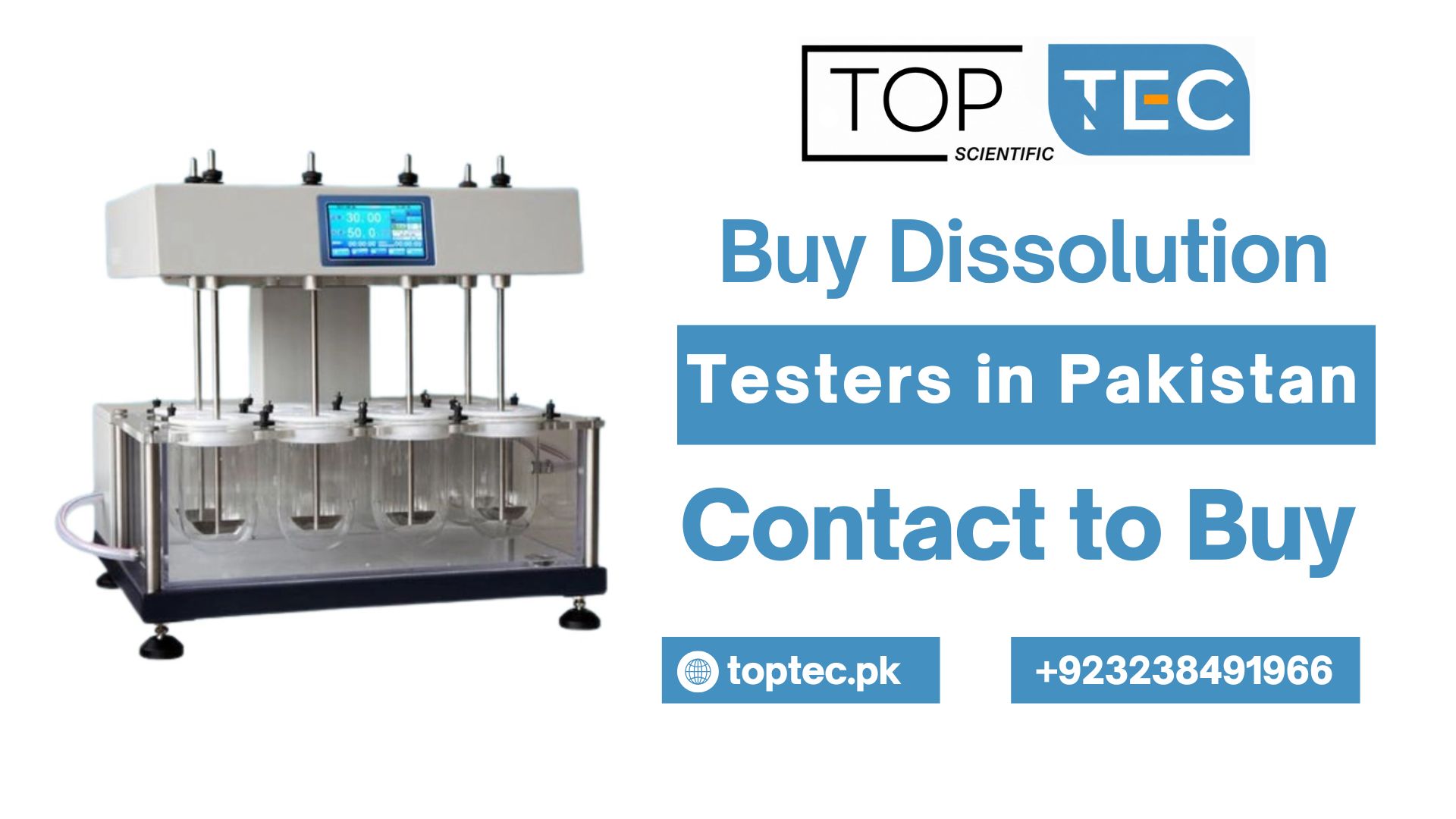
Dissolution testing Equipments is at the intersection of pharmaceutical science and patient safety in a way that few other quality control tests do.
Think about it this way. A tablet can have perfect appearance. It can pass weight uniformity. It can meet assay specification for active ingredient content. But if the API doesn’t dissolve properly in the gastrointestinal tract — if it doesn’t release at the right rate under the right conditions — the patient doesn’t get the therapeutic benefit the prescribing physician intended.
Dissolution testing is how pharmaceutical manufacturers demonstrate, batch after batch, that their solid oral dosage forms will actually release drug in a way that allows absorption. It’s the in vitro surrogate for in vivo bioavailability. And the equipment performing that test — the dissolution tester — needs to execute the test with enough precision and reproducibility that the results mean something.
This guide is written for Pakistani pharmaceutical QC professionals, laboratory managers, and procurement decision-makers who are evaluating options to buy Dissolution Testing Equipment or buy Dissolution Testers in Pakistan for their laboratories. We’ll cover what this equipment actually does, how different apparatus types work, what specifications matter for GMP compliance, and how to make a buying decision you’ll be confident about.
What Is Dissolution Testing and Why Is It Mandatory?
Before getting into equipment specifics, a clear understanding of what dissolution testing achieves is foundational.
Dissolution testing measures the rate and extent to which a drug substance is released from a solid oral dosage form — tablet, capsule, or modified-release formulation — under standardized in vitro conditions. The test medium simulates gastrointestinal fluid (or specific compartments thereof). The temperature mimics body temperature. The mechanical conditions simulate gastrointestinal motility.
Samples of the test medium are withdrawn at defined time intervals and analyzed for drug concentration — typically by UV spectrophotometry or HPLC. The dissolution profile — drug concentration versus time — characterizes the release behavior of the dosage form.
Why is this mandatory?
The United States Pharmacopeia (USP), European Pharmacopeia (EP), and other major pharmacopeias include dissolution as a required test for most solid oral dosage forms. DRAP product registrations in Pakistan reference pharmacopeial methods. Batch release of pharmaceutical products requires dissolution testing demonstrating that each batch meets the dissolution specification established during product development.
Beyond batch release, dissolution testing is essential for:
Formulation development: Understanding how formulation changes affect drug release helps developers optimize compositions for bioavailability.
Scale-up and technology transfer: Demonstrating that production-scale batches maintain the same dissolution profile as development batches validates the manufacturing process.
Post-approval changes: Regulatory submissions for manufacturing changes — site transfer, equipment changes, supplier changes — require comparative dissolution data demonstrating bioequivalence.
Stability assessment: Dissolution is a critical stability parameter for many solid oral dosage forms — changes in dissolution profile over time indicate formulation degradation.
Bioequivalence studies: Generic pharmaceutical development requires demonstrating bioequivalence with reference products, and dissolution profiling is a key element of in vitro bioequivalence assessment.
Given this breadth of application, dissolution test equipment is among the most important analytical instruments in any pharmaceutical QC laboratory.
The USP Apparatus Types — Understanding What You’re Evaluating
When pharmaceutical professionals discuss dissolution test equipment, they’re typically referring to the apparatus types defined by the USP. Understanding these apparatus types is fundamental to specifying the right equipment when you buy Dissolution Testing Equipment for your laboratory.
USP Apparatus 1 — Rotating Basket
USP Apparatus 1 — the rotating basket — is the original dissolution apparatus and remains one of the two most widely used configurations.
In USP Apparatus 1, the dosage form is placed inside a wire mesh basket — typically 40-mesh stainless steel — attached to the bottom of a shaft that rotates at a specified speed. The basket assembly is positioned in a vessel containing the dissolution medium, with the basket rotating while the vessel is stationary.
The rotation creates fluid flow around and through the basket, providing the hydrodynamic conditions under which the dosage form dissolves. Rotation speeds are specified in the individual monograph — commonly 50 or 100 RPM.
When is USP Apparatus 1 appropriate?
USP Apparatus 1 is specified for dosage forms that tend to float in dissolution medium — capsules and some granular formulations — because the basket physically contains the dosage form rather than relying on gravity to keep it in the dissolution zone. It’s also specified for dosage forms where the basket geometry provides more appropriate hydrodynamic conditions than a paddle.
Many capsule dissolution methods specify USP Apparatus 1. Some tablet methods also use Apparatus 1, particularly for formulations where floating could affect results.
USP Apparatus 1 limitations:
Coning — accumulation of undissolved material at the bottom of the basket that can shield it from dissolution medium — can be a problem with some formulations. The basket assembly requires more careful cleaning than paddle equipment and is more susceptible to mesh clogging with sticky formulations.
USP Apparatus 2 — Paddle
USP Apparatus 2 — the paddle — is arguably the most commonly used dissolution apparatus in pharmaceutical QC. The dosage form is placed freely in the dissolution vessel — sinking to the bottom. A paddle-shaped stirring element rotates above the dosage form, creating the hydrodynamic conditions for dissolution.
The paddle apparatus is simpler mechanically than the basket, easier to clean, and appropriate for the majority of tablet dissolution methods. Standard rotation speeds are 25, 50, or 75 RPM depending on the monograph.
Sinker devices — small wire mesh coils or clips that hold floating dosage forms at the vessel bottom — are used with Apparatus 2 for formulations that would otherwise float.
USP Apparatus 3 — Reciprocating Cylinder
USP Apparatus 3 uses a glass cylinder that reciprocates vertically through a series of medium vessels. The dosage form is placed inside the glass cylinder. As the cylinder moves up and down through the medium, dissolution occurs. The ability to move the dosage form through vessels containing different media — simulating the pH gradient along the gastrointestinal tract — makes Apparatus 3 useful for extended-release formulations and for simulating sequential pH conditions.
USP Apparatus 4 — Flow-Through Cell
USP Apparatus 4 circulates fresh dissolution medium continuously through a cell containing the dosage form. The continuous replenishment of medium creates sink conditions — the drug concentration never builds up to levels that would slow dissolution — making this apparatus particularly appropriate for poorly soluble drugs where non-sink conditions would limit dissolution.
Apparatus 4 is also well-suited to modified-release formulations, implants, suppositories, and other non-standard dosage forms.
USP Apparatus 5, 6, and 7 — Specialized Systems
These apparatus types address specialized dosage forms:
Apparatus 5 (Paddle over disk): For transdermal patches.
Apparatus 6 (Rotating cylinder): For transdermal patches.
Apparatus 7 (Reciprocating disk): For implants, stents, and extended-release systems.
These specialized apparatus types are not relevant for most standard pharmaceutical tablet and capsule dissolution programs but are important for companies developing these specific dosage forms.
Key Technical Specifications That Determine Dissolution Tester Quality
When you evaluate options to buy Dissolution Testers in Pakistan, these specifications distinguish instruments that will generate regulatory-acceptable data from those that won’t:
Temperature Control Accuracy and Uniformity
Dissolution testing is conducted at 37.0°C ± 0.5°C — body temperature, simulating the environment in which the drug will dissolve in vivo. This temperature is maintained by immersing the dissolution vessels in a water bath or by individually jacketing each vessel.
Temperature accuracy within ±0.5°C across all vessels throughout the test is a USP requirement. Temperature non-uniformity between vessels means samples in different positions are dissolving at different rates — introducing systematic variability between vessels that compounds with all other sources of variability.
When evaluating dissolution test equipment, verifying individual vessel temperature control (not just bath temperature) and the uniformity between all vessels simultaneously is essential.
Rotation Speed Accuracy and Stability
USP Apparatus 1 and Apparatus 2 specify shaft rotation speed in RPM. Speed accuracy of ±4% of the specified rate is the USP requirement. Speed stability — maintaining the specified speed without fluctuation during the test — affects the hydrodynamic conditions and therefore the dissolution rate.
Shaft wobble — lateral movement of the rotating shaft — is specified by USP as a maximum of 2mm at any point. Wobble creates non-reproducible, non-uniform hydrodynamic conditions that introduce variability into dissolution results. When evaluating dissolution testers, shaft wobble specification and its verification through factory calibration is an important quality indicator.
Vessel Geometry
USP specifies the geometry of dissolution vessels — hemispherical bottom, defined internal diameter, defined volume — because vessel geometry directly affects the hydrodynamic conditions and therefore the dissolution results. Vessels that deviate from USP specification produce non-standard hydrodynamic conditions that generate data not comparable to results from properly specified equipment.
When you buy Dissolution Testing Equipment, verifying that vessels meet USP geometric specification — and obtaining documentation confirming this — is a basic quality requirement.
Sampling System
Manual sampling — withdrawing samples with a syringe through a filter at the defined sample port position — is the traditional approach and remains common. Automated sampling systems — peristaltic pumps or syringe pumps drawing samples automatically at programmed time points — reduce operator variability and improve throughput for high-volume testing.
The sampling position — specified as midway between the bottom of the paddle and the surface of the medium, not less than 1cm from the vessel wall — must be reproducible between samples to ensure consistent hydrodynamic conditions at the sampling point.
Number of Vessels
Standard dissolution testers have 6 vessels — matching the 6-unit requirement of most USP dissolution methods. Eight-vessel and twelve-vessel configurations are available for laboratories with high throughput requirements or for running simultaneous comparative dissolution studies.
UV/Vis Spectrophotometry Integration
Modern dissolution test equipment increasingly integrates online UV/Vis spectrophotometry with fiber optic probes inserted directly into each dissolution vessel. This online monitoring provides continuous dissolution profiles rather than discrete time-point samples, eliminates sampling-related variability, and dramatically increases data richness.
Integrated online UV systems are more expensive than standard dissolution testers but provide significant advantages for formulation development and for dissolution method development where real-time visibility of the dissolution profile accelerates understanding.
Data Acquisition and Documentation
GMP dissolution testing requires documented results — individual vessel data, mean calculations, acceptance criteria comparison, instrument parameters. Modern dissolution testers provide software with electronic data capture, calculation, reporting, and regulatory compliance features including audit trail, user access control, and electronic signatures per 21 CFR Part 11.
For pharmaceutical GMP laboratories, software with these compliance features is a regulatory expectation rather than an optional upgrade.
Calibration Requirements — USP Mechanical and Chemical Calibration
USP dissolution apparatus require periodic performance verification through both mechanical calibration and chemical calibration (performance verification test — PVT).
Mechanical Calibration
Mechanical calibration verifies the physical parameters of the dissolution apparatus:
- Shaft speed at each position
- Shaft wobble at each position
- Vessel temperature at each position
- Paddle or basket height position
- Vessel geometry compliance
These parameters are verified at installation and at defined periodic intervals — typically semi-annually for most pharmaceutical QC laboratories. The calibration documentation becomes part of the instrument qualification file.
Performance Verification Test (PVT)
USP provides prednisone tablets (for Apparatus 1 and 2) and salicylic acid tablets as dissolution performance verification standards. These reference materials have defined dissolution specifications. Testing these calibrators in your dissolution apparatus under specified conditions, with results within the specified range, verifies that the complete system — apparatus, medium, analyst technique — is performing correctly.
The PVT is the dissolution-specific performance check that goes beyond mechanical verification to confirm the complete test system performance. USP guidance recommends PVT testing when new equipment is installed, after significant maintenance, and periodically during routine operation.
When you buy Dissolution Testers in Pakistan, confirming that appropriate dissolution calibrator tablets (prednisone/salicylic acid reference standards) are available locally for PVT performance is a practical operational consideration.
Dissolution Test Equipment Price Considerations in Pakistan
The dissolution test equipment market in Pakistan includes a range of products at different price points. Understanding what drives price differences helps you evaluate whether a quotation represents appropriate value.
What Drives Price Differences
Number of vessels: 6-vessel, 8-vessel, and 12-vessel configurations have different price points reflecting the additional mechanical complexity and vessel quantity.
Apparatus type capability: Equipment supporting only Apparatus 2 (paddle) costs less than equipment switchable between USP Apparatus 1 (basket) and Apparatus 2. Multi-apparatus capability adds mechanical complexity and cost.
Temperature control system: Circulating water bath systems vary in sophistication and precision. Individual vessel temperature control systems provide better uniformity than shared bath systems but cost more.
Automation level: Manual sampling dissolution testers cost significantly less than fully automated sampling systems with integrated fraction collection and UV analysis. The automation adds value through reduced operator involvement, improved reproducibility, and increased throughput — but the investment is meaningful.
Software compliance features: Basic software without regulatory compliance features costs less than validated software with 21 CFR Part 11 audit trail, electronic signatures, and comprehensive reporting. For pharmaceutical GMP applications, compliance software is necessary.
Online UV integration: Fiber optic inline UV systems represent significant additional investment over offline analysis approaches but provide substantially richer dissolution data.
Brand and service infrastructure: Established instrument brands with local calibration support, application specialists, and reliable spare parts supply cost more than generic alternatives without local support. For GMP-regulated pharmaceutical QC, local service availability is a total cost of ownership consideration.
When you buy Dissolution Testers in Pakistan, total cost of ownership matters
The acquisition price of dissolution test equipment is one component of total cost. Calibration costs — which happen at least semi-annually throughout the equipment’s operational life — add up over years. Spare parts availability and cost, service engineer availability and rates, and the cost of analytical downtime when instruments require service all contribute to total cost of ownership that the purchase price alone doesn’t capture.
Instruments with good local support infrastructure — calibration services available, spare parts stocked locally, service engineers accessible — have lower total cost of ownership than cheaper alternatives with poor support, even when the initial price difference favors the latter.
Qualifying Dissolution Equipment for GMP Use
Like all pharmaceutical analytical instruments, dissolution test equipment must be formally qualified before generating GMP-critical data.
Design Qualification (DQ)
The instrument specification must be documented to confirm it meets the requirements of your intended use — the dissolution methods you’ll run, the regulatory requirements of your submissions, and your laboratory’s operational requirements.
Installation Qualification (IQ)
Confirms the instrument was installed correctly — location meets environmental requirements, electrical connections are correct, instrument number and specification are documented, all accessories are present, and documentation including manuals and calibration certificates was received.
Operational Qualification (OQ)
Verifies the instrument operates within specification:
Temperature verification at each vessel position — confirming 37.0°C ± 0.5°C is achieved and maintained.
Speed verification at each shaft position at the RPM values your methods specify.
Shaft wobble verification at each position — confirming ≤2mm USP specification is met.
Vessel dimension verification — confirming geometric compliance with USP specification.
Software function verification including alarm function, data logging, and calculation accuracy.
Performance Qualification (PQ)
Ongoing demonstration that the instrument continues to perform acceptably for its intended use. PVT testing with USP reference calibrators, periodic re-calibration, and regular performance verification between formal calibration events constitute the PQ activities for dissolution equipment.
TOPTEC Scientific — Building the Complete Dissolution Testing Environment
When pharmaceutical QC laboratories invest in dissolution test equipment, the surrounding laboratory environment affects both the quality of dissolution testing and the efficiency of the complete testing workflow.
TOPTEC Scientific is a Pakistan-based manufacturing company producing high-specification laboratory furniture and pharmaceutical laboratory infrastructure for facilities throughout Pakistan. Everything they manufacture is produced locally — with direct technical support, local installation, and pricing that reflects local manufacturing economics.
For dissolution testing laboratories specifically, TOPTEC Scientific manufactures the complete surrounding environment:
Dissolution Tester Bench Stations
The workbench supporting dissolution testing equipment needs to be stable — vibration from an unstable bench affects the hydrodynamic conditions in dissolution vessels and introduces variability into dissolution results. TOPTEC Scientific manufactures dedicated dissolution tester bench stations with appropriate mass, stability, and construction for dissolution testing environments.
These aren’t generic laboratory benches. They’re designed with the specific requirements of dissolution testing in mind — appropriate height for vessel access and sampling operations, adequate space for the dissolution apparatus plus auxiliary equipment (fraction collectors, UV spectrophotometer), chemical-resistant surfaces for dissolution medium spills, and organized storage for dissolution vessels, sampling equipment, and reference materials.
Chemical-Resistant Laboratory Workbenches
Dissolution testing involves media preparation — preparing buffer solutions, adjusting pH, filtering media — that requires chemical-resistant bench surfaces. Spillage of acidic and alkaline dissolution media is routine. TOPTEC Scientific manufactures workbenches with epoxy resin, phenolic resin, or stainless steel tops appropriate for dissolution media chemistry environments.
Dissolution Media Preparation Stations
Dissolution media preparation — weighing buffer salts, dissolving in purified water, adjusting pH, degassing — is a critical upstream step that affects dissolution test quality. TOPTEC Scientific manufactures dedicated media preparation workstations with appropriate chemical resistance, pH meter positioning, and organized storage for reagents and equipment.
Analytical Balance Workstations
Accurate weighing of dissolution medium components and dissolution calibrator tablets requires stable, vibration-damped analytical balance workstations. TOPTEC Scientific manufactures anti-vibration instrument stands appropriate for analytical balances in dissolution laboratory environments.
Purified Water Station Furniture
Dissolution media preparation requires purified water meeting USP specification. The purified water system — typically a point-of-use reverse osmosis and deionization system — needs appropriate bench support, with nearby storage for water quality monitoring equipment. TOPTEC Scientific manufactures appropriate support furniture for laboratory water purification systems.
Sample Preparation and HPLC Interface Stations
Dissolution samples frequently require filtration and dilution before HPLC or UV analysis. Dedicated sample preparation stations with appropriate surfaces for filter holder use, sample transfer, and dilution operations support efficient, contamination-controlled sample processing.
For laboratories where dissolution samples feed HPLC analysis, the physical positioning of the dissolution apparatus relative to HPLC systems affects workflow efficiency. TOPTEC Scientific can design complete analytical laboratory layouts that optimize the dissolution-to-analysis workflow.
Fume Hoods for Volatile Media Preparation
Some dissolution media contain organic solvents — methanol, acetonitrile, isopropanol — for dissolution of poorly soluble drugs in non-aqueous or mixed media systems. Preparation of these media requires fume hood ventilation for operator safety. TOPTEC Scientific manufactures ducted fume hoods with appropriate airflow performance and chemical-resistant interior surfaces for dissolution laboratory environments.
Reference Standard Storage Systems
Dissolution calibrator tablets (prednisone, salicylic acid) and API reference standards used for dissolution analysis require controlled storage — typically refrigerated for temperature-sensitive materials. TOPTEC Scientific manufactures organized reference standard storage cabinets and refrigerator support furniture for pharmaceutical QC laboratory reference standard management.
Complete QC Laboratory Fit-Out
For pharmaceutical QC laboratories establishing or expanding dissolution testing capability as part of a broader laboratory development, TOPTEC Scientific provides complete laboratory furniture fit-out — integrated design that places dissolution apparatus, HPLC systems, UV spectrophotometers, balances, and sample preparation stations in logical, ergonomically optimized arrangements that support efficient analytical workflows.
The local manufacturing advantage of TOPTEC Scientific is particularly valuable for complete laboratory fit-out projects — custom dimensions, custom configurations, coordinated delivery and installation, and local support for modifications as laboratory needs evolve.
Selecting the Right Dissolution Apparatus for Your Product Portfolio
When you’re preparing to buy Dissolution Testing Equipment for your pharmaceutical QC laboratory, matching the apparatus configuration to your product portfolio prevents specification mistakes:
Standard tablet products (immediate release): USP Apparatus 1 (basket) or Apparatus 2 (paddle) depending on individual product methods. Most laboratories purchasing dissolution equipment for general tablet QC start with a paddle apparatus — Apparatus 2 — which covers the majority of immediate-release tablet monographs. Switchable basket/paddle capability provides flexibility for the full range.
Capsule products: USP Apparatus 1 (basket) is commonly specified for capsule dissolution. A dissolution tester with switchable USP Apparatus 1/Apparatus 2 capability covers both tablet and capsule requirements.
Modified-release products: Extended-release and delayed-release formulations may use Apparatus 1, 2, 3, or 4 depending on the specific method. Laboratories focused on modified-release products should carefully review the specific methods for their products before specifying equipment.
Poorly soluble drugs (BCS Class II and IV): Apparatus 4 (flow-through cell) is frequently specified. If your portfolio includes poorly soluble APIs — an increasingly common situation as pharmaceutical development programs pursue more challenging chemical space — Apparatus 4 capability is relevant.
Common Mistakes When Buying Dissolution Testing Equipment
These patterns come up regularly when pharmaceutical QC laboratories reflect on dissolution equipment purchases they regret:
Buying without software compliance features for GMP applications
A dissolution tester with basic software that doesn’t provide audit trail, user access control, and electronic data records is non-compliant for GMP pharmaceutical QC use regardless of its mechanical performance. Confirm software compliance features before purchase.
Ignoring calibration service availability
Semi-annual mechanical calibration and periodic PVT testing are GMP requirements. If calibration services aren’t available locally for the instrument you’re considering, you’re creating an ongoing compliance challenge. Confirm calibration service availability and cost before purchase.
Underspecifying based on current product portfolio without considering growth
If your laboratory will add modified-release products, capsule products, or poorly soluble drug products to its testing scope, equipment that only handles paddle apparatus for immediate-release tablets may be inadequate within a few years. Buy switchable apparatus capability to accommodate foreseeable portfolio growth.
Not verifying vessel geometry compliance
Non-USP-compliant vessel geometry produces non-standard hydrodynamic conditions and non-comparable data. Request vessel dimension documentation confirming USP specification compliance.
Separating instrument purchase from laboratory environment planning
A high-quality dissolution tester on an inadequate, vibrating workbench in a poorly organized laboratory doesn’t perform to its potential. Plan the laboratory environment — including furniture from TOPTEC Scientific — alongside the instrument purchase.
Questions to Ask Before You Buy Dissolution Testers in Pakistan
Before finalizing any decision to buy Dissolution Testers in Pakistan, get specific answers to:
What apparatus types are supported — paddle only, or switchable paddle/basket? Can Apparatus 3 or 4 be added?
What is the temperature control system — circulating bath or individual vessel control? What temperature uniformity between vessels is demonstrated?
What is the shaft speed accuracy and wobble specification? Is this verified with factory calibration documentation?
What software compliance features are included — audit trail, electronic signatures, 21 CFR Part 11?
Are calibration services available locally? What is the calibration cost and interval?
What qualification documentation is provided — IQ/OQ protocol templates, factory calibration records, vessel dimension documentation?
What is the local spare parts availability for critical components?
Can I see the instrument operating with a demonstration or visit existing customers using this equipment?
Closing Thoughts
The decision to buy Dissolution Testing Equipment for your pharmaceutical QC laboratory is an investment in the quality testing infrastructure that protects patients who take your products.
USP Apparatus 1 and Apparatus 2 dissolution testers, properly specified and qualified, generate the reliable dissolution data that supports batch release decisions, stability assessment, and regulatory submissions. Getting the specification right — temperature accuracy, speed precision, vessel geometry compliance, software compliance capability — ensures the data you generate is analytically sound and regulatorily defensible.
When you buy Dissolution Testers in Pakistan, evaluating total cost of ownership rather than purchase price alone, confirming local calibration service availability, and planning the complete laboratory environment from TOPTEC Scientific alongside the instrument investment produces better long-term outcomes than instrument purchase decisions made in isolation.
Your dissolution testing results represent the quality of your pharmaceutical products. The equipment generating those results deserves the same seriousness as the products themselves.
