

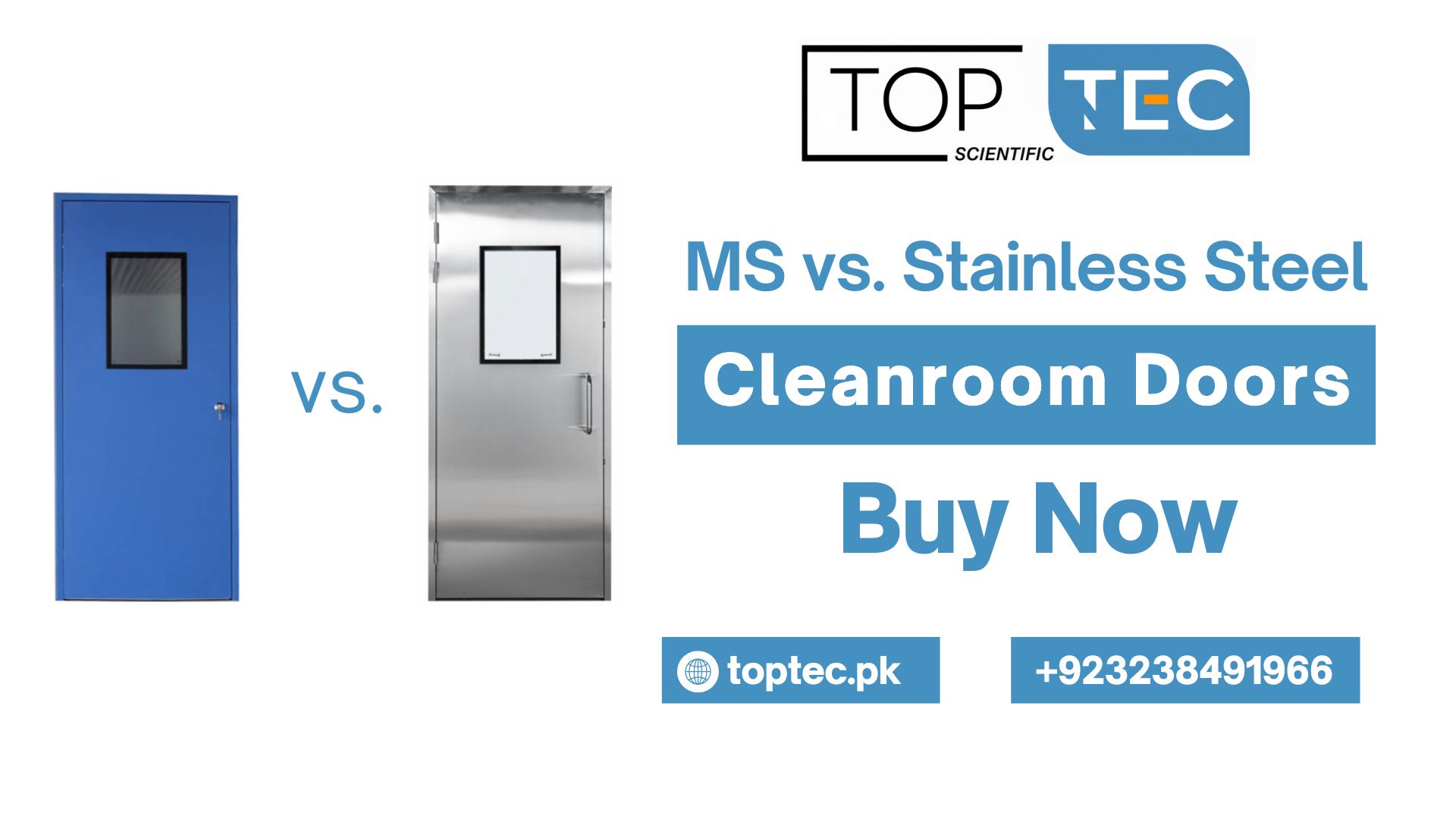
What type of door you should choose for your lab? Lets know about MS vs. Stainless Steel Cleanroom Doors for Pharma. Let’s be honest — when someone brings up the topic of cleanroom doors in a project meeting, everyone in the room either zones out or starts talking in circles. It’s one of those decisions that seems small on paper but ends up having a surprisingly large impact on your facility’s compliance, your contamination control strategy, and yes, your project budget.
If you’re managing a pharmaceutical setup in Pakistan — or even a research laboratory or biotech facility — you’ve probably faced this question at some point: Do I go with Mild Steel Cleanroom Doors or spring for the more expensive stainless steel option?
It’s not a question with one universal answer. And that’s exactly what this article is going to break down for you — honestly, practically, and without the usual sales fluff. At TOPTEC Scientific, we manufacture both types right here in Pakistan, and we deal with this question from clients on an almost daily basis. So let’s get into it.
First Things First — Why Cleanroom Doors Are a Big Deal
Before comparing materials, it’s worth reminding ourselves why the cleanroom door conversation matters so much.11 Cleanroom doors are a critical component of controlled environments where contamination control, air pressure stability, and hygiene compliance are essential. They’re not just there to give workers a way in and out — they’re doing active work. They’re maintaining differential pressure between zones, blocking airborne particles, supporting your GMP audit trail, and taking a beating from industrial-grade disinfectants every single day. 11 Cleanroom doors are specialist doors designed for use in controlled environments where airborne particles and contamination must be strictly limited. Unlike standard doors, they are engineered with smooth surfaces, airtight sealing systems, and non-porous materials to support hygiene and environmental control.
So when you’re choosing between Mild Steel clean room doors and stainless steel ones, you’re not choosing between two versions of the same thing. You’re choosing between two very different engineering and financial decisions — each with its own place in a well-designed facility.
A Quick Look at the Regulatory Landscape
To make a smart material decision, you first need to understand what the regulations actually say.7 ISO 14644-1 specifies the classification of air cleanliness, which directly impacts the selection of cleanroom doors. Doors must align with the cleanroom’s designated ISO class, influencing material choice and design features to prevent contamination. GMP guidelines, particularly relevant in pharmaceutical settings, dictate that doors must be easy to clean and maintain, with non-wood materials to prevent microbial growth. 6 Traditionally, pharma doors consisted of various materials, such as laminate, wood, fiberglass, and steel. However, GMP door regulations now prohibit wooden doors. This limitation is because wooden doors fail to provide adequate temperature regulation and require extensive cleaning and maintenance.
So wood is completely out of the picture. That narrows it down to steel (mild or stainless), fiberglass, aluminum, and HPL composites. And when Pakistani pharma clients talk to us about cleanroom doors for pharma use, the conversation almost always boils down to: mild steel with powder coat, or stainless steel?
It’s also worth noting that 2Annex 1 requires every facility to develop a holistic Contamination Control Strategy (CCS). An airtight door installation is no longer just a physical barrier — it is an active component of your CCS. The door’s leakage rate, interlock delay times, and resistance to sporicidal cleaning agents must be documented and justified within your CCS risk assessment.
This means your door material choice needs to appear in your validation documentation — which is another reason the decision carries more weight than most project managers expect.
Mild Steel Cleanroom Doors: What Are They, Really?
Let’s start with the underdog of the conversation — mild steel. There’s a surprising amount of confusion about what Mild Steel Cleanroom Doors actually are. Some people assume they’re basically “cheaper” doors that sacrifice quality. That’s not accurate.
Mild Steel Cleanroom Doors are fabricated from cold-rolled mild steel sheets — typically 16 to 18 gauge — and then powder-coated using an electrostatic finishing process. The result is a smooth, non-porous, sealed surface that resists contamination, handles chemical disinfectants, and looks clean and professional. The door core is usually filled with rockwool, honeycomb paper, or CFC-free PU foam for structural integrity and insulation.9 Steel swing doors are a traditional door type, usually made of stainless steel or carbon steel. They are robust and widely used in environments where high durability and strong sealing properties are required. Steel clean room doors have very high durability — they can withstand high frequency of opening and closing as well as harsh environments, making them suitable for long-term use.
When properly manufactured and coated, Mild Steel Cleanroom Doors perform exceptionally well in GMP environments — particularly in Grade C and D zones, as well as ISO Class 6, 7, and 8 areas. They tick the boxes for hygiene, airtight sealing, flush surface design, and contamination control. And they do it at a significantly lower price point.
At TOPTEC Scientific, our Mild Steel Cleanroom Doors are built with full perimeter neoprene/PVC gasket seals, flush-mounted vision panels (optional), concealed hinges, and surface-mounted door closers — all in compliance with GMP design requirements.
Stainless Steel Cleanroom Doors: The Premium Option
Stainless steel doors — typically 304-grade or 316L-grade — are widely considered the gold standard in high-grade cleanroom environments.1 The seamless molded design meets FDA and cGMP requirements. 304-grade stainless steel is rigid, durable, long-lasting, promotes aseptic conditions, provides privacy, and resists biocides and hospital-grade disinfectants.
The difference between 304 and 316L matters a lot in pharmaceutical settings. 2For Grade A/B zones subjected to VHP or aggressive sporicides, auditors expect 304 or 316L stainless steel. The 316L grade adds molybdenum to the alloy, which dramatically improves its resistance to chloride-based disinfectants and more aggressive chemical environments.
Stainless steel doors are also non-corrosive, non-reactive, and virtually immune to the kind of surface degradation that can compromise a cleanroom environment over years of heavy-duty cleaning.
But all of that comes at a cost — a significant one.
The Cost Factor: Where Mild Steel Makes a Very Strong Case
Here’s the number that catches most people’s attention: 2over-specifying Grade A stainless doors in Grade D zones is a common way project managers unnecessarily inflate their budgets by 30–40%.
Read that again. Thirty to forty percent of unnecessary cost — just because someone defaulted to stainless steel without thinking about whether it was actually needed for that particular zone.
This is exactly why Mild Steel Cleanroom Doors deserve serious consideration. In Pakistani pharmaceutical facilities, research labs, and even food processing units, the majority of spaces are Grade C, Grade D, or ISO Class 7 and 8. In these environments, a properly coated mild steel door with airtight gaskets delivers essentially the same contamination control performance at a fraction of the price of stainless.
When you Buy Laboratory Furniture and cleanroom infrastructure for a full facility — we’re talking about dozens of doors across multiple zones — those cost savings add up fast. The money saved on lower-grade zones can be redirected toward upgrading critical Grade A/B areas where stainless steel is genuinely necessary.
At TOPTEC Scientific, we actively help our clients zone their facilities correctly and match door materials to their actual needs rather than just upselling the most expensive option. When you Buy Laboratory Furniture and cleanroom products from us, you’re getting honest guidance — not just a catalog quote.
Durability Comparison: Does Mild Steel Actually Hold Up?
This is the question we hear most often. People worry that mild steel will rust, corrode, or degrade over time — especially in environments where chemical disinfectants are used daily. It’s a fair concern.
Here’s the truthful answer: it depends entirely on the quality of the coating and finish. A poorly coated mild steel door will absolutely degrade. A properly powder-coated mild steel door — with the right primer, electrostatic topcoat, and quality edge sealing — will last for many, many years in a Grade C or D pharmaceutical environment.13 For GMP compliance and to achieve the cleanliness specification, all surfaces in a cleanroom should be “smooth and impervious” — they should not generate their contamination, should be easy to clean with all surfaces easily accessible, and should be rigid and robust without creasing, cracking, shattering, or denting easily.
Our Mild Steel Cleanroom Doors at TOPTEC Scientific meet every one of those criteria. The electrostatic powder coat provides a hard, smooth, non-porous surface that doesn’t chip easily and holds up well against common pharmaceutical disinfectants including quaternary ammonium compounds, isopropyl alcohol, and chlorine-based agents.1 Terra’s signature white powder-coat formulation exceeds ASTM and ISO paint standards to resist chipping, scratching, and fading — and we follow the same rigorous standards in our powder-coating process at TOPTEC Scientific.
That said, if your facility uses aggressive VHP (Vaporized Hydrogen Peroxide) fumigation regularly, or if the environment is particularly humid or exposed to coastal air — stainless steel becomes a much more defensible choice. 3ISO 14644 Class 7–8 cleanrooms — electronics assembly, general pharmaceutical packaging, food processing, standard hospital corridors, and laboratory support areas — are well-suited for more cost-effective steel options.
Zone-by-Zone Material Guide: When to Choose What
This is the practical part that most articles skip over. Here’s how to think about it when designing or upgrading your facility:
Grade A / ISO Class 5 — Always Stainless Steel
2 Grade A and B zones (ISO 5) demand the highest level of protection. You must utilize hermetically sealed doors, often featuring inflatable or highly compressed silicone gaskets. The pressure differential is typically maintained at a minimum of 15 Pascals.
In these zones, stainless steel — specifically 316L — is the standard, and it’s non-negotiable for audit purposes. No compromises here.
Grade B / ISO Class 5 — Stainless Steel (304 or 316L)
2 For Grade A and B environments, 316L stainless steel is the undisputed standard. Even if your budget is tight, this is not the zone to cut costs on **clean room doors**.
Grade C / ISO Class 7 — Mild Steel is Fully Acceptable
2 In Grade C areas (ISO 7), standard GMP cleanroom door designs with perimeter compression gaskets are acceptable. This is the sweet spot for **Mild Steel Cleanroom Doors** — you get full GMP compliance without paying the stainless steel premium. For most Pakistani pharma facilities, a large portion of production areas fall into this category.
Grade D / ISO Class 8 — Mild Steel is the Recommended Choice
2 Generally only in Grade C and D zones is a more economical door material appropriate. **Mild Steel Cleanroom Doors** with powder-coat finish are perfectly matched for Grade D zones — corridors, storage areas, equipment rooms, and non-sterile production areas. This is where you save the most money without compromising compliance.
Side-by-Side Comparison Table
| Feature | Mild Steel Cleanroom Doors | Stainless Steel (304/316L) |
|---|---|---|
| Material | Cold-rolled mild steel + powder coat | 304 or 316L stainless steel |
| Cost | ✅ Budget-friendly | ❌ Premium cost (30–40% higher) |
| GMP Compliance | ✅ Grade C & D, ISO 6–8 | ✅ Grade A–D, ISO 5–8 |
| Surface Finish | ✅ Smooth, powder-coated | ✅ Brushed or polished |
| Chemical Resistance | ✅ Good (standard disinfectants) | ✅ Excellent (incl. VHP, sporicides) |
| Corrosion Resistance | ✅ Adequate (with quality coating) | ✅ Excellent |
| Customizability | ✅ High | ✅ High |
| Weight | ✅ Lighter, easier to install | ❌ Heavier |
| Maintenance | ✅ Low | ✅ Very Low |
| Best For | Grade C/D, ISO 6–8 zones | Grade A/B, ISO 5 zones |
| Local Availability (Pakistan) | ✅ Readily available | ⚠️ Often imported |
The Pakistani Context: Why Local Manufacturing of MS Doors Makes Sense
There’s something else that doesn’t get discussed enough in this conversation — the reality of running a pharma or lab project in Pakistan.
Imported stainless steel cleanroom doors come with long lead times, customs complications, freight costs, and no local after-sales support. When something needs adjustment or a gasket needs replacement, you’re waiting — and in a production facility, waiting costs money.
When you Buy Laboratory Furniture and cleanroom doors for pharma from a local manufacturer like TOPTEC Scientific, you eliminate all of those headaches. Our Mild Steel Cleanroom Doors are fabricated in Pakistan, customized to your exact specifications, and delivered on your timeline. If you need technical support, our team is a phone call away — not a time zone and a customs clearance away.
And because we also manufacture a full range of laboratory furniture — from fume hoods and biosafety cabinets to lab benches and chemical storage units — you can source your entire facility infrastructure from a single, reliable Pakistani manufacturer. That kind of consolidated, local sourcing is something every project manager in Pakistan can appreciate.
What GMP Auditors Actually Look for in Cleanroom Doors
Passing a DRAP inspection or EU GMP audit isn’t just about having the right door material. Auditors are looking at a broader picture.2 An airtight door installation is no longer just a physical barrier — it is an active component of your Contamination Control Strategy. The door’s leakage rate, interlock delay times, and resistance to sporicidal cleaning agents must be documented and justified within your CCS risk assessment. 15 Overlooking flush detailing and coved corners creates particle traps that auditors flag immediately. Our **Mild Steel Cleanroom Doors** and **cleanroom doors for pharma** are designed with these exact audit points in mind — fully flush surfaces, no exposed fasteners, recessed vision panels, and perimeter gasket sealing. 2 A single failed pressure differential reading at an airlock door can trigger an FDA Form 483 observation or halt your EU GMP certification.
This is serious. The right door — properly specified, properly installed, and properly documented — protects your entire compliance standing. That’s another reason why working with an experienced, knowledgeable local manufacturer matters.
How to Decide: A Quick Decision Framework
Still not sure which way to go? Use this simple framework:
Choose Mild Steel Cleanroom Doors if:
- Your zone is Grade C, Grade D, ISO Class 6, 7, or 8
- You use standard disinfectants (quaternary ammonium, IPA, mild chlorine solutions)
- Your budget is a serious constraint across a multi-door facility
- You want fast local delivery and support in Pakistan
- You need custom sizes without long fabrication lead times
Choose Stainless Steel Clean Room Doors if:
- Your zone is Grade A or Grade B (ISO Class 5)
- You regularly use VHP, aggressive sporicides, or high-concentration chlorine fumigation
- Regulatory audits specifically require stainless steel documentation for the zone
- The environment is highly humid, coastal, or involves liquid splash exposure
- Long-term corrosion resistance is the priority over initial cost savings
Most well-designed pharmaceutical facilities in Pakistan actually need both — stainless steel in their critical zones and Mild Steel Cleanroom Doors across their support, packaging, and general production areas. That combination gives you optimal compliance without unnecessary budget inflation.
Why TOPTEC Scientific for Your Clean Room Doors?
At TOPTEC Scientific, we don’t believe in one-size-fits-all answers. When clients come to us looking to Buy Laboratory Furniture and cleanroom infrastructure, we start with a conversation about their facility zones, their regulatory targets, and their project timeline — before we ever talk about product specifications.
Our Mild Steel Cleanroom Doors are manufactured to precise standards using quality cold-rolled steel, electrostatic powder coating, airtight perimeter gaskets, and GMP-compliant hardware. Every door we make is custom-fabricated — size, swing direction, vision panel configuration, surface color, and hardware — to match your exact project requirements.
And because we manufacture everything locally in Pakistan, you get:
- Faster lead times — No waiting on imports
- Competitive pricing — Local raw materials, lower overheads
- Custom fabrication — Every door built to your drawing
- Full product range — Clean room doors, lab benches, fume hoods, biosafety cabinets, storage solutions, and more
- Expert consultation — Our team guides you through zone-by-zone material decisions
- After-sales support — We’re here when you need adjustments, replacements, or additional units
When you Buy Laboratory Furniture or cleanroom equipment from TOPTEC Scientific, you’re not just placing an order — you’re building a long-term supply relationship with a manufacturer who understands Pakistani pharma and lab environments inside and out.
Frequently Asked Questions
Q: Are Mild Steel Cleanroom Doors GMP compliant?
A: Yes — when properly manufactured with powder-coat finish, airtight gaskets, and flush surfaces, Mild Steel Cleanroom Doors are fully GMP compliant for Grade C, Grade D, ISO Class 6, 7, and 8 environments.
Q: Which is better — MS or stainless steel for pharma?
A: Both have their place. Stainless steel is better for Grade A/B zones with aggressive cleaning regimes. Mild Steel Cleanroom Doors are the smarter, more cost-effective choice for Grade C/D and general production zones.
Q: How long do Mild Steel Cleanroom Doors last in a pharma facility?
A: With proper powder-coat finishing and routine gasket maintenance, our Mild Steel Cleanroom Doors deliver years of reliable performance in pharmaceutical and laboratory environments.
Q: Where can I buy clean room doors in Pakistan?
A: TOPTEC Scientific manufactures and supplies high-quality cleanroom doors for pharma, research labs, and industrial facilities across Pakistan. Contact us for custom quotes.
Q: Can I mix MS and stainless steel doors in the same facility?
A: Absolutely — in fact, that’s what we recommend for most clients. Use stainless steel where regulations require it, and Mild Steel Cleanroom Doors everywhere else to optimize your budget.
Conclusion
The MS vs. stainless steel debate isn’t really a debate at all — it’s a zoning question. Understand your ISO class, know your GMP grade, and match your material accordingly. Over-specifying drains your budget. Under-specifying creates compliance risk. Getting it right is the job.
Mild Steel Cleanroom Doors from TOPTEC Scientific give Pakistan’s pharma and lab sector a quality, GMP-compliant, locally manufactured option that doesn’t force you to choose between budget and performance. For the right zones — and for most facilities, that’s a lot of zones — they’re simply the smarter choice.
Ready to spec out your cleanroom door requirements? Reach out to TOPTEC Scientific today and let’s build something compliant, durable, and built for real Pakistani conditions.
