

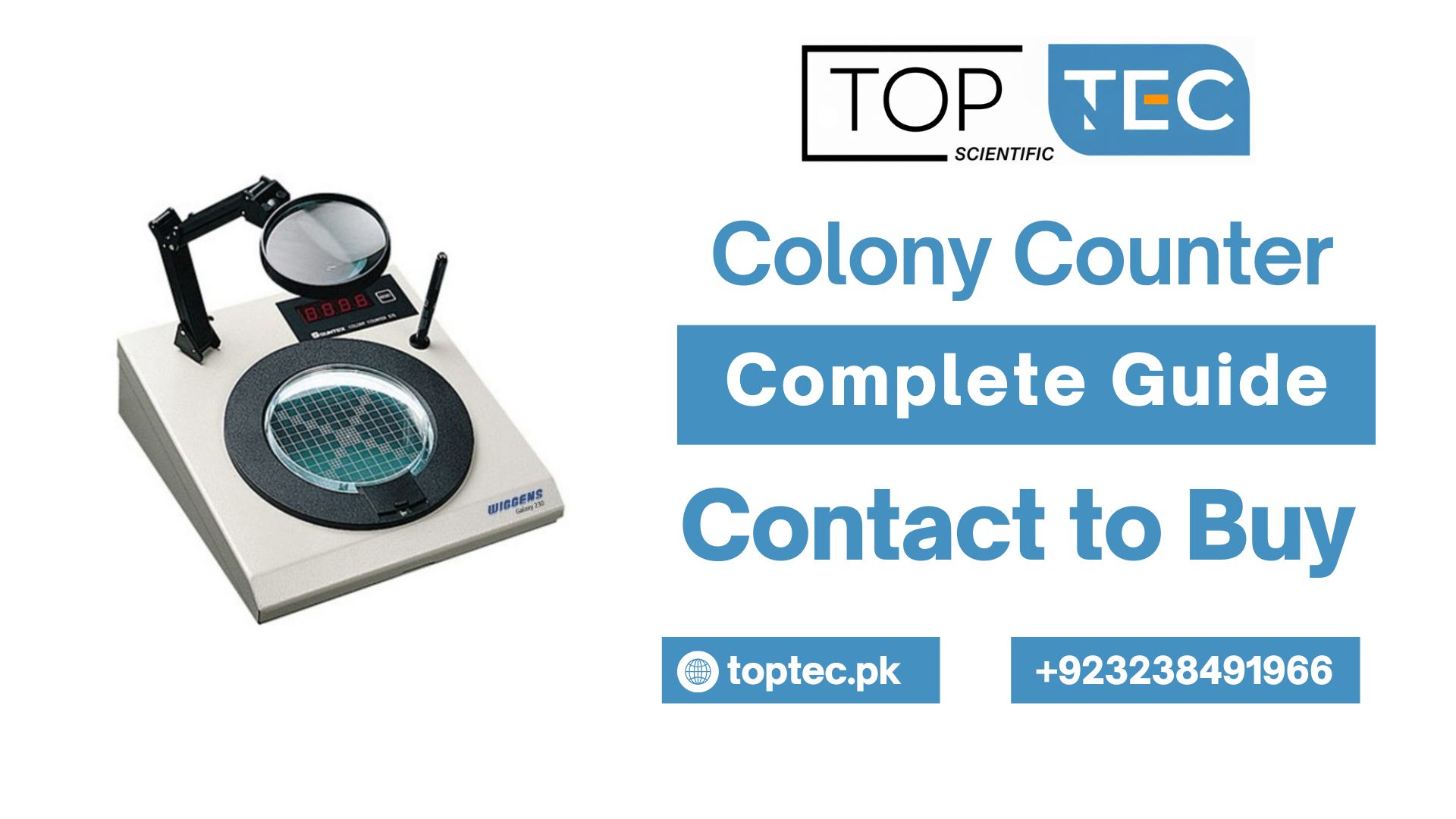
Do you want to buy Colony Counter? Walk into any microbiology lab, pharmaceutical QC department, food safety unit, or research facility, and you’ll almost certainly find one sitting on the bench — a colony counter. It’s one of those instruments that most lab technicians use every day without thinking too much about it. But when the time comes to upgrade your setup, replace an aging piece of equipment, or set up a brand new lab, the question hits hard: Manual or automatic — what’s actually the right choice for my lab?
That’s what this guide is going to answer. No jargon overload, no unnecessary padding — just a practical, honest breakdown of both technologies, who they’re suited for, and how to make a smart buying decision. And if you’re looking to Buy Colony Counter equipment or any other lab infrastructure in Pakistan, TOPTEC Scientific is your go-to manufacturer and supplier.
Let’s get into it.
What Is a Colony Counter, and Why Does It Matter So Much?
Before we get into the manual vs. automatic debate, it’s worth grounding ourselves in why this instrument matters in the first place.1 Colony counting is a fundamental technique used in microbiology to estimate the number of viable microorganisms present in a sample, with applications ranging from clinical diagnostics to food safety assessments. 4 As each colony originates from a single viable microorganism, colony counting is a valuable method for assessing growth patterns, antibiotic resistance, sensitivity to disinfectants, and genetic mutations. 4 It is also used to evaluate the effectiveness of treatments like fermentation, pasteurization, sterilization, or filtration.
In a pharmaceutical QC lab, the results from a bacterial colony counter can determine whether a batch of medicine ships to patients or gets quarantined. In a food safety lab, it can be the difference between a product recall and a clean bill of health. In a university research lab, it forms the backbone of experimental data.10 A colony counter is used to count bacterial or yeast colonies growing on an agar plate quickly and consistently. The count feeds decisions such as whether a urine culture crosses the significant-bacteriuria threshold, whether water is safe to drink, or whether a food or pharmaceutical sample passes a viable-count specification.
In other words, this is not a “nice to have” instrument. It’s a core piece of laboratory infrastructure — and choosing the right one matters more than most people realize.
The Three Types of Colony Counters You Should Know
When you go to Buy Colony Counter equipment, you’ll quickly discover that there are three broad categories available in the market:
1. Manual Colony Counters
1 Manual colony counting relies on human observation and judgement to visually inspect agar plates (or other media) containing microbial colonies and physically counting each one. 1 This method typically requires the use of a colony counter grid or software to aid in the counting process, along with tools like a marker or counting pen. 9 Manual colony counters are used to assist with visual counting of colonies. They generally include transmitted lighting for illuminating a Petri dish with cultured microorganisms and a loupe for easier identification of smaller colonies. Some types even include a built-in counter that can be pressed with an attached pen.
These are the most affordable and widely used in smaller labs, teaching labs, and facilities with low to moderate testing volumes.
2. Semi-Automatic (Digital) Colony Counters
10 The digital or semi-automated type features a pressure-pad pen that increments the count as the operator touches each colony. 8 A Petri plate is placed on an electronic pressure pad with light illumination, and each colony on the plate is marked by tapping the plate with an auto marker probe pen. A count is registered in the digital display by the touch’s pressure. This pressure can be altered based on the situation. It facilitates avoiding the error of overlooking or counting colonies twice.
This is the middle-ground option — faster and more accurate than pure manual counting, but without the full automation of image-based systems. 12It’s a cost-effective semi-automatic solution — an affordable alternative to fully automatic counters while significantly reducing counting time compared to manual tally counters.
3. Fully Automatic Colony Counters
9 Automated colony counters use a built-in camera to capture images of samples and then use image-processing technology to automatically count the number of colonies. 10 A digital imaging device (a document scanner, digital camera, webcam, or CCD) captures an image of the plate. Software then digitizes that image and applies segmentation, using single or multi-threshold processing together with steps like gray scaling and filtering, to separate the colonies from the background and detect each one.
These are the most advanced and accurate systems available — and for high-throughput pharmaceutical and research labs, they’re becoming the new industry standard.
Manual Colony Counting: The Honest Pros and Cons
Manual colony counters have been around for decades, and they remain perfectly valid tools in the right setting. But they’re not without their limitations — and it’s worth being honest about both sides.
✅ Advantages of Manual Colony Counters
Simplicity — There’s very little that can go wrong with a manual counter. It’s a straightforward instrument with minimal components, which means minimal maintenance and minimal training time for new staff.
Cost — Manual bacterial colony counter devices are significantly more affordable than automatic systems. For small labs or teaching institutions, this matters a lot.
Flexibility — Manual counting allows the technician to apply judgment. Experienced microbiologists can distinguish overlapping colonies, satellite colonies, and artifacts that automated systems might miscount.
Reliability in Low-Volume Settings — 2Manual counting remains a viable option in many labs, particularly those dealing with low volumes of plates per day where automation doesn’t provide a significant advantage.
❌ Disadvantages of Manual Colony Counters
2 It involves a trained technician visually inspecting agar plates and film, identifying individual colonies, and recording their number. This method, while straightforward, is time-consuming and prone to human error. Factors like eye strain, visual impairment, fatigue, and subjective judgment can lead to variations in results, particularly with dense or complex colony patterns. 6 Since manual PCT analysis can result in eye fatigue and errors, in particular when hundreds of samples are processed every day, automatic colony counters have been built and are commercially available.
The traceability problem is another serious issue. 1Traceability in colony counting is fundamental to ensuring accuracy, reliability, and credibility in microbiological analysis. It supports quality control, regulatory compliance, data integrity, reproducibility, troubleshooting, historical documentation, and overall transparency. However, with any manual process, having robust documentation, tracking, and traceability can be problematic, exposing companies to the possibility of fines and penalties.
For any lab operating under GMP, USP, or ISO standards — like most cleanroom doors for pharma-equipped pharmaceutical facilities — that traceability gap is a real compliance risk.
Automatic Colony Counters: The Honest Pros and Cons
Automated systems have been gaining serious ground in recent years — and for good reason.
✅ Advantages of Automatic Colony Counters
Speed and Throughput — 2Automated counters are particularly beneficial in high-throughput environments where large numbers of plates must be analyzed quickly. The ability to process hundreds of plates in a fraction of the time required for manual counting dramatically increases laboratory efficiency.
In fact, 7a report indicates that laboratories utilizing automated counters can experience a time reduction in colony counting by up to 50%, allowing scientists to focus on critical research tasks rather than manual counting.
Accuracy and Reproducibility — 2The accuracy of automated colony counters is one of their primary advantages. By eliminating human error and variability, these systems can deliver consistent and repeatable results.
Traceability and GMP Compliance — 2Moreover, automated systems enhance traceability, a growing concern in regulated industries like pharmaceuticals and food safety. 9Data integrity refers to the reliability of the data. This is a basic requirement of Good Manufacturing Practices (GMP), a pharmaceutical industry concept that manufacturers are required to comply with.
Advanced Differentiation — 5Algorithmic analysis differentiates colonies based on size, color, and other defining characteristics. Some systems go even further — 14the automated colony counter has the ability to differentiate colonies based on color and even measure the inhibition zones of antibiotic reactions.
Standardization Across Operators — 9While results may be inconsistent depending on the skill of the person counting the colonies visually, automated colony counters enable reliable, stable counting by matching image capturing conditions and image processing settings for more efficient microbiological testing.
❌ Disadvantages of Automatic Colony Counters
6 While quick and reliable, these instruments are generally expensive, thus, portable colony counters based on smartphones have been developed and are of low cost but also not as accurate as commercial benchtop instruments.
There’s also the learning curve. Automated systems come with software interfaces, protocol configurations, and image analysis settings that require training. In some cases, the software flags edge cases or overlapping colonies that still require human review. 3After visual correction of the automatically generated results, the concordance with manual counts was high; however, there was no advantage in reading time in certain complex colony scenarios.
Key Applications: Where Is a Colony Counter Actually Used?
Whether you’re using a manual bacterial colony counter or a fully automated system, these are the primary environments where colony counting is performed every day:12 Colony counters are used in the following standard microbiological tests: Total Plate Count (TPC) — Enumeration of total aerobic bacteria in food, water, and environmental samples. Aerobic Plate Count (APC) — commonly used in dairy and meat industries. Heterotrophic Plate Count (HPC) — For drinking water and potable water testing. Yeast & Mold Count — Detection of fungal contamination in food, cosmetics, and pharmaceuticals. CFU Enumeration — General colony-forming unit counting for any incubation media. Microbial Limit Test (MLT) — USP <61> / <62> compliant enumeration for non-sterile pharmaceutical products. 8 Bacterial colony counting is used in microbiology labs to assess the filter or membrane’s capacity for retention. It is crucial for determining the efficacy of disinfectants, including for use in testing the safety of food and drugs, as well as medical examination assessments in medical facilities and the pharmaceutical industry. 11 With numerous manual or automatic colony counter units installed in a variety of microbiology and research laboratories within industries such as Environmental, Food, Pharma and Biotech, they have become a standard in bacterial colony counting.
Colony Counters in Pharmaceutical Facilities: What the Regulations Say
If you’re running a pharmaceutical lab or QC department in Pakistan — operating under DRAP, WHO, USP, or EU GMP guidelines — colony counting isn’t just a routine lab task. It’s a regulated activity, and the instrument and method you use must be justified and validated.12 The colony counter should be compatible with ISO 4833, FDA BAM, USP <61>, and other standard plate count methods. 7 By adopting advanced technologies and rapid microbiology methods, laboratories can achieve enhanced reliability in bacterial enumeration, critical for both research and compliance in the pharmaceutical industry, thereby contributing to better public health outcomes.
This is also why the broader lab environment matters so much. A bacterial colony counter placed in a poorly designed lab — one with improper ventilation, contaminated surfaces, or compromised airflow — can produce results that simply aren’t reliable. This is why pharma labs invest in controlled environments from the ground up: proper clean room doors, laminar airflow units, biosafety cabinets, and GMP-compliant furniture all work together to ensure that the environment in which your colony counting happens is as controlled as the counting method itself.
At TOPTEC Scientific, we supply not just bacterial colony counter instruments — we supply the complete laboratory infrastructure. From GMP-compliant clean room doors to lab benches and biosafety cabinets, when you Buy Laboratory Furniture from us, you’re equipping your entire lab environment for reliable, audit-ready results.
Manual vs. Automatic: A Direct Comparison Table
| Feature | Manual Colony Counter | Semi-Automatic | Fully Automatic |
|---|---|---|---|
| Cost | ✅ Lowest | ✅ Moderate | ❌ Highest |
| Speed | ❌ Slowest | ✅ Moderate | ✅ Fastest |
| Accuracy | ⚠️ Operator-dependent | ✅ Good | ✅ Excellent |
| Traceability | ❌ Limited | ✅ Moderate | ✅ Full digital records |
| GMP Compliance | ⚠️ Manual documentation | ✅ Acceptable | ✅ Fully aligned |
| Training Required | ✅ Minimal | ✅ Minimal | ⚠️ Software training needed |
| High-Throughput | ❌ Not ideal | ⚠️ Moderate | ✅ Ideal |
| Maintenance | ✅ Very Low | ✅ Low | ⚠️ Software updates required |
| Best For | Teaching labs, low volume | Mid-volume labs | Pharma, food, research |
How to Choose the Right Colony Counter for Your Lab
Before you decide to Buy Colony Counter equipment for your facility, ask yourself these four questions. They’ll help you narrow down your choice quickly:
1. What Is Your Testing Volume?
5 Microbial counting methods have evolved from manual observation to advanced digital automation. Understanding the difference helps laboratories choose the right approach for their testing volume, accuracy needs, and efficiency goals.
If you’re counting fewer than 20–30 plates per day, a manual or semi-automatic bacterial colony counter will serve you well. If you’re processing 50+ plates daily, the time savings from automation pay for themselves very quickly.
2. How Critical Is Data Traceability for Your Facility?
For pharmaceutical QC labs, hospital microbiology departments, and food safety testing labs — anywhere that regulatory audits happen — traceability is non-negotiable. 5The transition from manual microbial counting methods to automated systems reflects a broader shift in microbiology: the move toward digitization and traceable data. If you need an audit trail, go automatic.
3. What Is Your Budget?
Be realistic. 12Automatic colony counters are recommended for high-throughput labs requiring image documentation and advanced analysis — but if your budget doesn’t stretch that far right now, a quality semi-automatic system with digital display is a smart intermediate investment. When you Buy Colony Counter equipment from TOPTEC Scientific, we can help you match your instrument choice to your budget and testing requirements.
4. What Is Your Colony Type and Complexity?
3 Challenges include various bacterial and fungal species possessing different morphological characteristics. Moreover, different agar types are included in routine testing. If your colonies are typically well-separated and easy to distinguish, automation works beautifully. If your plates regularly show overlapping, satellite, or morphologically complex colonies, having a semi-automatic system where human judgment is still part of the process may give you better practical results.
The Full Lab Picture: Colony Counters Don’t Work in Isolation
Here’s something that doesn’t get said enough: your bacterial colony counter is only one piece of a much larger puzzle. A colony counter produces reliable results when everything around it — the environment, the equipment, the workflow — is designed for contamination control and accuracy.
Think about it this way. The cleanest possible colony count starts with clean air, clean surfaces, and controlled environments. That’s why pharmaceutical and research labs invest in proper clean room doors, laminar flow cabinets, and GMP-grade lab furniture. When those elements are compromised, your colony count results can be compromised too — regardless of how good your counter is.
This is exactly why TOPTEC Scientific takes a holistic approach to lab setup. When clients come to us to Buy Laboratory Furniture, we don’t just hand over a catalog. We have a conversation about their environment, their testing needs, their regulatory targets, and their workflow — and then we help them configure a lab that works as a system.
A well-designed microbiology lab in a pharma facility should have:
- ✅ GMP-compliant clean room doors with airtight seals
- ✅ Laminar airflow workstations or biosafety cabinets
- ✅ Stainless steel or powder-coated laboratory benches
- ✅ Proper chemical and biological storage units
- ✅ A reliable, validated bacterial colony counter
- ✅ Autoclaves, incubators, and other essential lab equipment
All of these items are available from TOPTEC Scientific — manufactured right here in Pakistan, to your exact specifications and GMP requirements. If you’re planning to Buy Laboratory Furniture and lab equipment for a new facility, or upgrading an existing one, we’re the one-stop local manufacturer you’ve been looking for.
Why Choose TOPTEC Scientific to Buy Colony Counter Equipment in Pakistan?
There are plenty of overseas suppliers out there. But when you Buy Colony Counter instruments and lab furniture from an international supplier, you deal with long lead times, import duties, customs delays, and zero local after-sales support. When something goes wrong — and in a busy lab, something always eventually goes wrong — you’re on your own.
TOPTEC Scientific changes that equation entirely.
- 🇵🇰 100% Made and Supported in Pakistan — We manufacture and supply from within the country, meaning faster delivery and real support when you need it
- 🔬 Wide Product Range — From colony counters and lab benches to fume hoods, biosafety cabinets, and clean room doors — we supply it all
- 🛠️ Custom Fabrication — Every piece of furniture and equipment built to your dimensions and specifications
- 💰 Competitive Pricing — Get international-quality products at local prices
- 📋 Expert Guidance — Our team understands GMP, DRAP, and ISO requirements and helps you choose the right instruments for your context
- 🤝 Long-Term Partnership — We’re not just a supplier; we’re a lab infrastructure partner
When you Buy Laboratory Furniture and lab instruments from TOPTEC Scientific, you’re choosing reliability, accountability, and a team that genuinely understands what Pakistani labs need.
Frequently Asked Questions
Q: What is the best colony counter for a pharmaceutical QC lab in Pakistan?
A: For pharmaceutical QC labs under GMP or DRAP compliance, we recommend a semi-automatic or fully automatic bacterial colony counter with digital data logging and export capability. This supports data integrity requirements. Contact TOPTEC Scientific to discuss your specific lab setup before you Buy Colony Counter equipment.
Q: Is manual colony counting still acceptable under GMP?
A: Manual counting is still used in many labs, but it carries data integrity risks due to its operator-dependent nature. If you’re undergoing GMP audits, a semi-automatic or automatic system with traceable digital records is strongly recommended.
Q: Can I buy a colony counter in Pakistan without importing?
A: Yes — TOPTEC Scientific supplies colony counters and a full range of laboratory equipment in Pakistan, without the headaches of importing.
Q: What other lab equipment should I buy alongside a colony counter?
A: A properly equipped microbiology lab also needs biosafety cabinets, laminar flow units, incubators, autoclaves, and GMP-compliant lab furniture. When you Buy Laboratory Furniture from TOPTEC Scientific, you can source all of these from a single trusted manufacturer.
Q: Does TOPTEC Scientific also supply cleanroom infrastructure for pharma labs?
A: Absolutely. We supply clean room doors, cleanroom wall panels, lab benches, fume hoods, and complete cleanroom furniture packages for pharmaceutical and research facilities across Pakistan.
Final Thoughts: Make the Right Call for Your Lab
Colony counting seems like a small decision. But as we’ve walked through in this guide, it actually connects to some big questions — about regulatory compliance, data integrity, laboratory efficiency, and the overall quality of your lab environment.1 While manual counting offers flexibility and simplicity, automated systems provide greater speed, accuracy, and throughput, making them well-suited for modern microbiological analysis.
The right choice depends entirely on your lab’s volume, your compliance requirements, and your budget. The wrong choice — over-specifying when you don’t need it, or under-specifying when compliance demands more — costs you in one way or another.
Use this guide as your starting point. And when you’re ready to Buy Colony Counter instruments, Buy Laboratory Furniture, or set up your entire lab from scratch, reach out to TOPTEC Scientific. We’re Pakistan’s trusted manufacturer and supplier of laboratory equipment and furniture — and we’re here to help you build a lab that works.
