

Discover air showers for cleanroom decontamination with HEPA filtration (99.99% efficiency at 0.3µm) and 25 m/s air velocity. Available in single, double, and cargo configurations with automatic interlocking doors. Request a quote from verified manufacturers today.
Walk into any serious pharmaceutical manufacturing facility, electronics fabrication plant, or food processing cleanroom and you’ll find an air shower at the personnel entry point. Sometimes it’s a compact single-person unit. Sometimes it’s a larger double-person tunnel that two people can walk through simultaneously. From the outside, both look roughly similar — enclosed chambers, nozzles, doors, indicator lights. But the decision between them isn’t just about size.
The wrong choice costs you in one of two ways. Too small a system and you’ve created a bottleneck that disrupts shift changes, frustrates production staff, and potentially encourages people to rush through or bypass the decontamination process entirely. Too large a system and you’ve spent significantly more than you needed to on capital cost, installation space, and operating energy for capability you simply don’t use.
Getting this decision right requires understanding both the technology and your specific operational context. At TOPTEC Scientific, we manufacture and supply cleanroom equipment and laboratory infrastructure in Pakistan — including air shower systems for pharmaceutical, research, and electronics facilities. We have this conversation with facility managers regularly, and this article is the complete version of it.
What an Air Shower Actually Does (And Why It Matters)
Before comparing configurations, it’s worth being clear on what an air shower is doing — because the operational logic is what drives the sizing decision.
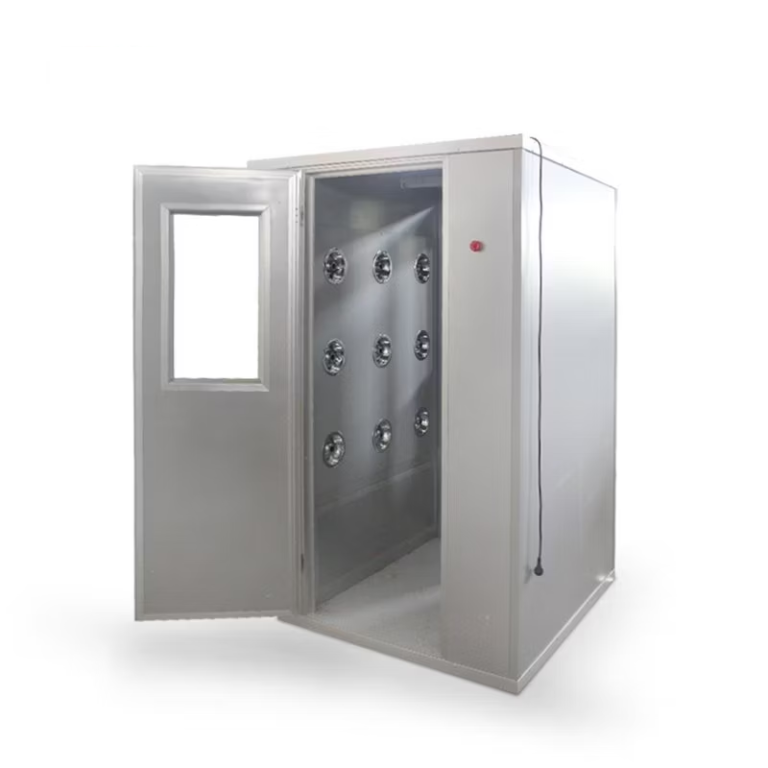
An air shower is a personnel decontamination chamber positioned at the entry point of a controlled environment. When a gowned person steps inside and the outer door closes, high-velocity jets of HEPA-filtered air blast from strategically positioned nozzles — typically at 20 to 25 meters per second — for a timed cycle of 15 to 30 seconds. The turbulent airflow physically dislodges surface particles from the gown, gloves, and exposed surfaces, sweeping them away to return filters where they’re captured permanently.
The person rotates slowly during the cycle to expose all surfaces to the airflow. When the cycle completes, the inner door unlocks and the person enters the cleanroom.
Both doors are interlocked throughout — the inner door cannot open while the outer door is open, and vice versa. This interlock is what maintains the pressure differential and zone separation between the controlled environment and the outside. It’s not just a convenience feature. It’s the physical containment mechanism.
The context connection to other laboratory equipment is worth noting here. In pharmaceutical facilities, the air shower is one layer in a complete contamination control system that includes biological safety hood cabinets in the QC laboratory, cleanroom furniture, and pass-through boxes for material transfer. When clients come to TOPTEC Scientific to Buy Air Shower systems and Buy Laboratory Furniture for their facility, we always look at how all of these elements work together — not in isolation.
Single-Person Air Showers: The Standard Configuration
A single-person air shower accommodates one gowned individual at a time. The person enters, the outer door closes and seals, the cycle runs, the inner door releases. The next person can then enter the outer door while the first proceeds into the cleanroom.
Single-person systems are available in a range of widths — typically 900mm to 1000mm interior width — with the chamber depth sufficient for one person to stand and rotate comfortably during the cycle.
Where Single-Person Units Work Well
Low to moderate personnel traffic: Facilities where fewer than 15 to 20 people need to enter the cleanroom per shift change, or where cleanroom entry is ongoing throughout the shift rather than concentrated at specific entry times, are well-served by a single-person configuration. The throughput per cycle — typically 30 to 45 seconds including entry, cycle time, and exit — is adequate for these traffic patterns.
Space-constrained facilities: Single-person units have a significantly smaller footprint than double-person alternatives. In retrofitted facilities where the gowning room and cleanroom entry corridor have limited space, a single-person air shower fits where a larger unit simply won’t. When you Buy Air Shower equipment for a space-constrained installation, the compact dimensions of single-person units are a genuine practical advantage.
Lower capital and operating budget: Single-person units are meaningfully less expensive than double-person configurations — smaller blower systems, smaller HEPA filter areas, simpler control electronics. For smaller pharmaceutical manufacturers, research facilities, and laboratory cleanrooms in Pakistan where budget is a genuine constraint, the single-person air shower delivers the required contamination control at a cost-effective investment level.
Most pharmaceutical QC and research laboratory applications: University research laboratories, hospital cleanroom preparation areas, pharmaceutical QC microbiology environments, and compounding pharmacy cleanrooms typically have personnel traffic volumes that are entirely appropriate for single-person air shower systems. If you’re Buy Air Shower equipment for a setting like this, single-person is almost certainly the right starting point.
Limitations of Single-Person Units
The limitation is throughput — and it becomes significant when personnel volume is high. A 30-second cycle time with a single-person unit means a theoretical maximum of 120 people per hour through the entry point. In practice, accounting for the time people spend actually walking through and the occasional extended cycle, real-world throughput is somewhat lower.
For pharmaceutical facilities with large production workforces where multiple shifts of 30 to 50 people each need to enter the cleanroom within a relatively short window at shift change, a single-person air shower creates a queue. And queues at cleanroom entry points create several problems: they create time pressure that encourages people to rush the rotation and shortchange the decontamination cycle, they can cause congestion in the gowning area, and they represent a production efficiency loss.
Double-Person Air Showers: When More Throughput Is Needed
A double-person air shower — sometimes called a double-leaf or two-person air shower — has a wider interior that accommodates two people simultaneously, both undergoing the decontamination cycle at the same time. The fundamental cycle operation is identical to a single-person unit; the difference is chamber width (typically 1400mm to 1600mm) and blower capacity, which must be scaled to maintain appropriate air velocity across a wider nozzle distribution.
This configuration effectively doubles throughput — two people per cycle rather than one — without doubling cycle time. The efficiency gain is significant for high-traffic entry points.
Where Double-Person Units Genuinely Add Value
High-traffic cleanroom entry points with shift changes: Pharmaceutical manufacturing facilities where 30, 50, or more production staff need to enter the cleanroom at shift change — all within a 15-to-20-minute window — benefit substantially from the throughput capacity of a double-person configuration. When you Buy Air Shower equipment for a large-scale pharmaceutical manufacturing facility in Pakistan, the shift change analysis should be the primary sizing driver.
Multi-tenant cleanroom facilities: Research campuses or contract manufacturing organizations where multiple teams use the same cleanroom across different shifts may have concentrated entry periods that exceed what single-person throughput can comfortably accommodate.
GMP facilities targeting EU or US regulatory approval: International GMP auditors evaluating pharmaceutical facility design look at cleanroom entry system adequacy as part of facility design review. A cleanroom entry system that demonstrably creates personnel queuing during shift changes is a facility design weakness that can attract audit observations. For Pakistani pharmaceutical manufacturers pursuing WHO prequalification or EU GMP certification, having a cleanroom entry system appropriately sized for their workforce is part of demonstrating compliant facility design.
Electronics and semiconductor facilities with large workforces: High-volume electronics manufacturing cleanrooms, where large numbers of workers may need to cycle through the entry point continuously during production shifts, often justify double-person air shower configurations for sustained throughput rather than just peak shift-change throughput.
The Trade-offs of Double-Person Configurations
Higher capital cost: A double-person air shower costs meaningfully more than a comparable single-person unit — larger chamber, larger blower, more HEPA filter area, wider door systems. When you Buy Air Shower equipment for a pharmaceutical facility, the additional investment needs to be justified by the throughput requirement.
Larger footprint: A 1400mm to 1600mm interior width, plus the structural frame and wall thickness, requires significantly more floor space than a single-person unit. In facilities where the gowning corridor and entry zone have limited width, a double-person unit may simply not fit without architectural modification.
Higher operating cost: More blower capacity running more HEPA filter area continuously represents higher electrical energy consumption. For facilities operating extended production shifts, this difference is worth including in total cost of ownership calculations.
Air velocity uniformity challenge: Maintaining consistent nozzle air velocity across a wider chamber requires careful blower sizing and nozzle distribution design. Poorly designed double-person chambers can have velocity dead spots — areas with insufficient airflow — that reduce decontamination effectiveness for people standing at the periphery of the chamber. When you Buy Air Shower equipment in a double-person configuration, ask specifically about air velocity uniformity testing data across the full chamber width.
The Throughput Calculation: How to Make the Decision
Here’s the practical tool for making the single versus double decision — a straightforward throughput analysis based on your actual personnel requirements.
Step 1: Identify your peak entry event. For most facilities this is shift change — the period when the largest number of people need to enter the cleanroom in the shortest time. How many people? Over what time window?
Step 2: Calculate single-person throughput for that window. Assuming a 30-second cycle and 10 seconds each for entry and exit movements, a single-person air shower processes approximately one person per minute, or 60 people per hour.
Step 3: Compare against your peak requirement. If your shift change puts 25 people through the cleanroom entry in 30 minutes, a single-person unit (handling approximately 30 people per 30 minutes) covers this comfortably with margin. If your shift change puts 50 people through in 20 minutes, a single-person unit creates a significant queue.
Step 4: Factor in your facility layout. Can your gowning area accommodate a queue without creating congestion that affects gowning quality? Can you install a second single-person air shower at a second entry point as an alternative to one double-person unit?
That last question is worth exploring. Two single-person air showers at two separate entry points can provide equivalent total throughput to one double-person unit, often at comparable total cost, with the added resilience benefit of redundancy — if one unit needs maintenance or recertification, the other keeps the facility operational. For facilities where cleanroom continuity is critical, this redundancy argument often outweighs the simplicity of a single double-person unit.
Tunnel Air Showers: The High-Throughput Option
Beyond double-person configurations, some high-throughput pharmaceutical and electronics facilities deploy tunnel-style air showers — extended chamber designs that allow multiple people to move through simultaneously in a continuous flow rather than a batch-cycle mode.
Tunnel air showers work on a conveyor logic — as one person completes their decontamination and exits through the inner door, the next person is already in the middle of the chamber undergoing their cycle, and another is entering through the outer door. The interlock logic in tunnel systems is more sophisticated than in single or double chambers — managing the positions of multiple people simultaneously within the tunnel while maintaining the zone separation between outer and inner doors.
These are specialized systems for genuinely high-throughput requirements — typically large-scale pharmaceutical manufacturing, semiconductor fabrication, or food processing facilities where dozens of people enter per shift across extended shifts. For the vast majority of pharmaceutical, research, and laboratory cleanroom facilities in Pakistan, single or double-person configurations are entirely adequate.
Technical Specifications That Matter Regardless of Configuration
Whether you’re looking to Buy Air Shower equipment in single or double-person configuration, these technical specifications determine actual decontamination performance:
HEPA Filter Grade
The air jets that dislodge particles from gowns must be supplied from HEPA-filtered air — otherwise the air shower is just distributing room air at high velocity, which defeats the purpose entirely. H13 HEPA filtration (99.95% at 0.3 microns) is the minimum specification for pharmaceutical and controlled environment applications. H14 (99.995%) provides an additional margin appropriate for higher-classification cleanrooms.
Particles dislodged from the gown must also be captured before they can re-settle or be carried through the inner door. The return filter system — where swept particles end up — should be accessible for regular maintenance and filter replacement without disrupting the sterile side of the system.
Air Velocity at Nozzle Outlets
The 20 to 25 meters per second specification for nozzle outlet velocity is what generates the turbulence needed to dislodge particles from dense gown fabrics. Below this range, the airflow disturbs rather than dislodges — surface particles vibrate but don’t separate from the fabric. Ask for measured velocity data at nozzle outlets, not just blower motor wattage specifications, which don’t translate directly to velocity performance.
Nozzle Coverage and Distribution
Nozzle banks should cover both side walls at multiple heights, with ceiling-mounted nozzles for top coverage and ideally low-positioned nozzles for foot and lower leg coverage — areas where cleanroom floor particles accumulate on gown cuffs. For double-person configurations specifically, verify that the nozzle distribution provides adequate coverage across the full chamber width, not just at the centerline.
Cycle Timer Adjustability
Minimum cycle time requirements vary with cleanroom classification. ISO Class 5 (Grade A/B) environments may warrant 30-second cycles. ISO Class 7 and 8 (Grade C/D) environments are typically adequately served with 15 to 20-second cycles. The ability to adjust cycle time allows the system to be calibrated to your specific cleanroom classification and to be revalidated when classification requirements change.
Interlock Reliability and Fail-Safe Behavior
The door interlock must fail in a safe state — if power fails or a fault occurs, the default should be that both doors remain locked rather than both opening. An interlock that fails open on power loss creates a direct air path between the cleanroom and the outside environment — exactly what the air shower exists to prevent.
Air Showers and the Broader Contamination Control System
An air shower doesn’t work in isolation. It’s one element of a personnel entry sequence that begins in the street clothes change area and ends at the cleanroom workstation. The sequence — change room → gowning room → air shower → cleanroom — needs to be designed as a coherent system, not as individual elements purchased and installed independently.
This is also why the air shower conversation connects to the broader laboratory infrastructure picture. In a pharmaceutical facility, the people who enter through the air shower are going to work at laboratory benches, at production equipment, and in some cases at biological safety hood cabinets in the QC laboratory. The contamination control function of the air shower at entry and the biosafety hood at the workbench are both components of the facility’s overall contamination control strategy.
When TOPTEC Scientific works with clients on complete pharmaceutical facility fit-outs — cleanroom entry systems, QC laboratory equipment including biological safety hood cabinets, and supporting laboratory furniture — the design considers how all of these elements interact. The air shower specification, the cleanroom classification, the biological safety hood grade, and the laboratory furniture surface materials all need to be coherent with each other.
The gowning room furniture — benches, lockers, shoe change facilities, PPE dispensers — also directly affects how well the air shower performs. If the gowning area is poorly designed and people aren’t properly gowned when they enter the air shower, the air shower’s performance doesn’t compensate for poor gowning. The furniture design in the gowning area matters. When you Buy Laboratory Furniture from TOPTEC Scientific for a pharmaceutical facility, we include gowning area furniture design as part of the complete facility fit-out.
Special Configurations Worth Knowing
Corner-Entry Air Showers
Standard air showers have entry and exit doors on directly opposite walls — you walk straight through. Corner-entry configurations have doors on adjacent walls at 90 degrees — you enter on one face and exit on the perpendicular face. This is useful where the gowning corridor and cleanroom access are positioned at right angles to each other, and a standard through-flow configuration would require corridor reorganization.
Corner-entry configurations are available in both single and double-person sizes. They’re less common than straight-through configurations but important to know exist when facility layout constraints make straight-through positioning impossible.
Pass-Through Material Air Showers
For material and equipment decontamination rather than personnel decontamination, pass-through air shower configurations — with wider doors, trolley access, and nozzle positioning optimized for equipment surfaces — serve a different function from personnel air showers. Low-mounted nozzles in these units reach the underside of trolleys and carts where contamination accumulates.
If your facility needs both personnel and material decontamination, these are specified as separate units — a personnel air shower for gowned staff and a pass-through unit for equipment and materials.
Why Local Sourcing Matters: TOPTEC Scientific in Pakistan
When pharmaceutical manufacturers and research facilities in Pakistan look to Buy Air Shower systems, the choice between local supply and importing involves practical considerations beyond price comparison.
Imported air shower systems come with extended lead times — 12 to 20 weeks is typical for custom-specified units from international manufacturers. Import duties add meaningfully to landed cost. After-sales support — including annual performance testing, HEPA filter replacement, and nozzle maintenance — is difficult to arrange for systems with no local service infrastructure.
TOPTEC Scientific manufactures and supplies air shower systems locally in Pakistan, with local technical support and realistic delivery timelines that fit Pakistani construction and commissioning schedules. When you Buy Air Shower equipment from TOPTEC Scientific, you eliminate the import overhead and gain access to the local support that keeps your cleanroom entry system performing correctly throughout its operational life.
Our cleanroom equipment range includes:
- Single-person air showers — standard and custom configurations, H13 and H14 HEPA filtration
- Double-person air showers — appropriate for high-throughput pharmaceutical and industrial cleanrooms
- Pass-through material air showers — for equipment and trolley decontamination
- Corner-entry configurations — for space-constrained facility layouts
- Class II biological safety hood cabinets — for pharmaceutical QC and research laboratories
- Gowning room furniture — benches, lockers, shoe change facilities
- Complete laboratory furniture — when you Buy Laboratory Furniture from TOPTEC Scientific, we supply the complete facility infrastructure
When you come to TOPTEC Scientific to Buy Air Shower equipment and Buy Laboratory Furniture as a combined project, the gowning room furniture, the air shower specification, and the cleanroom furniture are all designed together — coherent, coordinated, and appropriate for your cleanroom classification and personnel throughput requirements.
Decision Framework: Which Configuration Is Right for You?
Choose a single-person air shower if:
- Your peak shift change involves fewer than 25-30 people through one entry point
- Floor space in the gowning area and entry corridor is limited
- Budget is a primary consideration and throughput doesn’t justify the double-person premium
- You’re setting up a pharmaceutical QC laboratory, research facility, hospital compounding area, or small-scale manufacturing cleanroom
Choose a double-person air shower if:
- Your shift change puts 50 or more people through a single entry point within a 20 to 30-minute window
- You have floor space adequate for the wider chamber and frame
- The personnel throughput requirement genuinely justifies the additional capital cost
- You’re setting up a large-scale pharmaceutical manufacturing facility, electronics fab, or food processing cleanroom with a large workforce
Consider two single-person units if:
- Throughput requirement suggests double-person capacity
- You want redundancy — one unit can remain operational during maintenance of the other
- Two entry points serve the facility layout better than one wider entry point
Ask TOPTEC Scientific for a consultation if:
- You’re not sure which configuration fits your specific requirements — we’ll review your facility layout, personnel numbers, cleanroom classification, and budget before making a recommendation
Frequently Asked Questions
Q: Can a double-person air shower be used by one person at a time? Yes — a double-person air shower functions perfectly well with a single occupant. The cycle runs identically; the person simply has more space. The only “waste” is the additional chamber volume that the blower system is working harder to maintain than would be necessary for a single-person chamber. This isn’t an issue in practice, but it does mean a double-person unit is running at higher energy cost even when only one person uses it.
Q: How long does air shower installation take? A standard installation — site preparation complete, electrical supply in place, wall opening prepared — typically takes one to two days for a single-person unit and two to three days for a double-person unit. Commissioning testing adds time. When you Buy Air Shower equipment from TOPTEC Scientific, we provide installation support and commissioning testing as part of the supply scope.
Q: Does the air shower need annual certification like a biological safety hood? An air shower doesn’t have the same formal annual certification requirement as a biological safety hood under NSF/ANSI 49. However, periodic performance testing — verifying nozzle velocity, HEPA filter integrity, cycle timer accuracy, and interlock function — should be part of your planned maintenance program. For pharmaceutical GMP facilities, this performance verification should be documented in your equipment qualification system.
Q: Where can I Buy Air Shower systems in Pakistan without importing? TOPTEC Scientific supplies single and double-person air shower systems locally in Pakistan. Contact our team to discuss your cleanroom classification, personnel requirements, and facility layout — we’ll recommend the appropriate configuration and provide a competitive local quotation.
Q: When I Buy Laboratory Furniture from TOPTEC Scientific, can I include air shower equipment in the same project? Absolutely. When you Buy Laboratory Furniture — gowning room furniture, cleanroom furniture, QC laboratory benching — and Buy Air Shower systems from TOPTEC Scientific as a combined project, you get integrated design and coordinated delivery for your complete facility fit-out. Contact our team to discuss your project requirements.
Final Thoughts
The single versus double-person air shower decision is simpler than it might initially seem — it comes down to throughput. Calculate your peak personnel entry requirement, compare it against single-person throughput capacity, and the answer usually becomes clear. Where it’s close, the secondary factors — floor space, redundancy, budget — guide the final decision.
What matters equally is that the system you choose is correctly specified, properly installed, and operating to performance requirements throughout its life. An air shower that looks right but has inadequate nozzle velocity, loaded HEPA filters, or a non-functioning interlock is providing an unknown level of decontamination — which is not what a controlled environment entry point should be providing.
When you’re ready to Buy Air Shower equipment for your pharmaceutical, research, or industrial cleanroom in Pakistan — or when you need to Buy Laboratory Furniture and complete your facility infrastructure — reach out to TOPTEC Scientific. We’ll help you get the specification, the sizing, and the complete facility fit-out right.
Contact TOPTEC Scientific
TOPTEC Scientific — Cleanroom Equipment & Laboratory Furniture Manufacturers, Pakistan 📧 Contact us for air shower specifications, sizing consultation, and complete cleanroom fit-out 📍 Serving pharmaceutical, research, electronics, and food processing facilities across Pakistan
