

Explore air showers with stainless steel construction, adjustable 0-99 second cycles, and multi-angle nozzles for personnel and material decontamination. HEPA-filtered entry systems for GMP, ISO Class 5, and pharmaceutical cleanrooms. Compare specifications.
Spend enough time working in pharmaceutical manufacturing quality assurance and you develop a particular kind of vigilance about entry points. Not the dramatic contamination events — the spilled cultures, the obvious gowning failures — but the quiet, invisible ones. The particles carried into your Grade B filling area on a gown that looked clean. The fibres that dislodged from a cleanroom suit during transit from the gowning room to the production floor. The contamination that nobody caused deliberately and nobody noticed, but that showed up three days later as an out-of-specification environmental monitoring result.
This is precisely the contamination problem that a Pharmaceutical Air Shower exists to address. And in 2026, with DRAP enforcement intensifying, WHO prequalification requirements climbing, and EU GMP Annex 1’s updated contamination control strategy requirements now firmly in effect, understanding what a cleanroom air shower does, what GMP compliance requires from it, and how to specify and procure the right system for your facility in Pakistan has become considerably more important than it used to be.
At TOPTEC Scientific, we manufacture and supply cleanroom equipment and laboratory infrastructure in Pakistan — including Pharmaceutical Air Shower systems for pharmaceutical manufacturers, research institutions, and hospital facilities. This article is a complete guide to pharmaceutical air shower technology, GMP requirements, and practical specification decisions.
What a Pharmaceutical Air Shower Does and Why It Matters
A Pharmaceutical Air Shower is a personnel decontamination chamber positioned at the entry point of a pharmaceutical controlled environment. When a gowned person enters the chamber and the outer door seals, high-velocity jets of HEPA-filtered air — typically 20 to 25 meters per second at the nozzle outlets — blast from strategically positioned nozzles for a timed cycle. The turbulent, high-velocity airflow dislodges surface particles from gown fabrics, gloves, shoe covers, and all exposed surfaces. Dislodged particles are swept toward return grilles, captured in pre-filters and HEPA filters, and permanently removed from circulation.
The person rotates during the cycle to expose all surfaces. When the cycle completes, the inner door releases and they enter the cleanroom. Both doors are interlocked — neither can open while the other is open — maintaining zone integrity throughout.
The physics behind why this works is straightforward. Cleanroom gowns, despite appearing smooth, have surface textures that trap particles. Those particles don’t release easily under normal airflow — the adhesion forces holding them to the fabric require a mechanical disruption of sufficient intensity to overcome them. High-velocity air jets at 20 to 25 m/s generate enough turbulence and drag force to break that adhesion, lifting particles off fabric surfaces and into the return airflow path.
What makes a cleanroom air shower specifically appropriate for pharmaceutical environments — as opposed to a simpler pressure differential airlock — is this active particle removal. A standard airlock prevents unfiltered room air from entering the cleanroom. An air shower actively strips contamination from the person before they enter. For pharmaceutical Grade B and C environments where even low particle counts matter, that distinction is significant.
GMP Requirements for Pharmaceutical Air Showers
The regulatory framework governing Pharmaceutical Air Shower systems in 2026 is primarily shaped by EU GMP Annex 1 (2022 revision), WHO GMP Technical Report Series guidance, and DRAP requirements for pharmaceutical manufacturing facilities in Pakistan. Understanding what these frameworks actually require — not just aspirationally recommend — shapes every specification decision.
EU GMP Annex 1 and the Contamination Control Strategy
The 2022 revision of EU GMP Annex 1 introduced the Contamination Control Strategy (CCS) as a mandatory framework for sterile pharmaceutical manufacturing. The CCS must document and justify every contamination control measure in the facility — from HVAC design through surface materials and cleaning procedures to personnel entry systems.
A Pharmaceutical Air Shower at the entry point to a controlled manufacturing area is a named engineering control within the CCS framework. Its specification — cycle time, air velocity, HEPA filter grade, nozzle coverage — must be justified in the CCS as appropriate for the cleanroom classification being protected. The CCS framing matters because it moves the air shower from an optional best practice to a documented, justified component of your contamination control system that regulators evaluate during audits.
Annex 1 also strengthens requirements around personnel as contamination sources — specifically acknowledging that humans are the primary source of particulate and microbiological contamination in controlled environments, and that personnel entry systems must be designed to minimize this contribution. A well-specified cleanroom air shower directly addresses this requirement.
WHO GMP Requirements
WHO GMP guidance for pharmaceutical manufacturers — the framework that governs WHO prequalification and that DRAP requirements broadly align with — specifies that pharmaceutical manufacturing areas should be designed to minimize contamination risk, with personnel entry systems appropriate for the classification of the areas being accessed. Air showers are referenced as appropriate engineering controls for Grade B and Grade C area entry in facilities where contamination control is critical.
For Pakistani pharmaceutical manufacturers pursuing WHO prequalification — increasingly the gateway to export markets in Africa, Southeast Asia, and beyond — a properly specified and documented Pharmaceutical Air Shower system is part of the facility design evidence that supports prequalification dossier acceptance.
DRAP Requirements
DRAP GMP guidelines, aligned with WHO guidance, create clear expectations for pharmaceutical manufacturing facility design that includes appropriate personnel contamination control at cleanroom entry points. DRAP inspectors evaluating pharmaceutical manufacturing facilities in Pakistan increasingly examine cleanroom entry system design — including air shower specification, maintenance records, and integration with the overall contamination control strategy — as part of facility GMP assessment.
Facilities without documented, appropriate cleanroom entry systems face observations. Facilities with air showers that are inadequately specified — wrong HEPA grade, insufficient air velocity, non-functioning interlocks — face equally problematic findings.
HEPA Filtration in Pharmaceutical Air Showers: Why Grade Matters
The HEPA filter is the component that determines whether a Pharmaceutical Air Shower actually removes contamination or just disturbs it. High-velocity jets that dislodge particles from gowns are only useful if the return air system captures those particles rather than recirculating them. The HEPA filter in the return path is what makes the difference.
For pharmaceutical applications, HEPA filter grade is a specification decision with regulatory implications:
H13 HEPA (99.95% at 0.3 microns): The minimum acceptable specification for pharmaceutical controlled environment air shower applications. Captures the vast majority of particles dislodged from gowns, including the sub-micron particles that HVAC systems can’t always control at the point of generation.
H14 HEPA (99.995% at 0.3 microns): The preferred specification for Pharmaceutical Air Shower systems serving Grade A/B adjacent areas or for facilities where ISO Class 5 environment protection is the objective. The additional order of magnitude improvement in fine particle capture is meaningful in pharmaceutical environments where even very low particle concentrations matter for sterility assurance.
When TOPTEC Scientific clients look to Buy Air Shower equipment for pharmaceutical applications, we specify H14 HEPA filtration as the standard for pharmaceutical Grade A/B adjacent areas and H13 for Grade C/D area entry systems. We always ask what cleanroom classification the air shower is protecting before making a filter grade recommendation.
HEPA filter integrity in an installed air shower — confirming no bypass leaks at the filter frame or media — should be tested during commissioning and at regular intervals thereafter as part of the facility’s equipment qualification program. Filter efficiency specification alone doesn’t confirm integrity of the installed filter assembly.
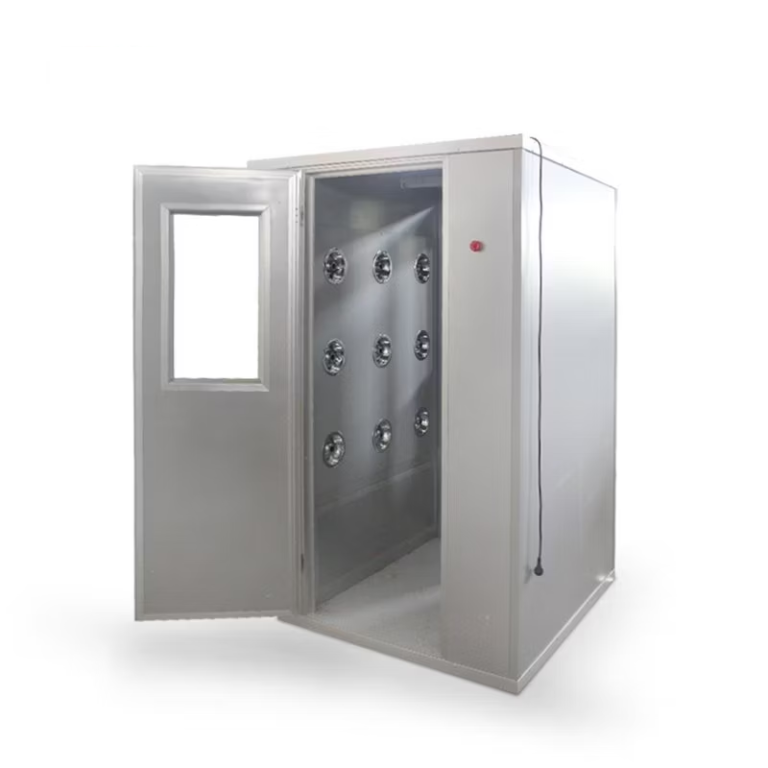
Key Components of a GMP-Compliant Cleanroom Air Shower
Understanding each component of a cleanroom air shower allows you to evaluate systems intelligently before procurement and maintain them properly after installation.
Nozzle System
Nozzles are the business end of the Pharmaceutical Air Shower — they’re what generates the high-velocity airflow that dislodges particles. GMP-appropriate nozzle systems have:
Comprehensive coverage: Nozzles on both side walls at multiple heights, ceiling-mounted nozzles for top-down coverage, and ideally low-positioned nozzles for foot and ankle coverage. Coverage gaps — particularly at the back of the torso, under the arms, and at floor level — are where particles escape decontamination.
Adjustable angle: Nozzles with adjustable angular positioning allow the airflow to be directed at specific zones — torso, legs, feet — based on where contamination is most likely to accumulate for your specific gowning protocol and manufacturing process.
Corrosion-resistant materials: In pharmaceutical environments where the air shower interior is cleaned and disinfected regularly with pharmaceutical-grade agents, nozzle materials must resist corrosion and chemical degradation. Stainless steel nozzles are the appropriate specification for GMP pharmaceutical air shower applications.
Verified outlet velocity: Nozzle outlet velocity must be measured and documented — not estimated from blower specifications. Measured velocity data at multiple nozzle positions is the only reliable confirmation that the airflow system is generating decontamination-effective turbulence.
Chamber Construction
For GMP pharmaceutical applications, the air shower chamber interior must meet the same surface quality standards as other pharmaceutical cleanroom surfaces:
Smooth, non-porous surfaces: Interior walls, floor, and ceiling must have smooth, non-porous finishes that don’t trap particles or harbor microorganisms. Rough or textured interior surfaces accumulate contamination between cleaning cycles and undermine the decontamination function of the chamber itself.
Stainless steel or epoxy-coated panels: Stainless steel interior panels are the premium specification for pharmaceutical air showers — excellent chemical resistance to pharmaceutical disinfectants, easy to inspect, and durable under frequent cleaning. Powder-coated or epoxy-coated mild steel panels are acceptable for Grade C/D applications with appropriate surface quality.
Coved floor-to-wall junctions: Coved transitions between floor and walls eliminate particle-trapping corners — the same design principle applied in pharmaceutical cleanroom construction generally.
Smooth, sealed door surfaces: Doors must have flush surfaces without exposed fixings or rebates that create particle accumulation sites. Vision panels in the doors should be flush-mounted — no glazing rebates on the interior faces.
Interlock System
The door interlock is the physical contamination control mechanism that maintains zone separation. For GMP pharmaceutical applications, the interlock must:
Physically prevent simultaneous door opening: Not just alarm when both doors are open, but physically prevent the second door from opening while the first is open. This physical prevention — through electronic door strikes or pneumatic locking — is what maintains the pressure differential and prevents a direct air path between zones.
Fail safe: If power fails or the control system faults, both doors must default to locked — not open. An interlock that fails open on power loss creates an uncontrolled opening between the cleanroom and outside environment at the most inconvenient moment.
Prevent inner door release before cycle completion: The inner door must not unlock until the decontamination cycle has run its full programmed duration. Systems that allow the inner door to be opened by impatient users mid-cycle are defeating the purpose of the air shower.
Provide status indication: Clear visual and audible indication of door status, cycle status, and fault conditions allows operators to use the system correctly and identify malfunctions promptly.
Control System
Modern Pharmaceutical Air Shower control systems should provide:
- Digital cycle timer display showing remaining cycle time
- Adjustable cycle duration — allowing the cycle time to be set appropriately for the cleanroom classification being served
- Air velocity alarm — alert when airflow drops below the minimum effective threshold
- Maintenance indicators — filter loading alerts, service reminders
- For pharmaceutical GMP applications: usage logging capability that supports the audit trail documentation that regulators increasingly expect for critical facility systems
Pharmaceutical Air Shower in the Personnel Entry Sequence
A Pharmaceutical Air Shower doesn’t work effectively in isolation. It’s a component in a personnel entry sequence that begins when a person arrives at the facility change room and ends when they reach their workstation in the controlled manufacturing or laboratory area. The sequence design determines how much of the air shower’s potential is actually realized.
A properly designed pharmaceutical personnel entry sequence for Grade B/C access:
Street change room: Street clothing removed, stored. Undergarments and cleanroom-compatible clothing donned. This first change is where the largest particle burden reduction occurs — removing street clothing eliminates the highest-contamination garments before any controlled area is entered.
Gowning room: Full cleanroom garments donned in the correct sequence — hair cover first, then coverall, then shoe covers, then gloves, then face mask, then outer gloves. The gowning sequence matters because later-donned items cover earlier-donned items; gowning out of sequence defeats the contamination control logic.
The Pharmaceutical Air Shower: Fully gowned personnel enter, outer door closes, cycle runs, person rotates. Residual surface particles from the gowning process and from the gowning room environment are stripped from the gown exterior.
Cleanroom entry: Inner door releases, person enters the controlled environment.
This sequence is physically supported by appropriate gowning room furniture — benches at the correct height for donning shoe covers without contaminating gloves, organized garment storage that keeps cleanroom garments separated from street clothing, PPE dispensers at appropriate positions for the gowning sequence, and hand washing facilities positioned for the hygiene steps within the gowning process.
When TOPTEC Scientific works with pharmaceutical clients who Buy Air Shower systems and Buy Laboratory Furniture for a complete facility, the gowning room furniture design and the air shower specification are coordinated — because how well the air shower performs depends partly on how well the gowning process upstream of it was executed. A poorly designed gowning room that produces inconsistently gowned personnel undermines air shower effectiveness regardless of the air shower’s technical specification.
Specification Considerations for Different Pharmaceutical Cleanroom Grades
The appropriate cleanroom air shower specification is directly linked to the GMP grade — and therefore the contamination sensitivity — of the area being protected. Over-specifying wastes capital. Under-specifying creates compliance gaps. Matching specification to classification is the goal.
Grade A/B (ISO Class 5) — Aseptic Manufacturing Areas
Grade A zones — filling lines, aseptic assembly, lyophilization loading — and their Grade B background environments are the highest-sensitivity controlled areas in pharmaceutical manufacturing. Every particle counts. Every entry event is a contamination risk.
For entry to Grade A/B environments, the Pharmaceutical Air Shower specification should include:
- H14 HEPA filtration — maximum filtration efficiency for supply and return air
- Air velocity at nozzle outlets: 23-25 m/s — upper end of the effective range
- Cycle time: minimum 30 seconds — longer cycles for higher-classification environments
- Full nozzle coverage: side walls, ceiling, and floor level
- Stainless steel interior construction throughout
- Automatic door bottom seals — sealing the critical gap at the floor
- Integration with cleanroom environmental monitoring where appropriate
Facilities serving Grade A/B areas should also evaluate whether the air shower alone is sufficient or whether additional entry sequence steps — longer gowning sequences, additional rinsing steps for gloves, extended gowning room exposure in a controlled environment — are warranted based on their risk assessment.
Grade C (ISO Class 7) — General Manufacturing Areas
Grade C encompasses most pharmaceutical tablet, capsule, granulation, and non-aseptic filling operations. The contamination control requirements are meaningful but less demanding than Grade A/B.
For Grade C area entry:
- H13 HEPA filtration — adequate for Grade C contamination control objectives
- Air velocity: 20-23 m/s — within the effective decontamination range
- Cycle time: 20-25 seconds
- Side wall and ceiling nozzle coverage — comprehensive but not requiring the floor-level nozzles that Grade A/B entry warrants
- Stainless steel or quality powder-coated interior
- Standard interlock system
Grade D (ISO Class 8) — Support and Packaging Areas
Grade D areas — packaging, material staging, support areas — have the least demanding cleanroom classification, but GMP requirements still apply. An air shower at Grade D area entry provides meaningful contamination reduction and is appropriate for facilities where Grade D areas are adjacent to higher-grade zones.
For Grade D area entry, quality cleanroom air shower systems with H13 HEPA and 15-20 second cycle times are appropriate. The specification can be more cost-effective than Grade B/C entry systems while still delivering genuine contamination control.
Pharmaceutical Air Shower Validation and Qualification
For pharmaceutical GMP facilities, an air shower is not just installed — it’s qualified. The qualification process establishes documented evidence that the system performs as specified and continues to perform over its operational life.
Installation Qualification (IQ)
IQ confirms the air shower was installed correctly — the correct system was delivered and installed per the manufacturer’s specifications and the facility’s design requirements. IQ documentation includes: equipment identification (serial number, model, HEPA filter serial numbers), installation location, electrical and mechanical connections, and confirmation that all components are present and correctly assembled.
Operational Qualification (OQ)
OQ confirms the installed system operates as designed across its functional range. OQ testing for a Pharmaceutical Air Shower typically includes:
- Air velocity measurement at all nozzle positions — confirming each nozzle delivers velocity within the specification range
- Cycle timer verification — confirming the timed cycle runs for the correct duration
- Interlock function testing — confirming both doors cannot be simultaneously opened, inner door cannot open before cycle completion, and fail-safe behavior on power interruption
- Alarm function testing — confirming velocity alarms activate at specified thresholds
- HEPA filter integrity testing — confirming no bypass leaks in installed filter assemblies
Performance Qualification (PQ)
PQ confirms the system delivers its intended contamination reduction performance in real operational use. For air showers, PQ may include particle count monitoring — comparing particle levels on gown surfaces before and after air shower exposure — or environmental monitoring trend analysis that demonstrates the air shower contributes to maintaining cleanroom particle counts within specification.
Periodic Requalification
Air shower performance degrades over time — HEPA filters load with captured particles, blower bearings wear, nozzle tips accumulate deposits that alter airflow direction. Periodic performance testing — typically annually and following any maintenance that affects system components — confirms continued compliance with qualification requirements.
When clients Buy Air Shower equipment from TOPTEC Scientific, we provide IQ/OQ protocol templates and commissioning support — generating the initial qualification documentation that pharmaceutical quality systems require. Annual requalification coordination is also part of our ongoing service relationship.
Maintenance Requirements for GMP Compliance
A Pharmaceutical Air Shower that was correctly specified and properly qualified at installation will drift out of compliance if not maintained. Maintenance isn’t incidental — it’s what sustains the contamination control performance that GMP requires.
Pre-filter maintenance: Most cleanroom air shower systems have a pre-filter upstream of the HEPA filter that captures larger particles before they reach the HEPA media. Pre-filters should be inspected monthly and replaced when differential pressure readings indicate loading — typically every 3 to 6 months in pharmaceutical environments. Neglecting pre-filter replacement causes premature HEPA filter loading and eventual airflow reduction.
HEPA filter integrity testing: Annual integrity testing of installed HEPA filters — using an aerosol challenge and photometer scan — confirms no bypass leaks have developed. This is the same principle applied to biological safety hood HEPA filter certification, and pharmaceutical facilities familiar with biosafety cabinet certification will recognize the approach. A cleanroom air shower HEPA filter that passes efficiency specification but has a gasket edge leak allows particles to bypass filtration at that location.
Nozzle inspection and cleaning: Nozzle openings can accumulate deposits — particularly in facilities where cleaning agents are applied to the air shower chamber interior during housekeeping. Deposits alter nozzle geometry and affect airflow direction and velocity. Quarterly visual inspection and cleaning of all nozzles maintains design airflow performance.
Interlock testing: Functional testing of the interlock system — confirming physical door locking, fail-safe behavior, and cycle completion sequencing — should be part of quarterly planned maintenance. Interlock failures are the highest-risk mode of air shower system failure for contamination control.
Interior chamber cleaning: The air shower chamber interior should be cleaned and disinfected on the same schedule as adjacent cleanroom surfaces — because the chamber interior is itself a controlled environment surface that accumulates particles between cleaning cycles. Smooth stainless steel or epoxy-coated interior surfaces support effective chamber cleaning; rough or textured surfaces don’t.
Common Pharmaceutical Air Shower Failures and How to Prevent Them
Low Face Velocity
The most common performance failure. Usually caused by pre-filter loading that hasn’t been addressed, HEPA filter loading from infrequent pre-filter maintenance, or blower bearing wear that reduces motor speed. Prevented by scheduled pre-filter monitoring and replacement, and by annual blower inspection as part of planned maintenance.
Interlock Bypass
In busy pharmaceutical facilities, personnel sometimes physically hold doors open or prop them during high-traffic periods — bypassing the interlock system that is the core contamination control mechanism. This is a behavioral failure addressed by training, SOPs, and where warranted, access control integration that requires full cycle completion before access is granted.
Reduced Cycle Time
Control system faults or deliberate adjustment of cycle timer settings below the validated cycle duration reduces decontamination effectiveness. The validated cycle time should be locked in the control system — not accessible for adjustment without a formal change control process.
HEPA Filter Bypass
Gasket deterioration at the filter frame allows particles to bypass the HEPA media — passing through the air shower but not being captured. Prevented by annual filter integrity testing that identifies bypass leaks before they become significant.
Final Thoughts
A Pharmaceutical Air Shower is not a box you tick on a GMP facility design checklist. It’s an engineering control with a specific function — active particle removal from gowned personnel at the cleanroom entry point — that contributes measurably to the contamination control performance of your controlled manufacturing environment.
Getting it right means specifying the correct HEPA filter grade for your cleanroom classification, ensuring adequate nozzle velocity and coverage, validating the system before putting it into GMP use, and maintaining it properly throughout its operational life. Getting it wrong means operating a piece of equipment that looks like contamination control but doesn’t reliably provide it — exactly the kind of gap that regulatory auditors find during facility inspections.
When you’re ready to Buy Air Shower equipment for your pharmaceutical facility in Pakistan — or to Buy Laboratory Furniture and complete your facility infrastructure from a trusted local manufacturer — reach out to TOPTEC Scientific. We’ll help you get the specification right, the documentation complete, and the facility built for the GMP expectations of 2026 and beyond.
