

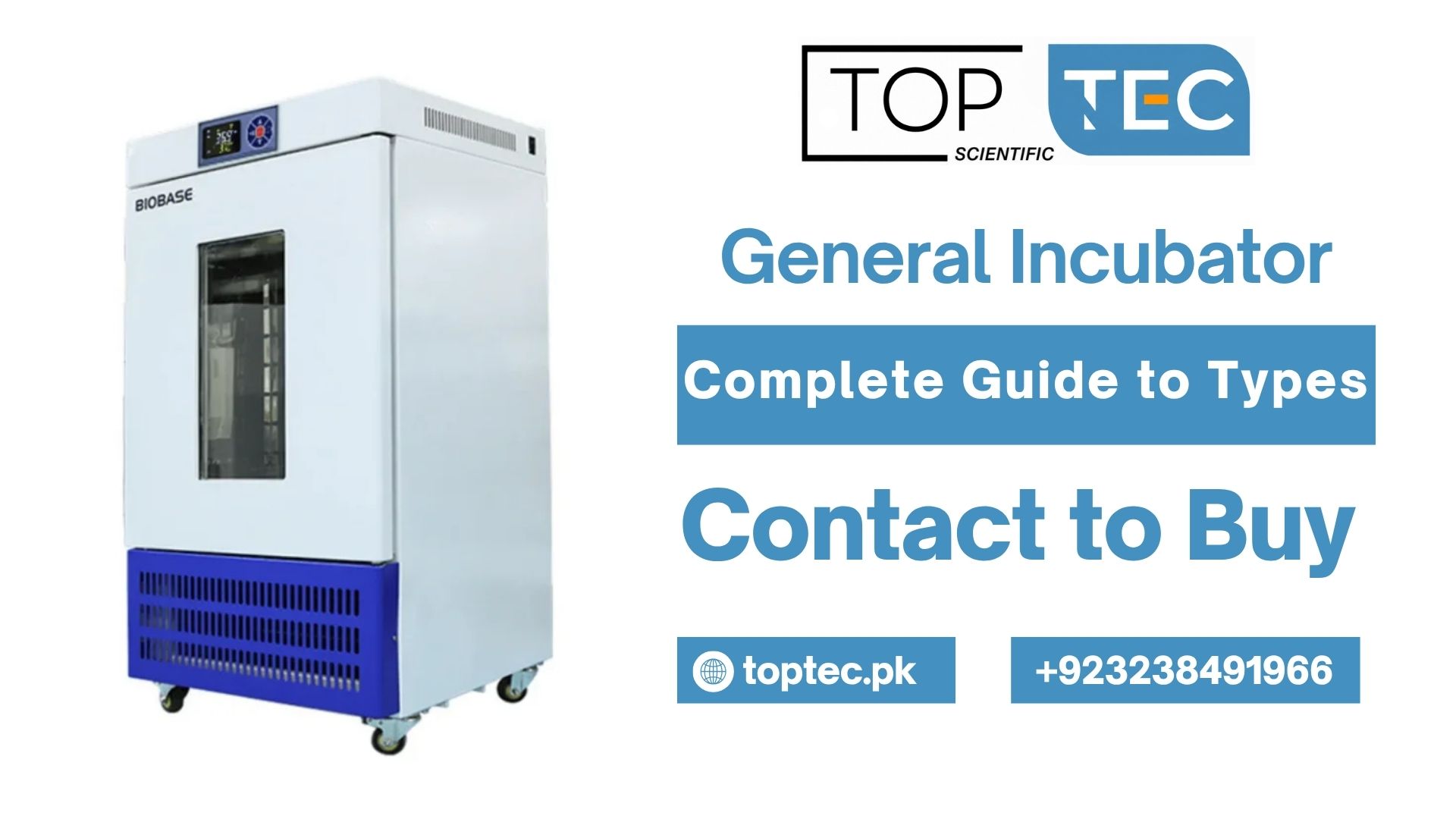
Buy general incubators for microbiology, cell culture, and lab testing. Benchtop and floor models with temperature ranges from ambient +5°C to 80°C. Digital controls, stainless steel interiors, and reliable performance. Request a quote today.
The first time I walked into a proper microbiology lab in Pakistan, I wasn’t impressed by the microscopes or the shiny centrifuges. Honestly, it was the incubators that caught my attention. Sitting quietly in the corner, humming away, these boxes were doing something pretty important around the clock—keeping temperatures exact for experiments that mattered a lot more than they looked. Years later, having worked with labs all over the country, I can say with confidence that a decent general purpose incubator isn’t optional equipment. If you’re dealing with microorganisms, cell cultures, or anything temperature-sensitive, you need one that actually works properly.
So maybe you’re setting up a diagnostic center. Or running a research lab. Or you teach microbiology at a university and need something reliable for your students. Doesn’t matter which—understanding what a general incubator actually does and how it works is something you really should know before spending money on one. These things sound simple on paper, but there’s more going on inside than most people realize. When you’re looking to Buy general incubator equipment, knowing what you’re actually buying makes a huge difference.
At TOPTEC Scientific, we build laboratory incubator units right here in Pakistan. We’ve put hundreds of these into diagnostic centers, research facilities, and schools over the years. I’ve picked up a lot about what separates a good incubator from a mediocre one, and what different labs actually need versus what they think they need. Let me walk you through it.
So What Is a General Incubator, Really?
Basically, it’s a chamber that holds temperature steady. Think oven, but way more precise. Your kitchen oven might swing 10-15 degrees around whatever you set it to—nobody notices because it doesn’t matter for cooking. A lab incubator though? It needs to stay within half a degree, sometimes tighter. That precision isn’t just nice to have. It’s the whole point, because microorganisms are picky about temperature in ways that can mess up your entire experiment if you’re not careful.
Here’s how it works in practice: you put your samples or cultures inside, set the temperature you need, and the incubator just… holds it there. For hours. Days. Sometimes weeks or months, depending on what you’re growing. It just keeps doing its job in the background while you work on other things.
I remember a microbiology technician in Karachi calling her incubator “the heartbeat of the lab.” At first I thought that was a bit dramatic, but she wasn’t wrong. Without it working properly, nothing else happens—no culturing, no growth studies, nothing. I’ve actually seen what happens when one breaks down mid-shift. The whole lab just stops. Everyone’s standing around waiting because their work depends entirely on that box maintaining temperature.
Think about what’s actually at stake here. You’ve got a patient’s blood sample. You inoculate it, put it in the incubator overnight at 37°C—body temperature, basically—and that warmth lets whatever bacteria is causing the infection grow enough that you can identify it the next day. But if that temperature drifts even two or three degrees off? The bacteria might not grow right, or might not grow at all. Now your diagnosis is unreliable, and that’s a real problem when someone’s health depends on getting it right.
What’s Actually Inside a Laboratory Incubator
Let’s break down the parts, because understanding this helps when you’re deciding what to Buy general incubator wise.
The Chamber Itself: Usually powder-coated or stainless steel on the outside. Stainless is better, honestly, especially for medical work. Inside that outer shell is insulation—foam or mineral wool, sometimes layered—that keeps heat from escaping and keeps the internal temperature stable even when the room outside is warmer or colder.
The interior itself is almost always stainless steel too. Makes sense—easy to clean, doesn’t rust from the moisture that naturally builds up inside. I saw an old unit in Hyderabad once with an aluminum interior that had corroded badly over the years. Not just ugly—bits were flaking off into the chamber, which is obviously a contamination risk. Stainless avoids that problem entirely.
Heating: Electric heating elements do the warming. Sensors (thermistors or RTDs, if you want the technical term) constantly check the actual temperature. Control circuitry compares what the sensor reads against what you set, then adjusts the heat accordingly. Simple feedback loop, really—temperature drops, heater kicks in; temperature’s fine, heater backs off.
What varies a lot is how precisely this gets controlled. Our units at TOPTEC use microprocessor controllers that hold within half a degree. Cheaper or older equipment might only manage two or three degrees of swing, which frankly isn’t good enough if your work is sensitive. I’ve watched technicians using old mechanical thermostats—manually checking with a separate thermometer, adjusting by hand, constantly fussing with it. Compared to modern digital control, it’s night and day.
Air Movement: There’s a small fan inside circulating air. Sounds minor but it matters a lot—without it, you get hot spots and cold spots inside the chamber. Top shelf warmer than bottom shelf, that sort of thing. A researcher in Multan told me they’d had exactly this problem without realizing it for ages, and it was quietly messing up their results. New incubator with proper circulation fixed it immediately.
Display and Alarms: Digital readouts showing current and set temperature are standard now, and honestly they should be. Good ones also have alarms that trigger if something goes wrong—say the temperature drops unexpectedly. That alert means you catch the problem before your samples are ruined, not after.
Doors and Shelving: Glass doors are common because you can see inside without opening it—every time you open a door, warm air escapes and temperature dips. Door seals matter more than people realize; a worn seal means heat loss every single time, and recovery takes minutes each time. Shelves are usually adjustable stainless steel, letting you configure the inside based on what you’re actually storing.
Temperature Ranges—Why They Matter
This is probably the most practical thing to understand before you Buy general incubator equipment, because not every unit covers the same range, and your application determines what you actually need.
37°C, the Standard: Most incubators default to this because it’s human body temperature, and most clinically relevant bacteria—E. coli, Staph, Strep, you name it—grow best right around there. Nearly every diagnostic lab I’ve worked with in Pakistan runs their cultures at 37°C. Blood work, wound samples, respiratory stuff, all overnight at this temperature. If that’s all you’re doing, a basic incubator that just does 37°C reliably is honestly all you need.
But not everything happens at body temperature. That’s where extended ranges come in handy.
Lower Ranges (18-28°C): Useful for organisms that prefer cooler conditions—some fungi, environmental samples, cold-tolerant bacteria. I worked with a research group in Peshawar studying bacteria pulled from glacial samples up in the mountains. These organisms were adapted to cold—37°C would’ve been far too warm for them to grow at all. They needed that lower range specifically.
Wide Range Units (ambient up to 60°C): These cover almost anything. Low end works for stability testing at room-temperature conditions with tight control. High end—50 or 60°C—gets used for thermophilic organisms, or for accelerated pharmaceutical stability testing. A company in Lahore I know uses 40 and 50°C settings to simulate months of room-temperature storage in just a few weeks. Saves enormous amounts of time versus waiting out real-time storage periods.
Accuracy Matters More Than People Think: Look for ±0.5°C if you can get it—that’s the gold standard for research and quality control work. ±1.0°C is fine for routine diagnostic culturing, still decent. Anything worse than ±2°C, honestly, I’d be cautious about using for anything sensitive. The difference sounds trivial but it isn’t—a culture meant to grow at exactly 37°C might behave completely differently at 38 or 36. I’ve literally run the same culture side-by-side in two incubators with different accuracy specs and gotten noticeably different growth patterns. It’s not imaginary.
What You Actually Use These For
Growing Cultures: The bread-and-butter use. Inoculate your media, stick it in the incubator at the right temperature, wait 18-48 hours depending on the organism, and you’ve got a culture ready for identification or further testing. Every diagnostic center and research lab doing microbiology leans heavily on this. I knew a center in Islamabad processing 50-70 cultures daily—their incubator space was literally the bottleneck limiting how much work they could take on.
Identification Tests: After you’ve got a culture, you run tests to figure out exactly what organism you’re dealing with. Many of these tests need specific incubation conditions to work correctly.
Antibiotic Testing: Genuinely important work—exposing cultures to different antibiotics and incubating to see which ones inhibit growth. This tells doctors which drug will actually treat an infection. Get the incubation wrong, and you could end up recommending the wrong treatment. Not a small mistake.
Pharmaceutical QC: Companies test their products for microbial contamination by inoculating culture media with product samples and incubating to check for growth. No growth, product’s clean. This is part of how they prove their products are safe before they reach patients.
Picking the Right General Purpose Incubator
Size: Ranges from maybe 50 liters up to 500+ liters. Depends entirely on your volume. A diagnostic center in Faisalabad started small with a 100-liter unit, then within three years had outgrown it completely—running continuously but still couldn’t keep up with demand during busy periods. In hindsight, going bigger from the start would’ve saved them the hassle of adding capacity later.
Temperature Range: If you’re strictly doing 37°C diagnostic work, don’t overspend on a wide-range unit you won’t use. But if there’s any chance you’ll need flexibility down the line—research applications, different organisms—paying more upfront for that range is usually worth it.
One Big Unit vs. Several Smaller Ones: Multiple incubators let you run different protocols simultaneously without one affecting another, and if one breaks, you’re not completely stuck. A pharma facility in Karachi runs three separate units—37°C for routine work, 50°C for stability testing, another for enzyme work. Keeps everything independent.
Why Buying Local Makes Sense
Here’s something I feel strongly about. When you Buy Laboratory Furniture or lab equipment generally, going local—working with a manufacturer like TOPTEC Scientific rather than importing—has real advantages that people don’t always consider upfront.
Support Actually Shows Up: If something breaks on an imported unit, you’re often waiting weeks for parts, dealing with people overseas who don’t really get your situation. I know a hospital in Multan whose imported incubator failed and took nearly three months to get fixed because everything had to be shipped internationally. With us, you call, we come out, we fix it. That’s just how it works when the manufacturer is actually in the same country.
Built for Here, Not There: Equipment designed in Europe assumes European conditions—stable power, moderate humidity. Pakistan’s different. We deal with power fluctuations, Karachi’s humidity, dust in some regions. Our designs account for all that because we’re building for this environment specifically, not adapting something meant for somewhere else.
Pricing: Cutting out international shipping, import duties, customs, and multiple middlemen markups means we can offer competitive pricing without compromising on build quality.
Training Included: When you Buy general incubator units from us, you get proper installation, staff training, and documentation in both English and Urdu. No fumbling through manuals written for a market that isn’t yours.
What This Actually Costs
Rough pricing, based on what we see:
- Basic compact units: PKR 80,000-120,000
- Mid-size general purpose: PKR 150,000-300,000
- Larger capacity: PKR 350,000-600,000
- Advanced/specialty features: PKR 600,000 and up
Don’t forget operating costs either. A 200-liter unit running continuously might cost PKR 15,000-25,000 monthly in electricity. Annual maintenance runs PKR 10,000-30,000. Calibration checks add a bit more. Over five years, total ownership cost typically lands somewhere between 1.1 and 2.2 million rupees depending on size and usage patterns.
The point is—don’t just look at sticker price. Factor in what it’ll actually cost to run over its lifetime, and buy appropriately for your actual needs, not more than you’ll use.
Wrapping This Up
A laboratory incubator isn’t glamorous equipment, but it’s foundational if your work involves biological materials or anything temperature-sensitive. Understanding what you’re buying, what temperature range you genuinely need, and what level of accuracy matters for your specific applications makes the difference between a good investment and wasted money.
At TOPTEC Scientific, when you Buy general incubator systems from us, you’re getting equipment built locally, with real support behind it—not just a product dropped off and forgotten. We’ve worked with enough labs across Pakistan to understand what actually matters in practice, not just on a spec sheet.
If you’re setting up new, replacing something old, or just need more capacity, reach out. We’ll talk through what you actually need rather than just pushing whatever’s most expensive. That’s how we’d want to be treated buying equipment ourselves.
