

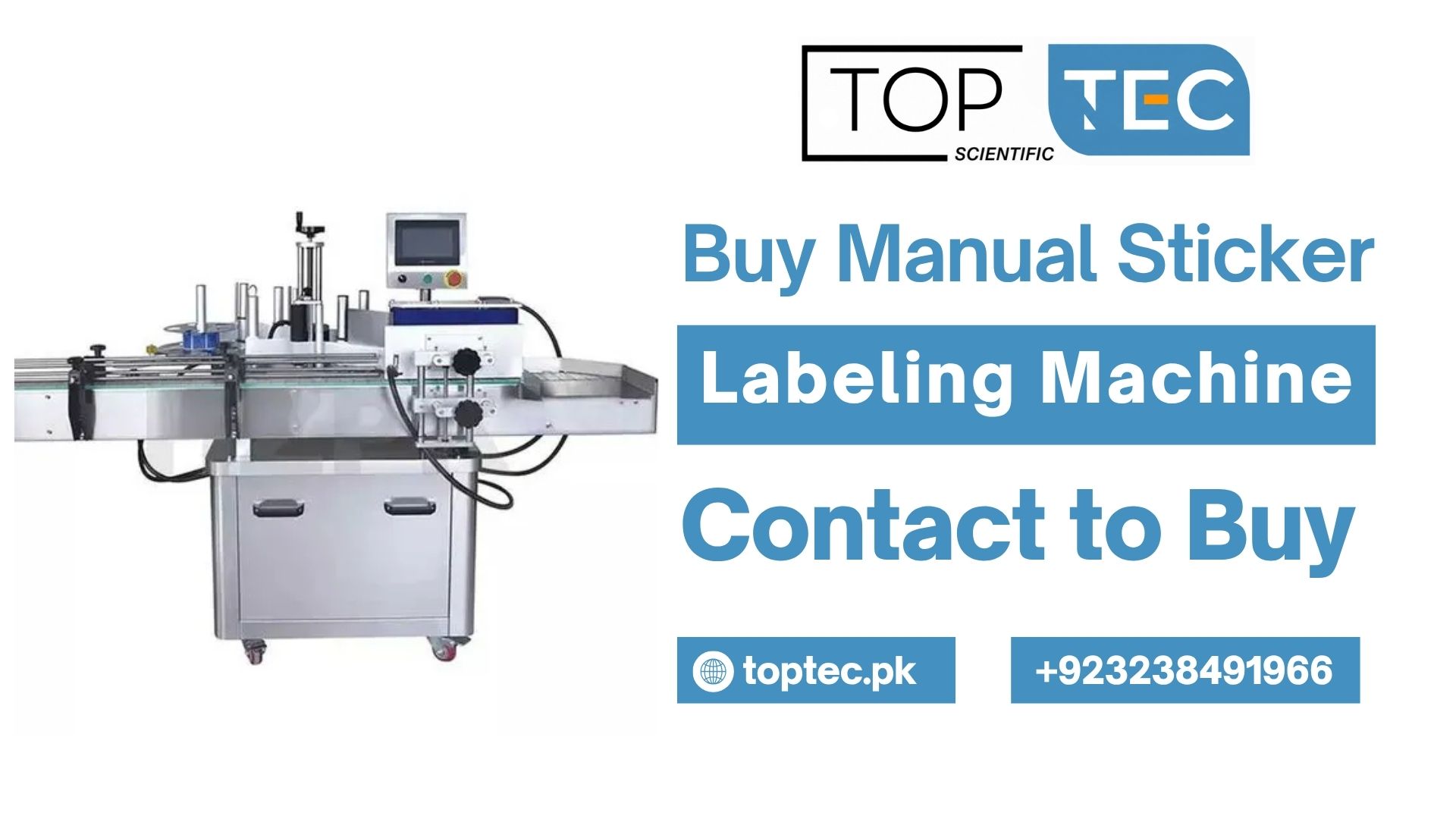
Find manual sticker labeling machines with adjustable guides for precise labeling on round or flat surfaces. Simple operation, low maintenance, and budget-friendly.
Let’s be honest for a second — labeling doesn’t sound glamorous. Nobody in a production facility or research lab gets excited about applying stickers to bottles, vials, or containers. But here’s the thing: get it wrong and you’ve got misidentified samples, compliance headaches, or worse, a product recall that could have been avoided with a two-thousand-rupee labeling process done properly.
I’ve walked into small pharmaceutical units in Lahore and Karachi where operators were peeling labels off backing sheets by hand and trying to stick them straight onto round bottles. The results were exactly what you’d expect — crooked labels, air bubbles, inconsistent positioning, and a lot of wasted time. A basic Manual Sticker Labeling Machine would have solved most of those problems in an afternoon.
This article is about why a simple, portable labeling machine might be one of the smartest small investments your lab or production line can make — and how TOPTEC Scientific, a Pakistani manufacturer known primarily for laboratory furniture, is also supplying practical production equipment like these to local facilities.
What Exactly Is a Manual Sticker Labeling Machine?
If you’ve never used one, the concept is almost too simple to need explaining — but that simplicity is actually the point.
A manual labeling machine is a hand-operated device that holds a roll of pre-printed labels and applies them to containers — bottles, jars, vials, tubes, boxes — with consistent positioning and pressure. No electricity required for the most basic models. No compressed air. No PLC programming. You load the label roll, place your container against the guide, and pull a lever or turn a handle. The label wraps around or sticks to the surface evenly.
That’s it.
The beauty of a manual label applicator is that it removes the human inconsistency from what is otherwise a surprisingly error-prone task. When someone applies a label by hand, the position varies by a few millimeters every time. The pressure varies. Air gets trapped under the label. On a round bottle, the label wrinkles. Multiply that across hundreds or thousands of units in a production run, and you’ve got a quality control problem that shows up in photographs during audits.
A Manual Sticker Labeling Machine standardizes the process. Every label goes on at the same height, with the same alignment, with consistent pressure across the entire surface. The difference in finished product appearance is immediately obvious — even to someone who doesn’t normally pay attention to labeling.
Why Manual Instead of Automatic?
This is a fair question, and the answer depends entirely on your production volume and budget.
Automatic labeling machines are impressive pieces of equipment. They can label hundreds of bottles per minute with precision that’s hard to match manually. They’re also expensive — we’re talking lakhs or even crores of rupees for a fully automatic inline system — and they require space, power, maintenance, and trained operators.
For a small pharmaceutical unit producing a few thousand bottles per batch, a research lab labeling sample vials, a cosmetics startup doing small production runs, or a food processing facility with seasonal output — an automatic system is overkill. You’d spend more on the machine than you’d save in labor over several years.
A manual labeling machine hits the sweet spot for these operations. The initial investment is modest. Setup takes minutes. Training an operator takes about fifteen minutes. Maintenance is minimal — mostly keeping the rollers clean and replacing the label roll when it runs out. And the output quality, while not matching the speed of an automatic system, is perfectly consistent and professional.
I’ve seen small pharma units in Pakistan double their labeling throughput simply by switching from hand application to a basic manual label applicator. The operators weren’t working faster — the machine just eliminated the fumbling, repositioning, and re-application that hand labeling involves.
Types of Manual Sticker Labeling Machines Worth Knowing About
Not all manual labelers are the same. The right type depends on your container shape and label format.
Flat Surface Labelers
These are the simplest. Designed for applying labels to flat surfaces — boxes, pouches, flat-sided bottles. The container slides under a label dispensing head, and the label transfers with even pressure. Straightforward and effective for their intended use.
Round Bottle Labelers
This is where a Manual Sticker Labeling Machine really earns its keep. Round bottles are genuinely difficult to label by hand — getting a label to wrap smoothly around a curved surface without wrinkles or air pockets requires more dexterity than most people have at the end of a long shift. A round bottle labeler holds the bottle in a cradle or between rollers, and as you rotate the bottle, the label feeds on evenly. The result is a smooth, professional application every time.
Top and Bottom Labelers
Some products need labels on both the top and bottom of the container — think of jars or flat boxes that need a primary label on top and a batch information label underneath. Dual-head manual labelers handle this in a single pass.
Handheld Label Applicators
For operations where containers vary in size or shape and a fixed-position machine isn’t practical, a handheld manual label applicator gives you portability and flexibility. You hold the device, position it against the container, and trigger the label release. These are popular in warehouse operations, retail environments, and labs where sample containers come in various formats.
The GMP and Regulatory Angle
Here’s something that often surprises people outside the pharmaceutical and food industries: labeling is one of the most heavily scrutinized elements in GMP audits.
Regulatory bodies — DRAP in Pakistan, FDA internationally, WHO for prequalification — treat labeling errors as critical defects. A mislabeled product isn’t a minor quality issue; it’s a potential patient safety risk. Wrong dosage information, wrong batch number, wrong expiry date on a label can have serious consequences.
While a manual labeling machine doesn’t prevent content errors (that’s a printing and verification process), it does prevent the physical application problems that lead to labeling defects during inspections:
- Labels that are partially detached because they weren’t applied with sufficient pressure
- Labels that are wrinkled or bubbled, making text difficult to read
- Labels positioned inconsistently, suggesting poor process control
- Labels that overlap or are misaligned, raising questions about quality systems
When an auditor walks through your production area and sees operators using a proper manual labeling machine rather than peeling and sticking by hand, it signals that you’ve thought about process control at every stage — including the ones that seem minor.
This connects to a broader point about facility setup. When you Buy Laboratory Furniture and production equipment from a supplier who understands GMP requirements, the recommendations you get tend to account for these regulatory realities. That’s one of the reasons facilities working with TOPTEC Scientific appreciate their approach — the product recommendations come from an understanding of the environment, not just a catalog.
TOPTEC Scientific: More Than Just Laboratory Furniture
Most people in Pakistan’s pharmaceutical and research sectors know TOPTEC Scientific for their laboratory furniture — fume hoods, laminar flow cabinets, lab benches, cleanroom wardrobes, and similar equipment. And that reputation is well-earned. Their locally manufactured stainless steel clean wardrobe units and other cleanroom furniture have become a standard in many Pakistani facilities.
But TOPTEC’s product range extends beyond furniture into practical production and laboratory equipment — including labeling machines, mixing equipment, and other small-scale production tools that facilities need alongside their primary infrastructure.
Why This Matters for Pakistani Facilities
When you Buy Laboratory Furniture from an international supplier, you’re typically dealing with a narrow product category. They sell furniture. If you also need a labeling machine, you’re starting a new procurement process with a different supplier, different shipping arrangements, different payment terms, and different after-sales support channels.
TOPTEC simplifies this by offering a broader range under one roof. When a pharmaceutical unit in Faisalabad or a cosmetics manufacturer in Karachi needs to equip a new production line — lab benches, storage cabinets, laminar flow units, and a Manual Sticker Labeling Machine for the packaging stage — they can source everything from a single local manufacturer.
The practical benefits are significant:
Single point of contact for procurement, which simplifies communication and reduces administrative overhead.
Consistent quality standards across all equipment, since everything comes from the same manufacturing facility with the same quality control processes.
Unified after-sales support — one technical team that understands your entire setup rather than multiple suppliers pointing you at each other when something needs attention.
Local availability of spare parts — when a roller needs replacement on your manual labeling machine or a filter needs changing on your laminar flow cabinet, you’re not waiting for international shipping.
Practical Considerations Before You Buy
If you’re seriously evaluating a Manual Sticker Labeling Machine for your operation, here are the things worth thinking through before making a decision.
Container Size Range
What are the smallest and largest containers you’ll be labeling? A machine designed for 50ml vials won’t handle 1-liter bottles, and vice versa. Some manual labelers have adjustable guides that accommodate a range of sizes — worth confirming the specific range before purchasing.
Label Dimensions
Width and length of your labels determine which machine models are compatible. Measure your actual labels, not the label design on screen — there’s often a small difference between design dimensions and the physical label after printing and cutting.
Label Material
Paper labels, vinyl labels, transparent labels, and metallic labels behave differently during application. Some manual label applicator designs handle certain materials better than others. If you use transparent labels (which are notoriously tricky to apply without visible air bubbles), mention this specifically when discussing your requirements.
Production Volume
Be realistic about your daily and weekly labeling volumes. A manual labeling machine is ideal for hundreds to low thousands of units per day. If you’re consistently labeling tens of thousands of units daily, you may need to consider a semi-automatic or automatic system — and TOPTEC can advise on that transition as well.
Operator Ergonomics
This sounds minor until someone is labeling eight hundred bottles in a shift. The physical effort required to operate the machine — lever pull force, handle rotation, container loading — affects operator fatigue and consistency over long runs. Try the machine before buying if possible, or ask for a demonstration.
Build Quality
A Manual Sticker Labeling Machine is a mechanical device with moving parts — rollers, guides, springs, tension mechanisms. Build quality determines how long those parts maintain precision before wearing out. Stainless steel and aluminum construction lasts longer than plastic components, particularly in environments where cleaning agents are used regularly.
Where Manual Labeling Machines Fit in a Laboratory Setting
The connection between labeling machines and laboratory operations might not be immediately obvious if you’re thinking of large-scale production lines. But in research and quality control labs, labeling is a daily reality.
Sample vials need labels with sample IDs, dates, and storage conditions. Reagent bottles need content identification and hazard warnings. QC reference standards need batch numbers and expiry dates. Stability study samples need detailed labeling that remains legible for months or years under controlled storage conditions.
In these environments, a manual label applicator provides the consistency and legibility that hand-applied labels often lack. When a lab is preparing for ISO 17025 accreditation or a regulatory inspection, the quality of sample labeling is part of the overall impression of laboratory management — and crooked, handwritten, or partially attached labels don’t create a good one.
When facilities Buy Laboratory Furniture and equipment from TOPTEC Scientific for a new lab setup, including a small labeling machine in the procurement plan is a practical addition that addresses a real operational need. It’s a small line item in the overall budget that eliminates a recurring daily frustration.
The Cost Perspective
Let’s talk numbers in general terms, since specific pricing depends on model and configuration.
A basic Manual Sticker Labeling Machine for round bottles — the most common type in pharmaceutical and food applications — typically costs a fraction of what even the simplest semi-automatic system would run. We’re talking about an investment that most small production units can justify within the first few months based on labor savings and reduced label waste alone.
Consider the hidden costs of hand labeling that most facilities don’t calculate:
Label waste — operators misapply labels, especially on round containers, and discard them. At a few rupees per label, this adds up across thousands of applications.
Time — hand labeling is slow. A manual labeling machine can double or triple the speed of hand application for most container types.
Rework — products with poorly applied labels sometimes need to be relabeled, which means removing the old label (not always easy), cleaning the surface, and applying a new one. This is expensive in both time and materials.
Compliance risk — as discussed earlier, labeling defects during audits can trigger corrective actions that cost far more than the equipment that would have prevented them.
Against these costs, the investment in a proper manual labeling machine pays for itself quickly. And when you’re already working with TOPTEC Scientific to Buy Laboratory Furniture for your facility, adding a labeling machine to the order is logistically simple and often comes with bundled pricing advantages.
Common Questions
Can a manual labeling machine handle different bottle shapes?
Most round bottle labelers handle cylindrical containers of varying diameters within their specified range. Non-cylindrical shapes — oval, square, tapered — may require specific machine models or custom guides. Discuss your actual container shapes with TOPTEC’s team before finalizing your order.
How long does it take to change label rolls?
On most manual label applicator designs, a roll change takes two to five minutes. The mechanism is straightforward — remove the empty core, load the new roll, thread the label through the guide path, and you’re ready to resume.
Do manual labelers work with pre-printed labels or blank labels?
Both. Most facilities use pre-printed labels from a label supplier, and the machine simply applies them. Some operations use blank labels and print variable information (batch numbers, dates) with a separate label printer before application.
What maintenance does a manual labeling machine require?
Minimal. Keep the rollers clean and free of adhesive residue. Check spring tension periodically. Lubricate moving parts according to the manufacturer’s schedule. Replace worn rollers or guides as needed. TOPTEC provides maintenance guidelines and replacement parts locally.
Is training required for operators?
Basic training takes about fifteen to thirty minutes. Most operators become proficient within the first hundred labels. The learning curve is genuinely short — this is one of the main advantages of manual equipment over automated systems.
Bringing It All Together
A Manual Sticker Labeling Machine is one of those pieces of equipment that doesn’t get much attention in facility planning discussions — everyone’s focused on the big-ticket items like cleanroom construction, HVAC systems, and analytical instruments. But labeling is where your product actually meets the real world. It’s what the end user sees, what the regulator examines, and what your quality system needs to defend.
Getting it right doesn’t require a massive investment or complex automation. A well-built manual labeling machine from a reliable supplier handles the job consistently, day after day, with minimal fuss.
For Pakistani facilities — whether you’re a pharmaceutical manufacturer in Lahore, a food processing unit in Karachi, a cosmetics producer in Islamabad, or a research laboratory anywhere in the country — TOPTEC Scientific offers a practical local source for labeling equipment alongside their established range of laboratory and cleanroom furniture.
When you Buy Laboratory Furniture and production equipment from a single local manufacturer, you simplify procurement, reduce costs, and get after-sales support that’s actually accessible. That’s a combination worth taking advantage of.
If you’re currently labeling by hand and wondering whether a machine would make a real difference — it will. The improvement in speed, consistency, and finished product appearance is immediately visible, and the investment is modest enough that the payback period is measured in weeks rather than years.
