

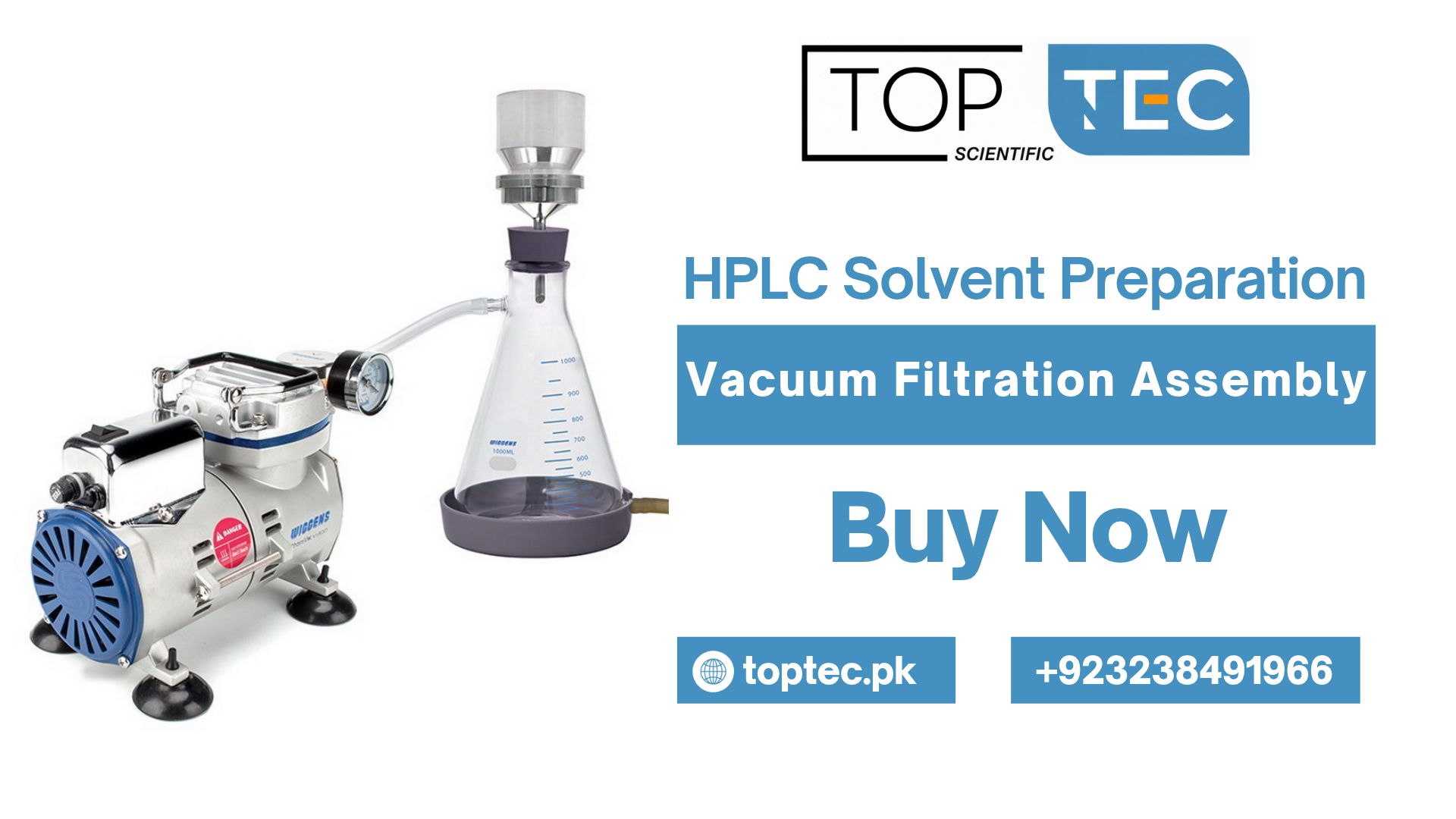
Ensure sterile, efficient lab filtration. Explore our vacuum filtration assembly kits with 47mm funnels and durable flasks for water testing. Get a quote.
Anyone who has ever worked the night shift in a pharmaceutical quality control lab knows the exact sound of an HPLC pump losing its prime at two in the morning. One minute your system is humming along nicely at 1,800 PSI, running a routine assay batch that needs to be released by breakfast, and the next minute the pressure reading drops to zero or spikes past 4,000 PSI and trips the over-pressure alarm.
Nine times out of ten, when you pull the pump head apart or unscrew the guard column, the culprit isn’t an electronics failure. It is a microscopic crystal of undissolved potassium dihydrogen phosphate wedged right under a ruby check valve ball, or fine particulate dust clogging the 2-micron inlet frit of your C18 column. And almost every single time, it happened because someone was in a rush and skipped running their mobile phase through a proper vacuum filtration assembly.
A few months ago, I spent an afternoon at a busy QC laboratory in Lahore’s Sundar Industrial Estate where they were burning through expensive analytical columns every three weeks. They thought their column supplier was sending them bad batches of silica. When I walked over to their wet-chemistry prep bench, I saw what was actually going on. Their analyst was pouring unfiltered buffer straight into the reservoir bottle, and the single glass filtration assembly they did own had a chipped sintered frit wrapped in frayed Teflon tape that was shedding plastic fibers right into the flask. Worse yet, their buffer prep corner sat right next to an old wooden sink cabinet swollen with damp mold, and they never sanitized the room air with an ulv fogger to keep airborne spores out of their aqueous solutions. Once we got them set up with a clean borosilicate vacuum filtration assembly, put them on a weekly room sanitization schedule using a cold ulv fogger, and helped their management Buy Laboratory Furniture built from chemical-resistant stainless steel and phenolic resin, their column lifespan tripled immediately.
If you want flat chromatogram baselines, steady pump pressures, and zero midnight mechanical breakdowns, mobile phase preparation has to be treated as a precision step. Here is a practical, floor-level guide on how to prep HPLC solvents properly using a glass filtration assembly, why biological hygiene matters more than most chemists think, and what to look for when you equip your lab or Buy Laboratory Furniture in Pakistan.
Why Unfiltered Solvents Destroy HPLC Pumps and Columns
Modern High-Performance Liquid Chromatography systems—whether you are running a workhorse 5-micron C18 column or a tight sub-2-micron UHPLC setup—have internal clearances tighter than a human hair. Inside your solvent delivery pump, tiny sapphire pistons move back and forth through high-pressure polymeric seals, relying on microscopic ruby ball check valves to keep liquid flowing in one direction.
Even when you buy expensive “HPLC Grade” acetonitrile or methanol in sealed amber bottles, tiny dust fibers from the bottle cap liner or trace silicates from the glass can float in the liquid. And once you mix aqueous buffers using solid salts like sodium acetate, ammonium dihydrogen phosphate, or ion-pairing reagents, you are guaranteed to have undissolved micro-crystals floating around—even if the beaker looks crystal clear when you hold it up to the ceiling light.
Running every drop of mobile phase through a 0.45-micron (or 0.22-micron) membrane inside a vacuum filtration assembly solves two massive chromatography headaches at the exact same time:
- Particulate Removal: The membrane physically traps undissolved salt crystals, lint fibers, and microbial debris on top of the filter pad before they ever enter your PTFE solvent lines. A clean filtration assembly acts like an insurance policy for a hundred-thousand-rupee analytical column.
- Primary Dissolved Gas Removal (Degassing): When you mix water and acetonitrile or methanol, the solution heats up slightly and becomes supersaturated with dissolved air. Even if your HPLC has a built-in online membrane degasser, pouring gas-heavy solvent straight in will overwhelm the degasser tube and cause micro-bubbles to form inside the pump head—leading to noisy baselines and wandering retention times. Pulling negative pressure underneath the membrane in a vacuum filtration assembly draws those dissolved air bubbles out of the liquid as it drops into the Buchner flask.
Of course, pulling vacuum also means room air gets drawn across the mouth of your funnel while you work. In labs with dusty air or high fungal counts, chemists often see “ghost peaks” show up during gradient runs because airborne contaminants got pulled into the buffer flask. That is why strict analytical facilities use an ulv fogger loaded with residue-free hydrogen peroxide to knock down airborne dust and mold spores in the prep room, and why smart lab managers Buy Laboratory Furniture with non-porous, low-shedding worktops instead of flaking wooden desks.
Even a small upgrade to your prep station makes a noticeable difference. When you mount your filtration assembly on a solid, vibration-free counter—the kind you get when you Buy Laboratory Furniture engineered specifically for wet labs—and maintain clean room air with a portable ulv fogger, your baseline noise drops and your check valves stop sticking.
Inside the All-Glass Borosilicate 3.3 Setup
Walk into a microbiology lab and you will see stainless steel manifolds everywhere. Walk into an HPLC instrumentation lab, however, and an all-glass borosilicate vacuum filtration assembly is the undisputed standard.
Why shouldn’t you use a metal funnel for HPLC mobile phase prep? Because mobile phases are chemically aggressive. Chemists routinely adjust buffer pH down to 2.0 using orthophosphoric acid or trifluoroacetic acid (TFA), or run strong organic modifiers like tetrahydrofuran (THF) and acetonitrile. Acidic buffers and halides can slowly corrode metal funnels and leach trace iron, nickel, or chromium ions into your solvent. Those leached metal ions wash straight onto your silica column bed, binding to silanol groups and causing horrible peak tailing on basic pharmaceutical compounds.
An all-glass filtration assembly constructed from true Borosilicate 3.3 glass is chemically inert. Whether you are filtering 100% organic solvent or low-pH phosphate buffer, nothing leaches out of the glass.
A standard 47mm HPLC glass vacuum filtration assembly breaks down into four simple parts:
- The Graduated Funnel (300ml or 500ml): Holds your unfiltered solvent above the membrane.
- The Support Base: Features a porous sintered glass frit (or a removable PTFE-coated stainless screen) that supports the thin membrane disc under suction so it doesn’t tear.
- The Anodized Aluminum Spring Clamp: Locks the funnel flange and support base together around the membrane edge without needing screws or tools.
- The Heavy-Wall Receiver Flask (1000ml to 2000ml): Collects the filtered, degassed mobile phase via a ground-glass neck joint or silicone stopper.
Because you are handling expensive, fragile glassware filled with toxic organic solvents like acetonitrile or methanol every morning, your bench layout matters tremendously. Facilities that Buy Laboratory Furniture with integrated chemical fume hoods, polypropylene drip sinks, and padded glassware drying racks lose far fewer funnels to accidental sink breakage. And for adjacent clean zones where sterile buffers are prepared, running a cold ulv fogger ensures the glassware stays biologically clean between shifts without leaving oily films on the borosilicate surfaces.
Before putting a new filtration assembly into daily service, always inspect the ground-glass sealing flange under a bright light. It should be completely flat and smooth, just like the precision-leveled epoxy countertops you expect when you Buy Laboratory Furniture for an analytical suite, and free from any manufacturing burrs that could tear a delicate membrane after you sanitize the room with an ulv fogger.
Choosing the Right Membrane Filter Without Melting It
Here is a classic rookie mistake I’ve seen happen in at least four different pharmaceutical labs in Karachi and Islamabad: a newly hired chemist grabs a white 47mm membrane filter box off the shelf, clamps a disc into the vacuum filtration assembly, pours in 500ml of pure acetonitrile, and switches on the vacuum pump.
Thirty seconds later, the membrane filter literally melts into a clear, slimy plastic jelly that coats the sintered glass frit and ruins the entire batch of solvent.
Why did that happen? Because someone handed the chemist a mixed cellulose ester (MCE) or cellulose nitrate filter meant for water microbiology instead of a solvent-resistant HPLC membrane. Acetonitrile dissolves cellulose ester on contact. Once melted plastic gets sucked deep into the porous glass frit of your filtration assembly, you might as well throw the glass base in the trash, because no solvent on earth will ever get it completely out of those microscopic pores.
To keep your vacuum filtration assembly running smoothly and prevent dissolved filter plastic from wrecking your HPLC column, stick to this simple membrane compatibility guide:
| Membrane Material | Best HPLC Solvent Application | What to Avoid |
|---|---|---|
| Nylon (0.45 µm / 0.22 µm) | Universal choice for aqueous buffers, methanol, and water/acetonitrile mixes | Strong acids (pH < 3.0) or high TFA concentrations (causes polymer shedding) |
| Hydrophilic PTFE | The gold standard—safe for 100% organics, THF, harsh acids, and aqueous mixes | Practically nothing; slightly higher cost per disc |
| PVDF (Hydrophilic) | Great for protein/peptide bio-chromatography and low-binding assays | Strong bases, acetone, or DMF |
| Cellulose Nitrate / MCE | Pure water bioburden testing ONLY (Microbiology) | NEVER use with Acetonitrile or Methanol (dissolves instantly) |
Keeping your different membrane boxes clearly separated and organized right above your work area stops operators from grabbing the wrong box during a busy shift. That is a small detail to remember when you Buy Laboratory Furniture—ask for overhead reagent shelves and labeled drawer dividers right at the solvent prep bench. Meanwhile, if you store open boxes of 0.22-micron filters in a humid room without periodic biological air control from an ulv fogger, mold spores can settle right inside the filter box.
When you clamp a fresh PTFE or Nylon disc into your filtration assembly, never touch the center of the membrane with bare fingers. Skin oils wash right through the filter and show up as ugly baseline humps around ten minutes into a reverse-phase gradient run. Use clean, blunt-tip stainless forceps kept on a clean tray—another reason labs Buy Laboratory Furniture with dedicated stainless steel instrument drawers and run a weekly ulv fogger cycle to keep all benchtop storage sanitized.
Ghost Peaks, Buffer Mold, and Room Sanitization
Ask any experienced HPLC method development chemist what gives them the worst headaches, and they won’t say pump repairs—they will say “ghost peaks.”
You inject a blank sample of pure mobile phase, run a 30-minute gradient from 90% water to 90% acetonitrile, and suddenly three mysterious peaks pop up right where your active drug impurity is supposed to elute. Where do those ghost peaks come from?
Almost every time, they come from bacterial and fungal growth inside your aqueous buffer bottle or dirty lab air getting pulled through your vacuum filtration assembly.
Think about it: a pH 6.8 potassium phosphate buffer sitting in a warm Pakistani lab at 28°C is basically a luxury five-star buffet for bacteria and mold. Within twenty-four hours of sitting on an open bench, airborne microbes multiply in the buffer. When you pump that contaminated buffer through your HPLC, bacterial cell wall fragments and metabolic organic toxins collect at the head of your C18 column during the high-water phase, and then elute off as sharp ghost peaks as soon as the acetonitrile percentage climbs. Even if you run the liquid through a 0.45-micron filtration assembly, dissolved bacterial endotoxins and organic byproducts pass right through the pores.
To stop buffer contamination and ghost peaks dead in their tracks, disciplined QC labs follow three strict rules:
- Filter fresh aqueous buffer daily through a 0.22-micron membrane in an all-glass vacuum filtration assembly using freshly distilled or Type-1 ultrapure water.
- Never top up yesterday’s buffer bottle with fresh buffer—dump the old remainder, rinse the bottle with pure methanol, and dry it properly.
- Keep the wet-chemistry and buffer preparation room biologically clean. You cannot make contamination-free buffers inside a room with dusty wooden cupboards and moldy ceiling tiles. By running a portable cold ulv fogger with a cleanroom-grade hydrogen peroxide solution across the prep bay once or twice a week, you eliminate airborne spores before they ever land in your water carboys.
And because regular misting from an ulv fogger requires moisture-proof, chemical-proof room surfaces, quality-focused pharma plants always Buy Laboratory Furniture constructed from genuine SS304 stainless steel or solid phenolic laminate that won’t swell, peel, or harbor mold colonies behind the sink splashback.
Even the way you store your glass filtration assembly between batches matters. If you leave a wet funnel sitting upright on a dusty shelf, room dust settles right onto the sintered glass frit and gets pushed into the receiver flask on your very next run. Store your clean funnels inside closed, corrosion-resistant glass-door cabinets—the kind of hygienic storage you get when you Buy Laboratory Furniture built for GMP labs and keep the surrounding air sanitized with an ulv fogger.
Building an Ergonomic HPLC Prep Suite with TOPTEC Scientific
If you look at how an HPLC laboratory actually operates day to day, solvent preparation involves toxic vapors (acetonitrile, methanol, triethylamine), corrosive acids (orthophosphoric acid, hydrochloric acid), heavy glass flasks, and vibrating vacuum pumps. You cannot stick an analyst in the corner on a wobbly carpenter-made wooden desk with no exhaust ventilation and expect good analytical output or pass a DRAP audit.
This is where TOPTEC Scientific steps in as a genuine partner for pharmaceutical plants, commercial testing labs, universities, and research institutes across Pakistan. Unlike middleman trading firms that import generic catalog items with four-month shipping delays and zero local spare parts, TOPTEC Scientific manufactures laboratory and cleanroom furniture right here in Pakistan, alongside supplying essential lab hardware like your vacuum filtration assembly and cleanroom decontamination tools like an ulv fogger.
When you decide to Buy Laboratory Furniture directly from TOPTEC Scientific, you can design an HPLC and wet-chemistry prep station where every single piece of equipment works together smoothly:
- Ducted Fume Hoods for Toxic Solvent Filtering: Pouring liters of acetonitrile, methanol, or TFA through an open filtration assembly on an open table exposes your chemists to harmful organic vapors all day long. TOPTEC manufactures chemical-resistant fume hoods locally in Pakistan with built-in vacuum ports, electrical sockets, and high-velocity sash extraction so your team can run their vacuum filtration assembly inside the hood without breathing toxic fumes.
- Solvent-Proof Countertops: Spill acetonitrile or concentrated buffer acid on cheap laminate, and the surface blisters immediately. When you Buy Laboratory Furniture from TOPTEC Scientific, their island benches and wall tables come fitted with heavy-duty phenolic resin, epoxy resin, or SS316 stainless steel worktops that shrug off harsh organic solvents and acids for decades.
- Vibration-Isolated HPLC Instrument Benches: An oil-free diaphragm pump hooked up to a filtration assembly vibrates constantly. If you put that pump on the same flimsy table as your HPLC detector or analytical microbalance, your baseline will jump all over the screen. TOPTEC builds heavy-gauge welded steel frames and dedicated anti-vibration balance tables that keep mechanical hum completely isolated from sensitive optics.
- Built to Survive Room Sanitization: Every cabinet, stainless sink unit, and pass box TOPTEC fabricates in Pakistan is engineered with smooth, non-porous surfaces that stand up to regular room decontamination with an ulv fogger without rusting or flaking paint.
Instead of chasing five different importers for benches, hoods, filtration glassware, and sanitation machines, choosing to Buy Laboratory Furniture and lab accessories from TOPTEC Scientific gives you one local engineering team in Pakistan that backs up everything they build.
4 Golden Bench Rules to Make Your Glassware and Pumps Last
Before we wrap up, here are four practical habits every QC supervisor should enforce at the solvent prep bench. Following these simple steps will save your lab thousands of rupees in broken glass frits and ruined vacuum pumps:
1. Flush Phosphate Buffer Out of the Sintered Frit Immediately
Never finish filtering a liter of potassium phosphate buffer through your vacuum filtration assembly and walk away leaving the glass frit wet with buffer. Within an hour, the water evaporates and razor-sharp phosphate salt crystals grow deep inside the microscopic pores of the sintered glass disc. The next morning, your filtration rate will drop to a slow drip, and trying to scrape the frit will ruin it. Always keep a wash bottle of warm distilled water next to your filtration assembly and pull 100ml of pure water straight through the glass frit the second you remove your membrane disc.
2. Always Put a Safety Trap Flask Before Your Vacuum Pump
As solvent drops into the receiver flask under vacuum, part of the volatile organic phase (like methanol or acetonitrile) flashes into vapor and gets pulled down the vacuum hose. Worse, if an analyst gets distracted and lets the receiver flask overflow, liquid shoots straight into the pump head. Always connect an empty heavy-walled safety trap flask between your vacuum filtration assembly and your diaphragm pump. It catches accidental overflows and condenses solvent vapors before they corrode your pump valves.
3. Pre-Mix Your Mobile Phase Before Filtering (With One Exception)
Whenever your method calls for a premixed isocratic mobile phase (say, 60% methanol and 40% phosphate buffer), mix the two liquids together in a beaker first, let the mixture equilibrate for five minutes, and then pour it through your filtration assembly. Why? Because mixing water and alcohol releases heat and forces dissolved air out of solution; pulling it through the vacuum filtration assembly after mixing removes all that evolved gas at once. (Just make sure the buffer salt concentration isn’t so high that the organic solvent causes the salt to precipitate out!)
4. Keep the Prep Bay Clean From Floor to Ceiling
Treat your HPLC solvent prep corner with the same discipline as a cleanroom. Wipe down the chemical-resistant tops you got when you chose to Buy Laboratory Furniture at the end of every shift, store clean glassware off the counter in closed cabinets, and run a cold ulv fogger on your scheduled sanitation days to keep background mold and dust out of your water carboys and reagent shelves. Even in adjoining sample prep rooms, a ten-minute cycle with a handheld ulv fogger keeps airborne contamination from drifting into your open flasks.
Final Thoughts
Great chromatography starts long before you click “Inject” on the software screen. It starts at the solvent prep bench. Taking five minutes to pull your buffers and organic modifiers through a clean, well-maintained borosilicate filtration assembly protects your high-pressure pump seals, stops check valves from sticking, keeps your C18 column backpressure low, and gives you the rock-steady baselines every analyst wants to see.
Just remember that your benchtop glassware is part of a bigger laboratory ecosystem. Keeping your aqueous buffers free from mold and ghost peaks requires clean room air—easily maintained with a residue-free cold ulv fogger—and durable, solvent-proof work surfaces. When it is time to upgrade your QC lab, install new chemical fume hoods, order a replacement vacuum filtration assembly, or Buy Laboratory Furniture manufactured right here in Pakistan to international GMP standards, get in touch with TOPTEC Scientific. With local Pakistani manufacturing, custom bench sizing, and direct engineering support, TOPTEC gives your analytical team the solid foundation they need to produce audit-ready results every single shift.
