

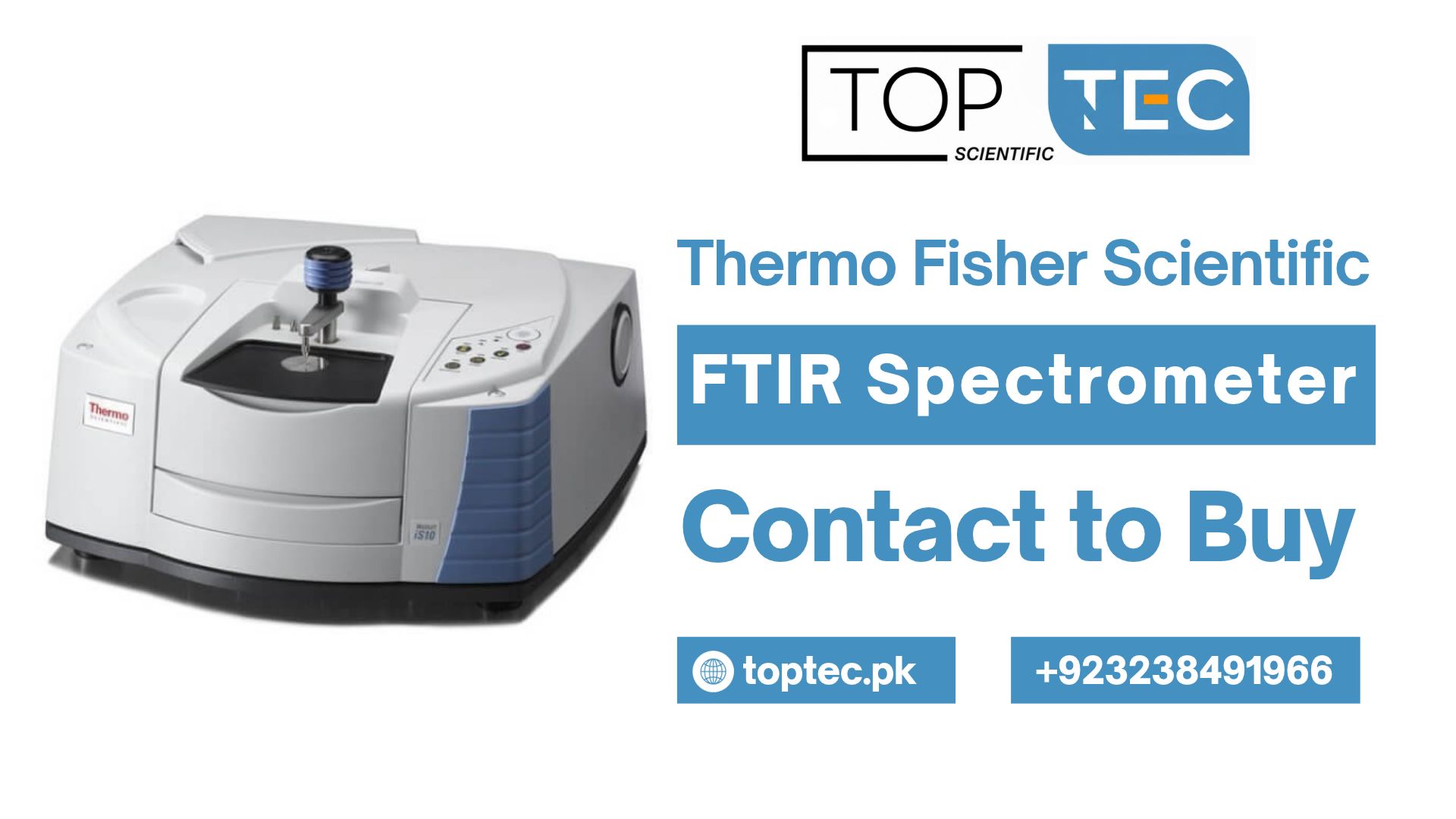
A material can look perfectly ordinary and still be the wrong one. A white powder, for example, might resemble another raw material closely enough to fool the eye. That is why laboratories use analytical instruments to investigate a sample’s chemical identity rather than relying on appearance alone.
An FTIR Spectrometer helps analysts do this by measuring how a sample interacts with infrared radiation. The resulting spectrum can reveal chemical features and support comparisons with reference materials.
But how does the instrument turn infrared light into a spectrum? The answer involves two important steps: an interferometer creates a signal, and a Fourier transform converts that signal into a form an analyst can interpret.
What Is FTIR Spectroscopy?
FTIR spectroscopy stands for Fourier Transform Infrared spectroscopy. It is an analytical technique used to investigate how a sample absorbs infrared radiation at different wavelengths.
Molecules contain bonds that can vibrate. When infrared radiation interacts with a sample, some frequencies may be absorbed if they correspond to suitable molecular vibrations. The resulting absorption pattern can help an analyst identify functional groups or compare the sample against a known reference.
An FTIR Spectrometer can be used with solids, liquids, and gases when the appropriate sampling accessories and methods are available. Common applications include raw material identification, polymer analysis, research, and investigation of unknown residues.
It is useful to think of a spectrum as a pattern of evidence—not a guaranteed identification on its own. Sample quality, method suitability, and reference data all affect the conclusion.
The Main Parts of an FTIR Spectrometer
Most instruments share the same basic components:
- Infrared source: Produces a broad range of infrared radiation.
- Interferometer: Modulates the radiation to create a measurable interference signal.
- Sample area: Holds the sample or an accessory such as an ATR attachment.
- Detector: Measures radiation reaching it after interaction with the sample.
- Software: Converts and displays the data as a spectrum.
A Thermo Fisher Scientific FTIR Spectrometer, for example, uses these general principles, although features and accessories depend on the model. Always check the manufacturer’s documentation for the instrument you are considering.
Now let’s look at the part that often sounds more complicated than it needs to: the interferometer.
What Does the Interferometer Do?
The interferometer is the part of an FTIR Spectrometer that prepares infrared light for measurement. A common design is the Michelson interferometer.
In simplified terms, it contains:
- A beam splitter, which divides the incoming infrared beam.
- A fixed mirror, which reflects one part of the beam.
- A moving mirror, which reflects the other part.
- A point where the two reflected beams recombine.
Because one mirror moves, the distance travelled by one beam changes relative to the other. When the beams recombine, they interfere with each other. Sometimes they reinforce one another; at other positions, they partly cancel.
The detector records the changing signal as the mirror moves. This signal is called an interferogram.
An interferogram does not look like the familiar spectrum with peaks labelled by wavenumber. It contains combined information from many infrared frequencies. That is where the Fourier transform comes in.
What Is a Fourier Transform?
A Fourier transform is a mathematical operation that separates a complex signal into its frequency components.
For an FTIR Spectrometer, the software applies this calculation to the interferogram. The result is a spectrum showing how the detected signal varies across infrared frequencies, usually reported as wavenumber in cm⁻¹.
The analyst normally collects a background measurement first, then measures the sample. The software compares the two measurements to display a spectrum, commonly in absorbance or transmittance.
You do not need to perform the calculation by hand to use FTIR spectroscopy. The important point is understanding what the software has done—and making sure the background, sample, and instrument settings are appropriate.
A Thermo Fisher Scientific FTIR Spectrometer may offer software tools for collecting backgrounds, processing spectra, and comparing results with libraries. The available tools will depend on the model and software package.
How an FTIR Measurement Works, Step by Step
Although procedures differ by instrument and sample type, a typical workflow looks like this:
- Prepare the instrument. Check that it is ready for use under the laboratory’s procedure.
- Collect a background. Measure the instrument environment and sampling accessory without the sample.
- Place the sample. Use the appropriate accessory and preparation method.
- Collect the sample signal. The detector records an interferogram.
- Generate the spectrum. Software applies the Fourier transform and compares the sample signal with the background.
- Review the result. Assess the spectrum using the approved method and suitable reference data.
- Clean the accessory. Prepare the instrument for the next user.
A clean sampling surface and a suitable background are just as important as a capable FTIR Spectrometer. Residue from a previous sample, for example, can complicate interpretation.
Laboratories using FTIR spectroscopy under GMP should follow their approved procedures for instrument checks, sample handling, documentation, and review.
Understanding the FTIR Spectrum
An FTIR spectrum is usually displayed with wavenumber on the horizontal axis and absorbance or transmittance on the vertical axis. Peaks represent regions where the sample interacts with infrared radiation.
Some regions are associated with particular types of molecular vibration. Analysts also examine the fingerprint region, where a more complex pattern can help distinguish materials when compared with a suitable reference.
That said, interpretation takes context. A spectrum may be affected by mixtures, sample preparation, contamination, moisture, accessory choice, and data-processing settings.
A library match can be helpful, but it should be reviewed critically. Whether you use a Thermo Fisher Scientific FTIR Spectrometer or another manufacturer’s system, a high match score is not a substitute for a suitable method and an understanding of the sample.
ATR vs. Transmission: Two Common Sampling Options
When purchasing an FTIR Spectrometer, the accessory can matter as much as the instrument itself. Two common approaches are ATR and transmission.
ATR-FTIR
ATR stands for attenuated total reflectance. The sample is brought into contact with a crystal, and the instrument measures the interaction between the infrared radiation and the sample near the crystal surface.
ATR can be convenient for many solids and liquids because it often requires relatively little preparation. Good contact and careful cleaning are important, especially for solid samples.
Transmission FTIR
In transmission measurements, infrared radiation passes through the sample. Preparation depends on the material and method; the sample must be suitable for transmitting enough radiation to produce a useful signal.
Both approaches can support FTIR spectroscopy, but they are not automatically interchangeable. Choose the technique based on your sample, method requirements, and the results you need.
If you are considering a Thermo Fisher Scientific FTIR Spectrometer, ask which ATR crystals, transmission accessories, and software options are compatible with the model.
Applications in Pharmaceutical and Research Laboratories
An FTIR Spectrometer can support a range of analytical tasks, including:
- Comparing incoming raw materials with approved reference spectra.
- Investigating an unfamiliar particle or residue.
- Examining polymers used in packaging or manufacturing.
- Supporting formulation development and research.
- Comparing materials before and after processing.
For pharmaceutical QC, FTIR spectroscopy may form part of an identification workflow where an applicable method has been established and validated or verified as required. The instrument result should be interpreted alongside the laboratory’s specifications and quality procedures.
How to Choose an FTIR Instrument
Before requesting a quotation, make a list of what your lab needs to test. A purchasing discussion becomes much more productive when the supplier knows your sample types and expected workload.
Start with the sample
Will you mainly test powders, tablets, liquids, films, or residues? The answer affects accessory selection and sample preparation.
An FTIR Spectrometer used primarily for incoming powders may need a different setup from one used to examine small particles or polymer films.
Review the software
Ask how spectra are collected, stored, searched, and reported. If your lab operates in a regulated environment, discuss user access, audit trails, electronic records, and data integrity with the supplier. Confirm which features are included rather than assuming they are standard.
For a Thermo Fisher Scientific FTIR Spectrometer, request details of the specific software edition and licensing included in the offer.
Check support and consumables
Ask about installation, training, qualification support, preventive maintenance, and replacement accessories. Also confirm the availability and cost of any reference materials or consumables your method requires.
Finally, consider where the instrument will sit. When you Buy Laboratory Furniture, plan enough space for the instrument, computer, accessories, sample preparation, and routine cleaning.
Creating a Suitable FTIR Workspace
An instrument bench does not have to be complicated, but it should be planned around the work being done.
A stable surface, accessible power, sufficient clearance, and nearby storage all make daily operation easier. Follow the instrument manufacturer’s requirements for temperature, humidity, ventilation, and placement.
Before you Buy Laboratory Furniture, measure the instrument and its accessories—not just the main housing. An ATR attachment, computer, sample tray, and reference materials all need room.
If the lab will use solvents during sample preparation or cleaning, assess chemical compatibility and ventilation separately. The right worktop depends on the chemicals and procedures involved; no single material is resistant to everything.
These practical details help staff use an FTIR Spectrometer comfortably and keep the work area organized. They also make routine cleaning and inspection less of a chore.
TOPTEC Scientific: Laboratory Furniture Made in Pakistan
TOPTEC Scientific manufactures laboratory furniture in Pakistan. If you are setting up a new analytical lab or upgrading an existing QC room, TOPTEC can be contacted to discuss furniture suited to your available space and equipment layout.
When you Buy Laboratory Furniture for an FTIR area, share the following with the supplier:
- Instrument and accessory dimensions.
- Computer and power requirements.
- Expected sample-preparation activities.
- Storage needs for references and accessories.
- Worktop compatibility requirements.
- Room dimensions and any utility constraints.
If your lab uses a Thermo Fisher Scientific FTIR Spectrometer, provide the specific model’s installation requirements when discussing the bench. TOPTEC Scientific’s furniture manufacturing should not be assumed to mean that it manufactures or represents Thermo Fisher instruments; confirm instrument availability and support directly with the relevant supplier.
Frequently Asked Questions
Why does an FTIR instrument need a background scan?
A background gives the software a measurement to compare with the sample signal. It helps account for the instrument and measurement environment. The timing and frequency of background collection should follow the instrument instructions and laboratory procedure.
Can FTIR identify every unknown material?
No. FTIR spectroscopy can provide useful chemical information and support identification, but mixtures, low concentrations, contamination, and limitations in reference libraries can make a result difficult to interpret. Other analytical techniques may be needed.
Is an ATR accessory always included?
Not necessarily. Accessories vary by model and quotation. If you are purchasing a Thermo Fisher Scientific FTIR Spectrometer, confirm whether the desired ATR accessory and crystal are included and suitable for your samples.
Does FTIR require a special laboratory bench?
The bench should meet the instrument manufacturer’s installation requirements and provide a stable, suitable workspace. When you Buy Laboratory Furniture, discuss the full setup, including the computer, accessories, and sample-preparation area.
Final Thoughts
An FTIR Spectrometer works by collecting an interferogram and using a Fourier transform to turn that signal into a spectrum. The analyst can then examine the spectrum and compare it with suitable reference information.
For reliable work, focus on the whole process: sample preparation, background collection, accessory cleanliness, method selection, and interpretation. Those habits matter whether your laboratory uses a Thermo Fisher Scientific FTIR Spectrometer or another system.
If you are planning an analytical workspace in Pakistan and want to Buy Laboratory Furniture, contact TOPTEC Scientific to discuss locally manufactured furniture for your laboratory.
