


Where t buy Mini Pleated HEPA Filter? Walk into any modern laboratory, hospital, or cleanroom and everything looks immaculate. The floors shine, the surfaces are wiped down, and everyone’s wearing gloves and lab coats. But here’s the thing nobody mentions — the air in that room could be full of invisible particles that make all those surface-level precautions completely pointless.
The Air Problem Nobody Wants to Talk About
I’m talking about particles so small you’d need an electron microscope to see them. Bacteria, fungal spores, skin flakes, chemical vapours, pollen fragments — they’re all floating around in concentrations that would shock most people if they could actually see what they were breathing. And in settings where precision and sterility matter, those invisible contaminants can cause very real, very expensive problems.
This is exactly why mini pleated HEPA filters exist. And if you’ve never really understood what separates them from other types of filtration, stick around. There’s more to this than you might expect.
What Exactly Is a Mini Pleated HEPA Filter?
Let me break this down in plain language. A HEPA filter — High-Efficiency Particulate Air filter — captures at least 99.97% of airborne particles down to 0.3 microns in size. That’s the baseline performance standard defined by international testing frameworks like EN 1822.
Now, “mini pleated” refers to the way the filter media is folded inside the frame. Instead of the wider, deeper folds you see in traditional deep pleated HEPA filters, mini pleated versions use much tighter, shallower folds packed closely together with thin separators — usually hot melt adhesive beads or thread. The result is a filter that squeezes an enormous amount of media surface area into a surprisingly slim profile.
Think of it like this. If a deep pleated HEPA filter is a thick hardcover textbook, a mini pleated HEPA filter is a slim paperback with the same number of pages — just printed on thinner paper and bound more tightly. Same content, much less space on the shelf.
When you buy mini pleated HEPA filter units, you’re essentially getting the same particle capture efficiency as their bulkier cousins, but in a package that fits into tighter spaces and often performs even better in terms of airflow resistance.
Why Would You Choose Mini Pleated Over Deep Pleated?
This is a question I hear constantly, and the honest answer is that it depends on your situation. Both types meet the same HEPA efficiency standards, so the filtration performance itself isn’t really the deciding factor. What differs is how they achieve that performance and where they fit best.
Mini pleated HEPA filters shine in applications where space is limited. Biosafety cabinets, laminar flow hoods, ceiling-mounted terminal housings, fan filter units — all of these benefit from a filter that doesn’t stick out six or eight inches into the plenum space. When ceiling voids are shallow or equipment footprints need to stay compact, the mini pleat design is often the only practical option.
But there’s another advantage people overlook. Because the pleats are tighter and more uniform, the airflow distribution across the face of the filter tends to be more even. This translates into more consistent air velocity downstream, which is critical in laminar flow applications where turbulence can compromise the entire clean zone.
If you’re setting up a new cleanroom or upgrading existing equipment and you need to buy mini pleated HEPA filter products, understanding this distinction can save you from specifying the wrong filter for your application.
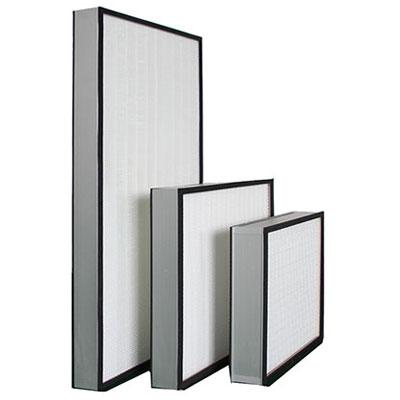
The Engineering Behind Those Tiny Folds
I want to spend a minute on the actual construction because it’s genuinely clever and the engineering details matter more than people realise.
In a traditional deep pleated filter, corrugated aluminium separators hold the folds apart. These separators create channels for air to flow through, but they also take up space. Every centimetre occupied by an aluminium separator is a centimetre that isn’t occupied by filter media.
Mini pleated designs ditch the aluminium separators entirely. Instead, thin beads of hot melt adhesive are applied to the media surface at regular intervals. These beads maintain consistent spacing between the folds without wasting nearly as much space. The result is that you can pack significantly more filter media — sometimes 40% to 60% more — into the same physical footprint.
More media means more surface area. More surface area means lower velocity through each individual section of the filter. Lower velocity means less resistance. And less resistance means your fans don’t have to work as hard to push the required volume of air through the system.
It’s a beautiful chain of cause and effect, and it’s one of the main reasons why people buy mini pleated HEPA filter units over older designs whenever the application allows it.
Where Are These Filters Actually Used?
Mini pleated HEPA filters show up in more places than most people would guess. Here’s where they really earn their keep.
Pharmaceutical manufacturing is one of the biggest markets. Cleanrooms in pharma facilities require terminal HEPA filtration at virtually every air supply point, and many of these facilities have ceiling grids designed around standard filter dimensions. Mini pleated filters slot right into these grids and deliver uniform airflow across the entire clean zone. Drug production demands absolute consistency, and these filters deliver it.
Hospital operating theatres and isolation rooms use mini pleated HEPA filtration to maintain positive or negative pressure environments. In an operating theatre, clean filtered air flows downward over the surgical site, pushing contaminants away from the patient. In an isolation room for infectious diseases, HEPA-filtered exhaust prevents airborne pathogens from escaping into the corridor. Either way, the filter is doing life-or-death work.
Electronics and semiconductor manufacturing operates in cleanrooms that make pharmaceutical facilities look casual. Microchip fabrication requires air cleanliness measured in particles per cubic metre, and even class ISO 3 or ISO 4 environments demand HEPA or ULPA filtration at every air supply point. Mini pleated filters are the standard choice for ceiling-mounted fan filter units in these settings.
Research laboratories of all kinds — university labs, government research facilities, private sector R&D — use mini pleated HEPA filters in biosafety cabinets, fume hoods, and laboratory ventilation systems. Any experiment sensitive to airborne contamination needs this level of filtration.
Food and beverage processing is another area where these filters are quietly essential. Filling lines for bottled water, dairy packaging zones, and bakery production areas all benefit from HEPA-filtered supply air to prevent microbial contamination of products.
The Pressure Drop Advantage Nobody Talks About
Let me get a little technical here because this is one of the most practical reasons to buy mini pleated HEPA filter products over alternatives, and it rarely gets the attention it deserves.
Every filter creates resistance to airflow. This resistance is called pressure drop, and it’s measured in Pascals. A brand new HEPA filter might have an initial pressure drop of 120 to 250 Pascals depending on its design, size, and the airflow rate it’s handling.
As the filter loads up with captured particles over time, the pressure drop climbs. When it reaches the manufacturer’s recommended maximum — typically somewhere around 450 to 600 Pascals — it’s time to replace the filter.
Here’s where mini pleated filters really stand out. Because they pack more media into the same frame size, the air velocity through each square centimetre of media is lower. Lower velocity means lower initial pressure drop. And a lower starting pressure drop means the filter has more room to load up before hitting its maximum. Translation: it lasts longer before needing replacement.
But there’s also an energy cost angle. Your air handling unit’s fans have to overcome the filter’s pressure drop to push the required airflow through. Higher pressure drop equals harder-working fans equals more electricity consumed. Over the life of a filter — which could be one to three years — the energy savings from a lower pressure drop add up to real money. I’ve seen facilities reduce their HVAC energy consumption meaningfully just by switching from deep pleated to mini pleated HEPA filters.
TOPTEC PVT. LTD — Manufacturing Quality Filtration in Pakistan
I want to bring up TOPTEC PVT. LTD here because they represent something that’s genuinely important for the Pakistani laboratory and cleanroom market.
TOPTEC is a Pakistani manufacturer — and I want to emphasise the word manufacturer, not distributor, not reseller, not importer. They actually build laboratory furniture and filtration equipment right here in Pakistan. That distinction matters enormously, and here’s why.
For years, the default assumption among lab managers and procurement officers in Pakistan has been that anything worth having has to come from Europe, the US, or Japan. And while there’s certainly excellent equipment coming out of those regions, importing it comes with a painful list of complications. International shipping costs have gone through the roof in recent years. Customs clearance is unpredictable at best and maddening at worst. Lead times stretch out to three, four, sometimes six months. And if something arrives damaged or doesn’t match the spec you ordered, good luck getting it resolved quickly with a supplier twelve time zones away.
TOPTEC eliminates all of those headaches. When you buy mini pleated HEPA filter units from them, you’re dealing with a local manufacturer who can deliver in a fraction of the time, respond to custom specifications without excessive lead times, and provide after-sales support without you having to send emails at 2 AM to catch someone during their business hours.
More Than Just Filters
What I find particularly compelling about TOPTEC PVT. LTD is that they understand laboratories as complete systems, not just collections of individual components. They manufacture a full range of laboratory furniture and equipment including lab benches, fume hoods, biosafety cabinets, laminar flow cabinets, chemical storage units, and yes, the HEPA filters that go inside many of these products.
This integrated approach matters. When you buy a biosafety cabinet from one company and try to source a replacement HEPA filter from another, you’re gambling on compatibility. Will the dimensions match exactly? Will the gasket seal properly against the housing? Will the airflow characteristics meet the cabinet’s design specifications? Maybe, maybe not.
When you source both from the same manufacturer, compatibility isn’t a gamble — it’s a given. TOPTEC designs their filters to work perfectly with their equipment because they control both sides of the equation. That’s a genuine advantage when you buy mini pleated HEPA filter products as part of a broader laboratory setup.
How to Tell a Real HEPA Filter From a Fake One
This is a topic that genuinely annoys me, because the market is flooded with products that trade on the HEPA name without actually meeting the standard.
You’ll see labels that say “HEPA-type,” “HEPA-style,” “True-HEPA” (which ironically sometimes isn’t), or “99% HEPA.” None of these terms have any regulatory meaning. They’re marketing language designed to make you think you’re getting HEPA performance when you’re often getting something significantly worse.
A real HEPA filter is individually tested and certified under EN 1822 or an equivalent standard. It comes with documentation — a scan or leak test report — that proves it captures at least 99.97% of particles at the most penetrating particle size (MPPS), which is typically around 0.3 microns for H13 class filters, or 99.995% for H14 class.
When you buy mini pleated HEPA filter products from a reputable manufacturer like TOPTEC PVT. LTD, every filter comes with its individual test certificate. If a supplier can’t produce this documentation, that’s a massive red flag, and you should look elsewhere.
Installation: Where Good Filters Go to Die
I wish I didn’t have to write this section, but experience tells me I do. I’ve walked into facilities where someone spent serious money on high-quality HEPA filters and then completely undermined that investment through sloppy installation.
The most common mistake is inadequate gasket compression. A mini pleated HEPA filter typically has a continuous gasket — neoprene, silicone, or polyurethane — running around its entire perimeter. When the filter is clamped into its housing, this gasket needs to compress evenly on all four sides to create an airtight seal. If one side is compressed more than another, or if the gasket doesn’t make full contact somewhere along its length, unfiltered air leaks through the gap.
And here’s the frustrating part — you won’t see the leak. You won’t hear it. You won’t smell it. The only way to know it’s there is to perform a proper integrity test after installation.
DOP (Dioctyl Phthalate) or PAO (Poly-Alpha Olefin) aerosol testing is the standard method. An aerosol is generated upstream of the filter, and a photometer scans the downstream face and all the sealing surfaces. Any spike in particle concentration indicates a leak. This test isn’t optional in regulated environments — it’s mandatory, and for very good reason.
If you’re going to invest the money to buy mini pleated HEPA filter products of genuine quality, please invest the relatively small additional cost of having them properly integrity tested after installation. Otherwise you’re just throwing money away.
Maintaining Your Mini Pleated HEPA Filters
HEPA filters aren’t really maintenance items in the traditional sense. You don’t clean them, you don’t wash them, and you definitely don’t try to vacuum them out and reuse them. The filter media is a dense mat of ultrafine glass fibres arranged in a specific configuration, and any attempt to clean it will damage the media structure and compromise its particle capture efficiency.
What you should be maintaining is everything around the HEPA filter. That means changing your pre-filters on schedule, keeping the air handling system in good working order, monitoring the pressure drop across the HEPA filter, and visually inspecting the gasket and frame during routine checks.
Pre-filtration is especially important and often neglected. Most air handling systems include one or two stages of coarser filtration upstream of the HEPA filter. These pre-filters catch the bigger particles — dust, fibres, pollen — so they don’t clog up the expensive HEPA media prematurely. A pre-filter might cost five to ten percent of what a HEPA filter costs, and changing it regularly can dramatically extend the HEPA filter’s service life.
I’ve personally seen situations where a lab was replacing their HEPA filters every eight months because they were neglecting their pre-filters. Once they started changing pre-filters on a proper schedule, their HEPA filters lasted over two years. Do the maths on that — the savings are substantial.
Knowing When It’s Time to Replace
The question “how long does a HEPA filter last?” doesn’t have a single answer because it depends on so many variables. Air quality in the facility, operating hours of the system, effectiveness of pre-filtration, temperature and humidity conditions — all of these influence filter life.
Rather than guessing or going by the calendar, monitor the pressure drop. Install a differential pressure gauge or manometer across each HEPA filter and check it regularly. When the pressure drop reaches the manufacturer’s recommended maximum for that specific filter, schedule a replacement.
Some facilities set up continuous monitoring with digital pressure transducers connected to their building management system. This gives real-time visibility into filter loading and can even generate automatic alerts when a filter is approaching end of life. If you have the infrastructure for this kind of monitoring, it’s well worth the investment.
And one more thing — don’t push a loaded filter beyond its recommended maximum pressure drop thinking you’ll save money by extending its life a few more months. An overloaded filter restricts airflow, which means your clean zone isn’t getting the air changes it needs. It also puts extra strain on your fans, increasing energy consumption and accelerating wear on fan bearings and motors. The false economy isn’t worth it.
Choosing the Right Filter Class
When you buy mini pleated HEPA filter products, you need to specify the correct efficiency class for your application. This isn’t a one-size-fits-all decision.
Under EN 1822, HEPA filters are classified as H13 or H14. H13 filters capture 99.95% of particles at MPPS, while H14 filters capture 99.995%. For most pharmaceutical, hospital, and general laboratory applications, H13 is perfectly adequate and offers a better balance of efficiency and pressure drop.
H14 filters are typically specified for more critical applications — aseptic filling lines, high-containment labs, certain semiconductor processes — where the extra half-order-of-magnitude improvement in particle capture is genuinely necessary.
Beyond HEPA, there are ULPA (Ultra-Low Penetration Air) filters classified as U15 through U17. These capture 99.9995% to 99.999995% of particles and are reserved for the most demanding cleanroom applications. Most laboratories won’t need ULPA filtration, and specifying it unnecessarily means paying more for filters that are harder to source and create higher pressure drops.
TOPTEC PVT. LTD can advise you on the appropriate filter class for your specific application. Getting this right at the specification stage saves confusion and unnecessary expense down the line.
Custom Sizes and Configurations
One of the realities of working in older facilities — or facilities designed around non-standard equipment — is that filter dimensions don’t always match what’s available off the shelf. Standard sizes like 610mm × 610mm × 78mm or 1220mm × 610mm × 78mm work for many installations, but not all.
This is another area where working with a local manufacturer pays dividends. TOPTEC PVT. LTD can produce mini pleated HEPA filters in custom dimensions tailored to your existing housings. No shimming, no adapter frames, no air gaps around the edges. Just a filter that fits perfectly and seals properly because it was built specifically for your setup.
Try getting a custom-sized HEPA filter from an overseas supplier and you’ll quickly discover that minimum order quantities are high, lead times are long, and the per-unit cost is eye-watering. When you buy mini pleated HEPA filter units locally from TOPTEC, custom sizing is straightforward and doesn’t require you to order a container load to make the numbers work.
Handling and Storage Before Installation
Mini pleated HEPA filters are precision products, not construction materials. They need to be handled and stored with care, and I’ve seen too many filters damaged before they even made it into their housings.
Store filters in their original packaging in a clean, dry area away from direct sunlight. Don’t stack them more than the manufacturer recommends — excessive stacking can compress the gaskets permanently, compromising their ability to seal. Don’t store them on their sides if they’re designed to stand upright.
When moving filters, carry them by the frame, never by the face. The filter media is fragile, and even a moderate impact can create a pinhole that’s invisible to the naked eye but shows up immediately during integrity testing. Use both hands, don’t rush, and if you’re moving multiple filters, use a cart instead of trying to carry a stack.
I know this sounds like common sense, but I’ve personally witnessed filters worth thousands of rupees ruined by someone dropping them or banging them against a doorframe during installation. Five seconds of carelessness, and you need to order a replacement.
Safe Disposal of Used Filters
Used HEPA filters are not ordinary waste. They’ve spent their entire service life collecting particles that might include biological hazards, chemical residues, or other dangerous materials. Treat them accordingly.
In a biosafety environment, used HEPA filters should be decontaminated before removal — typically by in-situ fumigation with formaldehyde or vaporised hydrogen peroxide. For high-containment facilities, bag-in bag-out filter housings allow the used filter to be sealed inside a bag before it’s removed from the housing, preventing any release of captured contaminants into the room.
Even in less hazardous settings, always wear appropriate PPE when changing HEPA filters. Gloves, respiratory protection, and eye protection are the minimum. Bag the used filter immediately after removal and dispose of it according to your facility’s waste management procedures and any applicable local regulations.
If you’re unsure about the right disposal protocol for your situation, TOPTEC PVT. LTD can provide guidance when you buy mini pleated HEPA filter units for containment applications. They understand the full lifecycle of their products, not just the point of sale.
The Economics of Going Local
Let’s talk numbers for a moment, because the financial case for buying locally manufactured HEPA filters is stronger than many people realise.
When you import a mini pleated HEPA filter, the cost on your purchase order is just the beginning. Add international freight charges, which have been volatile and generally trending upward. Add customs duties and import taxes. Add clearing agent fees. Add local transportation from the port to your facility. Add the cost of your procurement team’s time dealing with international documentation, letters of credit, and foreign exchange transactions.
By the time an imported filter is sitting in your warehouse, its landed cost can be 40% to 70% higher than the supplier’s quoted price. And that’s assuming everything goes smoothly — which, in my experience, it often doesn’t.
When you buy mini pleated HEPA filter products from TOPTEC PVT. LTD, the price quoted is much closer to the price you’ll actually pay. No freight surprises, no customs headaches, no forex risk. Just a straightforward transaction between two Pakistani entities in Pakistani rupees.
Regulatory Compliance and Documentation
If your facility operates under GMP, ISO 14644, or any other regulatory framework that governs air quality, documentation isn’t optional — it’s survival. Auditors want to see test certificates for every HEPA filter in your facility. They want installation records, integrity test results, pressure drop monitoring logs, and replacement histories. They want traceability from the filter media all the way through to the finished installed product.
TOPTEC PVT. LTD provides comprehensive documentation with every filter they sell. Individual test certificates, material specifications, performance data, installation guidelines — everything you need to satisfy an auditor’s questions without scrambling to find paperwork at the last minute.
Building a proper documentation trail starts at procurement. When you buy mini pleated HEPA filter products, make sure you’re receiving and filing all the documentation from day one. Don’t leave it for later because later never comes, and then suddenly you’re three days away from an audit and nobody can find the test certificate for the filter in cleanroom number four.
Planning Ahead for Filter Replacements
One thing that catches facilities off guard is the lead time for replacement filters. You’re monitoring your pressure drop, you see it climbing toward the maximum, and suddenly you need a new filter in two weeks. If you’re sourcing internationally, two weeks is a fantasy. Even domestically, manufacturing and delivery take time.
Smart facilities maintain a small buffer stock of replacement filters and reorder when the stock drops below a defined minimum. This ensures you always have filters available when you need them, without tying up excessive capital in inventory.
Working with a local manufacturer like TOPTEC makes this easier because replenishment lead times are measured in days or weeks rather than months. But even so, don’t wait until your last spare filter is in the housing before placing another order. Murphy’s law applies to HEPA filter procurement just as reliably as it applies to everything else.
Building a Complete Laboratory With One Supplier
If you’re in the fortunate position of setting up a new laboratory from scratch, consider the efficiency of working with a single supplier for as much of your fit-out as possible.
TOPTEC PVT. LTD manufactures laboratory benches and workstations, fume hoods and fume cupboards, biosafety cabinets across all classes, laminar flow cabinets for both horizontal and vertical flow, chemical storage cabinets, reagent shelving, and of course, mini pleated HEPA filters for all of the above equipment plus ceiling-mounted terminal installations.
Sourcing all of this from one manufacturer means one set of purchase orders, one delivery schedule, one installation team, one warranty relationship, and guaranteed compatibility across every component. Compare that to juggling five or six different suppliers from three different countries, each with their own lead times, payment terms, and warranty conditions. The administrative burden alone is enough to make the single-supplier approach attractive, even before you consider the technical advantages.
Supporting Pakistan’s Manufacturing Capability
Every time a Pakistani institution chooses to buy mini pleated HEPA filter products from a local manufacturer rather than importing, it sends a signal that domestic manufacturing capability matters. It creates employment, builds technical expertise within the country, and strengthens the supply chain for everyone.
There’s a growing recognition across Pakistan’s pharmaceutical, healthcare, and research sectors that local manufacturers like TOPTEC PVT. LTD are producing equipment that stands up against anything coming from abroad. This isn’t nationalism or sentimentality — it’s a pragmatic assessment based on actual product quality, service responsiveness, and total cost of ownership.
Wrapping Up
Mini pleated HEPA filters aren’t glamorous. Nobody’s going to put one on the cover of a magazine or make a documentary about the exciting world of air filtration. But behind every clean drug product, every successful surgery, every reliable lab result, and every functioning microchip, there’s a HEPA filter quietly doing its job.
Getting the right filter for your application, installing it correctly, testing it after installation, monitoring it throughout its life, and replacing it at the right time — these aren’t complicated steps, but they require attention and commitment. Skip any one of them and the entire filtration system’s integrity is compromised.
If you’re in Pakistan and looking to buy mini pleated HEPA filter products — or any laboratory furniture and equipment — reach out to TOPTEC PVT. LTD. They manufacture right here in the country, they know their products inside and out, and they’ll give you honest technical guidance without the sales pressure. Whether you need a single replacement filter or a complete laboratory fit-out, they’re the kind of partner that makes the process easier rather than harder.
Your air quality is too important to leave to chance. Get it right, and everything else in the lab works better. Get it wrong, and nothing else matters.
