

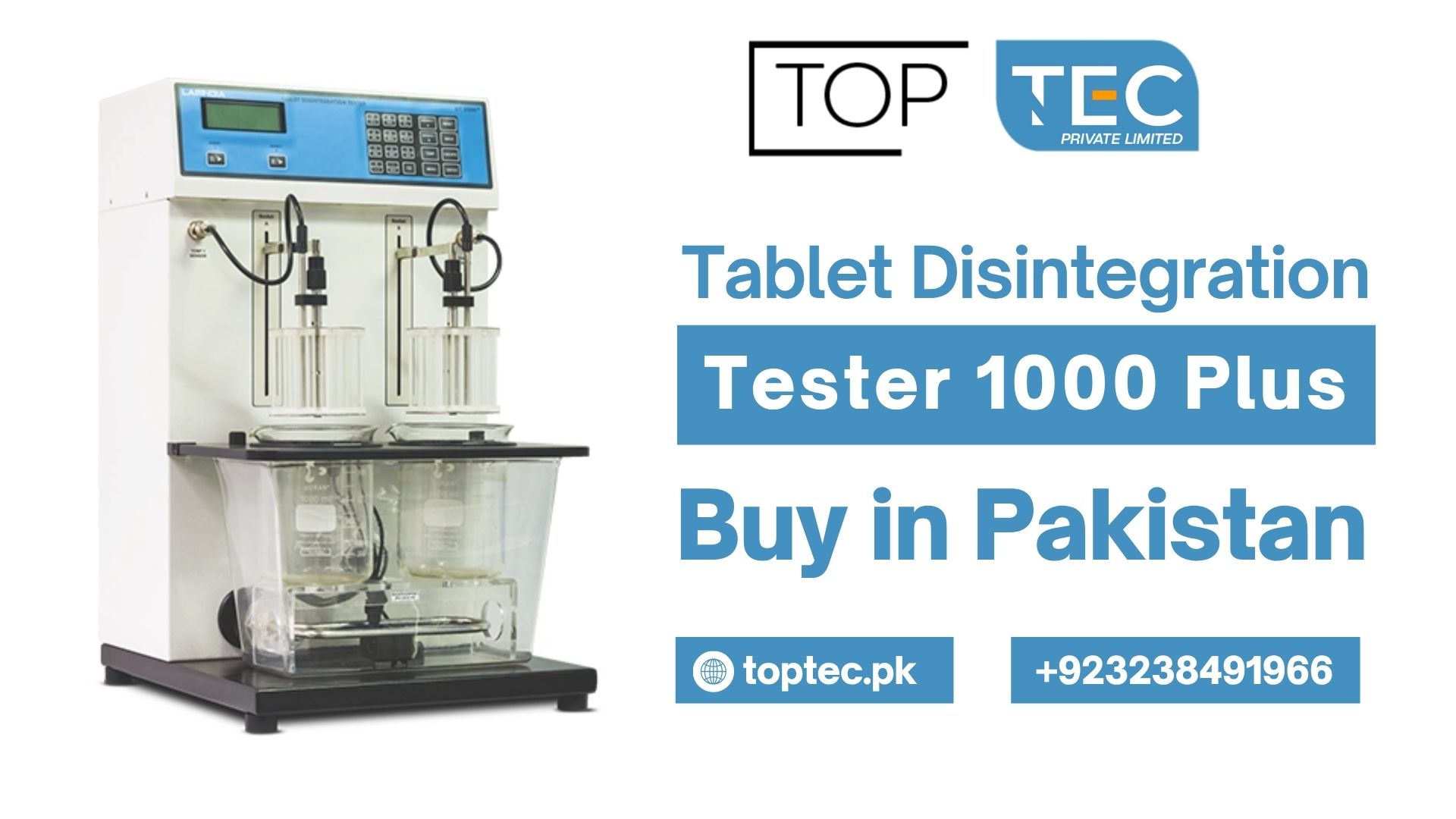
Do you want to buy Tablet Disintegration Tester 1000 Plus? If you’ve landed on this page, you’re probably somewhere in the process of evaluating disintegration testing equipment for your pharmaceutical quality control lab. Maybe you’ve already heard about the LABINDIA DT 1000 Plus and want to know if it’s the right choice. Maybe you’re comparing it against other options and can’t find a clear, unbiased comparison anywhere online. Or maybe you’ve been asked to buy Tablet Disintegration Tester equipment for your facility and you’re trying to make sure you don’t make an expensive mistake.
Whatever brought you here — this guide is going to be genuinely useful. I’ve tried to write this the way a knowledgeable colleague would explain it, not the way a product brochure reads.
We’ll cover what actually matters when comparing disintegration testers, dig into the LABINDIA DT 1000 Plus specifically, look at serious alternative suppliers, talk about what this equipment costs in Pakistan’s market, and — importantly — cover the lab infrastructure side of things, because a good instrument in a poorly designed lab space still gives you problems.
Let’s get into it.
Why Disintegration Testing Matters More Than People Sometimes Realize
Before we compare instruments, let’s spend a moment on why this particular test actually matters.
Tablet disintegration is often considered a basic, almost routine test. And in one sense it is — it’s been a standard pharmacopeial test for decades. But it’s also a critical quality attribute for solid dosage forms. A tablet that doesn’t disintegrate within specification may not dissolve properly, and a tablet that doesn’t dissolve properly may not achieve adequate bioavailability — meaning the patient doesn’t get the intended therapeutic effect.
Regulatory bodies — whether it’s DRAP in Pakistan, the USFDA, EMA, or any other authority — treat disintegration testing seriously. Your data needs to be reliable, reproducible, and generated on qualified, calibrated equipment. That’s why the decision to buy Tablet Disintegration Tester equipment deserves proper attention, not a quick price comparison and an impulse purchase.
Understanding the Pharmacopeial Requirements
The disintegration test for tablets and capsules is described in:
- USP <701> — Disintegration
- BP Appendix XII A — Disintegration test for tablets and capsules
- IP — Indian Pharmacopoeia equivalent
- Ph. Eur. 2.9.1 — Disintegration of tablets and capsules
The basic test apparatus requirements across all these pharmacopeias are essentially the same: a basket-rack assembly with tubes, a specified mesh screen, a water bath maintained at 37°C ± 2°C, and a specified stroke rate (typically 29-32 cycles per minute) and stroke length (53-57mm).
Any instrument you evaluate when looking to buy Tablet Disintegration Tester equipment should meet these specifications. But meeting minimum pharmacopeial specifications is the floor, not the ceiling — the real differentiators are in features, build quality, software, documentation, and support.
LABINDIA DT 1000 Plus: A Detailed Look
LABINDIA Instruments is an Indian manufacturer that has established a solid presence in South Asian pharmaceutical markets, including Pakistan. The DT 1000 Plus is their flagship disintegration tester and is genuinely worth understanding in detail.
What the DT 1000 Plus Actually Is
The DT 1000 Plus is a dual-station disintegration tester — meaning it runs two sets of baskets simultaneously, allowing you to test two batches (or the same batch in duplicate) at the same time.
Key Specifications:
- Number of stations: 2 (6 tubes per station, standard)
- Temperature range: Ambient to 50°C
- Temperature accuracy: ±0.5°C
- Stroke rate: 29-32 DPM (adjustable)
- Stroke length: 53-57mm (adjustable per pharmacopeia)
- Display: Digital LCD
- Compliance: USP, BP, IP, Ph. Eur.
- Timer: Individual timers per station, programmable
- Water bath: Transparent for easy observation
What People Actually Like About It
Dual station operation is genuinely valuable in a busy QC lab. Being able to run two tests simultaneously doubles throughput on what can otherwise be a bottleneck test. When you have multiple product lines all needing disintegration testing every day, this matters.
Temperature stability on the DT 1000 Plus is generally well-regarded. The water bath maintains 37°C consistently across the basket positions, which is important because temperature variation across the bath can give you variable results.
Build quality is reasonable for the price point. The basket assemblies are stainless steel and the machine feels solid. It’s not the most elegant instrument in the world, but it’s functional and serviceable.
Spare parts availability in Pakistan is decent because of the established India-Pakistan trade channel for pharmaceutical equipment. When you need a replacement basket assembly or motor component, you can usually get it reasonably quickly.
Where the DT 1000 Plus Has Limitations
Software integration is basic compared to some European competitors. If you’re running a 21 CFR Part 11-compliant operation and need full audit trails, electronic signatures, and user access controls in your disintegration software, the DT 1000 Plus may not provide this out of the box.
Documentation for validation — while LABINDIA can provide IQ/OQ documentation, it’s not always as comprehensive as what you’d get from a Pharmatest, Sotax, or Erweka instrument. This can mean more work for your validation team.
Long-term reliability — this varies and is honestly the most common criticism you hear from users over time. Some labs report very few issues over years of use; others have had more maintenance challenges. This may partly be a function of how well the instrument is maintained and how reliably the local service support responds.
Alternative Suppliers Worth Considering
LABINDIA is a legitimate option, but it’s far from the only one. When you’re making the decision to buy Tablet Disintegration Tester equipment for a serious pharmaceutical QC operation, here are the other manufacturers worth evaluating.
1. Pharmatest (Germany)
Pharmatest is a German manufacturer with a long reputation in pharmaceutical testing equipment. Their disintegration testers — particularly the PTZ-S and PTZ-Auto series — are considered reference-standard instruments.
Strengths:
- Exceptional build quality and long operational life
- Comprehensive documentation packages for GMP validation
- 21 CFR Part 11-compatible software options
- Established global service network
- Highly accurate temperature control and stroke specifications
Weaknesses:
- Significantly higher price point — expect to pay 3-5x what you’d pay for a LABINDIA unit
- Longer lead times for Pakistan delivery
- Local service support in Pakistan is less immediate than Indian-made equipment
Best for: FDA-inspected facilities, export-oriented manufacturers, labs where validation documentation is critically important
2. Erweka (Germany)
Another German manufacturer with a strong global presence. Erweka’s ZT series disintegration testers are widely used in European and international pharmaceutical operations.
Strengths:
- Very good software with 21 CFR Part 11 compliance
- Automatic endpoint detection options (video monitoring of disintegration endpoint)
- Excellent temperature uniformity
- Good regulatory acceptance history globally
Weaknesses:
- Import pricing in Pakistan makes these expensive
- Service support requires coordination with regional distributor
Best for: Automated testing environments, facilities with high testing volumes needing automatic endpoint detection
3. Sotax (Switzerland)
Sotax is a Swiss company that has built a strong reputation particularly in dissolution testing, but their disintegration testers are equally well-regarded.
Strengths:
- Swiss engineering quality
- Integrated system options (dissolution and disintegration on one platform)
- Strong regulatory compliance documentation
- Good global support network
Weaknesses:
- Premium pricing
- Relatively limited local presence in Pakistan
Best for: Labs that want integrated dissolution-disintegration workflow, high-end research facilities
4. Campbell Electronics (India)
Campbell is an Indian manufacturer that’s been in the pharmaceutical instrument space for many years. They’re generally considered a tier below LABINDIA in terms of features and documentation but are priced accordingly.
Strengths:
- Very competitive pricing
- Reasonable spare parts availability in Pakistan
- Meets basic pharmacopeial requirements
Weaknesses:
- Limited software features
- Less comprehensive validation documentation
- Build quality is functional but not impressive
Best for: Budget-constrained labs with basic testing needs, teaching institutions
5. Electrolab (India)
Electrolab is another Indian manufacturer worth mentioning. Their EDT-08LX and similar models have gained traction in Pakistani pharmaceutical labs.
Strengths:
- Competitive pricing similar to LABINDIA
- Decent build quality
- Good availability and support in Pakistan through distributors
- Some models offer better software features than comparable LABINDIA units
Weaknesses:
- Still lags behind European manufacturers on validation documentation quality
- Software compliance features vary by model
Best for: Mid-tier pharmaceutical companies, generics manufacturers with standard regulatory requirements
Direct Comparison Table: LABINDIA DT 1000 Plus vs. Key Competitors
| Feature | LABINDIA DT 1000 Plus | Pharmatest PTZ-S | Erweka ZT 722 | Electrolab EDT-08LX |
|---|---|---|---|---|
| Stations | 2 | 1 or 2 | 1 or 2 | 1 or 2 |
| Temperature Accuracy | ±0.5°C | ±0.1°C | ±0.2°C | ±0.5°C |
| Software/21 CFR Pt 11 | Basic/Limited | Full compliance | Full compliance | Limited |
| Validation Docs | Moderate | Comprehensive | Comprehensive | Basic |
| Auto Endpoint Detection | No | Optional | Optional | No |
| Local Pakistan Support | Good | Limited | Limited | Good |
| Approximate PKR Price | 350K–650K | 1.5M–3M | 1.8M–3.5M | 300K–550K |
| Build Quality | Good | Excellent | Excellent | Good |
| Regulatory Acceptance | DRAP/WHO | FDA/EMA/DRAP | FDA/EMA/DRAP | DRAP/WHO |
Prices are approximate and subject to market conditions. Always obtain current quotations.

What to Actually Evaluate When You Buy Tablet Disintegration Tester Equipment
This is the part that most buying guides skip. They give you spec sheets and prices but don’t tell you what questions to actually ask. Here’s my list:
Question 1: What Are Your Regulatory Requirements?
If your facility is FDA-inspected or EU GMP-certified, the documentation and software requirements are significantly higher than if you’re operating under DRAP requirements for domestic Pakistani market supply. Be honest with yourself about this — buying an entry-level instrument for an FDA-inspected facility is going to create problems.
Question 2: What Pharmacopeias Do Your Methods Use?
Most instruments claim multi-pharmacopeia compliance, but verify this specifically for the stroke rate and stroke length settings your methods require. Some instruments are more straightforward than others when switching between USP and BP stroke specifications.
Question 3: What Is Your Testing Volume?
If you’re running dozens of disintegration tests per day across multiple products, a dual-station unit like the DT 1000 Plus makes more sense than a single-station instrument. If you only run a few tests per week, a single-station unit might be perfectly adequate.
Question 4: Who Services the Instrument Locally?
Before you buy Tablet Disintegration Tester equipment, find out specifically who services it in your city. Get a name, not just a company. Call them and ask how quickly they can respond to a service call. Ask about spare parts availability and typical lead times for common replacement items.
Question 5: What Does the Validation Package Look Like?
Ask for sample IQ/OQ documentation before you commit to purchase. Review it against your internal validation requirements. Is it complete enough to use as-is, or will your team need to develop significant additional protocols? Time spent on validation documentation has a real cost.
Question 6: How Is Temperature Calibrated and Verified?
Temperature accuracy is critical for disintegration testing. Ask specifically: how is the temperature sensor calibrated? How is temperature uniformity across the bath verified? Is there a temperature mapping protocol in the OQ documentation?
Question 7: What Is the Warranty and What Does It Cover?
Not all warranties are the same. A one-year warranty that requires you to ship the instrument to the manufacturer for repair is essentially no warranty for a Pakistani buyer. A warranty backed by local service engineers who will come to your lab is worth substantially more.
Pricing in Pakistan’s Market: What to Realistically Budget
When labs in Pakistan need to buy Tablet Disintegration Tester equipment, the market presents a fairly wide range of options at different price points. Here’s a realistic breakdown:
Budget Tier (PKR 200,000 – 400,000)
Entry-level Indian-manufactured units, basic digital control, mechanical timer, single station. Meets minimum pharmacopeial requirements. Suitable for teaching labs or very low-volume QC operations.
Mid-Tier (PKR 400,000 – 800,000)
This is where the LABINDIA DT 1000 Plus and Electrolab comparable models sit. Dual station, better temperature control, basic software, adequate for most Pakistani pharmaceutical QC environments. Suitable for generics manufacturers supplying domestic market.
Upper Mid-Tier (PKR 800,000 – 1,500,000)
Better-specification instruments with improved software, some 21 CFR Part 11 features, better validation documentation. Imported units from established manufacturers. Suitable for export-oriented manufacturers with some regulatory inspection history.
Premium Tier (PKR 1,500,000 – 4,000,000+)
European manufacturers — Pharmatest, Erweka, Sotax. Full regulatory compliance features, comprehensive validation documentation, automatic endpoint detection options. Suitable for FDA-inspected facilities and international GMP-certified operations.
Common Problems with Disintegration Testers — And How to Avoid Them
Even if you buy Tablet Disintegration Tester equipment that’s well-specified for your needs, problems can arise. Here are the most common ones and how to prevent them.
Problem: Temperature Instability
Cause: Most commonly caused by using tap water with high mineral content in the bath. Scale buildup on the heating element reduces efficiency and causes temperature fluctuations.
Prevention: Use purified water (distilled or deionized) in the water bath. Descale the bath regularly. Calibrate the temperature sensor quarterly.
Problem: Inconsistent Stroke Rate
Cause: Motor wear over time, or mechanical issues with the drive mechanism.
Prevention: Regular preventive maintenance. Check stroke rate with a calibrated tachometer/stopwatch at each OQ and during routine calibration.
Problem: Basket Corrosion or Distortion
Cause: Using inappropriate cleaning agents, mechanical damage, or poor quality stainless steel.
Prevention: Clean baskets with mild detergent and purified water. Avoid aggressive acids or alkalis. Inspect baskets for distortion at each use.
Problem: Water Bath Contamination
Cause: Tablet fragments and excipients accumulating in the bath over time.
Prevention: Drain and clean the water bath frequently. Use a fine mesh strainer to catch debris. Change water regularly.
Problem: False Pass Results
Cause: Disks not properly weighted, mesh damage, or incorrect basket positioning.
Prevention: Inspect disks and mesh before each test. Verify basket positioning meets pharmacopeial specifications. Include a known pass and fail reference standard in your system suitability protocol.
Setting Up Your Disintegration Testing Area: Infrastructure Matters
Here’s something that often gets overlooked in buying guides like this one — the environment in which you operate your disintegration tester matters for result quality and instrument longevity.
When pharmaceutical labs decide to buy Tablet Disintegration Tester equipment, they often focus entirely on the instrument and forget about the workspace design. But a poorly designed QC lab bench can affect test reproducibility, create ergonomic problems for analysts running multiple tests, and shorten instrument life.
This is where TOPTEC PVT. LTD becomes directly relevant to your equipment purchase decision.
TOPTEC PVT. LTD: Pakistan’s Manufacturer for Laboratory Furniture and QC Lab Infrastructure
TOPTEC PVT. LTD is a Pakistani manufacturer — genuinely manufacturing, not importing and reselling — of laboratory furniture and lab infrastructure solutions. For pharmaceutical QC labs specifically, TOPTEC offers products that directly support the kind of environment where instruments like disintegration testers perform reliably and analysts work safely and efficiently.
Why Lab Furniture Matters for Disintegration Testing Specifically
Vibration Isolation
Disintegration testers have an internal drive mechanism that creates some vibration. But they’re also sensitive to external vibration from other equipment sharing the same bench. A heavy-duty, properly constructed bench designed for laboratory use provides better isolation and stability than a standard table or an imported flat-pack bench.
TOPTEC’s laboratory workbenches are built with structural steel frames and appropriate surface materials — designed for the loads and conditions of a pharmaceutical QC environment, not a home office.
Surface Material
Disintegration testing involves water baths, buffer solutions, and occasional chemical exposure. Bench surfaces need to be water-resistant and easy to clean. TOPTEC offers chemical-resistant laminate and phenolic resin surface options appropriate for this environment.
Ergonomics for Repetitive Testing
Analysts running disintegration tests repeatedly throughout the day need a workspace at the right height, with clear sight lines to the water bath window, and with adequate space to handle multiple test sets without awkward reaching. TOPTEC can customize bench height and configuration to your specific team requirements.
Storage Integration
QC labs need organized storage for basket assemblies, reference standards, documentation, and consumables. TOPTEC integrates under-bench storage, overhead shelving, and drawer units into their bench designs — creating an organized, efficient workspace rather than a cluttered surface with equipment balanced precariously.
What TOPTEC Manufactures for Pharmaceutical QC Labs:
Laboratory Workbenches
Steel-framed, chemical-resistant surfaces, available in custom dimensions. Standard and heavy-duty options depending on equipment load requirements.
QC Testing Benches
Specifically configured for pharmaceutical QC equipment — disintegration testers, dissolution apparatus, hardness testers, friability testers. Proper cable management, surface finish, and structural support.
Reagent and Chemical Storage Cabinets
Secure, ventilated storage for reference standards, reagents, and controlled substances used in QC testing.
Fume Hoods
For QC operations involving volatile solvents in sample preparation.
Sink Units and Preparation Areas
For water bath filling, glassware cleaning, and buffer preparation areas adjacent to testing zones.
Document Storage and Laboratory Furniture
Filing systems, logbook storage, and document control furniture appropriate for a GMP document management environment.
Custom Fabrication
If your QC lab has unusual dimensions, specific layout requirements, or non-standard equipment combinations, TOPTEC can design and fabricate accordingly. You’re dealing with the manufacturer directly — not working through a distributor who has to relay your requirements to a factory somewhere else.
The Practical Advantage of Local Manufacturing
When you’re simultaneously planning to buy Tablet Disintegration Tester equipment and set up the QC lab space to house it, coordinating both on similar timelines is important. Importing laboratory furniture carries the same lead time problems as importing instruments — weeks of shipping, customs clearance, and inland delivery.
TOPTEC manufactures in Pakistan. Standard items can be delivered in weeks, not months. Custom fabrications are achievable on realistic project timelines. And if something needs adjustment after delivery — a shelf at the wrong height, an additional power outlet integrated into the bench — you’re talking to the people who built it, not a distributor who has to check with the manufacturer in another country.
Building a Complete Pharmaceutical QC Lab: Integrated Planning
Let me walk through what a well-designed disintegration testing area actually needs, combining both instrument and infrastructure considerations.
The Testing Zone
Your disintegration tester (or testers, if you have multiple) should be positioned on a dedicated testing bench with:
- Adequate bench depth (minimum 75cm, preferably 90cm for dual-station units)
- Water supply access nearby for bath filling (or a fixed plumbed connection)
- Adequate drainage for bath emptying
- Electrical outlets at bench level — not extension cords running across the floor
- Good lighting — you need to clearly observe the basket during testing
- Temperature-controlled environment — the room temperature affects the water bath’s ability to maintain 37°C; aim for 22-25°C ambient
The Preparation Area
Adjacent to testing, you need space for:
- Buffer preparation (pH meter, magnetic stirrer, volumetric equipment)
- Basket cleaning and drying
- Reference standard preparation
- Sample weighing (isolated from vibration as much as possible)
Documentation Area
In a GMP environment, results are recorded contemporaneously. Your analyst needs:
- Adequate bench space for worksheets, logbooks, and calculator/computer
- Clear visibility from documentation area to testing equipment
- Access to calibration records and SOPs (physical or electronic)
Storage
Immediately accessible from the testing area:
- Basket assembly storage (clean, dry, organized by specification)
- Reference standards storage (secure, temperature-appropriate)
- Consumables (purified water containers, cleaning supplies)
- Maintenance tools and spare parts
TOPTEC can design a complete QC lab zone incorporating all of these elements into a coherent, efficient layout. If you’re setting up a new QC lab, having this conversation with TOPTEC at the same time as your instrument procurement is exactly the right approach.
Qualification Requirements for Disintegration Testers in Pakistan
For pharmaceutical manufacturers in Pakistan operating under DRAP GMP requirements, your disintegration tester needs to be properly qualified and calibrated.
Installation Qualification (IQ)
Verify that:
- The instrument is correctly installed per manufacturer requirements
- Electrical connections are correct and safe
- Environmental conditions at installation site are appropriate
- All components are present and undamaged
- Serial numbers and model numbers match purchase documentation
Operational Qualification (OQ)
Verify that:
- Temperature accuracy and stability meet specification (typically ±0.5°C or better)
- Temperature uniformity across the bath and at basket position
- Stroke rate meets pharmacopeial specification (typically 29-32 DPM)
- Stroke length meets specification (typically 53-57mm)
- Timer accuracy
- Interlock and alarm functions (if present)
Performance Qualification (PQ)
Verify that:
- The instrument consistently delivers acceptable results using a reference disintegration standard
- Inter-operator reproducibility is acceptable
- The instrument performs to specification over time
Ongoing Calibration
After initial qualification, calibration verification should be performed:
- Temperature: Before each use (check) and formal calibration quarterly or per your internal SOPs
- Stroke rate: Quarterly or per SOP
- Stroke length: Quarterly or per SOP
- Full OQ-level requalification: Annually or after any significant repair or relocation
Maintain all calibration records in your instrument qualification file. These will be reviewed during DRAP inspections and any other regulatory audits your facility undergoes.
Making the Final Decision: A Framework
Let me give you a practical decision framework for choosing where to buy Tablet Disintegration Tester equipment for your specific situation.
If you’re a domestic-market generics manufacturer in Pakistan:
LABINDIA DT 1000 Plus or Electrolab equivalent is probably your best value choice. Good enough for DRAP compliance, reasonable local support, manageable price point.
If you’re an export-oriented manufacturer with WHO-GMP certification:
Consider stepping up to a better-documented instrument. Pharmatest or Erweka may be justified by the regulatory inspection risk reduction they provide in terms of validation documentation quality.
If you’re FDA-inspected or EU GMP certified:
Seriously evaluate Pharmatest or Erweka with full 21 CFR Part 11 software. The additional upfront investment is small compared to the cost of an observation during an FDA inspection.
If you’re a teaching institution or research lab:
Budget-tier Indian manufacturers are probably fine. You’re not running regulated product testing; you need functional, pharmacopeially compliant equipment at a price that fits an educational institution’s budget.
If you’re a contract testing organization:
This depends entirely on who your clients are and what regulatory environments their products need to meet. Match your instrument capability to your client base.
Where to Buy: Practical Sourcing Advice for Pakistan
When you’re ready to buy Tablet Disintegration Tester equipment in Pakistan, here are your practical sourcing channels:
Authorized Local Distributors
For LABINDIA, Electrolab, and other Indian manufacturers, there are established Pakistani distributors with offices in Karachi, Lahore, and Islamabad. These are your best choice for after-sales support and spare parts.
Direct Import
For European manufacturers, you may need to work with a regional distributor (often based in UAE or Singapore for this part of the world) and arrange direct importation. This requires experience with the import process and is generally only cost-effective for higher-value purchases.
Pharmaceutical Equipment Dealers
There are pharmaceutical equipment trading companies in Pakistan’s major cities that carry multiple brands. Useful for comparison shopping, though verify their after-sales support capability carefully.
Caution with Online Marketplaces
Be careful about purchasing calibrated, GMP-relevant analytical instruments through general online marketplaces. Authenticity, warranty validity, and after-sales support are all potentially compromised. For instruments used in pharmaceutical product release testing, this is not the place to cut corners.
Final Thoughts
The decision to buy Tablet Disintegration Tester equipment is more nuanced than it might initially seem. It’s not just about meeting a pharmacopeial specification — it’s about choosing an instrument that fits your regulatory environment, your testing volume, your validation capability, and your ongoing support needs.
LABINDIA DT 1000 Plus is a legitimate, capable instrument for a broad range of Pakistani pharmaceutical QC applications. But it’s not the only option, and for some facilities, it’s genuinely not the right one. Take the time to evaluate alternatives against the criteria that actually matter for your specific situation.
And don’t forget the infrastructure side of this. A well-designed QC lab workspace — proper benching, organized storage, appropriate surfaces, good ergonomics — is what allows your instruments to perform at their best and your analysts to do their jobs properly. TOPTEC PVT. LTD manufactures exactly this kind of laboratory furniture in Pakistan, with the practical advantages of local manufacturing: realistic lead times, PKR pricing, customization capability, and local support.
Whether you’re equipping a new QC lab from scratch or upgrading an existing facility, getting both the instrument and the infrastructure right from the beginning saves time, money, and regulatory headaches down the road.
If you’re ready to buy Tablet Disintegration Tester equipment and need laboratory furniture to go with it — reach out to TOPTEC PVT. LTD and discuss your requirements with a team that understands Pakistan’s pharmaceutical laboratory environment.
Contact TOPTEC PVT. LTD
TOPTEC PVT. LTD is a Pakistan-based manufacturer of high-quality laboratory furniture and lab infrastructure solutions for pharmaceutical, research, and industrial laboratory environments. Products include laboratory workbenches, fume hoods, QC testing benches, storage cabinets, sink units, and complete laboratory fit-out solutions — all manufactured locally in Pakistan.
Contact TOPTEC to discuss your QC lab infrastructure requirements and receive a customized quotation based on your specific layout and application needs.
