


Biological Safety Cabinet vs. Fume Hood: I’ve seen it happen more times than I’d like to admit. A lab manager orders a fume hood thinking it will protect their team from biological hazards. Or worse, someone tries to handle volatile chemicals inside a biological safety cabinet and creates a genuinely dangerous situation.
These two pieces of equipment look somewhat similar to the untrained eye. They’re both large, boxy enclosures where people do lab work. They both have some kind of air filtration or ventilation. And they’re both expensive enough that you really don’t want to buy the wrong one.
But here’s the thing — they are fundamentally different machines designed for fundamentally different purposes. Mixing them up isn’t just a procurement error. It’s a safety hazard.
So whether you’re setting up a new lab, upgrading an existing one, or simply trying to understand what equipment your facility actually needs, this article will give you a clear and honest breakdown. And if you’re in Pakistan looking to buy Biological Safety Cabinet units or fume hoods that are manufactured locally to international standards, I’ll point you in the right direction too.
Let’s get into it.
Starting With the Basics — What Does Each One Actually Do?
Biological Safety Cabinet (BSC)
A Biological Safety Cabinet is a ventilated enclosure designed to protect three things simultaneously:
- The operator — from exposure to infectious or hazardous biological agents
- The product/sample — from environmental contamination
- The laboratory environment — from release of biohazardous material
It achieves this through carefully engineered HEPA-filtered airflow patterns. Air is drawn inward through the front opening (protecting the operator), passes through HEPA filters (cleaning it), and recirculates within the cabinet in a laminar flow pattern (protecting the sample). Exhaust air is also HEPA-filtered before being released back into the room or ducted outside.
The key word here is containment — biological containment.
Fume Hood (Chemical Fume Hood)
A fume hood, on the other hand, is designed primarily to protect the operator from chemical fumes, vapors, and gases. It works by drawing air from the lab into the hood and then exhausting it outside the building through ductwork.
There’s no HEPA filtration in a standard fume hood. There’s no recirculation. The air goes in one direction — away from the user and out of the building. That’s it. The sample inside receives no protection from contamination. The environment outside the building receives whatever the hood exhausts (though some setups include scrubbers or carbon filters).
The key word here is ventilation — chemical ventilation.
See the difference already? One is about biological containment with filtered air. The other is about chemical ventilation through exhaust. They solve completely different problems.
A Side-by-Side Comparison That Actually Makes Sense
Let me lay this out in plain terms, category by category.
Protection Type
| Feature | Biological Safety Cabinet | Chemical Fume Hood |
|---|---|---|
| Protects the operator | Yes | Yes |
| Protects the sample/product | Yes (Class II and III) | No |
| Protects the environment | Yes (HEPA-filtered exhaust) | Partially (exhausted outside) |
| Handles biological hazards | Yes — this is its primary purpose | No |
| Handles chemical hazards | Limited (some chemical-resistant models) | Yes — this is its primary purpose |
| Handles radioactive materials | Only specific models with proper ducting | Some specialized models |
Airflow Design
Biological Safety Cabinet: Uses a combination of inflow air (drawn in from the room through the front opening) and downflow air (HEPA-filtered air flowing vertically downward over the work surface). This creates a “curtain” of clean air that protects both the user and the sample. Air is filtered through HEPA before recirculation or exhaust.
Fume Hood: Uses a single-direction airflow. Room air enters through the front sash opening and sweeps across the work surface, carrying fumes and vapors toward the back and up through the exhaust duct. There’s no filtration — just dilution and removal.
Filtration
BSC: HEPA filters rated at 99.99% efficiency for particles 0.3 microns and larger. Some models have dual HEPA filters (supply and exhaust). This is what makes them effective against bacteria, viruses, fungi, and spores.
Fume Hood: No HEPA filtration in standard models. Some ductless fume hoods use activated carbon or other chemical-specific filters, but these are for chemical vapors — not biological particles.
Noise Level
Biological safety cabinets tend to be quieter than ducted fume hoods because their blowers are typically smaller and the air volumes lower. However, this varies by model and manufacturer.
Energy Consumption
Fume hoods are generally more energy-intensive because they continuously exhaust conditioned room air to the outside. This means your HVAC system has to work harder to replace that air. Biological safety cabinets that recirculate most of their air (like Class II Type A2) are more energy-efficient in comparison.
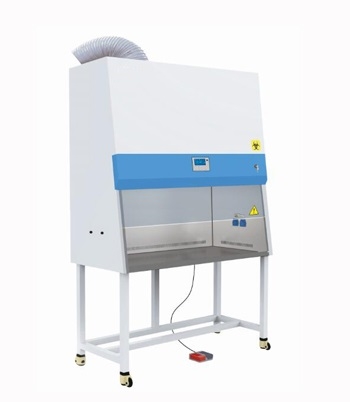
Classes of Biological Safety Cabinets — Know What You’re Buying
If you’re going to buy Biological Safety Cabinet equipment, you need to understand the classification system. This isn’t just academic — it directly affects what work you can safely perform.
Class I
- Provides operator and environmental protection
- Does NOT provide product protection
- Air flows inward through the front opening and exhausts through a HEPA filter
- Rarely used today — mostly replaced by Class II
Class II (Most Common)
This is the workhorse of modern microbiology, cell culture, and pharmaceutical labs. Class II cabinets are further divided into types:
Type A1
- 70% air recirculated, 30% exhausted
- Minimum inflow velocity of 75 fpm (feet per minute)
- Suitable for work with low to moderate risk biological agents
- Cannot be used with volatile chemicals
Type A2 (Most Popular)
- Similar to A1 but with higher inflow velocity (100 fpm)
- Can handle minute quantities of volatile chemicals if properly ducted
- This is what most labs need and what most people mean when they say they want to buy Biological Safety Cabinet units
- Provides operator, product, and environmental protection
Type B1
- 30% recirculated, 70% exhausted through hard duct
- Can handle small quantities of volatile chemicals
- Requires dedicated exhaust system
Type B2 (Total Exhaust)
- 100% of air is exhausted — nothing recirculated
- Can handle volatile chemicals and radionuclides
- Requires a dedicated, powerful exhaust system
- Most expensive to install and operate
Class III (Glove Box)
- Completely sealed, gas-tight enclosure
- Operator works through attached gloves
- Maximum containment for the most dangerous pathogens (BSL-4)
- Supply and exhaust air both HEPA-filtered (double filtration on exhaust)
- Rarely needed outside specialized government or military research facilities
For the vast majority of labs in Pakistan — whether pharmaceutical, clinical, academic, or research — Class II Type A2 is the right choice. It’s versatile, effective, and cost-efficient.
Types of Fume Hoods — A Quick Overview
Since we’re comparing, let’s also cover the basic fume hood types:
Conventional (Ducted) Fume Hood
The standard model. Connected to an exhaust duct that sends fumes outside the building. Requires building infrastructure (ductwork, roof penetration, exhaust fan).
Ductless (Recirculating) Fume Hood
Uses activated carbon or other chemical filters to clean the air and recirculate it back into the room. No ductwork needed. However, filters must be matched to the specific chemicals being used, and they need regular replacement.
Acid Digestion Hood
Built with acid-resistant materials for handling concentrated acids and corrosive chemicals. Usually has specialized ventilation rates.
Perchloric Acid Hood
Specialized hood with a wash-down system to prevent buildup of explosive perchloric acid residues.
Radioisotope Hood
Designed for work with radioactive materials. Features seamless interiors and specialized disposal systems.
When to Buy a Biological Safety Cabinet vs. a Fume Hood
This is the practical decision most lab managers face. Here’s my honest guidance:
You Need a Biological Safety Cabinet If:
- You work with infectious microorganisms (bacteria, viruses, fungi, parasites)
- You perform cell culture and need to protect samples from contamination
- You handle human blood, tissue, or body fluids
- Your work involves recombinant DNA
- You’re operating at Biosafety Level 2 (BSL-2) or higher
- Regulatory guidelines (WHO, NIH, CDC) require biological containment
- You need to protect both the operator AND the product simultaneously
You Need a Fume Hood If:
- You work with volatile organic solvents
- You handle concentrated acids or bases
- Your procedures generate chemical fumes or vapors
- You’re doing chemical synthesis or analysis
- You work with formaldehyde, xylene, or similar hazardous chemicals
- You need to prevent chemical exposure but don’t need sample protection
You Might Need Both If:
- Your lab performs both microbiological work AND chemical analysis
- Different departments or research groups have different hazard profiles
- You handle biological specimens that require chemical fixation or staining
The critical mistake — and I really want to emphasize this — is using a fume hood for biological work. A standard fume hood provides zero biological containment. The air isn’t filtered. Microorganisms can escape through the exhaust. And the sample receives no protection from contamination.
Similarly, using a standard biological safety cabinet for work with significant quantities of volatile chemicals is dangerous. Most BSCs recirculate air back into the room. If that air contains chemical vapors, you’re exposing everyone in the lab.
What Happens When People Get This Wrong
Let me share a few scenarios I’ve either witnessed or heard about from colleagues:
Scenario 1: A university lab was culturing pathogenic bacteria inside a chemical fume hood because their BSC was broken and they “needed to keep the project going.” The fume hood exhausted unfiltered air containing aerosolized bacteria directly to the building’s exterior — right next to an air intake vent for the adjacent building. They got lucky that nobody got sick.
Scenario 2: A pharmaceutical quality control lab was using a Class II BSC to handle a chemical solvent during a dissolution test. The solvent vapors were recirculated by the cabinet’s HEPA system and released into the room. Three analysts reported headaches and dizziness before someone figured out what was happening.
Scenario 3: A clinical lab purchased a laminar flow hood (which provides product protection but NOT operator protection) thinking it was a biological safety cabinet. Technicians processed potentially infectious patient samples in it for months before an audit caught the error.
These aren’t hypothetical situations. They happen because people don’t understand the differences. And they’re entirely preventable.
TOPTEC PVT. LTD — Your Local Source for Lab Safety Equipment in Pakistan
Now let’s talk about where to actually get this equipment if you’re based in Pakistan.
TOPTEC PVT. LTD is a Pakistani manufacturer of laboratory furniture and equipment. They design and build their products locally, which gives them several advantages over imported alternatives.
Why Buy from TOPTEC?
Local Manufacturing
Everything is built in Pakistan. This means shorter lead times, no customs delays, no international shipping costs, and no currency fluctuation headaches. When you buy Biological Safety Cabinet units from TOPTEC, you’re getting equipment manufactured to international standards without the import markup.
Customization Options
Different labs have different space constraints, electrical configurations, and workflow requirements. TOPTEC can customize dimensions, materials, and features to fit your specific setup. Try getting that kind of flexibility from an overseas manufacturer.
Technical Support You Can Actually Reach
When something needs servicing, calibrating, or repairing, you want a team that can actually show up at your facility. TOPTEC provides after-sales support within Pakistan — no waiting for an international service engineer or shipping parts across continents.
Competitive Pricing
Let’s be honest — budgets matter. Especially for universities, government labs, and smaller pharmaceutical companies. When you buy Biological Safety Cabinet equipment from a local manufacturer, you avoid the layers of cost that come with importing — freight, duties, agents, and margin stacking.
Quality Construction
TOPTEC uses stainless steel interiors, certified HEPA filters, reliable blower motors, and proper electrical components. The build quality holds up to daily use in real laboratory environments.
What Else Does TOPTEC Manufacture?
Beyond biological safety cabinets and fume hoods, TOPTEC offers a full range of laboratory furniture:
- Laboratory Workbenches — with various countertop materials (epoxy resin, stainless steel, phenolic resin, chemical-resistant laminate)
- Laboratory Storage Cabinets — for chemicals, acids, flammables, and general storage
- Pass Boxes — static and dynamic models for cleanroom material transfer
- Laminar Flow Hoods — horizontal and vertical airflow models
- Laboratory Sinks and Fixtures
- Anti-Vibration Tables — for sensitive analytical instruments
- Cleanroom Furniture — stainless steel tables, trolleys, chairs
- Steel Shelving and Racking Systems
- ESD Workstations — for electronics and sensitive equipment handling
If you’re building out a new lab or renovating an existing one, being able to source everything from a single local manufacturer simplifies procurement enormously.
Key Specifications to Check When You Buy Biological Safety Cabinet Units
Alright, let’s get practical. Here’s what to look at and ask about before you make a purchase:
1. HEPA Filter Certification
The HEPA filters should be individually tested and certified. Ask for the test certificate. Filters should meet 99.99% efficiency at 0.3 microns minimum. Some premium models offer 99.999% (ULPA grade).
2. Airflow Velocity
For a Class II Type A2 cabinet, the inflow velocity should be at least 100 feet per minute (0.51 m/s) measured at the face of the opening. The downflow velocity should maintain laminar flow across the work surface.
3. Sash/Window Design
The front sash should be made of tempered or laminated safety glass. It should slide smoothly and have a mechanism to hold it at the proper working height. Some models have motorized sash operation.
4. Interior Material
The work zone interior should be 304 stainless steel at minimum. All joints should be smooth, sealed, and coved (rounded) to prevent microbial accumulation and make cleaning easier.
5. UV Lamp
Most BSCs include a UV germicidal lamp (253.7 nm) for surface decontamination when the cabinet is not in use. The UV lamp and the fluorescent light should be interlocked so they cannot operate simultaneously (UV exposure is harmful to skin and eyes).
6. Electrical Outlets
Internal outlets are useful for small equipment like micropipettes, vortex mixers, or aspirators. They should be properly sealed and rated for laboratory use.
7. Alarm Systems
Good cabinets include audible and visual alarms for airflow disruption. If the inflow drops below safe levels, the operator needs to know immediately.
8. Noise Level
Look for cabinets rated below 65 dB at operating conditions. Anything louder than that becomes fatiguing during extended use.
9. NSF/ANSI 49 or EN 12469 Certification
These are the international standards for biological safety cabinet performance. When you buy Biological Safety Cabinet equipment, confirm which standard the unit has been tested against.
Installation Considerations That People Often Overlook
Buying the right cabinet is only half the battle. Installing it incorrectly can completely undermine its performance.
Location in the Lab
Place the BSC away from:
- Doors (opening/closing creates air currents)
- High-traffic walkways
- HVAC supply diffusers and return vents
- Other equipment that generates air movement
Air currents across the face of a BSC can disrupt the protective air curtain and compromise both operator and product protection.
Room Air Supply
A Class II Type A2 BSC exhausts approximately 30% of its air volume. Your room’s HVAC system needs to supply enough makeup air to compensate. Without adequate room air supply, the cabinet’s airflow balance will be affected.
Electrical Requirements
Most BSCs require a dedicated electrical circuit. Check the voltage and amperage requirements before installation. In Pakistan, ensure compatibility with local power supply (220V, 50Hz).
Certification After Installation
After installation, the cabinet should be field-certified by a qualified technician. This includes:
- HEPA filter integrity testing (DOP/PAO test)
- Airflow velocity measurements
- Containment testing (KI-Discus or similar)
- Alarm function verification
This certification should be repeated annually and after any filter replacement or major service.
Maintenance — Don’t Buy It and Forget It
Whether you buy Biological Safety Cabinet units or fume hoods, maintenance is what keeps them working properly over their lifespan.
For Biological Safety Cabinets:
Daily:
- Wipe down interior surfaces with 70% ethanol or appropriate disinfectant before and after use
- Run UV lamp for 15-30 minutes after completing work (with sash closed)
- Visually confirm airflow indicators are normal
Monthly:
- Clean the exterior surfaces
- Check the sash operation for smooth movement
- Inspect drain valve (if applicable)
Annually:
- Professional certification (HEPA filter integrity, airflow measurements, containment testing)
- UV lamp replacement (or based on hours of use — typically every 8,000-9,000 hours)
- HEPA filter replacement if integrity test fails
Every 3-5 Years:
- Blower motor inspection and service
- Complete HEPA filter replacement (even if still passing integrity tests, filters degrade over time)
- Electrical component inspection
For Fume Hoods:
Daily:
- Check face velocity indicator or alarm
- Ensure sash is at proper working height
- Keep work at least 6 inches behind the sash plane
Annually:
- Face velocity measurement and certification
- Exhaust system inspection
- Sash mechanism and counterweight inspection
- Baffle adjustment if needed
Regulatory and Compliance Context in Pakistan
If you’re working in a regulated environment in Pakistan — particularly pharmaceuticals — your choice of safety equipment needs to align with regulatory expectations.
Drug Regulatory Authority of Pakistan (DRAP)
DRAP requires pharmaceutical manufacturers to follow GMP guidelines, which include provisions for containment and personnel safety during manufacturing and quality control processes.
WHO-GMP
Many Pakistani pharmaceutical companies seek WHO-GMP certification for export markets. WHO guidelines specify requirements for biological safety cabinets in microbiology testing areas.
ISO 17025
Laboratories seeking accreditation under ISO 17025 need to demonstrate that their equipment is appropriate for the tests being performed and is properly maintained and calibrated.
Biosafety Guidelines
Pakistan’s National Institute of Health (NIH) and institutional biosafety committees reference international guidelines (CDC/NIH Biosafety in Microbiological and Biomedical Laboratories) for laboratory biosafety practices.
When you buy Biological Safety Cabinet equipment that meets these standards, you’re not just improving safety — you’re supporting your facility’s compliance posture.
The Real Cost of Choosing Wrong
Let me be blunt about this because I think it’s important.
If you buy Biological Safety Cabinet when you actually need a fume hood, you’ll have a cabinet that can’t safely handle your chemical work. You’ll either need to purchase additional equipment (doubling your cost) or you’ll use the wrong equipment and put people at risk.
If you buy a fume hood when you need a BSC, you’ll have zero biological containment, zero product protection, and a potential biosafety incident waiting to happen.
If you buy cheap, uncertified equipment from an unknown source, you’ll have something that looks like safety equipment but may not actually function as intended. The filters might not be properly sealed. The airflow might not meet specifications. The interlock systems might not work correctly.
The right approach is simple: understand your hazards, choose the correct equipment type, and buy Biological Safety Cabinet or fume hood units from a manufacturer you can verify and trust.
Frequently Asked Questions
Can I use a biological safety cabinet as a fume hood?
No. Standard BSCs (especially Type A models) recirculate air. Chemical vapors would be recirculated into the room. Only Type B2 (total exhaust) models can handle volatile chemicals, and even then, they must be properly ducted.
Can I use a fume hood for cell culture?
Absolutely not. Fume hoods provide no product protection. Your cultures will be contaminated by unfiltered room air.
Is a laminar flow hood the same as a biological safety cabinet?
No. A laminar flow hood (clean bench) provides product protection only. It blows HEPA-filtered air toward the operator — meaning any biological hazard would be directed at the user. Never use a laminar flow hood with potentially infectious materials.
How often should a BSC be certified?
Annually, and after any HEPA filter replacement, relocation, or major repair.
What’s the typical lifespan of a biological safety cabinet?
With proper maintenance, a quality BSC can last 15-20 years. HEPA filters typically need replacement every 3-5 years depending on usage and environment.
Where can I buy Biological Safety Cabinet units in Pakistan?
TOPTEC PVT. LTD manufactures biological safety cabinets in Pakistan. They offer Class II Type A2 and other configurations with local support and competitive pricing.
Making Your Decision
Here’s my honest recommendation for anyone trying to decide between these two pieces of equipment:
If your primary hazards are biological — infectious agents, cell cultures, clinical specimens, recombinant DNA — you need a biological safety cabinet. Full stop. And when you’re ready to buy Biological Safety Cabinet equipment, do your homework on specifications, get the right class and type for your biosafety level, and choose a manufacturer that offers certification support.
If your primary hazards are chemical — solvents, acids, volatile compounds, chemical reagents — you need a fume hood. Make sure it’s properly ducted, meets face velocity requirements, and is appropriate for the specific chemicals you’re handling.
If you have both types of hazards — and many labs do — you need both pieces of equipment. Don’t try to make one do the job of the other.
And regardless of which direction you go, if you’re in Pakistan, talk to TOPTEC PVT. LTD before you look at imported options. Getting quality equipment manufactured locally, with proper after-sales support and the ability to customize — that’s a practical advantage that’s hard to argue against.
Final Word
Laboratory safety isn’t something you figure out after an accident. It’s something you build into your facility from day one — starting with choosing the right equipment for the right application.
A biological safety cabinet and a fume hood might sit side by side in the same lab catalog, but they serve entirely different purposes. Understanding those differences isn’t just good practice. It’s your responsibility to every person who walks into your lab.
Choose wisely. Buy smart. And if you’re ready to buy Biological Safety Cabinet units or fume hoods from a reliable Pakistani manufacturer, TOPTEC PVT. LTD is ready to help you make the right choice for your specific facility.
