


How a Laminar Laminar Flow Hoods works? A research scientist I know spent three weeks troubleshooting inconsistent cell culture results. Same cell line, same media, same protocol — but results were varying in ways that made no sense. She changed reagent batches, checked incubator settings, reviewed her technique repeatedly. Nothing obvious stood out.
The problem turned out to be her work environment. She was working on an open bench in a busy laboratory. Every time someone walked past, every time a door opened, every air current from the HVAC system — all of it was depositing airborne particles and microorganisms onto her work surface and into her cultures.
When her facility finally installed a vertical laminar air flow cabinet at her workstation, the inconsistency disappeared almost immediately. Same scientist, same cells, same reagents. But now she had a controlled microenvironment where the air above her work surface was continuously swept clean by downward-flowing HEPA-filtered air.
That’s what a vertical laminar air flow cabinet does. And understanding how it works — and how it connects to a broader contamination control strategy that includes proper environmental monitoring with a cleanroom particle counter — is what this article covers.
What Is a Vertical Laminar Air Flow Cabinet, Really?
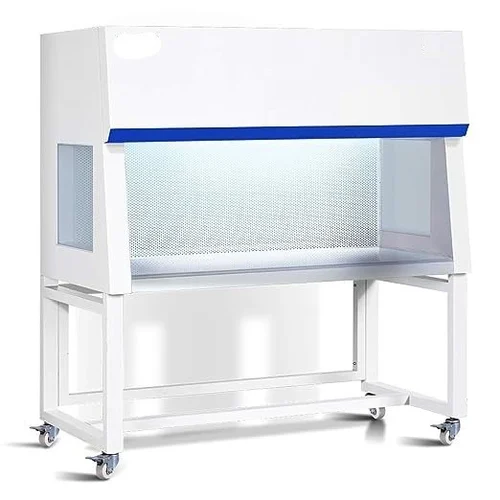
A vertical laminar air flow (VLAF) cabinet is a work enclosure that produces a continuous downward flow of HEPA-filtered air across the work surface. This unidirectional airflow — moving vertically from the top toward the surface, then exhausting through the base — creates an environment dramatically cleaner than any open bench.
The word “laminar” is the key here. Unlike turbulent air movement — which mixes air from different directions and carries particles unpredictably — laminar flow moves in parallel layers at uniform velocity. Every part of the work surface receives the same clean air simultaneously. Particles that happen to land on the work surface get swept away downward rather than circulating back onto the product.
The result is a work zone that typically meets ISO Class 5 conditions — fewer than 3,520 particles ≥0.5 micrometers per cubic meter. To put that in perspective, a typical busy laboratory room might have 100,000 to over a million particles per cubic meter in that same size range.
If you have a cleanroom particle counter and want to appreciate what this equipment actually achieves, measure inside the cabinet while it’s running, then measure the open room beside it. The difference will surprise you.
Vertical vs. Horizontal — Why the Direction of Airflow Matters
There are two main laminar flow configurations. People sometimes treat this choice as minor. It’s not.
Horizontal Laminar Flow
Air flows from the back of the cabinet toward the operator — horizontally across the work surface. The product gets clean air from behind. But anything generated during the work — particles, aerosols, whatever you’re working with — gets blown directly toward the person sitting in front of the cabinet.
For non-hazardous product protection applications where there’s genuinely no risk to the operator from what’s being handled, horizontal flow works fine. But you need to be certain about that “no risk” assessment before you choose it.
Vertical Laminar Air Flow
Air flows downward from a HEPA filter bank at the top, sweeps across the work surface, and exits through a perforated base. Because the flow is perpendicular to the operator rather than directed at them, contaminants generated during work tend to go downward rather than toward the operator’s face.
This is generally better for operator comfort and provides more intuitive protection against product-generated contamination. It’s why vertical flow has become the dominant configuration for pharmaceutical and research applications.
But here’s something I want to be absolutely clear about: a vertical laminar air flow cabinet is not a biological safety cabinet. This is one of the most dangerous equipment mix-ups in laboratory settings.
A vertical laminar air flow cabinet protects the product. It does not provide biological containment. It doesn’t protect the operator from exposure to hazardous biological material. Air is not contained — it exhausts into the room. For work with infectious agents, human pathogens, cytotoxic compounds, or anything requiring BSL-2 containment or higher, you need a Class II Biological Safety Cabinet. Using a laminar flow cabinet as a substitute for a BSC isn’t a cost-saving measure — it’s a safety failure.
The Airflow System — How It Actually Works
HEPA Filtration
Room air enters the cabinet through a pre-filter that catches larger particles, protecting the more expensive HEPA filter beneath it. The air then passes through the HEPA filter and emerges clean on the other side.
A true HEPA filter removes at least 99.97% of particles ≥0.3 micrometers. Pharmaceutical-grade cabinets typically use H14-rated HEPA filters — 99.995% efficiency. After passing through, this clean air descends vertically through the work zone at typically 0.36 to 0.54 m/s (70-100 feet per minute).
That velocity range isn’t arbitrary. Too slow and the laminar pattern breaks down, allowing room air to intrude. Too fast and you create turbulence that disrupts the very flow pattern you’re trying to maintain. The physics are specific.
The Pre-Filter
People consistently underestimate how important pre-filter maintenance is. Without regular pre-filter replacement, room dust loads the HEPA filter prematurely. An over-loaded HEPA filter reduces airflow velocity, which degrades cabinet performance — often without any visible indication that something is wrong.
Pre-filter replacement is the most frequent and most important maintenance task for any laminar flow cabinet. It’s inexpensive and takes minutes. Neglecting it is how facilities end up with cabinets that look fine on the outside but aren’t actually providing ISO Class 5 conditions inside.
The Motor and Blower
A centrifugal blower driven by an electric motor pulls air through the filtration system and pushes it into the work zone. Better cabinets use variable speed motor control. This matters because as HEPA filters gradually load with particles over their service life, resistance increases and airflow velocity would naturally drop. Variable speed control compensates for this by increasing motor speed, maintaining target velocity even as filter loading increases.
Fixed-speed motors can’t compensate. The cabinet provides good airflow velocity with a fresh filter, and gradually reduced velocity as the filter ages — with no indication that this is happening unless you’re measuring with a cleanroom particle counter or anemometer.
The Work Surface
The work surface is typically perforated stainless steel. Air that’s swept down through the work zone exits through these perforations into a plenum below. Some cabinet designs also exhaust a portion of air through the front base opening, creating a low-velocity air curtain that helps prevent room air from entering the work zone.
Verifying Performance — This Is Where the Cleanroom Particle Counter Comes In
Having a laminar air flow cabinet is one thing. Knowing it’s actually working is another. This is where a cleanroom particle counter becomes a genuinely essential tool — not optional equipment.
Why You Need to Measure
HEPA filters can fail in ways that aren’t visible. A pinhole breach in the filter media, a degraded seal between the filter and the frame, a crack in the filter housing — none of these are detectable by looking at the cabinet from the outside. The cabinet runs. The motor hums. The air moves. And particles are passing through the compromised filter into your supposedly clean work zone.
A cleanroom particle counter catches this. Without measurement, you’re operating on assumption.
What to Measure
Position your cleanroom particle counter inlet probe within the working zone — typically at multiple grid points across the work surface, at working height (approximately 15-30cm above the surface). Measure at minimum the 0.5μm and 5.0μm channels.
ISO Class 5 limits:
- ≤3,520 particles/m³ at ≥0.5μm
- ≤29 particles/m³ at ≥5.0μm
All locations should meet these limits. If any location fails, the cabinet is not providing the claimed ISO Class 5 protection at that point. Investigation is required before the cabinet returns to critical use.
Sample Volume Matters
Your cleanroom particle counter flow rate determines how much sample you collect per unit time. At lower concentrations like ISO Class 5, statistical validity of measurements requires adequate sample volume. Don’t take a 10-second measurement and call it verified. Collect enough volume — typically at least 28.3 liters (1 cubic foot) per sample location — to have statistically meaningful results.
HEPA Integrity Testing
Particle counting verifies overall air cleanliness. HEPA integrity testing goes further — it directly verifies that the filter and its frame seals have no penetration points. Using a PAO or DOP aerosol challenge upstream and scanning the filter face and frame with a photometer or scanning cleanroom particle counter, you can detect even very small filter failures.
Annual HEPA integrity testing should be a non-negotiable part of your cabinet certification program.
Applications — Where These Cabinets Actually Belong
Pharmaceutical Compounding
Hospital pharmacies use vertical laminar air flow cabinets for compounding non-hazardous sterile preparations — IV admixtures, irrigation solutions, ophthalmic preparations. The clean air environment protects the sterility of the preparation during compounding.
The word “non-hazardous” is critical. If you’re compounding cytotoxic drugs, hormone preparations, or anything with an occupational exposure concern, you need a biological safety cabinet, not a laminar flow cabinet.
Microbiological Media Preparation
Culture media is inherently vulnerable to contamination during preparation. Environmental microorganisms landing in the media during preparation invalidate subsequent test results. Working within a cabinet significantly reduces this risk and improves the reproducibility of microbiological testing.
Cell Culture Work (Non-Hazardous)
Plant tissue culture, non-pathogenic insect cell lines, and other non-hazardous cell culture applications benefit from the product protection a laminar flow cabinet provides. Research scientists doing this work see dramatically improved consistency when they move from open bench to cabinet — exactly as the scientist I mentioned at the beginning of this article experienced.
Electronics and Precision Components
Semiconductor assembly, optical component inspection, precision instrument assembly — all of these benefit from reduced airborne particle levels. Even particles invisible to the naked eye can cause functional failures in these applications.
Using the Laminar Flow Hoods Correctly — Habits That Actually Matter
Warm-Up Time
Allow the cabinet to run for at least 15 minutes before starting work. During the idle period, particles settle on the work surface and within the work zone. The warm-up period purges these out and establishes stable laminar flow conditions throughout the working area.
Positioning Work
Large objects placed at the front of the work surface create downstream turbulence that can compromise the clean zone in front of them. Position large items toward the rear of the cabinet — closer to the filter — where the turbulence they create is resolved by the time the airflow reaches the front work area.
Never work right at the front edge of the cabinet. This is the area most susceptible to room air intrusion, particularly if someone walks past quickly or a door opens nearby.
Arm Movements
Rapid arm movements disrupt laminar flow. When you move your arms quickly into or out of the cabinet, you’re generating turbulent eddies that can pull room air into the work zone. Work slowly and deliberately when hands are inside the cabinet, particularly when handling open containers or uncapped sterile products.
Cleaning Protocol
Wipe down the work surface before starting and after completing work. Use 70% isopropyl alcohol or your validated cleaning agent. Wipe from the back of the cabinet toward the front — working with the airflow direction, not against it. Allow the surface to dry completely before placing materials on it.
Qualification — What Pharmaceutical Facilities Actually Need to Do
For pharmaceutical applications, “installed and running” is not the same as “qualified and compliant.”
Installation Qualification (IQ)
Documenting that the cabinet arrived as specified, is installed in the correct location, and is connected to appropriate utilities. Recording filter specifications, motor details, cabinet dimensions, and construction materials. This happens once at installation.
Operational Qualification (OQ)
Actually testing that the cabinet performs within specification:
- Airflow velocity at multiple points across the work surface (should be within 0.36-0.54 m/s)
- Airflow uniformity across the work zone
- HEPA filter integrity test (PAO/DOP challenge)
- Particle count verification using a cleanroom particle counter — confirming ISO Class 5 conditions
- Interior lighting level (adequate for work activities)
- UV lamp function if equipped
- Alarm function if equipped
All of this gets documented in an OQ report that becomes part of your equipment qualification file.
Performance Qualification (PQ)
Demonstrating the cabinet maintains acceptable conditions during actual working activities. This might include particle monitoring during simulated use, verifying that typical work activities don’t create conditions that exceed ISO Class 5 limits.
Annual Recertification
Repeat the key OQ tests on an annual basis — airflow velocity, HEPA integrity, and particle count verification with a cleanroom particle counter. Between annual certifications, routine performance spot checks (particularly particle counts) maintain ongoing confidence.
When to Buy Laminar Air Flow Equipment — and From Whom
If you’re evaluating whether to Buy Laminar Air Flow cabinets for your facility, a few practical considerations help focus the decision.
Do you need product protection or containment? If it’s product protection for non-hazardous materials, a vertical laminar air flow cabinet is appropriate. If you need containment — anything biological, hazardous chemicals generating vapors, cytotoxic compounds — you need a biological safety cabinet or fume hood instead.
What size do you need? Working zone width typically ranges from 900mm to 1800mm. Base the choice on your actual work activities — what’s the largest item you’ll regularly be working with? What space do you need around it? Undersizing creates pressure to work at the front edges of the cabinet, which compromises the clean zone.
What’s your room environment like? The cleaner your surrounding room, the less work the cabinet has to do to maintain ISO Class 5 at its front opening. Regular cleanroom particle counter monitoring of your room environment gives you this context.
Buy Laminar Air Flow Equipment from TOPTEC PVT. LTD
When you’re ready to Buy Laminar Air Flow cabinets in Pakistan, TOPTEC PVT. LTD is a local manufacturer genuinely worth considering.
TOPTEC manufactures laboratory furniture and controlled environment equipment right here in Pakistan. That local manufacturing base changes the economics and the practical experience of buying significantly.
What TOPTEC Builds
Their vertical laminar air flow cabinets feature stainless steel 304 interior construction — smooth, non-shedding surfaces that don’t contribute to particle counts. H14-grade HEPA filtration for 99.995% efficiency. Variable speed motor control. Powder-coated steel exterior. LED interior lighting. UV germicidal lamp for surface decontamination between uses.
These aren’t catalog imports resold with a local markup. They’re manufactured in Pakistan to specifications appropriate for pharmaceutical and research applications.
The Local Advantage
I want to be direct about why this matters rather than just listing it as a selling point.
When you Buy Laminar Air Flow equipment from European or US manufacturers, you’re paying freight, customs duty, import taxes, and agent margins on top of the equipment price. You’re waiting weeks or months for delivery. And when something needs service — a pre-filter replacement, a motor issue, a blower that needs attention — you’re dealing with international logistics for parts and the possibility of waiting weeks for a service engineer.
When you Buy Laminar Air Flow equipment from TOPTEC, you don’t have any of that. Equipment is delivered on domestic timelines. If something needs attention, their team is accessible in Pakistan. Pre-filters and consumables don’t need international shipping. And if you need a cabinet with non-standard dimensions — perhaps to fit an existing workstation space — customization is a practical conversation rather than a catalog limitation.
TOPTEC’s Complete Range
Beyond laminar air flow cabinets, TOPTEC manufactures everything a pharmaceutical or research laboratory needs:
- Biological Safety Cabinets — Class II Type A2 and B2 for biological containment applications
- Fume Hoods — ducted and ductless for chemical handling
- Pass Boxes — static and dynamic for cleanroom transfer
- Cleanroom Furniture — stainless steel tables, trolleys, and seating
- Laboratory Workbenches — multiple configurations and countertop options
- Chemical Storage Cabinets — for acids, flammables, and general chemical storage
- Anti-Vibration Tables — for analytical balances and sensitive instruments
- Laboratory Sinks and Fixtures
- Shelving and Storage Systems
If you’re equipping or upgrading a laboratory, being able to Buy Laminar Air Flow cabinets and all supporting furniture from a single local manufacturer simplifies procurement considerably and gives you consistent quality across everything.
Connecting Cabinet Performance to Your Monitoring Program
A vertical laminar air flow cabinet exists within a broader contamination control strategy. It’s not a standalone solution — it’s one element in a system.
The room environment matters. The gowning procedures matter. The cleaning and disinfection program matters. How materials enter and leave the controlled area matters. All of these interact with cabinet performance.
Regular cleanroom particle counter monitoring of both room conditions and cabinet internal conditions gives you the data to understand this system. If room particle counts spike during certain activities, that pressure shows up at the cabinet’s front opening. If the cabinet starts performing below ISO Class 5 internally, that’s early warning of a filter issue before it becomes a product quality problem.
Document everything. Cabinet certification records, routine particle count checks using your cleanroom particle counter, HEPA integrity test results, and maintenance logs should all be organized and accessible. In pharmaceutical environments, these records support batch release decisions and regulatory inspections.
Final Thoughts
A vertical laminar air flow cabinet does one thing very well — it creates a localized clean air environment that protects sensitive products and processes from airborne contamination. When the right cabinet is chosen for the right application, properly installed, thoroughly qualified, and used correctly by trained people, it’s one of the most effective contamination control tools available.
The scientist I mentioned at the beginning of this article isn’t unusual. Her experience — inconsistent results explained entirely by contamination from an uncontrolled work environment — plays out in laboratories across Pakistan and around the world. The solution isn’t complicated. It just requires the right equipment in the right place, used and maintained properly.
If you’re building out or upgrading a laboratory or pharmaceutical facility and you need to Buy Laminar Air Flow equipment that’s manufactured to appropriate standards, locally supported, and honestly priced — talk to TOPTEC PVT. LTD. They’re building this equipment in Pakistan, for Pakistani laboratories, with the understanding of local conditions and requirements that overseas manufacturers simply don’t have.
And whatever particle counting equipment you use to verify your cabinet performance — make sure you’re using a properly calibrated cleanroom particle counter with documented traceability. The cabinet and the measurement program are partners. Neither one works properly without the other.
