

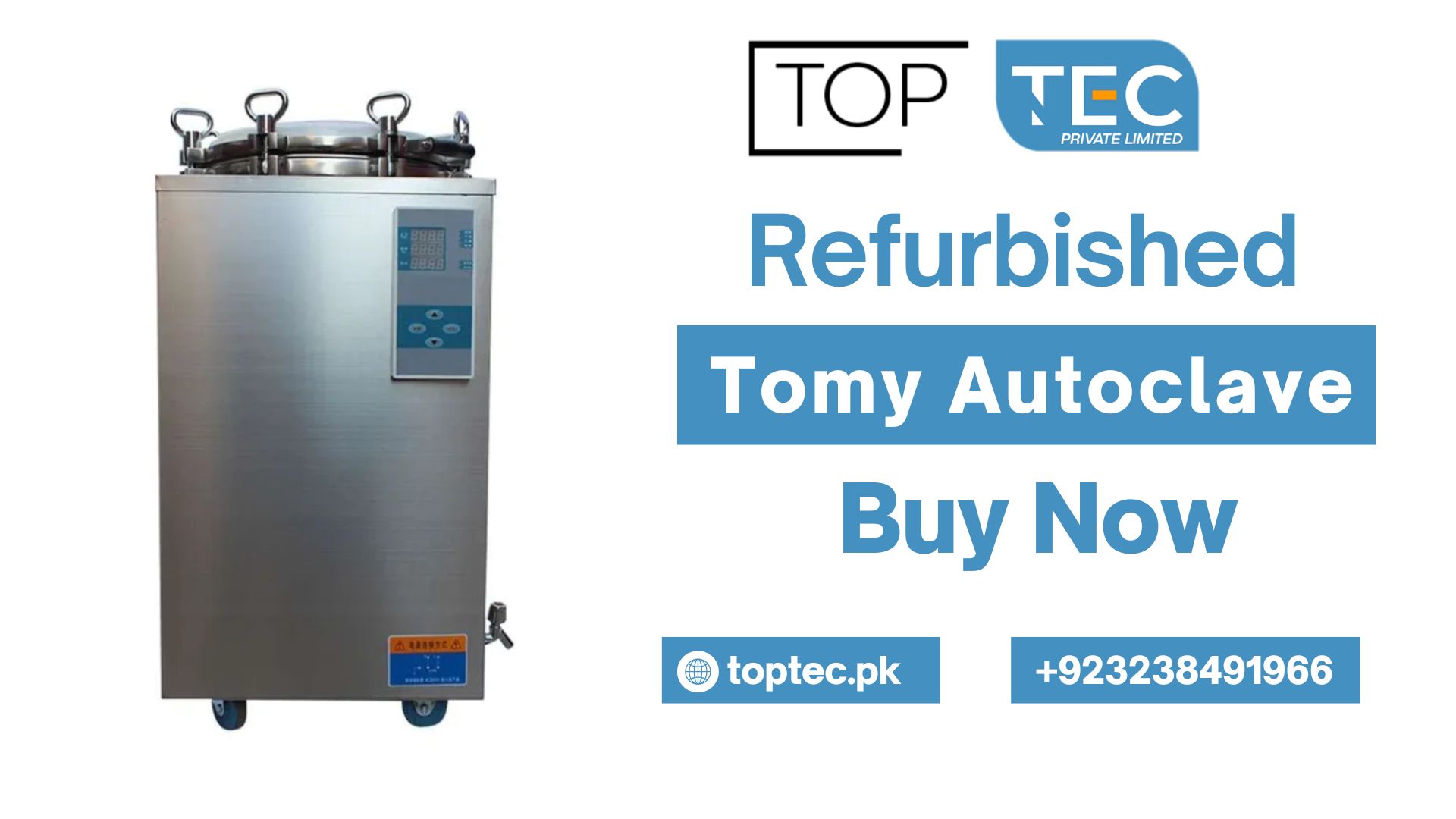
Let me be straightforward about something that doesn’t get discussed enough in laboratory procurement conversations in Pakistan. A brand new autoclave from a premium manufacturer is genuinely out of budget for a significant number of laboratories — university departments, small diagnostic facilities, startup research groups, hospital annexes running on tight allocations. And when budget is the constraint, the usual options are either buy something cheap and unreliable, or go without proper sterilization equipment entirely.
Neither of those options is acceptable when you’re talking about equipment that directly affects sterility assurance in clinical and research settings.
Most product listings give you a table of numbers — temperature range, pressure rating, chamber volume — and leave you to figure out what those numbers actually mean for your work. Is 0.25MPa maximum pressure adequate for your application? What does SUS304 chamber construction actually tell you about corrosion resistance? Why does the temperature range extend from 105°C to 135°C rather than just saying “121°C sterilization”?
These are the questions that matter when you’re making a purchasing decision, and they’re the questions this guide is going to answer properly.
We’re specifically talking about the Refurbished Tomy Autoclave available through TOPTEC PVT. LTD in Pakistan — a unit with specific published specifications that deserve proper explanation. Understanding these specifications is how you confirm whether this autoclave is the right fit for your laboratory’s sterilization requirements, and it’s how you evaluate whether the refurbishment has restored the unit to those specifications meaningfully.
Why Specifications Matter More for Refurbished Equipment
When you buy a new autoclave, the manufacturer’s specifications come with an implicit guarantee that the unit as delivered meets those specifications. Factory testing, quality control, and the manufacturer’s own liability all back that up.
With a Refurbished Tomy Autoclave, the specifications are still the same as the original unit — Tomy’s design doesn’t change because the unit has been refurbished. But the question of whether the refurbished unit actually meets those specifications depends entirely on how the refurbishment was executed. A properly refurbished Refurbished Tomy Autoclave meets its original specifications. A superficially cleaned-up unit may display the same spec sheet while actually performing outside those specifications in ways that compromise sterilization efficacy and safety.
This is why understanding the specifications matters so much for refurbished equipment purchasing — you’re not just reading a product description, you’re building the basis for questions you’ll ask the supplier to confirm the refurbishment was done properly. Does the temperature sensor calibration confirm the unit actually achieves 105–135°C accurately across that range? Has the pressure vessel been tested to verify it safely handles 0.25MPa maximum pressure? Is the SUS304 chamber surface in a condition that lives up to what SUS304 steel is supposed to provide?
Let’s work through each specification properly.
Temperature Range: 105°C to 135°C — What This Actually Covers
The temperature range of 105°C to 135°C is one of the most practically important specifications for understanding what this autoclave can and can’t do for your laboratory.
Why the Range Starts at 105°C
Standard moist heat sterilization — the process we’re all familiar with for culture media, instruments, and biological waste — uses 121°C as its reference temperature. This is the temperature at which steam under approximately 1 atmosphere of gauge pressure (approximately 0.1 MPa gauge) achieves reliable sterilization within defined exposure times for standard biological challenge organisms.
But not everything you might want to process in an autoclave is sterilized at 121°C. Some materials are heat-sensitive — certain culture media components, some polymeric materials, particular reagents — and need lower-temperature processing to avoid degradation while still achieving adequate microbial reduction. The 105°C lower limit on the Refurbished Tomy Autoclave provides this flexibility.
At 105°C, you’re not achieving the same sterility assurance level as at 121°C. But for applications where the goal is significant microbial load reduction rather than absolute sterilization — or where a specific method calls for lower-temperature autoclave processing — having this lower temperature option is genuinely useful.
The Standard 121°C — What Sits in the Middle of the Range
The pharmacopeial standard for moist heat sterilization is 121°C for 15 minutes for standard loads — but that’s the minimum specification. Many microbiology labs use 121°C for 20-30 minutes as a practical standard to provide additional margin. Pharmaceutical operations following specific validated cycles may use different time-temperature combinations within the pharmacopeia-accepted range.
The Refurbished Tomy Autoclave operating in the middle of its 105–135°C range at 121°C is running well within its design parameters. This isn’t the unit operating at its limit — it’s operating at the central part of its intended range.
The Upper Limit at 135°C — When You Need It
The 135°C upper capability addresses specific applications that require higher temperature cycles:
Prion decontamination: Standard 121°C cycles are not sufficient for prion proteins — the misfolded proteins responsible for diseases like CJD in humans and BSE in cattle. Current recommendations for prion decontamination typically specify 134–137°C for extended hold times. The Refurbished Tomy Autoclave upper temperature capability at 135°C makes it suitable for these applications when properly validated.
Accelerated cycle development: Some cycle optimization work uses higher temperatures with shorter exposure times to achieve equivalent sterility assurance — the F0 (F-naught) concept from pharmaceutical sterilization science. Having the flexibility to operate at 135°C supports this kind of work.
Specific material sterilization: Some materials — certain wrapped instrument configurations, specific porous loads — benefit from higher temperature cycles that can penetrate more effectively in shorter times.
Resistant organism challenges: For laboratories working with unusually heat-resistant organisms in research contexts, the ability to operate at 135°C provides additional decontamination assurance.
Temperature Accuracy and Calibration
The temperature range specification tells you the range the unit is designed to operate in. Equally important — and the thing you need to verify for a refurbished unit specifically — is how accurately it achieves and maintains temperatures within that range.
For a Refurbished Tomy Autoclave to legitimately meet its temperature specification, the temperature sensor must be calibrated against a traceable reference standard. The calibration certificate should show:
- The sensor’s reading at multiple temperature points across the operating range
- The reference reading at those same points
- The correction factor or confirmed accuracy within specification
- The calibration standard used and its own traceability
- The calibration date
If the calibration certificate only shows a single temperature verification at 121°C, that’s not sufficient to confirm the unit operates accurately across the full 105–135°C range. Ask specifically for multi-point calibration documentation.
0.25MPa Maximum Pressure: Understanding the Safety and Performance Envelope
The 0.25MPa maximum pressure specification is both a safety parameter and a performance parameter, and understanding what it means requires a brief discussion of the relationship between pressure and temperature in steam sterilization.
Pressure and Temperature Are Not Independent in Steam Sterilization
In a steam autoclave, the relationship between chamber pressure and chamber temperature follows the steam saturation curve — a predictable physical relationship. At a given pressure, steam (and water in equilibrium with steam) has a defined temperature. You cannot have higher temperature steam at lower pressure or lower temperature steam at higher pressure — the physics don’t allow it.
This means:
At 0.103 MPa absolute (0.0 MPa gauge / atmospheric pressure): 100°C
At 0.203 MPa absolute (0.103 MPa gauge / approximately 1 bar gauge): 121°C
At 0.313 MPa absolute (0.213 MPa gauge / approximately 2.1 bar gauge): 135°C
The 0.25MPa maximum pressure specification for the Refurbished Tomy Autoclave refers to the maximum pressure the vessel is rated to safely contain. At 135°C sterilization temperature, the chamber pressure is approximately 0.21 MPa gauge (0.31 MPa absolute). The 0.25MPa maximum specification refers to gauge pressure, giving the chamber an operating range that accommodates the full temperature range up to 135°C with appropriate safety margin.
What 0.25MPa Means for Safety
The maximum pressure rating of a pressure vessel reflects the design, materials, and testing that established the safe operating envelope. This is a safety-critical specification — not a nominal value but an engineering limit that the vessel has been designed and tested to contain safely.
For a Refurbished Tomy Autoclave, the pressure vessel integrity at 0.25MPa maximum must be verified as part of proper refurbishment. This means:
Visual inspection of the pressure vessel: Internal and external surfaces examined for corrosion, pitting, cracks, or mechanical damage. Any of these can compromise the vessel’s ability to safely contain maximum rated pressure.
Inspection of all penetrations: Drain ports, vent connections, sensor ports — these are potential weak points in the pressure vessel that need specific inspection.
Pressure testing: The vessel should be tested to confirm it holds pressure safely. A hydrostatic pressure test — filling the vessel with water (incompressible fluid) and applying test pressure — is the standard approach. Testing with water rather than steam or air means that if the vessel fails during testing, the consequences are far less hazardous than a gas or steam pressure failure.
Safety valve verification: The safety valve that prevents over-pressure conditions must be tested to confirm it activates at the correct set pressure. If the safety valve doesn’t activate at the correct pressure, the 0.25MPa maximum rating is not backed by the safety system it depends on.
When you’re evaluating a Refurbished Tomy Autoclave from TOPTEC, ask specifically for the pressure test record and the safety valve test record. These documents confirm the pressure-related safety of the refurbished unit.
Pressure Sensor Calibration
The pressure sensor that the autoclave’s control system relies on to monitor chamber pressure needs calibration against a traceable reference. An uncalibrated or drifted pressure sensor means the unit may be operating at pressures different from what the display shows — with both safety and sterilization efficacy implications.
Pressure calibration for a Refurbished Tomy Autoclave should be documented in the same way as temperature calibration — showing actual sensor reading, reference reading, and correction, with traceability information.
SUS304 Chamber Construction: What This Material Choice Means
The SUS304 designation for the autoclave chamber material is a specific technical specification that tells you quite a lot about the chamber’s design and expected performance. Understanding it properly helps you evaluate whether the chamber condition in a refurbished unit meets the standard this material specification implies.
What SUS304 Is
SUS304 is the Japanese Industrial Standards (JIS) designation for the austenitic stainless steel grade more commonly known internationally as AISI 304 or EN 1.4301. This is the most widely used stainless steel in laboratory and pharmaceutical equipment, food processing, and similar applications.
The composition that defines SUS304:
- Iron: approximately 66-74% (balance)
- Chromium: 18-20%
- Nickel: 8-10.5%
- Carbon: ≤0.08%
- Manganese: ≤2%
- Silicon: ≤1%
The chromium content is what creates stainless steel’s characteristic corrosion resistance. Chromium reacts with oxygen to form a thin, stable chromium oxide layer on the surface — the “passive layer.” This passive layer is chemically inert to most common laboratory chemicals and environments, and it self-repairs if scratched or damaged (as long as the environment allows chromium oxide reformation).
Why SUS304 for Autoclave Chambers
The choice of SUS304 for the Refurbished Tomy Autoclave chamber reflects several specific material requirements:
Steam resistance: SUS304 is stable in saturated steam environments across the autoclave operating temperature range. It doesn’t react with steam, doesn’t corrode in the steam-saturated environment, and maintains its mechanical properties at operating temperatures up to 135°C without degradation.
Thermal cycling resistance: Autoclave operation involves repeated thermal cycling — ambient temperature to 135°C and back, cycle after cycle. SUS304 handles this thermal cycling without significant dimensional change or fatigue cracking in the operating range of laboratory autoclaves.
Chemical resistance: The chamber needs to withstand exposure to cleaning agents, descaling solutions, and the chemical content of processed loads. SUS304 resists most common laboratory cleaning chemicals and autoclave descaling agents.
Cleanability: The surface of SUS304 can be finished to a smoothness that facilitates cleaning and minimizes bacterial attachment. Sterilization equipment needs to be cleanable — a chamber surface that harbors contamination in surface pits or crevices undermines the purpose of the equipment.
Non-reactivity with loads: SUS304 doesn’t leach significant metal ions into processed loads under normal autoclave conditions. This matters for culture media sterilization where trace metal contamination can affect growth.
Weldability: The chamber is a fabricated structure with welded joints. SUS304 has good weldability and, with proper welding technique, produces joints with corrosion resistance comparable to the base material.
The Limitation of SUS304 You Should Know
SUS304 is not resistant to chloride-induced stress corrosion cracking. In the presence of chloride ions at elevated temperatures — which can occur if tap water (which contains chloride) is used in the autoclave — SUS304 can develop pitting corrosion and stress corrosion cracks.
This is one of the key technical reasons why using only distilled or deionized water in the Refurbished Tomy Autoclave is not just a general recommendation but a material-specific requirement. Distilled and deionized water have very low chloride content. Tap water — even in areas where tap water quality is generally good — contains chloride ions that, over repeated autoclave cycles at elevated temperatures, will initiate corrosion in SUS304 chambers.
Chloride-induced corrosion in a SUS304 autoclave chamber typically manifests as:
- Pitting corrosion (small pits visible on the chamber surface)
- Crevice corrosion at joints and around ports
- In severe cases, stress corrosion cracking of the chamber walls
Once initiated, this corrosion is progressive. Early-stage pitting can sometimes be addressed by polishing, but advanced corrosion compromise both the chamber surface finish and, in severe cases, the structural integrity of the pressure vessel.
This is why chamber condition assessment is critical in evaluating a Refurbished Tomy Autoclave. The refurbisher should specifically inspect the SUS304 chamber interior for corrosion and document what was found. Cosmetic surface discoloration from mineral deposits is very different from actual corrosion pitting — but both indicate the unit was operated with inappropriate water quality and warrant careful assessment.
What Good SUS304 Chamber Condition Looks Like
In a well-maintained Refurbished Tomy Autoclave with proper water quality management throughout its operational life, the SUS304 chamber interior should be:
- Uniformly bright with the characteristic dull reflective finish of 2B or equivalent stainless steel
- Free of pitting, crevice corrosion, or stress corrosion cracking
- Clean of mineral scale deposits (though some minor scale from water evaporation is common and removable)
- Smooth at welded joints with no visible corrosion at weld heat-affected zones
- Clean at drain and vent ports with no evidence of corrosion at these penetration points
When evaluating a refurbished unit from TOPTEC, ask whether the chamber interior was photographically documented as part of the assessment. Visual documentation of the chamber condition before and after refurbishment is a mark of thorough refurbishment practice.
Additional Specifications Worth Understanding
Beyond the three headline specifications — temperature range, maximum pressure, and chamber material — a properly specified Refurbished Tomy Autoclave has additional technical characteristics that matter for real-world laboratory use.
Heating System
Tomy tabletop autoclaves use an internal electric heating element to heat the water reservoir and generate steam. The heating element specification — wattage and operating voltage — determines how quickly the unit heats up to sterilization temperature and how well it maintains temperature under varying load conditions.
Heating element condition is one of the primary assessment points in refurbishment. Scale buildup on the element surface insulates it, reducing heating efficiency and increasing heat-up time. In severe cases, reduced heating element efficiency means the unit cannot maintain sterilization temperature under load conditions.
A properly refurbished Refurbished Tomy Autoclave should have a heating element assessment documented, and replacement if the element shows significant scale or performance degradation.
Water Reservoir Capacity and Management
The internal water reservoir capacity determines how many consecutive cycles can be run before the unit needs refilling. For a 35L chamber unit, the water reservoir is sized to provide adequate steam generation for multiple cycles.
More importantly for long-term operation, the reservoir design affects how easily it can be drained, inspected, and cleaned. Stagnant water in an autoclave reservoir supports microbial growth and accelerates scale formation. The reservoir should be drainable and accessible for periodic cleaning.
Ask TOPTEC about the specific reservoir condition in the available unit — whether it was drained, inspected, and cleaned as part of the refurbishment, and what condition was found.
Safety Systems
The Refurbished Tomy Autoclave incorporates multiple safety systems that are specifications in their own right:
Pressure relief valve (safety valve): Activates at a set pressure below the maximum rated pressure to prevent over-pressure conditions. The set pressure is a specific technical specification that must be verified during refurbishment.
Over-temperature cutout: An independent temperature sensing system that shuts down the heating element if chamber temperature exceeds the safe upper limit. Independent of the primary temperature control system.
Door safety interlock: Prevents the door from being opened while chamber pressure exceeds a defined safe level. This is both a safety feature and a pressure specification — the interlock release pressure is a design parameter that should be documented.
Low water level protection: Some Tomy models include a system that detects insufficient water level in the reservoir and prevents heating activation or shuts down heating if water level drops below safe minimum during a cycle. This protects the heating element from dry-fire damage.
Each of these safety systems has a specification — an activation pressure, a cutout temperature, an interlock release pressure — and each should be tested and documented as part of proper refurbishment. These aren’t just nice-to-have documentation items; they’re what confirms the safety systems are actually working correctly.
Control System and Cycle Programming
The control system of the Refurbished Tomy Autoclave manages all cycle parameters — temperature setpoint, pressure monitoring, sterilization hold time, exhaust rate, and post-cycle functions. The control system specification includes:
- Number of programmable cycle memories
- Temperature setting resolution (typically 1°C increments)
- Timer resolution and maximum sterilization hold time
- Display type and information shown during cycles
- Alarm outputs and alarm conditions
For GMP pharmaceutical laboratories, the control system also has data integrity implications. Does the system log cycle data? Is there a cycle data output for record-keeping? Can the cycle parameters be locked to prevent unauthorized modification?
The control system condition in a refurbished unit should be verified through functional testing — running multiple complete cycles across the temperature range and confirming that the system executes programmed parameters accurately and responds appropriately to alarm conditions.
What Proper Refurbishment Restores in These Specifications
Understanding the specifications gives you the framework for evaluating what “properly refurbished” means in practical terms.
Temperature range restoration:
Cleaning and descaling the heating element restores heating efficiency. Recalibrating the temperature sensor against a traceable reference confirms the temperature control system accurately achieves temperatures across the 105–135°C range. Replacing the sensor if calibration shows uncorrectable drift restores temperature accuracy. A temperature distribution study with multiple calibrated loggers confirms that temperatures are uniform throughout the chamber volume.
Pressure specification restoration:
Inspecting and testing the pressure vessel confirms its integrity at 0.25MPa maximum. Testing and verifying the safety valve confirms it activates at the correct set pressure. Recalibrating the pressure sensor confirms the displayed pressure accurately reflects actual chamber pressure. Replacing the door gasket with a genuine Tomy component restores the door seal integrity that’s essential for pressure maintenance.
Chamber material specification restoration:
Cleaning and descaling the SUS304 chamber interior removes mineral deposits that compromise the surface. Assessing and documenting any corrosion present in the chamber. Where surface pitting is minor and superficial, polishing may restore acceptable surface condition. Where corrosion is advanced, honest assessment may indicate the chamber condition is below acceptable specification — and the refurbisher should communicate this rather than selling a unit with compromised chamber integrity.
This last point is important. A Refurbished Tomy Autoclave with advanced chamber corrosion cannot be refurbished to specification by cleaning alone. The chamber material specification is only meaningful if the chamber is actually in the condition that SUS304 should provide. If TOPTEC is providing a Refurbished Tomy Autoclave that genuinely meets its specifications, chamber condition should be honestly assessed and documented.
Buying from TOPTEC PVT. LTD: What Makes This the Right Source
For laboratories in Pakistan looking to buy Refurbished Tomy Autoclave equipment, TOPTEC PVT. LTD offers something that’s actually more valuable than just the autoclave itself.
They Understand the Laboratory Context
TOPTEC’s primary business is manufacturing laboratory furniture — workbenches, fume hoods, storage systems, sink units — for pharmaceutical, research, and industrial laboratories in Pakistan. This means they engage with laboratory environments daily. They understand what QC labs need from their sterilization equipment. They understand GMP documentation requirements. They understand what a DRAP inspection looks at.
This context shapes how TOPTEC approaches a Refurbished Tomy Autoclave sale differently from a general equipment dealer. They’re not just moving a piece of used equipment — they understand it’s going into an environment where it needs to perform reliably, generate defensible cycle records, and support a quality system.
Local Support Matters
For labs in Pakistan, the practical value of local support for laboratory equipment is something that only becomes fully apparent when equipment has a problem. A service relationship with a local company that knows the specific unit, can send an engineer in a reasonable timeframe, and can source replacement parts — compared with a distant manufacturer’s support line and 4-6 week spare parts lead times — is a meaningful operational difference.
TOPTEC’s local presence provides this for the Refurbished Tomy Autoclave they supply.
Integrated Laboratory Infrastructure
This is where TOPTEC’s primary business and their autoclave supply activity come together in ways that are genuinely useful.
When you purchase a Refurbished Tomy Autoclave from TOPTEC, you can simultaneously address the complete autoclave area infrastructure — bench, storage, adjacent work surfaces, sink unit — from the same local supplier who understands both the autoclave and what the surrounding environment needs to look like.
TOPTEC’s Laboratory Furniture for Your Autoclave Setup
Let’s be specific about what the autoclave area needs and what TOPTEC manufactures to address those needs.
Heavy-Duty Laboratory Workbenches
The bench supporting a Refurbished Tomy Autoclave needs to be specified appropriately. A loaded 35L autoclave with water in the reservoir can weigh 50-60 kg or more. The bench needs:
Steel frame construction with legitimate load rating — not the kind of bench that looks adequate until it has to support 60 kg of hot autoclave plus vibration from the operating cycle.
Chemical-resistant surface material — the bench surface will be exposed to steam condensation, autoclave cleaning agents, descaling solutions, and spillage from autoclave loads. Epoxy resin, phenolic resin, or appropriate chemical-resistant laminate are the right surface materials. Standard melamine laminate or wood surfaces are not.
Level, stable installation — autoclaves need to be level for proper door sealing and drainage. A bench that’s not level, or that deflects under load, undermines this.
Appropriate height for the workflow — loading and unloading a hot autoclave at the wrong height creates ergonomic problems and safety risks. TOPTEC’s benches are manufactured at appropriate laboratory working heights.
Custom dimensions as standard — TOPTEC fabricates benches to your specific room dimensions. Your bench run is whatever length your space requires, not a compromise between standard module sizes.
Adjacent Preparation and Staging Areas
The autoclave doesn’t operate in isolation. There’s a preparation area where loads are assembled, wrapped, and bagged before sterilization. There’s a staging area where loads cool after removal. There’s a documentation area where cycle logs are maintained. TOPTEC can design integrated bench systems that address all of these functional areas in a coherent layout specific to your space.
Storage Systems
Your autoclave area needs organized storage for autoclave bags and wrapping materials, biological and chemical indicators, PPE (heat-resistant gloves, face protection), cycle logs and documentation, purified water containers, and cleaning and maintenance materials.
TOPTEC’s under-bench cabinets, overhead shelving, and dedicated storage units integrate with their bench systems to create organized, functional storage rather than the improvised accumulation of materials that typically grows up around laboratory equipment.
Sink Units
Even without plumbing requirements for the autoclave itself, nearby water access and handwashing facilities are practically necessary and in many regulated environments required. TOPTEC manufactures laboratory sink units in appropriate materials with proper drainage specifications.
The Local Manufacturing Advantage for Pakistani Labs
I want to be specific about the practical advantages rather than just asserting them.
Lead time: A Refurbished Tomy Autoclave from TOPTEC is available now or in a few weeks. Imported laboratory furniture — from established European or Asian manufacturers — arrives in Pakistan 12-16 weeks after ordering when you account for manufacturing, shipping, port clearance, and inland delivery. Having the autoclave ready and waiting for furniture that’s still on a container ship somewhere is a genuinely frustrating situation that delays lab operations. TOPTEC delivers standard furniture items in 3-5 weeks, custom fabrications in 5-8 weeks.
Exact dimensions: Imported furniture comes in the standard module sizes the manufacturer chose for their international markets. Your specific lab space has specific dimensions that may or may not align with those standards. TOPTEC fabricates to your exact dimensions — the bench is the right length for your space, the storage units fit your available wall space, the layout works for your workflow.
PKR pricing: No currency exposure. No import duty calculation. No exchange rate surprises between quotation and delivery. In Pakistan’s current economic environment, this is not a trivial consideration.
Post-delivery support: When something needs adjusting after installation — a shelf height that doesn’t work for how the space actually gets used, an additional storage unit needed as the autoclave area’s workflow develops — you’re talking to the team that built your furniture. Locally. Without international communication delays or logistics complications.
Qualification Documentation: What to Get from TOPTEC
For laboratories that need to qualify a Refurbished Tomy Autoclave for GMP use, the documentation package from TOPTEC should support your IQ protocol. Verify before purchasing that the following are available:
Refurbishment assessment report: What was inspected, what was found, what was documented. Including chamber condition assessment.
Refurbishment work report: What was done. Parts replaced, with part numbers. Procedures performed. Condition restored to specification.
Temperature calibration certificate: Multi-point calibration across the 105–135°C operating range. Traceable to national standards. Current date.
Pressure calibration certificate: Verified accuracy at operating pressures. Traceable. Current.
Safety valve test record: Activation pressure verified at the specified set point.
Pressure test record: Vessel pressure test confirming integrity at rated pressure.
Functional test cycle records: Multiple complete sterilization cycles run and parameters recorded.
Electrical safety test results: Earth continuity, insulation resistance, leakage current.
User manual: Original or equivalent quality reproduction.
This documentation is not bureaucratic overhead. It’s what converts a piece of refurbished equipment into a qualified laboratory instrument with a documented performance baseline.
Practical Checklist: Setting Up Your Complete Autoclave Area
For labs purchasing a Refurbished Tomy Autoclave from TOPTEC and setting up the complete area:
Electrical:
- ☐ Dedicated circuit of appropriate amperage for the specific Tomy model
- ☐ Voltage stabilizer if local power quality warrants it
- ☐ Direct outlet connection — extension cords are not appropriate for pressure vessel equipment
Bench and Surface (TOPTEC):
- ☐ Steel-frame heavy-duty bench with appropriate load rating
- ☐ Chemical-resistant bench surface — epoxy or phenolic resin
- ☐ Level installation verified after bench setup
- ☐ Heat-resistant mat at autoclave footprint
- ☐ Pre/post-cycle staging area adjacent to autoclave
- ☐ Clearances for door operation, steam venting, maintenance access
Water:
- ☐ Distilled or deionized water source accessible
- ☐ Water quality verification if producing in-house
- ☐ Post-cycle water management addressed
Storage (TOPTEC):
- ☐ Consumables storage — bags, indicators, wrapping materials
- ☐ PPE storage — heat-resistant gloves, face protection
- ☐ Documentation storage — cycle logs, calibration records
- ☐ Maintenance materials organized and accessible
Safety:
- ☐ Eyewash station within required distance
- ☐ Burns first aid accessible
- ☐ Emergency procedures posted
- ☐ Adequate ventilation for steam management
Qualification:
- ☐ Refurbishment documentation reviewed and filed before IQ
- ☐ IQ completed with refurbishment history included
- ☐ OQ temperature distribution study completed
- ☐ OQ pressure verification completed
- ☐ Safety system testing documented
- ☐ PQ biological indicator testing completed for each load type
- ☐ Ongoing calibration schedule established
- ☐ Cycle logging system in place
Final Thoughts
The specifications of a Refurbished Tomy Autoclave — 105–135°C temperature range, 0.25MPa maximum pressure, SUS304 chamber construction — are meaningful technical parameters that tell you exactly what this equipment is designed to do and what it’s built from. Understanding them properly is what separates an informed purchasing decision from a leap of faith.
The temperature range covers standard 121°C sterilization comfortably while extending to 135°C for prion decontamination and other high-temperature applications. The 0.25MPa pressure rating provides the safety envelope for operating across that full temperature range. The SUS304 chamber construction provides the corrosion resistance and cleanability that sterilization equipment requires — provided it’s been used with appropriate water quality and the chamber is in the condition that SUS304 should provide.
For Pakistani laboratories looking to access this capability at a cost that new equipment doesn’t allow, a Refurbished Tomy Autoclave from TOPTEC PVT. LTD is a genuinely worthwhile option — not a compromise, but a considered decision backed by understanding of what the equipment is and what the refurbishment should restore.
Contact TOPTEC to discuss currently available Refurbished Tomy Autoclave units, review the refurbishment documentation, and explore the complete laboratory infrastructure they can provide alongside the autoclave.
Contact TOPTEC PVT. LTD
TOPTEC PVT. LTD supplies Refurbished Tomy Autoclave units and manufactures complete laboratory furniture solutions — heavy-duty workbenches, chemical-resistant bench surfaces, storage systems, sink units, and full laboratory fit-outs — all manufactured locally in Pakistan for pharmaceutical, research, and industrial laboratory environments.
Contact TOPTEC to inquire about available Refurbished Tomy Autoclave units and to discuss integrated laboratory infrastructure for your autoclave area setup.
