

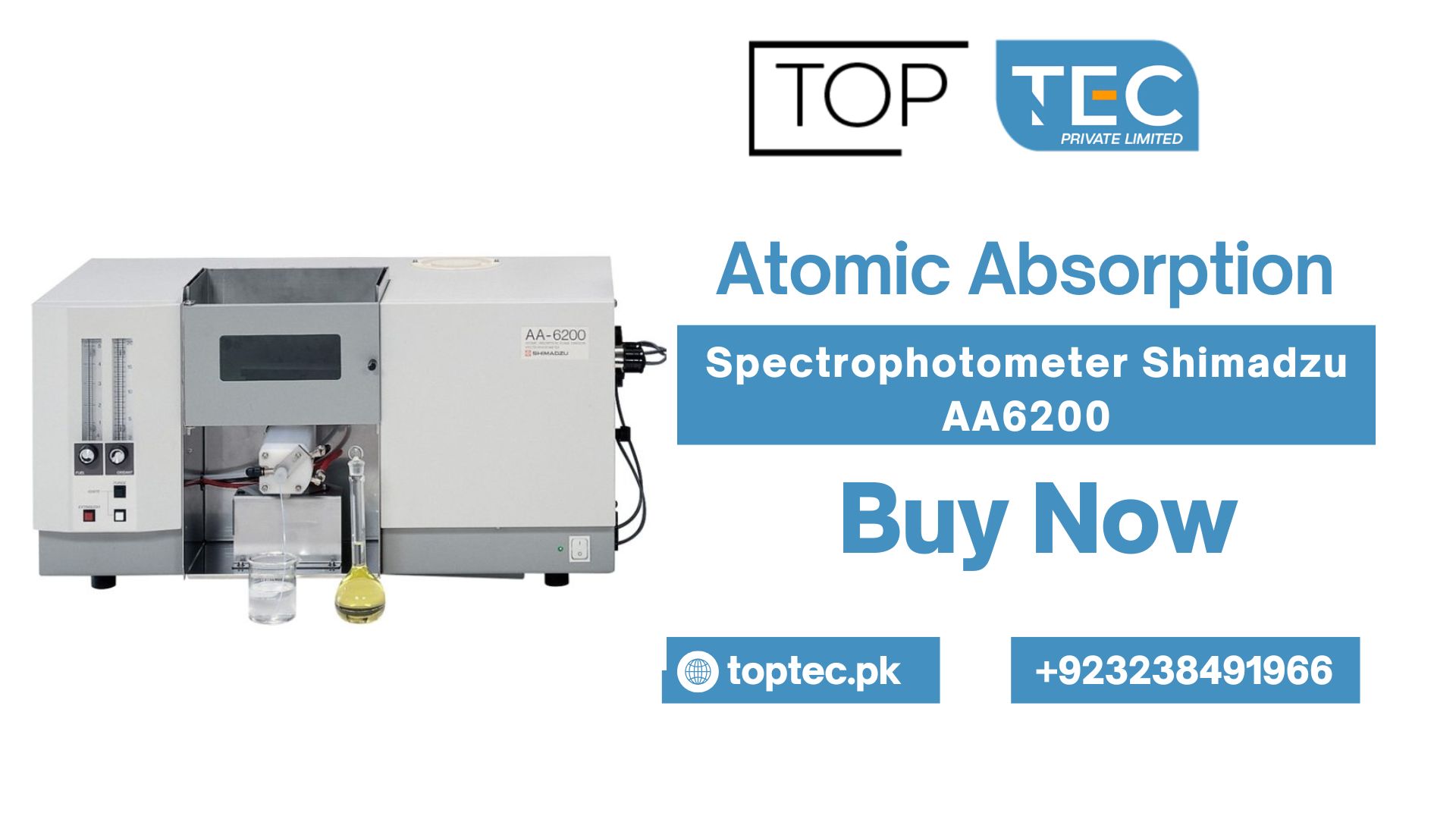
If you’re in the market for an Atomic Absorption Spectrophotometer and you’ve been researching the Shimadzu AA-6200, you’ve come to the right place. Let’s break down everything—specs, pricing, refurbished options, and why this particular instrument keeps coming up in conversations.
Last year I visited a metals testing lab in Lahore. The guy running it—been doing elemental analysis for over two decades—pulled me aside while his technician was processing samples. “Everyone chases the new instruments,” he said. “But you know what? My AA-6200 from 2011 still outperforms half the new stuff people are buying.”
He wasn’t exaggerating for effect. That Shimadzu AA-6200 was running lead, cadmium, copper, and zinc samples all day with precision numbers that would make some brand-new competitors uncomfortable.
That conversation stuck with me. Because it captures something important about this particular Atomic Absorption Spectrophotometer—it’s not just another instrument in a catalog. It earned a reputation through actual daily use, in real labs, over many years. And in 2026, it remains one of the most talked-about instruments in analytical labs across Pakistan.
If you’re researching the Shimadzu AA-6200 and trying to figure out whether it makes sense for your situation, let’s have a proper conversation about it. Specs, real-world performance, pricing, refurbished options—all of it.
What This Instrument Actually Is
The Shimadzu AA-6200 is a double-beam Atomic Absorption Spectrophotometer built for elemental analysis. It measures metal concentrations in liquid samples by detecting how much light gets absorbed at element-specific wavelengths.
The double-beam part matters more than most people realize when they’re first shopping for an Atomic Absorption Spectrophotometer.
Single-beam instruments measure your sample, then measure a reference, then calculate the difference. Problem is, the light source and detector drift slightly between those two measurements. That drift shows up as measurement error—especially on long runs.
The Shimadzu AA-6200 splits the beam simultaneously. One path hits your sample, the other hits a reference—at the exact same moment. Drift cancels out in real time. Baseline stays stable. You can run 50 samples in a row and trust that sample number 50 is measured with the same accuracy as sample number one.
For anyone running an Atomic Absorption Spectrophotometer commercially—water testing, pharmaceutical QC, food safety—this isn’t a minor technical detail. It directly affects how many samples you can process before recalibrating, which directly affects your throughput and revenue.
Specifications That Actually Matter
Let me walk through the specs that come up in real conversations with people using this instrument.
Wavelength range: 190–900 nm
This covers everything from UV elements like arsenic and selenium up through visible range elements. Essentially every metal you’d routinely analyze fits within this range.
Spectral bandwidth: 0.2, 0.4, 0.7, 1.0, 2.0 nm
Selectable bandwidth gives you flexibility. Narrower bandwidth for crowded spectral regions where you need resolution. Wider bandwidth when sensitivity matters more than spectral resolution.
Atomization options
Flame atomization using air-acetylene is standard. Nitrous oxide-acetylene extends capability to refractory elements like aluminum, silicon, and barium that air-acetylene can’t properly atomize.
The Shimadzu AA-6200 also accepts a graphite furnace (GFAAS) accessory. This pushes detection limits down dramatically—we’re talking parts per billion or even parts per trillion for some elements. One Atomic Absorption Spectrophotometer covering routine work and trace-level analysis is genuinely valuable.
Typical detection limits in flame mode
These vary with matrix and technique, but representative numbers:
- Copper: around 0.002 mg/L
- Lead: around 0.003 mg/L
- Cadmium: around 0.001 mg/L
- Zinc: around 0.005 mg/L
- Iron: around 0.004 mg/L
With graphite furnace, drop those numbers by 100 to 1000 times depending on element.
Background correction
Both deuterium lamp and Smith-Hieftje methods. The Shimadzu AA-6200 selects automatically based on wavelength. You don’t have to manually decide which method suits which element—the Atomic Absorption Spectrophotometer figures it out.
Data system
USB and RS-232 connectivity. Shimadzu’s software handles calibration curves (linear, quadratic, cubic), standard additions, peak area and peak height measurement. Straightforward enough that operators actually learn it without extended training.
Why This Particular Instrument Keeps Coming Up
I’ve asked plenty of lab managers why they chose the Shimadzu AA-6200 over PerkinElmer, Agilent, or other Atomic Absorption Spectrophotometer brands. The reasons aren’t surprising but they’re consistent.
It doesn’t break down constantly.
This sounds obvious, but you’d be amazed how many labs choose equipment based on specs on paper and then deal with constant service calls. The AA-6200 has a reputation—genuinely earned—for running day after day without drama. Labs that process hundreds of samples daily can’t afford instruments that need babysitting.
Maintenance costs stay manageable.
Hollow cathode lamps for the Shimadzu AA-6200 are less expensive than comparable lamps for many competitors. Consumables are widely stocked. When something does need replacing, the parts exist and aren’t outrageously priced.
Technicians in Pakistan actually know it.
This matters enormously and often gets overlooked. Shimadzu has significant market presence in Pakistan. Service engineers who’ve worked on the AA-6200 are findable. You’re not waiting weeks for a specialist to fly in from Singapore because nobody local has seen your instrument before.
It handles diverse applications without fuss.
Drinking water. Pharmaceutical raw materials. Food and agricultural samples. Environmental soil digests. Mining and metallurgy. The Shimadzu AA-6200 handles them all without requiring a different instrument for each application category.
2026 Pricing: What You’ll Actually Pay
This is where I need to be straight with you. The Shimadzu AA-6200 is a discontinued model. Shimadzu moved on to newer platforms years ago. You’re not buying this new from the factory.
The real market in 2026 is refurbished units, and honestly, that’s where the value is anyway.
Refurbished Shimadzu AA-6200 pricing ranges:
Basic flame-only configuration, older units (2007-2012): PKR 600,000–900,000
Flame configuration, newer condition (2013-2017), well-maintained: PKR 900,000–1,300,000
Flame plus graphite furnace, good condition with accessories: PKR 1,300,000–2,000,000
These ranges are rough. The actual price depends on several things that are worth understanding before you negotiate.
Age and operational hours
An AA-6200 with 5,000 hours of logged use is different from one with 40,000 hours. The optical system degrades gradually. Bearings wear. Detectors accumulate noise. Ask specifically for the hour meter reading and service history. Sellers who can’t provide this are probably selling something they don’t know much about.
What’s included
Some sellers package the Atomic Absorption Spectrophotometer with an autosampler, spare hollow cathode lamps, installation, and initial calibration. Others sell just the box. Compare total package costs, not just instrument prices.
Warranty terms
Reputable refurbishers offer 3–12 month warranties. Some stretch to 18 months. No-warranty sales happen but carry risk. For a six-figure purchase, skipping warranty to save PKR 40,000 doesn’t make sense.
Calibration documentation
A refurbished Shimadzu AA-6200 with a recent calibration certificate from a traceable lab is worth more than one without. You’re not just buying the instrument—you’re buying confidence it actually works correctly.
Evaluating Refurbished Units: What to Actually Check
Buying a refurbished Atomic Absorption Spectrophotometer isn’t like buying a used laptop. You need to verify specific things.
The optical system
This is non-negotiable. Ask to see the monochromator. Look for dust accumulation on the grating, scratches, or signs of misalignment. The optical path is the core of any Atomic Absorption Spectrophotometer—if it’s compromised, nothing else you check matters.
The nebulizer and burner head
Both are consumables but expensive to replace. Inspect for corrosion, physical damage, salt deposits from previous use, or wear patterns indicating thousands of hours of operation. A worn nebulizer trashes your precision regardless of how good everything else looks.
Background correction verification
This is where cheap refurbishments often fail. Run a sample with known background interference—high dissolved salt content works. Watch whether the deuterium correction actually cleans up the background or whether it’s basically decorative. Some “refurbished” units have background correction systems that work on paper but not in practice.
Lamp alignment demonstration
Hollow cathode lamps must align precisely with the optical path. Misaligned lamps produce erratic signals that look like matrix interference but aren’t. Have the seller demonstrate with a standard solution at two or three different wavelengths before you agree to anything.
Electronics stability
Run the baseline with no sample for 20-30 minutes. Watch the baseline drift. A healthy Shimadzu AA-6200 should show minimal drift after 15 minutes warmup. Significant drift suggests detector problems, electronics aging, or optical issues that aren’t going to improve.
Service history documentation
Maintenance logs tell a story. Regular lamp replacements, nebulizer cleaning, burner head maintenance—these indicate the instrument was cared for. No documentation indicates either poor record-keeping or problematic history.
Applications: Where This Instrument Actually Works
Understanding where the Shimadzu AA-6200 genuinely excels helps you decide if it fits your situation.
Water analysis
Drinking water, groundwater, wastewater—the AA-6200 handles these daily. WHO and EPA drinking water limits for lead, cadmium, arsenic, and other metals fall comfortably within its detection capability, especially with graphite furnace. Pakistani water quality labs use this Atomic Absorption Spectrophotometer extensively.
Pharmaceutical quality control
Heavy metals testing in raw materials, finished products, and packaging. Regulatory requirements from BP, USP, and ICH guidelines specify elemental impurities limits. The Shimadzu AA-6200 meets these requirements and produces documentation that satisfies auditors.
Food safety and agricultural testing
Cadmium and lead in food. Arsenic in rice. Heavy metals in soil and fertilizers. These applications need reliable detection at low concentrations—exactly what the AA-6200 provides.
Environmental monitoring
Soil digests, sediment samples, air filter extracts. Environmental labs often process high sample volumes with diverse matrices. The Shimadzu AA-6200‘s robustness and low maintenance cost suit high-volume environmental work.
Mining and metallurgy
Ore grade analysis, process stream monitoring, product quality control. Mining labs in Pakistan use atomic absorption routinely. The AA-6200’s ability to handle high matrix samples with proper dilution and background correction makes it suitable for these demanding applications.
Setting Up Properly: The Infrastructure Nobody Plans For
Here’s something that catches labs off guard when they buy the Shimadzu AA-6200. The instrument itself is only part of the story. Setting it up properly requires genuine thought about infrastructure.
You need:
- Stable bench surface (optical instruments hate vibration)
- Acetylene cylinder, compressed air, possibly nitrous oxide
- Exhaust ventilation positioned correctly over the atomizer
- Computer for data acquisition
- Sample prep space close enough to be convenient
- Standards and reagent storage
- Waste collection
Most labs underestimate the bench space and supporting equipment required. Then they jam everything onto a standard table that vibrates when someone walks past, wonder why their baseline drifts, and blame the instrument.
TOPTEC PVT. LTD manufactures laboratory furniture in Pakistan specifically for instruments like the Shimadzu AA-6200.
This isn’t generic furniture with a “laboratory” label slapped on it. TOPTEC builds workstations that understand what analytical instruments actually need.
Why this matters for the Shimadzu AA-6200 specifically:
Vibration isolation. The AA-6200’s optical system is sensitive. TOPTEC builds benches with appropriate mass, rigidity, and damping. A standard office table flexes when someone opens a drawer two meters away. TOPTEC benches don’t.
Chemical resistance. You’re working with concentrated acids for sample digestion, nitric acid for cleaning, various standard solutions. TOPTEC’s surfaces handle chemical exposure without staining, warping, or degrading.
Gas cylinder integration. Acetylene and nitrous oxide need secure, ventilated storage near the instrument but positioned safely. TOPTEC designs this into the workstation rather than leaving it as an afterthought.
Workflow design. Sample prep, the instrument, computer workstation, waste collection—these need logical spatial relationships. TOPTEC designs complete workflows, not just individual benches.
Local manufacturing. Made in Pakistan means weeks for delivery, not months. You talk directly to people who understand your requirements. Customization is genuinely possible. Pricing doesn’t include international shipping and import duties.
I know a lab in Islamabad that bought a properly refurbished Shimadzu AA-6200 for PKR 1.1 million and put it on a generic table. Baseline drift was constant. Results below 0.01 mg/L were unreliable. After TOPTEC built a proper analytical workstation, drift essentially disappeared and detection limits improved measurably. The supervisor said it was the most obvious improvement they’d made all year.
When you’re spending PKR 1-2 million on a refurbished Atomic Absorption Spectrophotometer, spending PKR 150,000-300,000 on proper furniture from TOPTEC is just logical.
Realistic Maintenance Costs
The Shimadzu AA-6200 has genuinely lower maintenance costs than most competitors. But lower doesn’t mean zero.
Annual costs for a typical flame AAS lab:
Hollow cathode lamps: PKR 15,000-45,000 depending on how many elements you routinely analyze. Some lamps last years. Others need replacement annually with heavy use.
Nebulizer and burner maintenance: PKR 10,000-25,000 annually. Nebulizers wear and need replacement. Burner heads need cleaning and occasional replacement.
Calibration standards: PKR 10,000-30,000 depending on elements and frequency.
If you’re running graphite furnace: add PKR 30,000-60,000 annually for graphite tubes, which are consumables.
Optional service contract: PKR 60,000-120,000 annually depending on what’s covered.
Total realistic annual cost: PKR 100,000-250,000 for active labs. More if running heavy graphite furnace work.
Comparing Options: Where AA-6200 Sits in the Market
People sometimes ask whether they should buy the Shimadzu AA-6200 or a current-production Atomic Absorption Spectrophotometer from another brand.
Honest comparison:
Current-production instruments (new): Better warranty, newer electronics, sometimes better software. But significantly more expensive. Parts will always be available—for now. Service infrastructure varies.
Shimadzu AA-6200 refurbished: Lower cost, proven reliability, excellent parts availability, strong service network in Pakistan. The instrument’s age means some features are older technology. But for most routine applications, the analytical performance is genuinely equivalent to current instruments.
Cheaper single-beam instruments: Lower purchase price but single-beam limitations affect long-run stability. Fine for basic work with frequent recalibration. Not appropriate for high-volume labs or demanding accuracy requirements.
For most Pakistani labs doing routine elemental analysis—water, pharma, food, environmental—the refurbished Shimadzu AA-6200 represents the best combination of capability, reliability, and total cost.
Making Your Decision
Whether the Shimadzu AA-6200 is right for you depends on what you’re actually doing.
Buy it if:
- Routine elemental analysis of metals in water, food, pharmaceutical, or environmental matrices
- You need double-beam stability for high-volume or long run analytical sessions
- Budget constraints make new instruments difficult to justify
- You want an Atomic Absorption Spectrophotometer with proven service network in Pakistan
- You’re running flame analysis with occasional graphite furnace work
Look elsewhere if:
- You need simultaneous multi-element analysis (ICP-OES is better)
- Routine ultra-trace work below ppb levels across many elements (ICP-MS is better)
- Your budget truly can’t stretch to proper refurbished pricing and you’d compromise on evaluation
For the middle ground—which describes probably 70% of analytical labs in Pakistan—the Shimadzu AA-6200 remains hard to beat even in 2026.
Bottom Line
The Shimadzu AA-6200 keeps showing up in conversations because it deserves to. This Atomic Absorption Spectrophotometer earned its reputation through reliability, low maintenance costs, genuine versatility, and the kind of consistent performance that matters when you’re running hundreds of samples a week.
Refurbished units in 2026 offer excellent value—provided you evaluate them carefully, buy from reputable sources with warranty coverage, and set up the instrument properly with appropriate laboratory infrastructure.
On that last point, talk to TOPTEC PVT. LTD before you finalize your lab setup. Their Pakistan-manufactured laboratory furniture is designed for instruments exactly like the Shimadzu AA-6200. Vibration-isolated benches, chemical-resistant surfaces, integrated gas storage, proper workflow design—the kind of infrastructure that lets an already-good instrument perform at its best.
