

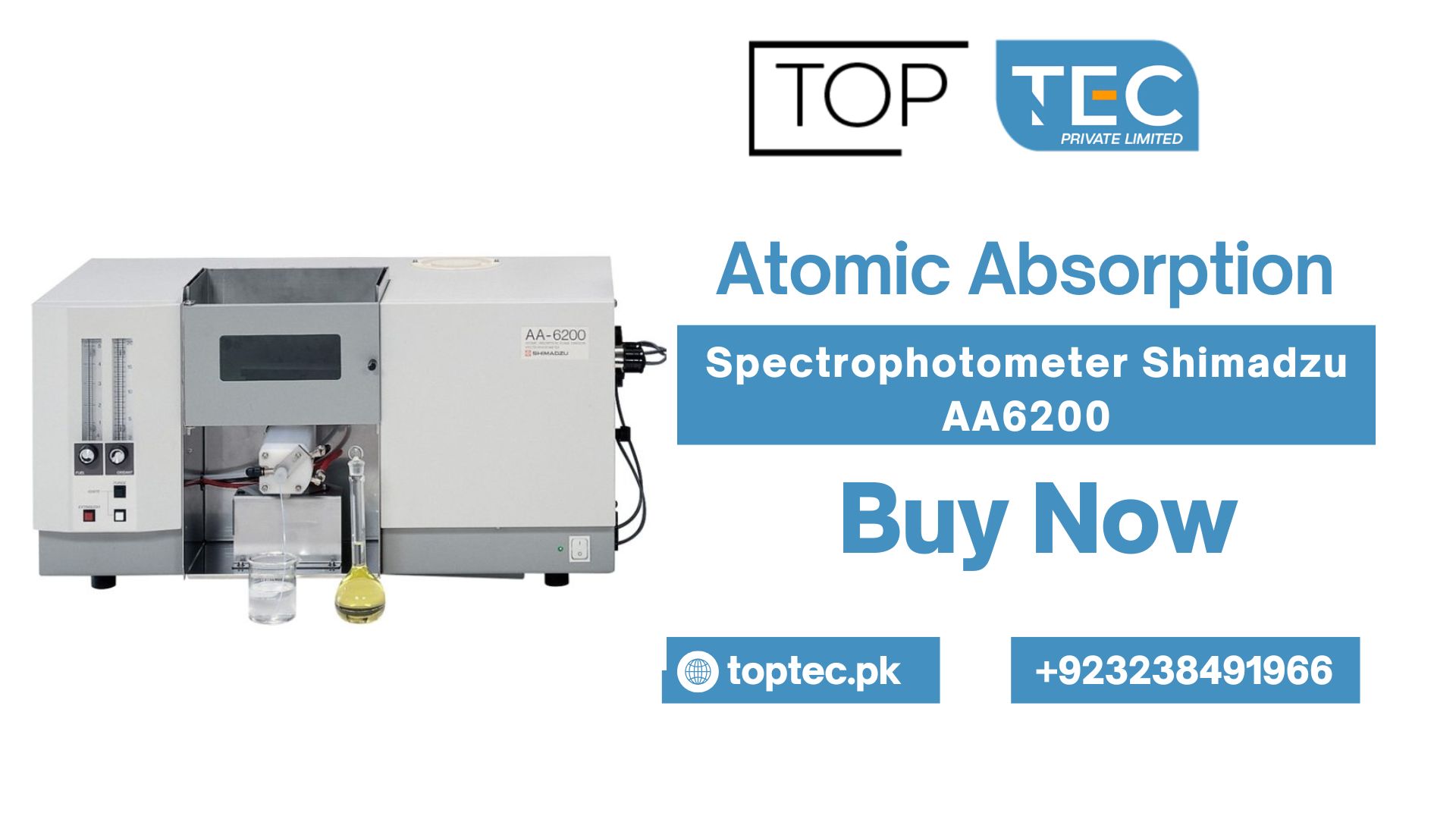
If you’ve been researching atomic absorption spectroscopy instruments and the Shimadzu AA-6200 keeps coming up in your search results, there’s a reason for that. It’s a genuinely capable instrument that’s found a strong position in pharmaceutical QC labs, environmental testing facilities, food safety laboratories, and water quality operations — particularly across South Asia and the Middle East, including Pakistan.
But “capable instrument” doesn’t tell you whether it’s the right choice for your specific application. So this guide is going to work through what the Shimadzu AA-6200 actually is, how its double-beam Atomic Absorption Spectrophotometer design works and why that matters, what it’s genuinely suited for, and what to think about before purchasing. We’ll also cover laboratory infrastructure — because an AAS instrument needs a properly designed lab space to perform correctly, and that’s something a lot of buyers don’t think about until after the instrument arrives.
What Is the Shimadzu AA-6200?
The Shimadzu AA-6200 is a flame and furnace Atomic Absorption Spectrophotometer manufactured by Shimadzu Corporation, a Japanese analytical instruments company with a long-established reputation in laboratory science.
Specifically, it’s a double-beam instrument — which is an optical design choice with real practical implications that we’ll get into shortly. It supports both flame AAS (using an air-acetylene or nitrous oxide-acetylene flame) and, with appropriate accessories, graphite furnace AAS for trace-level analysis.
The instrument is positioned in Shimadzu’s lineup as a mid-to-high range atomic absorption spectrophotometer — capable enough for serious analytical work, including regulatory compliance testing, without being at the upper extreme of price and complexity that research-grade systems occupy.
How Atomic Absorption Spectrophotometry Works
Before getting into the Shimadzu AA-6200 specifically, let’s make sure the underlying principle is clear. This is one of those analytical techniques where understanding the physics makes the instrument’s specifications much more meaningful.
The Basic Principle
Every element, when it exists as free atoms in the gas phase, absorbs light at very specific wavelengths — wavelengths that are unique to that element. This is the quantum mechanical fingerprint of each element’s electron structure.
An Atomic Absorption Spectrophotometer exploits this by:
- Creating free atoms from your sample — done by introducing the sample into a flame or graphite furnace at temperatures high enough to dissociate the sample matrix and produce ground-state atoms
- Shining light from a hollow cathode lamp (HCL) through those atoms — the lamp is element-specific, producing light at exactly the wavelengths that element absorbs
- Measuring how much of that light gets absorbed — the more atoms present, the more light absorbed. This follows Beer-Lambert law, giving you a linear relationship between absorbance and concentration
- Comparing absorption to calibration standards of known concentration — giving you the concentration of the element in your sample
The result: elemental analysis that’s highly sensitive, highly element-specific, and practical for routine laboratory work.
Why Single-Element Analysis?
AAS analyzes one element at a time. This is its fundamental characteristic compared to multi-element techniques like ICP-OES or ICP-MS. For many routine applications — checking lead in drinking water, confirming zinc content in a pharmaceutical formulation, monitoring copper in food products — this isn’t a limitation. You know which elements you need to test, and you test them sequentially. For labs needing simultaneous multi-element profiling of unknown samples, ICP-based techniques are more appropriate.
The Double-Beam Design: Why It Matters
The Shimadzu AA-6200 uses a double-beam optical configuration, and this is worth understanding properly rather than just accepting as a specification bullet point.
Single-Beam vs. Double-Beam
In a single-beam Atomic Absorption Spectrophotometer, the light from the hollow cathode lamp travels a single path: through the flame/furnace, then to the detector. Simple and effective, but with a vulnerability: any drift in lamp output intensity over time appears as a change in absorbance signal — indistinguishable from a real change in analyte concentration. Lamps need warm-up time, and even after warm-up, some drift occurs.
In a double-beam instrument like the Shimadzu AA-6200, the light beam is split by a half-mirror immediately after leaving the hollow cathode lamp. One beam goes through the sample (flame or furnace) — the sample beam. The other beam bypasses the sample entirely and goes directly to a reference detector — the reference beam.
The instrument continuously compares these two beams. If the lamp output fluctuates — drifts up or down — both beams change by the same amount. The ratiometric comparison between them cancels out this drift. What remains after the comparison is only the absorbance caused by the sample atoms.
Practical Benefits
Reduced warm-up time: With single-beam instruments, you typically need 20-30 minutes of lamp warm-up before measurements are stable. With the double-beam design of the Shimadzu AA-6200, the reference beam compensation means measurements are stable sooner after lamp ignition.
Better long-term stability: For long analytical runs with many samples — common in routine QC labs — double-beam instruments maintain calibration better over time. Recalibration frequency is reduced.
Improved baseline stability: Environmental factors like room temperature changes and vibrations affect lamp output slightly. Double-beam compensation reduces the impact of these factors on analytical results.
For a pharmaceutical QC lab running dozens of samples per day, or a water testing laboratory processing many environmental samples, this stability translates directly into more reliable data and more efficient analytical workflow.
Flame AAS on the Shimadzu AA-6200
Flame atomization is the primary mode for most routine applications on the Shimadzu AA-6200. The sample — typically a liquid — is aspirated into a nebulizer, converted to a fine aerosol, and introduced into a flame where the sample matrix is burned away and free analyte atoms are created.
Flame Types
Air-acetylene flame (approximately 2300°C): Used for most routine elements — copper, zinc, iron, manganese, lead, cadmium, nickel, chromium, and many others. This is the flame used in the majority of routine Shimadzu AA-6200 applications.
Nitrous oxide-acetylene flame (approximately 2900°C): For refractory elements that require higher temperatures to atomize — aluminum, silicon, calcium at high concentrations, barium, and others. The Shimadzu AA-6200 supports both flame types with appropriate burner head configurations.
Sensitivity and Detection Limits
Flame AAS has characteristic sensitivity in the mg/L (ppm) range for most elements. For many routine applications — water quality testing at regulatory limits, pharmaceutical raw material testing, food composition analysis — this sensitivity is entirely adequate.
Where flame AAS reaches its limits is in trace and ultra-trace analysis in the µg/L (ppb) range. For those applications, graphite furnace AAS (GFAAS) using the furnace accessory dramatically improves detection limits — typically 100-1000x better than flame.
Applications: Where the Shimadzu AA-6200 Is Used
Water Quality Testing
This is one of the most common applications for the Atomic Absorption Spectrophotometer in Pakistan and across the region. Drinking water, groundwater, wastewater, and industrial effluents all require monitoring for heavy metals — lead, cadmium, arsenic, chromium, copper, zinc, manganese, iron, and others.
The Shimadzu AA-6200 handles the standard water quality metals panel efficiently. For the trace-level metals (lead, cadmium, arsenic) where drinking water limits are very low, furnace atomization mode provides the necessary detection limits.
Environmental testing labs, municipal water authorities, industrial effluent monitoring programs — all are common operators of this Atomic Absorption Spectrophotometer configuration.
Pharmaceutical Testing
In pharmaceutical manufacturing in Pakistan, the Shimadzu AA-6200 is used for:
Heavy metals in raw materials and finished products: ICH Q3D elemental impurities guideline and USP <232>/<233> specify elemental impurity limits for pharmaceutical products. While ICP-MS is increasingly the preferred technique for comprehensive elemental impurity screening, AAS remains acceptable and widely used for specific element testing.
Catalyst residues: Many pharmaceutical synthesis processes use metal catalysts — palladium, platinum, nickel — that must be shown to be below specified limits in the final product.
Mineral supplement quantification: For vitamin and mineral supplement products, AAS provides straightforward quantification of calcium, magnesium, zinc, iron, and other mineral nutrients.
Water for pharmaceutical use: Metal content of purified water and water for injection is tested by AAS in many pharmaceutical facilities.
Food and Agricultural Testing
Food safety testing is a growing application area for the Shimadzu AA-6200:
Heavy metal contamination: Lead, cadmium, mercury, and arsenic in food products — particularly rice, vegetables, seafood, and products from areas with industrial contamination.
Mineral content: Nutritional labeling and composition analysis for minerals in food products.
Feed and fertilizer analysis: Agricultural input quality control.
Soil analysis: For agricultural research and environmental monitoring.
Industrial and Materials Testing
Alloy composition, plating bath analysis, process water monitoring in industrial facilities — the Shimadzu AA-6200 handles a broad range of industrial elemental analysis applications.
Key Specifications Worth Understanding
Rather than just listing numbers, let me explain what the main specifications mean practically.
Wavelength range (185–900 nm): Covers all elements analyzable by AAS. No element you’d practically want to measure by AAS is outside this range.
Spectral bandwidth options: Multiple bandwidth settings allow you to optimize sensitivity versus freedom from spectral interferences depending on the element and matrix. Narrower bandwidth improves selectivity; wider bandwidth increases light throughput for elements where the lamp is dim.
Background correction: The Shimadzu AA-6200 includes deuterium lamp background correction as standard. This corrects for non-specific absorption from the sample matrix that would otherwise cause positive errors. For complex matrices — food, environmental, pharmaceutical — background correction is essential for accurate results.
Automatic lamp turret: Holds multiple hollow cathode lamps and switches between them automatically when changing elements. This significantly improves workflow efficiency when analyzing multiple elements sequentially.
Data system: The Shimadzu AA-6200 integrates with Shimadzu’s WizAArd software, which manages instrument control, calibration, result calculation, and data storage. For GMP environments, compatibility with 21 CFR Part 11 electronic records requirements is relevant.
Setting Up an AAS Laboratory: Infrastructure Matters
Here’s where a lot of purchasing guides fall short. They tell you about the instrument and stop. But the instrument is only part of what you need to get right.
An Atomic Absorption Spectrophotometer is not a benchtop instrument you plug in and start using. It requires specific laboratory infrastructure that, if not properly planned, will create problems — with safety, with performance, and with your regulatory compliance.
Ventilation Requirements
The Shimadzu AA-6200 uses an open flame — air-acetylene and potentially nitrous oxide-acetylene — for sample atomization. This flame combustion produces combustion products and aerosolized sample material. Adequate ventilation is not optional; it’s a safety requirement.
The instrument needs a dedicated exhaust connection — typically a local exhaust ventilation hood above the instrument that captures combustion gases and sample aerosol and removes them from the lab. This isn’t a general room ventilation situation; it’s a direct connection from above the burner assembly to an external exhaust system.
This is a significant installation requirement that needs to be planned before the instrument arrives, not after.
Gas Supply Infrastructure
Flame AAS requires compressed gas — acetylene fuel and air (or nitrous oxide), delivered through appropriate regulators and supply lines. Acetylene is a flammable gas and requires specific storage, handling, and supply infrastructure per applicable safety standards.
Gas lines need to be properly rated and installed, with appropriate pressure regulators at both the cylinder and the instrument. Safety shutoff valves and leak detection are part of a properly installed AAS flame system.
The Bench and Work Surface
The Shimadzu AA-6200 is a substantial instrument. Depending on configuration, it weighs 40-60 kg or more. The bench it sits on needs to:
Handle that weight without deflection. Provide a vibration-stable surface — vibration affects the burner flame stability and detector signal. Be at the right height for comfortable operation. Be made of materials that resist the chemical exposure from reagent preparation and sample handling.
This is where TOPTEC PVT. LTD becomes directly relevant to your AAS instrument purchase.
TOPTEC PVT. LTD: Laboratory Furniture for Your AAS Setup
TOPTEC PVT. LTD is a Pakistani manufacturer of laboratory furniture — actually manufactured locally in Pakistan, not imported and relabeled. For labs setting up an Atomic Absorption Spectrophotometer workstation, TOPTEC provides the complete surrounding infrastructure.
What TOPTEC Makes for AAS Labs
Heavy-duty instrument benches: Steel-frame construction with appropriate load ratings for heavy analytical instruments. Chemical-resistant surface options — epoxy resin, phenolic resin, or chemical-resistant laminate — that handle acid digestion reagents, standard solutions, and routine laboratory chemical exposure. Custom dimensions fabricated to fit your specific lab space.
Fume hoods: For sample digestion and reagent preparation. AAS sample preparation often involves acid digestion — concentrated nitric acid, hydrochloric acid — that requires a fume hood. TOPTEC manufactures both ducted and ductless fume hoods locally.
Chemical storage cabinets: Acid storage, flammable solvent storage (acetylene-adjacent areas need organized, safe chemical management), and general reagent storage. Organized chemical storage is both a safety requirement and a GMP expectation.
Reagent preparation benches: Adjacent to the main AAS instrument bench, you need prep space for standard preparation, sample digestion, and dilution work. TOPTEC can configure integrated bench systems that address the complete workflow.
Sink units: For glassware washing and general laboratory water access.
Why Local Manufacturing Makes a Difference
The lead time reality matters for laboratory setup projects. Imported laboratory furniture — from European or other international manufacturers — typically arrives in Pakistan 12-16 weeks after ordering. TOPTEC delivers standard items in 3-5 weeks, custom fabrications in 5-8 weeks.
When your Shimadzu AA-6200 is on order with a 6-8 week delivery timeline, you want your lab furniture arriving at roughly the same time — not 8 weeks after the instrument is sitting in your receiving area waiting for a bench.
Custom dimensions are a practical issue too. Your lab space has specific dimensions. TOPTEC fabricates to your exact measurements. Imported furniture forces you to adapt your layout to standard module sizes.
PKR pricing eliminates currency exposure between quotation and delivery — meaningful in Pakistan’s current economic environment.
Is the Shimadzu AA-6200 Right for Your Lab?
Let me give you a direct answer based on application.
Good fit if:
- You need routine metals analysis for water, pharmaceutical QC, or food testing
- Your primary elements are in the standard flame AAS range
- You need regulatory compliance testing per WHO, USP, or local DRAP requirements
- You want double-beam stability for high-throughput routine work
- You’re in Pakistan and need local Shimadzu distributor support
Consider alternatives if:
- You need simultaneous multi-element analysis of many elements — ICP-OES or ICP-MS is more efficient
- Your entire workload is at ultra-trace ppb/ppt levels — ICP-MS offers better sensitivity across the board
- Budget is very constrained — entry-level single-beam AAS instruments cost less, though with performance trade-offs
For most pharmaceutical QC labs, water testing facilities, and food safety laboratories in Pakistan that need a reliable, double-beam Atomic Absorption Spectrophotometer with Shimadzu’s support infrastructure — the Shimadzu AA-6200 is a sound choice.
Final Thoughts
The Shimadzu AA-6200 is a double-beam Atomic Absorption Spectrophotometer that delivers genuine analytical capability for the applications it’s designed for — water quality metals testing, pharmaceutical elemental impurity analysis, food safety heavy metal monitoring, and industrial elemental analysis.
Understanding the double-beam design, the flame versus furnace options, and the application range helps you make a confident purchasing decision rather than relying on a salesperson’s word.
And when you’re setting up your AAS laboratory, invest equal attention in the infrastructure that surrounds the instrument — ventilation, gas supply, and proper bench and storage systems from a manufacturer who understands laboratory requirements. TOPTEC PVT. LTD manufactures all of this locally in Pakistan, with realistic lead times, PKR pricing, and the flexibility to match your specific lab dimensions and requirements.
Get both the instrument and the environment right, and your AAS operation will deliver reliable, compliant analytical data for years.
Contact TOPTEC PVT. LTD
TOPTEC PVT. LTD manufactures laboratory workbenches, fume hoods, chemical storage cabinets, sink units, and complete laboratory furniture solutions — all manufactured locally in Pakistan for pharmaceutical, environmental, food safety, and research laboratory environments.
Contact TOPTEC to discuss your AAS laboratory infrastructure requirements and receive a customized quotation.
