

A pharmaceutical company purchases a double cone mixer based primarily on the working capacity figure in a product brochure. The machine arrives, gets installed, and within the first few weeks of production they realize either the batch size they’re actually running is too small for the mixer volume — giving poor blending — or the machine is genuinely undersized for scale-up requirements that were already on the roadmap.
Both situations are expensive and frustrating. And both are avoidable if you understand what the specifications actually mean before you make the purchasing decision.
This guide covers double cone mixer specifications properly — sizes, capacities, speed ranges, and how these parameters interact for pharmaceutical powder blending. We’ll also cover the double cone blender in the context of regulatory compliance requirements and what laboratory infrastructure you need around this equipment.
What a Double Cone Mixer Actually Is
Before specifications, a brief description for anyone who needs it.
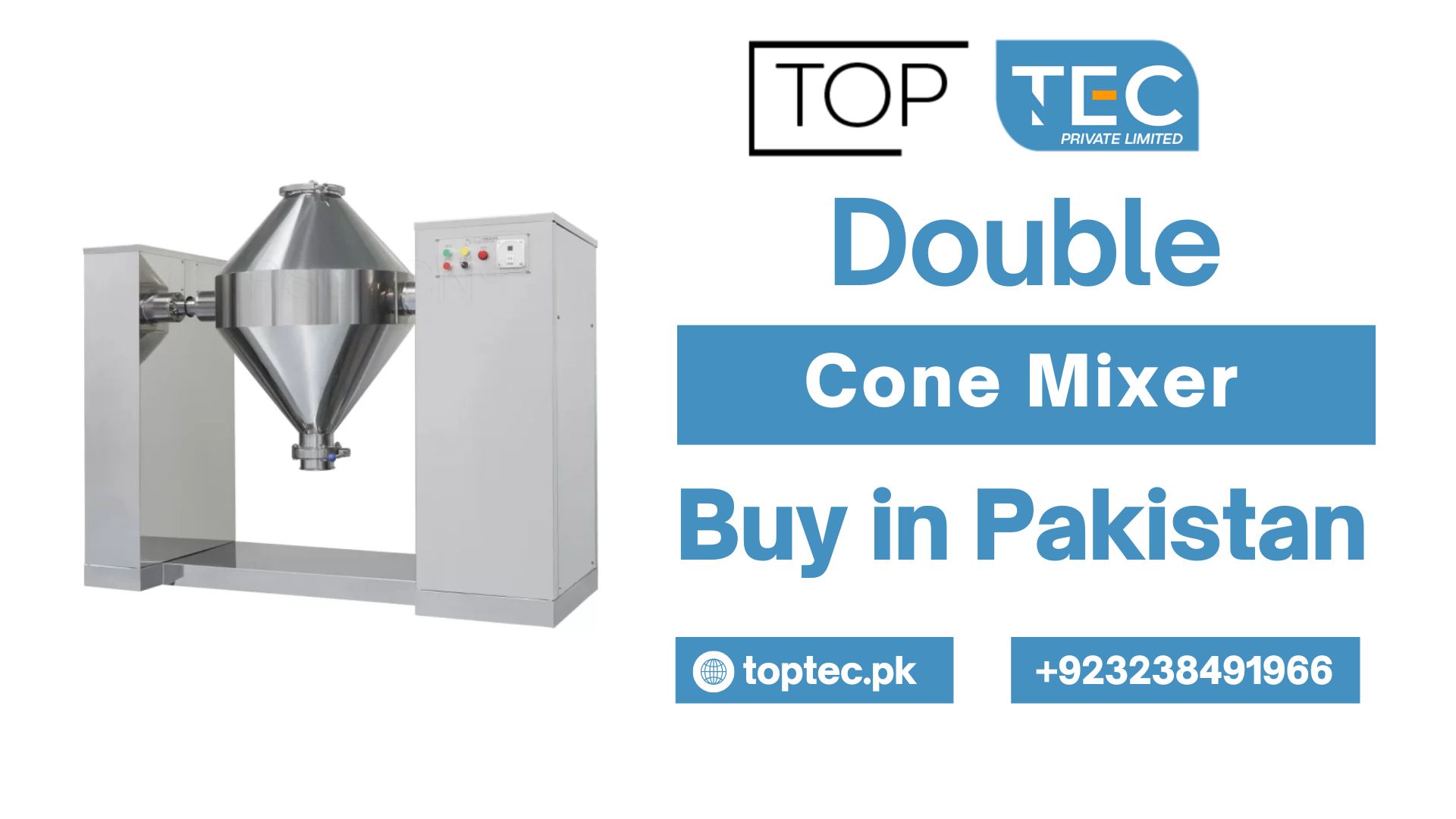
A double cone mixer consists of two conical sections joined at their widest diameter, mounted on a horizontal shaft that runs through both cone tips. The shell rotates around this shaft, tumbling the powder contents through a continuous folding and cascading motion.
It’s a tumble blender — no internal agitator, no impeller, no forced mixing element. The mixing action comes entirely from the geometry of the shell and its rotation. Material cascades from one cone section to the other with each rotation, progressively distributing components throughout the batch.
This gentle tumbling action is what makes the double cone blender well-suited to pharmaceutical powders: it mixes without generating significant heat, without degrading fragile particles or granules, and without creating excessive fines from attrition.
The double cone mixer is distinct from the V-blender (which has two cylinders in a V configuration) and the bin blender (which uses removable bins). Each has specific advantages — but the double cone’s enclosed geometry and efficient mixing action make it a popular choice for pharmaceutical solid dosage form manufacturing.
Total Volume vs. Working Capacity: The Most Important Distinction
This is the specification that causes the most confusion, so let’s deal with it first.
Every double cone mixer has two capacity figures:
Total volume: The entire internal volume of the shell in its empty state.
Working capacity: The actual usable batch volume — typically expressed as a percentage of total volume, most commonly 40–60%.
Why can’t you fill it completely? Because a tumble blender needs empty space for the powder to move. If you fill a double cone blender to 100% of its total volume, there’s nowhere for the material to cascade to — the powder just rotates as a solid mass without any mixing occurring.
The sweet spot for most pharmaceutical powder blending is 40–60% fill. Below 40%, the batch size is too small relative to the shell, the material behavior changes, and mixing efficiency drops. Above 60%, insufficient headspace limits cascading action and blending time increases significantly.
Practical implication: A double cone mixer with a 500L total volume has a working capacity of approximately 200–300L. If your batch size is 400L, this machine is undersized. If your batch size is 100L, you’re operating too far below the minimum fill and mixing quality will be inconsistent.
Match your intended batch size to the working capacity, not the total volume.
Standard Size Ranges Available
Double cone mixer and double cone blender equipment is manufactured across a very wide size range — from small laboratory units through full production-scale equipment. Here’s a practical overview of the common size categories:
Laboratory and Pilot Scale
5L to 50L total volume (2–25L working capacity)
These small units are used for:
- Formulation development — evaluating blending behavior of new formulations
- Analytical method development — preparing homogeneous powder blends for analytical work
- Process parameter studies — determining optimal blending time, speed, and fill level before scaling up
- Small batch production of clinical trial materials
At this scale, the double cone mixer is typically table-mounted or on a small stand. These units are affordable enough that a pharmaceutical development lab may have multiple sizes for different development stages.
Medium Scale
100L to 500L total volume (40–250L working capacity)
This is the most common range for small to medium pharmaceutical manufacturing operations. Working capacity of 40–250L covers batch sizes appropriate for:
- Small-scale commercial production
- Scale-up from pilot to initial commercial batches
- Manufacturing where batch sizes are constrained by API availability or market demand
This size range is also practical for multi-product facilities where different formulations with different batch sizes are manufactured on the same equipment. The working capacity range (40–60% of total volume) provides flexibility to accommodate batch size variation.
Large Scale
500L to 2000L total volume (200–1000L working capacity)
Full commercial production scale for pharmaceutical solid dosage forms. At this scale:
- The double cone blender is floor-mounted with significant structural requirements
- Material charging and discharge systems (lifts, pneumatic systems, bin handling) become important design considerations
- Motor sizing, drive mechanism, and frame construction are substantial engineering items
- Cleaning validation becomes more complex due to the surface area involved
Very Large Scale
2000L to 10,000L+ total volume
These exist in large-scale pharmaceutical and bulk chemical manufacturing. Structural requirements, installation complexity, and associated infrastructure costs are substantial. Most pharmaceutical tablet and capsule manufacturers don’t need equipment at this extreme — but bulk ingredient manufacturers may.
Speed Specifications: What RPM Actually Means for Blending
Speed is one of the most discussed and most misunderstood specifications for double cone mixer equipment. Let me explain what the numbers actually mean and how to think about speed selection.
Typical Speed Range
Most pharmaceutical double cone blender equipment operates in the range of 2–25 RPM. Some units have fixed speed; better equipment allows variable speed control — and for pharmaceutical applications, variable speed is strongly preferred.
Why Speed Selection Matters
The key parameter in tumble blending is not exactly RPM — it’s the relationship between the rotation speed and what’s called the critical speed.
Critical speed is the rotation speed at which centrifugal force equals gravitational force at the outermost point of the shell interior. At or above critical speed, powder sticks to the shell wall and stops cascading — mixing ceases completely. Effective blending happens at speeds well below critical speed, typically 30–60% of critical speed.
The actual critical speed depends on the shell diameter:
Critical Speed (RPM) ≈ 42.3 / √(radius in meters)
This means larger double cone mixer units have lower critical speeds, and their operating speeds need to be lower in absolute RPM terms to maintain the same relative tumbling action.
This is why simply comparing RPM between different size units is misleading. A 10 RPM operating speed on a 200L unit and a 10 RPM operating speed on a 2000L unit are completely different in terms of the cascade action created — the larger unit needs to run at lower RPM to achieve the equivalent relative motion.
Practical Speed Guidelines
For most pharmaceutical powder blending applications:
Cohesive, fine powders: Lower end of operating range, typically 6–10 RPM. Faster speeds can cause these powders to segregate or agglomerate.
Free-flowing granules: Middle of operating range, 10–15 RPM typically.
Mixed particle size materials: Careful speed optimization required — too fast promotes segregation of different-sized particles.
Blends containing lubricant (magnesium stearate): Critical to optimize both speed and blending time. Over-blending lubricants in a double cone blender reduces tablet compressibility — this is one of the most important process parameters to get right in solid dosage manufacturing.
Variable Speed: Why It Matters for Pharmaceutical Work
A double cone mixer with variable speed control gives you the flexibility to:
- Optimize speed for different formulations
- Scale-up validated processes while maintaining equivalent mixing action
- Comply with validated process parameters that may specify a particular speed range
- Troubleshoot blending issues by systematically evaluating speed effect
Fixed-speed units are cheaper but limit your flexibility. For pharmaceutical manufacturing where process validation is required, variable speed control is almost always worth the additional cost.
Material Construction Specifications
For pharmaceutical applications, the material of construction of a double cone blender is a regulatory and quality requirement, not just a cost consideration.
Shell Material
316L stainless steel is the standard for pharmaceutical-grade double cone mixer equipment. The “L” designation indicates low carbon content, which improves corrosion resistance at welds — important because the shell has welded seams.
316L offers:
- Excellent corrosion resistance to most pharmaceutical cleaning agents and active compounds
- Non-reactive with pharmaceutical ingredients under normal processing conditions
- Suitable for CIP (clean-in-place) and WIP (wash-in-place) cleaning if so designed
- Meets cGMP material requirements
304 stainless steel is sometimes offered at lower cost. It’s adequate for many applications but lacks the molybdenum content that gives 316L its superior corrosion resistance — particularly to chloride-containing cleaners and some active ingredients.
For a pharmaceutical-grade double cone blender, specify 316L as standard.
Surface Finish
The interior surface finish of the shell is specified by Ra value — average surface roughness in micrometers. Smoother surfaces:
- Are easier to clean completely
- Have lower surface area for product adhesion and contamination retention
- Are more resistant to corrosion initiation
Pharmaceutical-grade double cone mixer equipment typically specifies interior finish of Ra ≤ 0.4 µm or Ra ≤ 0.8 µm. Ra ≤ 0.4 µm (electropolished) is preferred for products with potent actives or stringent cleaning validation requirements.
Shaft and Bearing Design
The rotating shaft passes through both cone tips and is supported by bearings outside the process zone. The shaft/cone interface — where the shaft enters the powder contact zone — is a critical design area. Poor sealing here creates:
- Contamination of product with lubricant or bearing material
- Difficult-to-clean areas that retain product between batches (cross-contamination risk)
Better-designed double cone blender equipment uses inflatable shaft seals, mechanical seals, or split-shell designs that eliminate problematic shaft penetrations into the process zone. Ask specifically about shaft sealing design when evaluating equipment.
Drive and Motor Specifications
The drive system of a double cone mixer needs to be specified appropriately for the application.
Motor Power Requirements
Motor power scales approximately with shell volume and process material density. General guidelines:
- 5L–50L units: 0.25–1.5 kW
- 100L–500L units: 1.5–7.5 kW
- 500L–2000L units: 7.5–30 kW
For pharmaceutical powders with typical bulk densities (0.4–0.8 g/mL), these ranges are adequate. For very dense materials — certain inorganic salts, metal powder blends — motor sizing needs upward adjustment.
Drive Type
Gear-driven systems provide direct, reliable power transmission with good torque at low speeds. Standard for most pharmaceutical double cone blender applications.
Belt-driven systems offer some vibration isolation and are quieter, but require belt tension monitoring and periodic belt replacement.
Direct drive (gearmotor) systems combine motor and gearbox in a compact unit — increasingly common in modern equipment for reliability and reduced maintenance.
For a GMP pharmaceutical environment, specify a drive system with:
- Inverter (VFD) control for variable speed
- Torque limiting protection to prevent overload damage if the machine is overfilled
- Smooth start capability to prevent powder disturbance at startup
Discharge and Charging Systems
How material gets into and out of the double cone mixer is a specification area that has major implications for contained pharmaceutical manufacturing.
Discharge Valve Design
The discharge valve at one cone tip must:
- Open and close completely without trapping powder in the valve mechanism
- Be completely flushable during cleaning
- Have no dead spaces where cross-contamination can occur
- Be accessible for inspection and cleaning validation swabbing
Butterfly valves are common. Flush-diaphragm valves offer better cleanability. For highly potent APIs, contained discharge systems with split butterfly valves or active containment interfaces may be required.
Charging Port
The charging port — where material is loaded into the double cone blender — needs to accommodate your material handling system. Options include:
- Simple manhole with flanged cover for manual or sack-charging
- Flanged connection for pneumatic transfer from above
- Bin-to-blender connection systems for dust-free, contained charging
Blending Time and End-Point Determination
The double cone mixer specification that pharmaceutical manufacturers sometimes don’t think about during purchasing is blending time — and how you know when blending is complete.
Blending Time Ranges
Typical blending times in a double cone blender range from 5 to 30 minutes for most pharmaceutical powder formulations. This is surprisingly short — the tumble blending mechanism is efficient when operating parameters are correct.
Factors affecting required blending time:
- Number of components and their concentration differences
- Particle size differences between components
- Cohesiveness of the blend
- Fill level relative to working capacity
- Rotation speed
Blend Uniformity Testing
Pharmaceutical blend uniformity must be demonstrated analytically — typically by withdrawing samples from multiple positions in the blender at the end of the specified blending time and analyzing each for API content. Acceptance criteria per USP <905> or equivalent require relative standard deviation ≤6% and individual values within 85–115% of label claim.
The sampling system — how samples are extracted from a rotating double cone blender — is a specification item worth discussing with suppliers. Thief sampling through sampling ports in the shell is the common approach.
GMP and Regulatory Considerations
A pharmaceutical-grade double cone mixer purchased for a DRAP-regulated Pakistani pharmaceutical facility needs to satisfy GMP documentation requirements.
Documentation Package
At purchase, the supplier should provide:
- Design qualification (DQ) documentation or equivalent specifications
- Material certificates for all product-contact components (316L shell, seals, valves)
- Surface finish certification (Ra values)
- Dimensional drawings
- Weld inspection records
- Cleaning validation support data
At installation, IQ/OQ/PQ qualification is required:
- IQ verifies correct installation
- OQ verifies operational parameters (speed accuracy, rotation direction, safety system function)
- PQ verifies blending performance with actual pharmaceutical materials through blend uniformity testing
Setting Up Your Mixing Area: Lab Infrastructure Matters
A double cone blender doesn’t operate in isolation. The area around it — the floor space, the material handling systems, the cleaning infrastructure — needs to be designed properly.
This is where TOPTEC PVT. LTD is directly relevant to your equipment purchase planning.
TOPTEC is a Pakistani manufacturer of laboratory furniture and lab infrastructure — actually manufacturing locally, not importing and reselling. For pharmaceutical manufacturing areas housing double cone mixer equipment, TOPTEC provides the supporting infrastructure that enables the mixing operation to function safely, efficiently, and in compliance with GMP requirements.
What TOPTEC Makes for Mixing Area Support
Heavy-duty workbenches for adjacent operations: Material weighing, sampling, and documentation activities that happen around the double cone blender need appropriate bench infrastructure — load-bearing steel-frame construction with cleanable surfaces appropriate for a pharmaceutical manufacturing environment.
Sampling and testing stations: After blend discharge, samples are taken for blend uniformity testing. Dedicated, cleanable sampling stations adjacent to the blender discharge area with appropriate documentation surfaces.
Cleaning and maintenance access areas: GMP cleaning validation requires defined cleaning procedures with accessible surfaces. TOPTEC’s stainless steel and chemical-resistant furniture is designed for the cleaning agents used in pharmaceutical manufacturing.
Storage systems: Raw material containers, empty discharge bins, sampling equipment, and cleaning materials all need organized, GMP-appropriate storage adjacent to the manufacturing area.
Documentation and label stations: In a pharmaceutical manufacturing environment, every batch operation requires contemporaneous documentation. Properly positioned documentation stations with appropriate furniture support GMP record-keeping requirements.
The Local Manufacturing Advantage
When you’re planning a pharmaceutical manufacturing area that includes a double cone mixer installation, coordinating equipment delivery with infrastructure delivery matters significantly. A blender that arrives before the bench and material handling infrastructure is ready can sit in its crates for weeks.
TOPTEC manufactures in Pakistan with delivery timelines of 3-5 weeks for standard items and 5-8 weeks for custom fabrications — realistic timelines that can be coordinated with equipment installation schedules. Imported furniture takes 12-16 weeks.
Custom dimensions are also practically important. Pharmaceutical manufacturing areas are often in existing buildings with fixed floor plans. TOPTEC fabricates furniture to your exact room dimensions rather than requiring you to adapt your layout to standard module widths.
PKR pricing eliminates currency exposure between quotation and delivery.
Specification Summary Checklist
Before purchasing a double cone blender for pharmaceutical use:
- ☐ Total volume vs. working capacity — match working capacity to your batch size range
- ☐ Speed range and variability — variable speed strongly preferred for pharmaceutical work
- ☐ Shell material — 316L stainless steel as standard minimum
- ☐ Interior surface finish — Ra ≤ 0.4 µm or Ra ≤ 0.8 µm specified
- ☐ Shaft sealing design — reviewed for cleanability and containment
- ☐ Discharge valve type — appropriate for your containment and cleaning requirements
- ☐ Motor power — sized for your material density and batch size
- ☐ Drive type — with VFD for speed control
- ☐ Documentation package — material certificates, DQ documentation, drawings
- ☐ Sampling ports — for blend uniformity sampling during qualification
- ☐ Local support and spare parts availability — verified before purchasing
Final Thoughts
The double cone mixer is a deceptively simple-looking piece of equipment with specifications that have real consequences for pharmaceutical product quality. Getting the working capacity right, the speed range appropriate for your materials, the material construction to GMP standard, and the drive system properly specified — these decisions directly affect blend uniformity, cleaning validation success, process scalability, and regulatory compliance.
Invest the time to understand the specifications before purchasing. And invest equal attention in the manufacturing area infrastructure that surrounds the double cone blender — the benches, storage, sampling stations, and documentation areas that enable GMP-compliant operation.
TOPTEC PVT. LTD manufactures all of this infrastructure locally in Pakistan — on realistic timelines, at PKR pricing, fabricated to your exact space dimensions.
Contact TOPTEC PVT. LTD
TOPTEC PVT. LTD manufactures heavy-duty laboratory and pharmaceutical manufacturing workbenches, sampling stations, storage systems, and complete area infrastructure solutions — all manufactured locally in Pakistan.
Contact TOPTEC to discuss your pharmaceutical manufacturing area infrastructure requirements and receive a customized quotation.
