

A Practical Guide for Pharmaceutical QC Labs That Need Reliable Moisture Data Without the Wait – The result comes back four hours after the sample was received. Production is waiting. The warehouse is holding material. And four hours for a moisture test that could have been done in eight minutes feels genuinely wasteful when you understand the alternative.
The alternative is a digital moisture analyzer. And understanding how to use it correctly — when it’s appropriate, how to validate it, what the specifications mean for pharmaceutical raw material testing — is what this guide is about.
Loss-on-Drying: The Pharmacopeial Context
Before getting into instrument specifics, let’s be clear about what loss-on-drying actually is in a regulatory sense.
Loss on drying (LOD) is a pharmacopeial test — described in USP <731>, EP 2.2.32, and IP equivalents — that measures the loss of mass when a substance is dried under specified conditions of temperature and time. The result reflects volatile matter removed under those conditions, primarily water but potentially also other volatile substances present in the material.
This is an important nuance. LOD measures all volatile mass loss, not specifically water content. For most pharmaceutical raw materials, the volatile content is predominantly water and LOD is used as a practical proxy for moisture content. But for materials containing volatile organic solvents, or materials that partially decompose under drying conditions, LOD and water content are not the same thing. Karl Fischer titration — which specifically measures water — is the appropriate test when specific water content is needed and other volatiles complicate the LOD picture.
For most pharmaceutical raw material incoming testing, LOD per pharmacopeial specification is what’s required. The digital moisture analyzer provides LOD results by the same thermogravimetric principle as the oven method — just faster, automated, and with continuous monitoring.
How the Digital Moisture Analyzer Works for LOD Testing
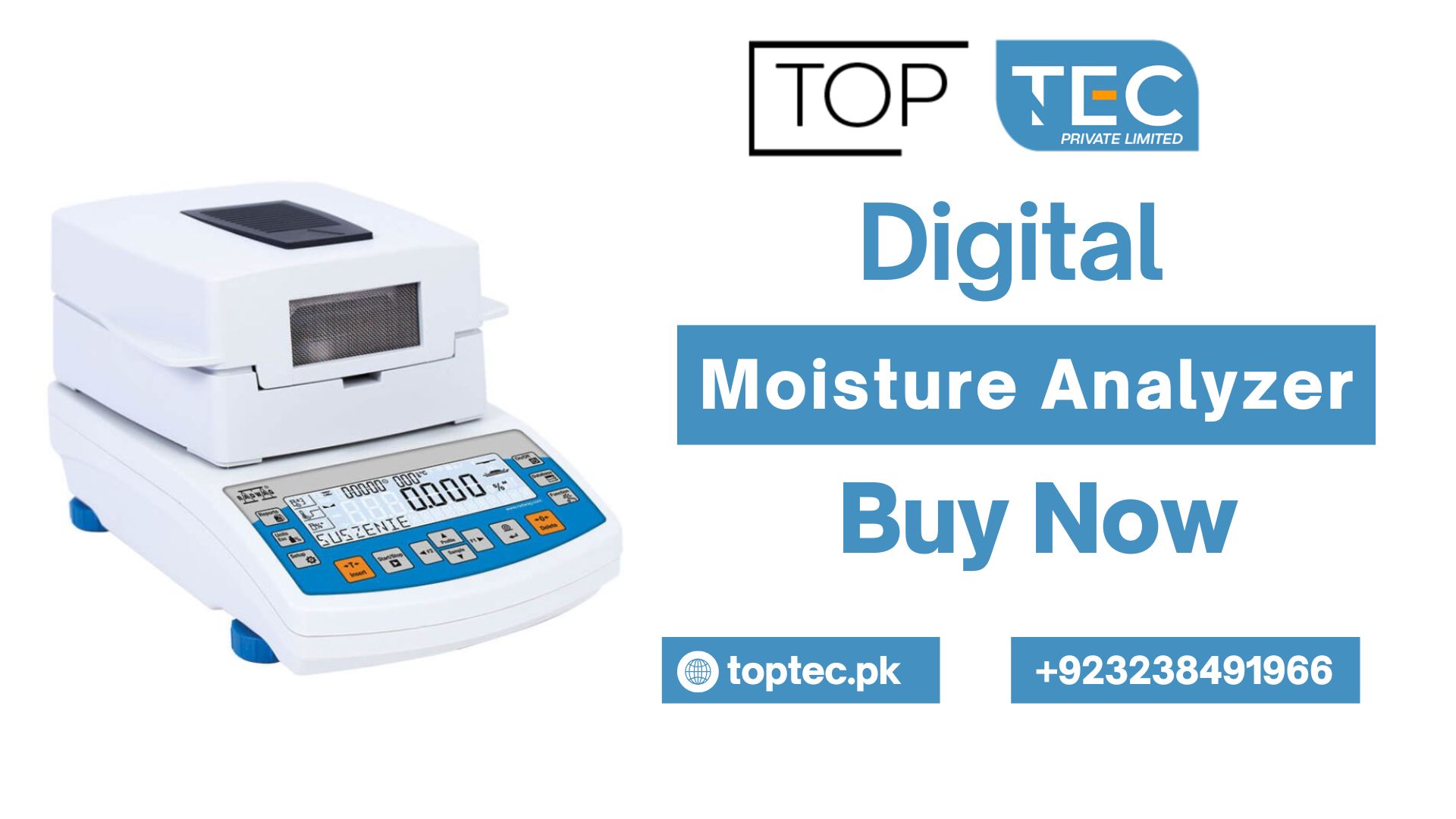
A digital moisture analyzer combines a precision balance and a drying chamber in a single integrated instrument. The sample sits on the balance pan inside the drying chamber. The instrument records the initial mass, activates the heating element, and continuously monitors mass as moisture evaporates.
The calculation is identical to the manual oven method:
LOD (%) = [(Initial mass − Dry mass) / Initial mass] × 100
What’s different is how the endpoint is determined.
With the oven method, you dry for a specified time, then weigh manually. You may not know whether drying is complete — some methods require repeated drying periods until constant mass is achieved, which means multiple oven cycles over many hours.
The moisture balance monitors mass continuously in real time. Modern instruments display the drying curve as it progresses — you can watch the moisture percentage decreasing toward its endpoint. Stop criteria can be set to automatically end the test when mass loss rate falls below a defined threshold (typically 1mg per defined time period), when a fixed time elapses, or when a target moisture content is reached.
This continuous monitoring is actually an improvement over the oven method in terms of understanding sample behavior. You can see whether the sample dried smoothly and rapidly, whether it has a long tail of slow moisture release, whether it reaches a clear endpoint or continues losing small amounts of mass indefinitely. This information is valuable for method development and for understanding material behavior.
Halogen Moisture Analyzer vs. Other Heating Technologies
When people say digital moisture analyzer, they’re usually referring to one of three heating technologies. Understanding which is which — and which is appropriate for pharmaceutical LOD testing — matters for equipment selection.
Halogen Moisture Analyzer
The halogen moisture analyzer uses a halogen lamp as its heat source. The lamp produces near-infrared radiation that heats the sample rapidly — the halogen moisture analyzer reaches its set temperature almost instantly, unlike a conventional oven that takes time to equilibrate.
This rapid heat-up is the primary advantage of the halogen moisture analyzer for pharmaceutical QC work. Analysis times for many materials are in the 3-10 minute range. For a busy incoming QC lab testing multiple raw material lots per day, this speed advantage is genuinely significant.
The halogen moisture analyzer is the most common type in modern pharmaceutical laboratory use — the combination of speed, adequate temperature range, and relatively straightforward maintenance (eventual lamp replacement) makes it the practical first choice for most applications.
Infrared Moisture Balance
Uses infrared lamp heating similar in principle to halogen but with slightly different spectral output. The moisture balance with infrared heating has similar characteristics to halogen in terms of application suitability, with somewhat slower heat-up response.
Resistive Metal Element
Some digital moisture analyzer instruments use resistive heating elements instead of lamps. These have very long element life (essentially no scheduled replacement) and consistent output over time, at the cost of slower temperature response. For labs prioritizing low maintenance over speed, this is worth considering.
Pharmaceutical Raw Material Applications: Where This Equipment Fits
Not all pharmaceutical raw materials are equally suited to digital moisture analyzer testing. Understanding where it works and where it doesn’t determines whether you’re getting valid LOD data or misleading numbers.
Materials Well-Suited to Digital Moisture Analyzer Testing
Excipients with straightforward moisture profiles: Microcrystalline cellulose (MCC), lactose monohydrate, starch, and similar common excipients typically have well-characterized moisture behavior that translates cleanly to moisture balance analysis. These materials have been studied extensively and correlation with oven LOD is well-established.
Pharmaceutical raw materials with specifications in the 0.5-8% LOD range: Materials in this range provide enough mass change for reliable measurement without the complications of very high or very low moisture content.
Granules and blends from in-process testing: Wet granulation process monitoring is one of the most valuable applications of the digital moisture analyzer in pharmaceutical manufacturing. Rapid LOD results at different stages of the granulation and drying process allow real-time process control decisions that simply aren’t possible with 4-hour oven methods.
Incoming raw material inspection: For materials with established and validated digital moisture analyzer methods, incoming QC testing becomes dramatically faster. A raw material lot can be released for sampling, tested for moisture, and the result in hand before other physical tests are even started.
Materials That Need Careful Validation or Alternative Methods
Thermolabile materials: APIs or excipients that degrade at elevated temperatures will show falsely high LOD because mass loss includes decomposition products, not just moisture. For these materials, either a very low drying temperature (35-50°C) must be used with the moisture balance, or alternative methods like Karl Fischer titration are more appropriate.
Materials with volatile components: If the material contains residual solvents, ethanol, or other volatile components from the manufacturing process, LOD by digital moisture analyzer captures all volatiles — the result is not a clean moisture measurement. Karl Fischer specifically measures water and avoids this complication.
Materials with very low moisture specifications: For APIs with moisture specifications of ≤0.1%, the analytical precision requirements exceed what most halogen moisture analyzer instruments can reliably deliver. Karl Fischer is the preferred method for these ultra-low moisture applications.
Hydrates with specific crystallization water: Some pharmaceutical materials exist as defined crystalline hydrates — the water is part of the crystal structure at a specific stoichiometric ratio. Drying these materials at too high a temperature can alter crystal form. Method development for these materials requires careful attention to drying conditions.
Correlation with the Pharmacopeial Oven Method
This is the part that pharmaceutical analysts sometimes skip, and it’s critically important for regulatory purposes.
The pharmacopeial LOD method (USP <731> and equivalents) specifies the oven-drying reference method: dry at specified temperature for specified time, weigh in tared dish, calculate loss. The digital moisture analyzer method is an alternative procedure that must be demonstrated to give equivalent results to the pharmacopeial reference method before it can be used for release testing.
This correlation study is not optional for pharmaceutical applications — it’s what converts a fast, convenient instrument into a validated analytical method.
How to perform the correlation study:
Test at least 10-20 samples spanning the expected range of moisture content for the material (from below specification to above specification if possible, or at least across the specification range if the material is always in-specification).
For each sample, run both methods simultaneously: conventional oven LOD per the pharmacopeial specification, and digital moisture analyzer LOD using the optimized instrument method.
Analyze the results statistically: calculate correlation coefficient (R²), slope and intercept of the regression line, and bias (systematic difference between methods). For the moisture balance method to be acceptable, R² should be ≥0.99, slope should be close to 1.0, intercept close to 0, and any systematic bias should be within defined acceptance criteria.
If correlation is acceptable, the digital moisture analyzer method is validated for that specific material. This validation is material-specific — you can’t assume that a method validated for lactose monohydrate also applies to MCC without doing the correlation work.
Document the validation with a formal protocol and report per your quality system requirements.
Method Development: Finding the Right Drying Conditions
Before you can validate a digital moisture analyzer method, you need to develop it — finding the drying temperature and stop criterion that give results correlating with the reference method for your specific material.
Step 1: Drying temperature selection
Start with the temperature specified in the pharmacopeial monograph for the conventional oven method — typically 100-105°C for most materials. Run several trials at this temperature and watch the drying curve.
If the drying curve shows rapid initial moisture loss followed by a clear plateau (constant mass), the temperature is likely appropriate. If the curve shows continued slow mass loss without reaching a clear plateau, either drying is genuinely slow at this temperature or some thermal degradation is occurring.
Check for thermal degradation by examining the sample after drying — color change, melting, charring, or unusual odor suggests the temperature is too high for this material.
Step 2: Stop criterion selection
For most pharmaceutical materials, automatic stop based on moisture equilibration (mass loss <1mg per defined time period) works well. For materials with very slow drying tails, a time-based stop may be more practical — set the time to match the point where the automatic criterion would trigger.
Step 3: Sample size optimization
Sample size affects both accuracy and analysis time. Larger samples give more mass change for the same moisture percentage — better signal-to-noise ratio. But larger samples dry more slowly, increasing analysis time. For digital moisture analyzer applications with 0.1mg readability, 1-2g samples often provide a good balance. With 1mg readability instruments, 2-5g is often appropriate.
Sample spreading — distributing the sample evenly across the sample pan rather than piling it in the center — significantly improves drying uniformity and reduces analysis time. Many halogen moisture analyzer instruments come with sample preparation accessories (spreading tools, mesh pans) that support even distribution.
Step 4: Verification with reference method
Once your instrument method parameters are established, run the correlation study described above. Adjust temperature or stop criteria if the correlation isn’t acceptable before finalizing the method.
Qualification of the Digital Moisture Analyzer in Pharmaceutical GMP
A digital moisture analyzer used for pharmaceutical QC testing must be properly qualified. The qualification requirements are analogous to other laboratory instruments.
Installation Qualification (IQ)
Document that the instrument was received as specified, installed correctly, and connected to appropriate utilities (power only for most bench-top moisture balance instruments). IQ documentation includes equipment identity (model, serial number, software version), verification against purchase specification, and environmental conditions at installation.
Operational Qualification (OQ)
Verify that the instrument operates within specification:
Balance verification: Use certified reference weights to verify that the balance reads accurately across the range of sample sizes you’ll use. For a 0.1mg readability digital moisture analyzer, this typically includes verification at multiple mass points (0.1g, 1g, 10g, full capacity). Verify repeatability by multiple readings at each weight.
Temperature verification: Verify that the drying chamber actually achieves the set temperature. This requires a calibrated contact thermometer or temperature reference device placed at the sample pan position. Verify at multiple set temperatures across your working range.
Timer accuracy: Verify that the elapsed time display is accurate against a calibrated reference.
Stop criteria function: Verify that the automatic stop criterion triggers correctly at the programmed threshold.
Performance Qualification (PQ)
Verify that the instrument performs correctly for its intended use with actual pharmaceutical materials. The method correlation study described above serves as PQ evidence when properly documented.
Ongoing Calibration
After initial qualification, maintain calibration with:
- Balance verification against certified reference weights: monthly or quarterly per your SOPs
- Temperature verification: quarterly or per SOPs
- Method verification: periodic re-verification with known reference samples to confirm method remains in-control
Common Problems in Pharmaceutical LOD Testing with Moisture Analyzers
Problem: Results consistently higher than oven method
Possible causes: Drying temperature too high causing partial thermal decomposition; volatile components other than water being measured; sample too thick on the pan.
Investigation: Compare results at lower temperatures. Examine sample after drying for signs of decomposition. Ensure sample is evenly spread.
Problem: Poor repeatability between replicates
Possible causes: Inconsistent sample preparation (varying thickness/spreading); air currents affecting balance; sample not representative (sampling from non-homogeneous material).
Investigation: Improve sample spreading consistency using accessories or technique SOP. Check instrument positioning relative to air currents. Review sampling procedure.
Problem: Result doesn’t correlate with Karl Fischer water content
This may not be a problem with the digital moisture analyzer — it may correctly reflect that the material contains volatile components other than water. LOD measures all volatiles; Karl Fischer measures specifically water. If the difference is consistent and predictable, both methods can be valid for different purposes.
Problem: Drying doesn’t reach endpoint (automatic stop never triggers)
Some materials have genuine slow-drying tails — a small fraction of moisture is bound more tightly and releases very slowly. For these materials, time-based stop criteria may be more appropriate. Alternatively, the stop criterion threshold (mg/time period) can be relaxed.
Setting Up Your Moisture Analysis Lab
A digital moisture analyzer — particularly a high-readability 0.1mg instrument — needs a properly designed environment to deliver the precision it’s capable of.
Air currents, vibration, and temperature instability all affect results. The instrument should be positioned away from HVAC vents, away from high-traffic areas that create air movement, and on a stable bench surface that doesn’t transmit vibration from adjacent equipment.
This is where TOPTEC PVT. LTD is directly relevant to your moisture analysis setup.
TOPTEC PVT. LTD manufactures laboratory furniture locally in Pakistan — genuinely manufactures, not imports and relabels. For pharmaceutical QC labs setting up digital moisture analyzer or halogen moisture analyzer workstations, TOPTEC provides the infrastructure that supports reliable moisture testing.
Instrument and balance tables: TOPTEC manufactures dedicated instrument tables with anti-vibration characteristics — marble or granite tops, or engineered isolation systems — appropriate for 0.1mg readability moisture balance instruments. Stable, level, vibration-resistant surfaces are the foundation of reliable analytical results.
Laboratory workbenches: Adjacent sample preparation areas with chemical-resistant surfaces — epoxy resin, phenolic resin, or appropriate laminate — for sample weighing, preparation, and record-keeping. Custom dimensions fabricated to your specific lab layout.
Storage systems: Organized storage for reference weights, desiccants, sample pans, glass fiber filters, and calibration materials. Under-bench cabinets and overhead shelving that integrate with TOPTEC bench systems.
Fume hoods: For pharmaceutical QC labs handling potent or sensitizing raw materials, fume hood access adjacent to the moisture analysis area provides appropriate containment during sample preparation.
The practical advantage of local manufacturing: TOPTEC delivers standard furniture in 3-5 weeks, custom fabrications in 5-8 weeks. Imported laboratory furniture takes 12-16 weeks. If your digital moisture analyzer arrives and is ready to use but the bench infrastructure isn’t there yet, you’re either improvising or waiting. TOPTEC’s local manufacturing timeline eliminates that gap.
Custom dimensions mean your bench exactly fits your lab space — not an approximation based on international standard module sizes. PKR pricing means no currency exposure between quotation and delivery.
Summary: When to Use the Digital Moisture Analyzer for Pharmaceutical LOD
The digital moisture analyzer is the right tool for pharmaceutical raw material LOD testing when:
- The material is thermally stable at the drying temperature
- The material’s moisture is primarily water (or total volatile content is the specified test)
- The LOD specification is in the range where the instrument’s readability provides adequate resolution
- A validated correlation with the oven reference method has been established and documented
It’s the wrong tool when: the material is thermolabile, contains significant non-water volatiles, has moisture specifications below 0.1%, or is a defined hydrate requiring careful temperature control.
For the materials where it’s appropriate, the halogen moisture analyzer or equivalent digital moisture analyzer transforms LOD testing from a 4-hour process into an 8-minute process — with continuous monitoring, automatic endpoint detection, and direct result output. The operational benefit for pharmaceutical incoming QC and in-process testing is substantial.
Set up the instrument correctly, validate the method against the pharmacopeial reference, maintain calibration, and support it with proper laboratory infrastructure from TOPTEC PVT. LTD — and your moisture analysis capability will be both faster and more reliable than conventional oven methods for the applications where it’s appropriate.
Contact TOPTEC PVT. LTD
TOPTEC PVT. LTD manufactures instrument tables, anti-vibration bench systems, laboratory workbenches, storage systems, fume hoods, and complete pharmaceutical QC laboratory furniture — all manufactured locally in Pakistan.
Contact TOPTEC to discuss your laboratory infrastructure requirements and receive a customized quotation for your specific lab space and application.
