

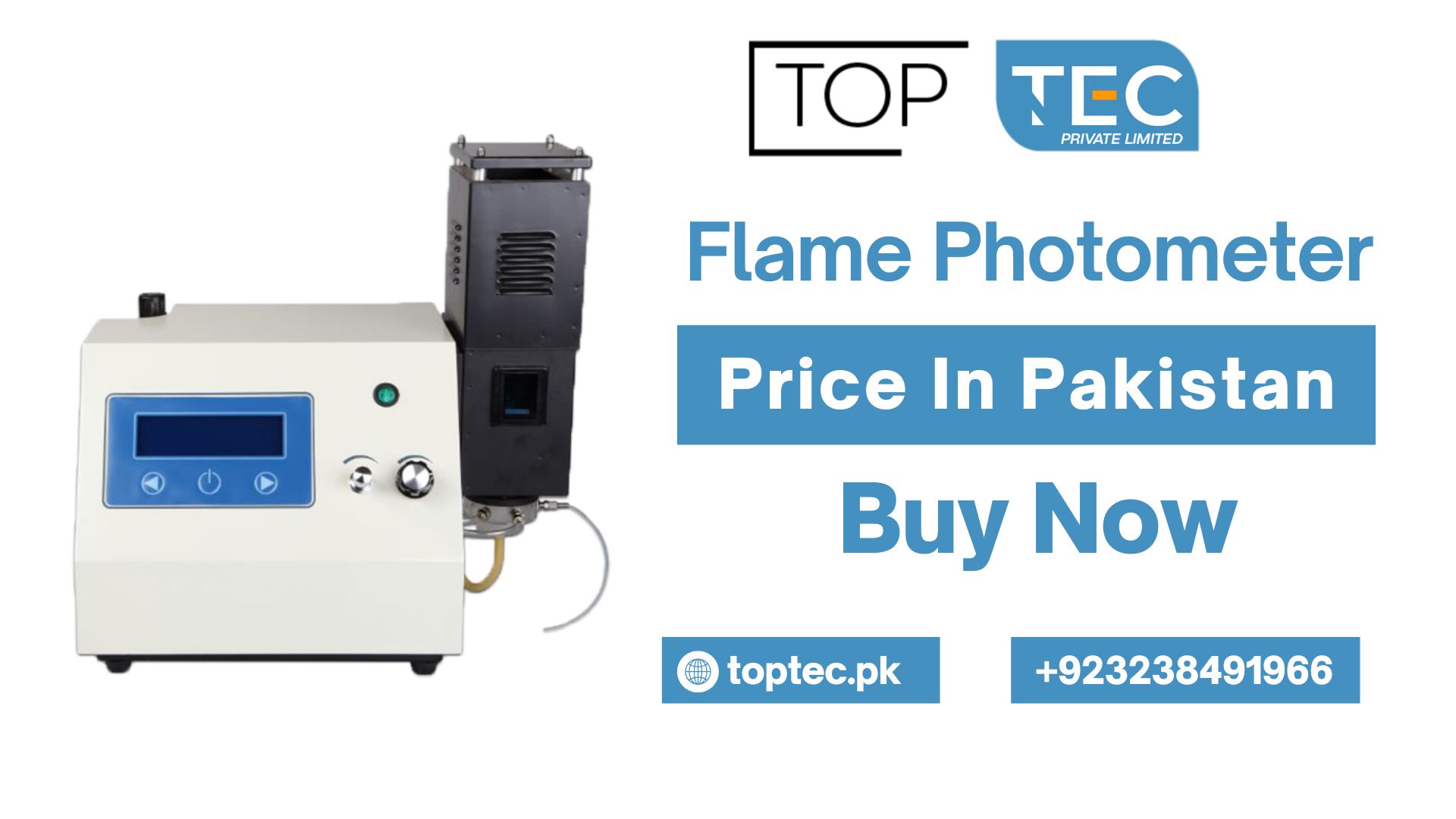
Learn how a clinical flame photometer measures sodium and potassium in body fluids, what specifications to check, and the expected Flame Photometer Price in Pakistan.
Electrolyte testing is a routine part of clinical chemistry, but the numbers carry real weight. Sodium and potassium results can support the assessment of fluid balance, renal function and several metabolic conditions. That means the equipment behind those results must be stable, properly calibrated and suitable for the laboratory’s workload.
Before you buy Flame Photometer equipment, it helps to understand how the technology works and where it fits alongside modern ion-selective electrode systems. The quoted Flame Photometer Price in Pakistan can vary widely because some instruments are designed for teaching or industrial analysis, while others offer the stability and controls expected in a clinical laboratory. Selecting a clinical flame photometer requires more than comparing the number of channels or the price printed on a supplier’s quotation.
What Is a Flame Photometer?
A flame photometer is an analytical instrument that measures certain metal ions through flame emission. When a diluted sample is introduced into a flame, metal atoms absorb thermal energy and become excited. As they return to a lower energy state, they emit light at characteristic wavelengths.
The instrument isolates and measures that emitted light. The signal intensity is related to the concentration of the element in the sample.
A clinical flame photometer is commonly configured to measure:
- Sodium at approximately 589 nm
- Potassium at approximately 766.5 nm
- Lithium at approximately 670.8 nm
- Calcium at approximately 422.7 nm on compatible models
Sodium and potassium are the most common clinical applications. Lithium measurement may also be relevant in specialised laboratories, although a method intended for therapeutic-drug monitoring needs proper validation.
A laboratory planning to buy Flame Photometer equipment should verify which elements are included in the standard configuration. Some models measure only sodium and potassium, while others need separate filters, channels or accessories. This difference is one reason the Flame Photometer Price in Pakistan cannot be judged from the instrument’s outer appearance alone.
How Flame Emission Photometry Works
A flame photometer normally includes a nebuliser, mixing chamber, burner, optical filter or monochromator, detector and electronic readout.
The process takes place in several stages:
- The diluted sample is aspirated through a capillary.
- The nebuliser converts the liquid into a fine aerosol.
- Larger droplets are removed in the mixing chamber.
- The fine aerosol enters the flame.
- Heat evaporates the solvent and excites the metal atoms.
- Excited atoms emit light at characteristic wavelengths.
- The optical system isolates the required wavelength.
- The detector converts light intensity into an electrical signal.
- The result is calculated against a calibration curve.
A stable flame and consistent aspiration rate are essential. If the gas pressure fluctuates or the nebuliser begins to block, the signal can drift even when the sample concentration has not changed.
For that reason, a clinical flame photometer should be installed with a suitable gas supply, regulator, air compressor and ventilation arrangement. If you buy Flame Photometer equipment, ask whether these supporting components are included or quoted separately.
Sodium and Potassium Testing in Body Fluids
Sodium and potassium may be measured in serum, plasma, urine and other validated body-fluid matrices. The sample type, dilution procedure and calibration range should be defined in the laboratory’s approved method.
Sodium Analysis
Sodium is the main extracellular cation. Accurate measurement requires careful control because the concentration in serum or plasma is relatively high compared with some other analytes.
Common sources of error include:
- Incorrect dilution
- Sodium contamination from glassware or reagents
- Use of unsuitable anticoagulants
- Carryover from concentrated samples
- Unstable aspiration
- Incorrect calibration standards
Potassium Analysis
Potassium is present at a much lower concentration in serum than sodium, so sample quality becomes especially important. Haemolysis can release intracellular potassium and produce a falsely elevated result.
The sample should be visually or instrumentally checked for haemolysis according to the laboratory’s procedure. Delayed separation of serum or plasma from cells may also affect the result.
A clinical flame photometer can provide reliable sodium and potassium measurements when the method, sample handling and quality-control system are properly validated. Before you buy Flame Photometer equipment for body-fluid analysis, confirm that the measurement range and precision are appropriate for clinical concentrations.
Correct Sample Collection and Preparation
Flame photometry is often described as simple, but the preparation stage can introduce significant error.
Suitable Specimens
Serum and appropriately collected heparinised plasma are commonly used. The anticoagulant must not introduce the element being measured. For example:
- Sodium-containing anticoagulants can interfere with sodium testing.
- Potassium EDTA can make potassium results unusable.
- Contaminated collection tubes may affect both analytes.
Urine samples usually require greater dilution because their electrolyte concentrations can be substantially higher than serum concentrations.
Dilution
Body-fluid samples are normally diluted before aspiration. The exact dilution factor depends on the instrument, calibration range and manufacturer’s method.
Use:
- Calibrated pipettes
- Clean volumetric glassware or suitable dispensers
- High-purity water
- Traceable calibration standards
- Documented preparation procedures
The same dilution technique should be used for calibrators, controls and patient samples wherever the method requires it.
Sample Mixing
Serum or plasma should be mixed gently before testing. Vigorous shaking may create foam or introduce bubbles that affect aspiration.
The clinical flame photometer should aspirate a steady stream without visible interruption. Irregular uptake, bubbles or salt deposits around the capillary are warning signs that the result may not be reliable.
Calibration and Quality Control
Calibration connects the instrument signal to a known electrolyte concentration. A single standard may be adequate for a simple linear instrument, but many laboratories use multi-point calibration to verify the working range.
A calibration sequence may include:
- Blank solution
- Low standard
- Mid-range standard
- High standard
- Independent quality-control samples
The clinical flame photometer should be recalibrated according to the manufacturer’s instructions and the laboratory’s validated procedure. Recalibration may also be needed after flame interruption, nebuliser cleaning, gas-cylinder replacement or significant signal drift.
A laboratory preparing to buy Flame Photometer equipment should ask whether the manufacturer provides traceable standards or recommends compatible third-party materials.
Internal Standards
Some systems use lithium as an internal standard. A fixed amount is added to calibrators and samples, allowing the instrument to compensate for variation in aspiration and flame conditions.
However, lithium cannot be used casually as an internal standard if lithium itself is the analyte of interest. The selected method and instrument configuration must account for this.
Daily Quality Control
At least two control levels are commonly used to monitor routine performance. A third level may be appropriate for laboratories with a broader analytical range.
Control results should be plotted and reviewed for:
- Sudden shifts
- Gradual trends
- Increasing imprecision
- Calibration failure
- Reagent or standard deterioration
- Aspiration instability
Westgard rules or another approved statistical approach may be applied depending on the laboratory’s quality system.
Important Performance Characteristics
A clinical flame photometer should be evaluated for more than its ability to display a result. Useful performance studies include:
Precision
Repeat measurements of the same material should produce closely grouped results. Both within-run and between-run precision should be assessed.
Linearity
The response should remain acceptably proportional across the intended measuring range. Samples above the verified range should be diluted and retested according to the procedure.
Accuracy and Bias
Results should be compared with traceable reference materials or a validated comparative method.
Carryover
A high-concentration sample should not significantly affect the sample tested immediately afterward. Carryover can be assessed by running a defined high-low sequence.
Detection and Quantification Limits
These may be especially relevant for lithium or non-routine body-fluid analysis.
Interference
Potential interference from haemolysis, lipaemia, contamination, other ions and matrix effects should be examined.
Before you buy Flame Photometer equipment, request available performance data for clinical samples rather than relying only on specifications based on aqueous standards. Better optical stability, reliable aspiration and stronger service support can all increase the Flame Photometer Price in Pakistan, but they may also reduce repeat testing and downtime.
Flame Photometer vs. Ion-Selective Electrode Analyzer
Modern clinical laboratories commonly measure electrolytes by ion-selective electrodes, or ISE. These systems are fast, automated and well suited to high-throughput testing.
A clinical flame photometer still has value in selected settings, including:
- Small clinical laboratories
- Teaching laboratories
- Research facilities
- Backup electrolyte testing
- Laboratories with moderate sample volumes
- Facilities where basic maintenance can be handled locally
Advantages of Flame Photometry
- Relatively straightforward analytical principle
- Good sensitivity for sodium and potassium
- Lower instrument complexity than many automated systems
- Useful for clinical, agricultural and industrial samples
- Calibration can be visually understood and reviewed
- May have lower reagent costs in some workflows
Limitations
- Requires a combustible gas supply
- Samples normally need manual dilution
- Throughput is lower than automated ISE systems
- Open-flame operation requires safety controls
- Nebuliser blockage can affect results
- Frequent calibration and cleaning may be necessary
- Manual preparation increases the opportunity for pipetting error
The decision to buy Flame Photometer equipment should therefore reflect the laboratory’s volume, staffing, safety arrangements and reporting needs. The Flame Photometer Price in Pakistan may be lower than the purchase price of a fully automated electrolyte analyser, but labour, calibration materials and gas consumption must also be considered.
Specifications to Check Before Purchasing
Before you buy Flame Photometer equipment, compare the following points carefully.
Number of Channels
Confirm whether sodium and potassium can be measured simultaneously or sequentially. Multi-channel instruments can improve throughput.
Measurement Range
The range should cover expected clinical concentrations after the stated dilution. Confirm that the manufacturer’s claims apply to sodium and potassium, not just a general detector range.
Precision and Repeatability
Ask for repeatability data at clinically relevant concentrations.
Aspiration Rate
A stable uptake rate is essential. Check the recommended sample volume and the time needed for the signal to stabilise.
Calibration Modes
Look for multi-point calibration, blank correction, internal-standard options and stored calibration curves where required.
Display and Data Output
Depending on the quality system, useful features may include:
- Digital concentration display
- Printer connection
- USB or serial output
- Patient or sample identification
- Stored calibration data
- Quality-control records
Gas and Air Requirements
Some instruments use LPG, propane, butane or natural gas with compressed air. The exact requirement should be confirmed before installation.
A suitable clinical flame photometer must match the gas supply available at the facility. Additional filters, regulators and compressors can affect the overall Flame Photometer Price in Pakistan.
Flame Photometer Price in Pakistan
The Flame Photometer Price in Pakistan varies with the instrument’s brand, channels, automation, optical system and included accessories. Exchange-rate movement also affects quotations because most complete instruments or their main components are imported.
The following figures are broad market estimates rather than fixed offers:
| Equipment category | Typical configuration | Indicative price range |
|---|---|---|
| Basic educational model | Single or dual element | PKR 250,000–600,000 |
| Digital Na/K model | Two-channel routine analysis | PKR 600,000–1,200,000 |
| Clinical multi-element model | Na, K, Li and optional Ca | PKR 1,000,000–2,500,000 |
| Premium imported system | Advanced calibration and data output | PKR 2,000,000–4,500,000+ |
| Gas, compressor and accessories | Depends on package | PKR 100,000–600,000+ |
To interpret this indicative Flame Photometer Price in Pakistan, check whether the quote includes a compressor, filters, gas regulator, standards, tubing, printer, installation and operator training.
Actual Flame Photometer Price in Pakistan quotations can change with taxes, currency rates and delivery location. Ask the supplier to state whether GST and inland freight are included. Before you buy Flame Photometer equipment, compare complete working packages rather than basic instrument prices.
Total Cost of Ownership
A realistic Flame Photometer Price in Pakistan assessment should include:
- Instrument purchase
- Gas cylinder and regulator
- Air compressor
- Calibration standards
- Control materials
- Replacement nebuliser components
- Filters and tubing
- Preventive maintenance
- Calibration or verification
- Staff training
- Laboratory ventilation
- Printer or computer connection
Laboratories that buy Flame Photometer equipment should also budget for downtime and local service. For a clinical flame photometer, fast access to replacement capillaries, burners and nebuliser components can be more important than a small saving on the original quotation.
Where to buy Flame Photometer Equipment in Pakistan
Laboratories looking to buy Flame Photometer equipment can approach scientific-instrument distributors in Karachi, Lahore, Islamabad and Rawalpindi. Suppliers may also serve Faisalabad, Multan, Peshawar and other cities through regional offices or service partners.
Choose a supplier that has experience with the clinical flame photometer, not only agricultural or industrial flame instruments. Compare the Flame Photometer Price in Pakistan alongside warranty, clinical application support, installation and spare-parts availability.
Suitable purchasing channels include:
- Authorised international-brand distributors
- Established scientific-instrument importers
- Clinical laboratory equipment suppliers
- University procurement vendors
- Pharmaceutical QC equipment companies
- Verified scientific marketplaces
Before you buy Flame Photometer equipment, ask for a live demonstration using sodium and potassium standards. When reviewing the Flame Photometer Price in Pakistan, request a line-by-line quotation showing every accessory.
Questions to Ask the Supplier
A supplier should answer the following before a purchase order is issued:
- Is the instrument intended for clinical sodium and potassium work?
- Can sodium and potassium be measured simultaneously?
- Which gas is required?
- Is an air compressor included?
- What sample dilution is recommended?
- What is the minimum sample volume?
- Are calibration standards included?
- Is an internal-standard channel available?
- What data-output options are provided?
- Is installation included?
- Is operator training available?
- Are spare nebulisers and capillaries stocked locally?
- What is the warranty period?
- Can the supplier support calibration and preventive maintenance?
Before you buy Flame Photometer equipment, obtain these answers in writing. Asking only about the Flame Photometer Price in Pakistan can lead to a low initial quote that excludes essential operating components.
Installation, Safety and Ventilation
A flame photometer uses combustible gas and an open flame. Installation must therefore be planned with appropriate safety precautions.
The laboratory should provide:
- Stable instrument bench
- Reliable electrical outlet
- Suitable gas regulator
- Secure gas-cylinder storage
- Adequate ventilation
- Clear space around the burner
- Fire extinguisher suitable for the risk
- No flammable-material storage near the flame
- Approved shutdown procedure
- Trained operators
Gas cylinders should be restrained and stored according to local safety requirements. Connections should be checked for leakage using an approved method.
Do not position the instrument where strong HVAC airflow can disturb the flame. At the same time, combustion gases must not accumulate in the room. Follow the equipment manufacturer’s installation instructions and the facility’s safety assessment.
Cleaning and Preventive Maintenance
Salt deposits can gradually block the nebuliser, burner and waste lines. A routine maintenance schedule should include:
- Aspiration of deionised water after sample runs
- Cleaning the nebuliser capillary
- Inspecting the burner
- Emptying the waste container
- Checking gas and air tubing
- Replacing filters as required
- Inspecting the flame
- Verifying aspiration rate
- Checking calibration stability
- Documenting maintenance work
A clinical flame photometer should never be cleaned with sharp wire or unapproved tools that may damage the capillary opening. Follow the manufacturer’s cleaning procedure.
Laboratory Furniture from TOPTEC PVT. LTD
A clinical flame photometer requires a stable, heat-resistant and chemical-resistant work surface with suitable space for sample preparation and instrument operation.
TOPTEC PVT. LTD manufactures laboratory furniture in Pakistan for clinical laboratories, pharmaceutical companies, hospitals, universities and research institutions.
When a facility plans to buy Flame Photometer equipment, TOPTEC can provide supporting furniture such as:
- Laboratory instrument benches
- Chemical-resistant workbenches
- Sample-preparation tables
- Reagent cabinets
- Gas-cylinder restraints or suitable storage arrangements
- Laboratory sinks and fixtures
- Fume hoods and local extraction solutions
- Chemical-storage cabinets
- Mobile laboratory trolleys
- Shelving systems
The final Flame Photometer Price in Pakistan does not usually include a suitable workstation, so furniture should be budgeted separately. TOPTEC can customise the bench according to the instrument’s footprint, operator height, cable routing and gas-line requirements.
The photometer should not be placed beside analytical balances or vibration-sensitive instruments. It should also be kept away from strong drafts and routine foot traffic. Local furniture manufacturing provides shorter lead times, easier customisation and accessible after-sales support.
Frequently Asked Questions
Can flame photometry measure both sodium and potassium?
Yes. Many instruments measure both elements, either sequentially or through separate channels. Check the exact configuration before purchasing.
Is flame photometry still used in clinical laboratories?
Yes, particularly in teaching, research, lower-volume laboratories and selected backup applications. However, ISE systems are more common in automated clinical chemistry.
Can urine be tested?
Yes, provided the instrument and method have been validated for urine. Greater dilution is usually required than for serum or plasma.
Does haemolysis affect potassium results?
Yes. Haemolysis releases intracellular potassium and may produce a falsely elevated measurement.
What gas does a flame photometer use?
It depends on the model. LPG, propane, butane and natural gas are commonly used with compressed air. Follow the manufacturer’s stated requirement.
Does the instrument require calibration every day?
Calibration frequency depends on the model, workload and validated laboratory procedure. Calibration or verification is commonly performed at the start of a run and after conditions that may affect the signal.
Final Thoughts
For a clinical flame photometer, reliable sodium and potassium testing depends on much more than the optical detector. Sample collection, dilution, flame stability, calibration, quality control and nebuliser maintenance all influence the final result.
Define the laboratory’s workload before purchasing. Check clinical measurement performance, gas requirements, data handling, spare parts and after-sales support. A low purchase price has little value if the instrument cannot maintain calibration or remains out of service while parts are imported.
For stable instrument benches, chemical-resistant sample-preparation tables and complete clinical laboratory furniture made in Pakistan, contact TOPTEC PVT. LTD.
