

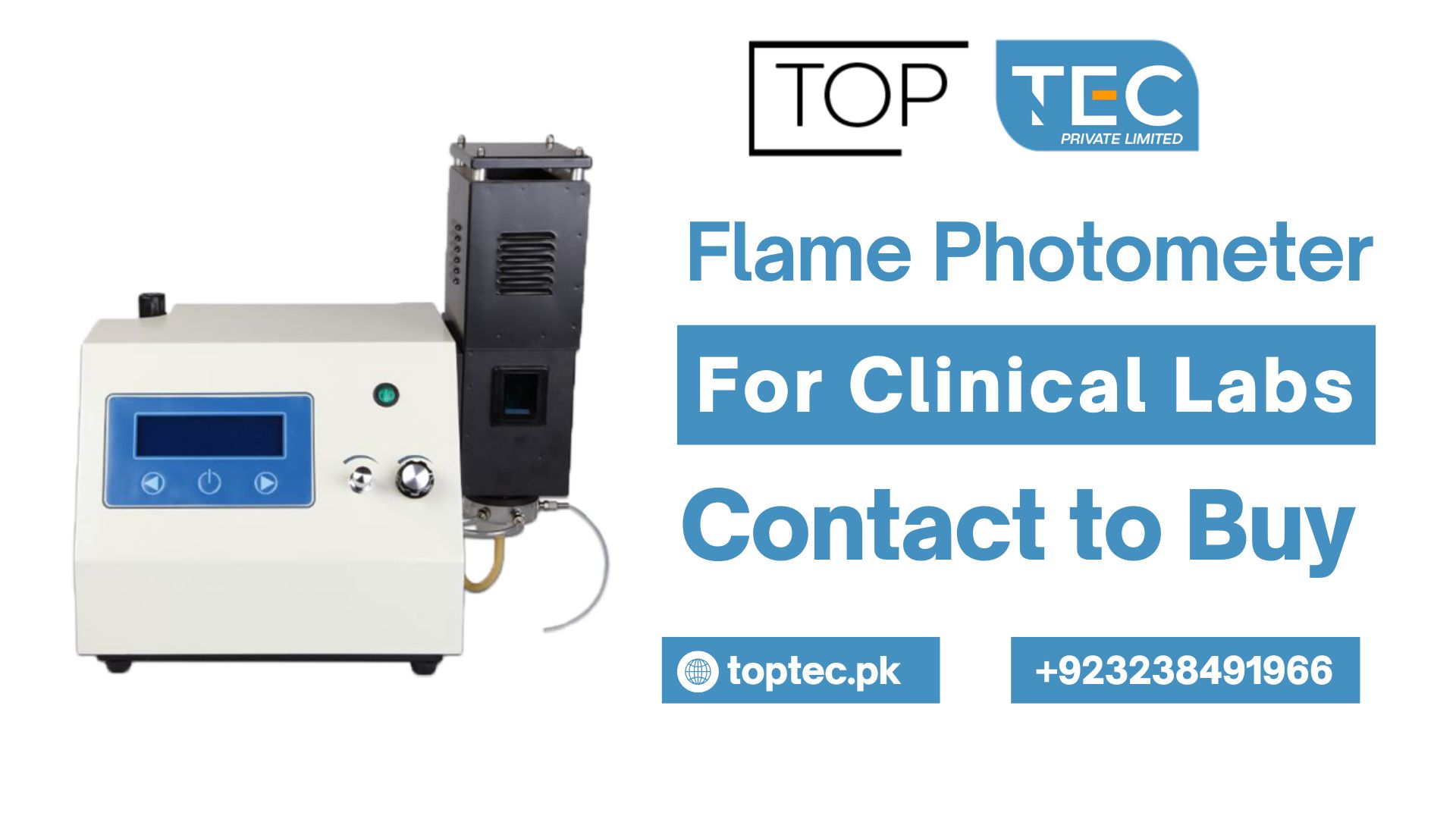
Learn about the Flame Photometer Working Principle, including atomisation, excitation, emission wavelengths, calibration, interferences, clinical uses and prices in Pakistan.
Flame photometry has been used for decades to measure sodium, potassium and lithium. The instrument is relatively straightforward, yet it can produce dependable results when the flame, sample preparation and calibration are kept under control.
Before laboratories buy Flame Photometer equipment, they should understand what the instrument actually measures. It does not count ions directly. Instead, it measures the light emitted when atoms in a sample receive energy from a flame.
The Flame Photometer Price in Pakistan varies according to the number of channels, optical design, calibration features and included gas or air accessories. An educational instrument and a laboratory model may look similar but offer very different precision and stability.
For medical testing, a clinical flame photometer must also be suitable for the expected sodium and potassium ranges in serum, plasma or urine. Sample-handling requirements, quality control and local service support are just as important as the detector.
What Is Flame Photometry?
Flame photometry, also known as flame emission photometry, is a type of atomic emission spectroscopy. It is mainly used for elements that become excited at the temperatures produced by a relatively low-temperature flame.
The technique is particularly useful for alkali metals, including:
- Sodium
- Potassium
- Lithium
Certain instruments can also measure calcium, which is an alkaline-earth metal rather than an alkali metal.
A clinical flame photometer commonly uses dedicated optical filters or channels for sodium and potassium. Some models add lithium as an internal standard or a separate analyte.
When organisations buy Flame Photometer systems, they should verify which elements are included in the base instrument. A four-element brochure may describe optional filters that are not supplied in the quoted package.
This configuration difference partly explains why the Flame Photometer Price in Pakistan may vary between suppliers even when the instruments appear to have similar specifications.
The Basic Working Principle
The working principle begins when a diluted sample is drawn into the instrument and converted into a fine aerosol. That aerosol enters a flame, where the solvent evaporates and the dissolved salts are converted into free atoms.
Some of those atoms absorb heat from the flame and move into an excited electronic state. This state is unstable. When the electrons return to a lower energy level, the atoms emit light at wavelengths characteristic of the element.
A clinical flame photometer isolates the required wavelength and measures the intensity of the emitted light. Under controlled conditions, that intensity is related to the element’s concentration.
A laboratory preparing to buy Flame Photometer equipment should not treat this relationship as automatically valid at every concentration. Calibration is needed because high concentrations, ionisation and matrix effects can cause non-linearity.
The instrument’s optical and electronic design also affects the final Flame Photometer Price in Pakistan. Basic models may use fixed interference filters, while more advanced systems may offer multiple channels, internal-standard correction and digital calibration curves.
What Happens to the Sample Inside the Flame?
The journey from liquid sample to measurable light occurs in several stages.
1. Aspiration
The sample is pulled through a narrow capillary by the movement of air or gas through the nebuliser. The aspiration rate must remain stable. A partial blockage, air bubble or worn capillary can change the amount of sample reaching the flame.
2. Nebulisation
The liquid is converted into a fine aerosol. Not every droplet reaches the burner. Large droplets are removed in the mixing chamber, while smaller droplets continue toward the flame.
3. Desolvation
The flame evaporates the solvent from the droplets, leaving small particles of dissolved salts.
4. Vaporisation
The remaining solid material is converted into gaseous molecules.
5. Atomisation
The gaseous compounds dissociate into free atoms. This is a critical stage because emission measurements depend on the population of free atoms in the flame.
6. Excitation
Some atoms absorb thermal energy. Their outer electrons move temporarily to higher energy levels.
7. Emission
The excited electrons return to lower levels and release energy as light. The relationship between energy and wavelength is:
E = hc/λ
Where:
- E is emitted energy
- h is Planck’s constant
- c is the speed of light
- λ is wavelength
A clinical flame photometer converts the intensity of this light into a concentration using its calibration data.
Before you buy Flame Photometer equipment, ask the supplier about aspiration stability, nebuliser construction and flame-control features. A strong detector cannot compensate for an inconsistent sample introduction system.
These practical differences can influence the Flame Photometer Price in Pakistan, especially where a package includes a regulated gas system, compressor and internal-standard channel.
Main Parts of a Flame Photometer
Nebuliser and Mixing Chamber
The nebuliser converts the sample into an aerosol, while the mixing chamber helps remove larger droplets. Both components need regular cleaning because salt deposits can affect aspiration and signal stability.
When laboratories buy Flame Photometer systems, spare capillaries and nebuliser parts should be included in the purchasing discussion. Small components can cause long periods of downtime if replacements are not available locally.
Burner and Flame System
The burner provides the thermal energy needed for atomisation and excitation. Depending on the model, the fuel may be LPG, propane, butane or natural gas combined with compressed air.
A clinical flame photometer needs a flame that remains stable throughout calibration, control and patient-sample analysis. Changes in fuel pressure or air supply can shift the signal.
Optical System
The optical system separates the required emission wavelength from other light produced by the flame. Basic instruments usually use interference filters. More sophisticated models may use additional optical components for improved selectivity.
The design of the optics and number of available channels contribute to the Flame Photometer Price in Pakistan.
Detector and Electronics
A photodetector converts light into an electrical signal. The electronic system amplifies that signal and calculates the result from the calibration curve.
Why Alkali Metals Are Easy to Measure
Alkali metals have one electron in their outer shell. That electron requires comparatively little energy to move into an excited state. A normal laboratory flame can therefore produce strong, characteristic emissions.
Common analytical wavelengths include:
| Element | Approximate wavelength | Emission colour |
|---|---|---|
| Sodium | 589.0 nm | Yellow |
| Potassium | 766.5 nm | Red-violet/near infrared |
| Lithium | 670.8 nm | Crimson red |
| Calcium | 422.7 nm | Orange-red |
A clinical flame photometer usually focuses on sodium and potassium because of their importance in body-fluid testing. Lithium may be measured where the instrument and laboratory method are validated for therapeutic monitoring.
Before you buy Flame Photometer equipment for multiple elements, check whether it measures them simultaneously or sequentially. Simultaneous channels may improve throughput, but they can add cost.
For this reason, the Flame Photometer Price in Pakistan should be compared together with the number of installed channels—not simply the total number mentioned in the catalogue.
Relationship Between Emission Intensity and Concentration
At low concentrations and under fixed conditions, emission intensity generally increases with analyte concentration. The relationship may be expressed in simplified form as:
I ∝ C
Where:
- I is emission intensity
- C is analyte concentration
In real testing, the relationship is not always perfectly linear across a broad range. Self-absorption, ionisation, flame variation and matrix differences can alter the response. This is why results must be calculated against standards rather than from theory alone.
A clinical flame photometer should be calibrated across the concentration range expected after sample dilution. Extrapolating beyond the validated calibration range is poor analytical practice.
Anyone planning to buy Flame Photometer equipment should ask whether the system supports one-point, two-point or multi-point calibration. Multi-point capability can help verify linearity across a wider working range.
Advanced calibration and data-storage functions may increase the Flame Photometer Price in Pakistan, but they can also make the instrument easier to manage in a regulated laboratory.
Calibration and Quality Control
Calibration standards should be traceable and prepared using high-purity water and suitable volumetric equipment. Standards, controls and samples should be handled in a consistent way.
A typical sequence may include:
- Blank solution
- Low calibration standard
- Mid-range standard
- High standard
- Independent control material
- Samples
- Periodic calibration verification
A clinical flame photometer may use lithium as an internal standard to compensate for variation in aspiration and flame conditions. However, lithium cannot serve as the internal standard when lithium itself is the analyte.
Before laboratories buy Flame Photometer equipment, they should confirm whether calibration standards and control materials are supplied or must be purchased separately.
The complete Flame Photometer Price in Pakistan should include the cost of standards, quality controls, gas, compressor filters, tubing and routine servicing—not just the main instrument.
Routine Quality-Control Checks
Quality control should monitor:
- Precision
- Accuracy
- Linearity
- Drift
- Carryover
- Aspiration stability
- Calibration recovery
- Blank contamination
Control results should be reviewed for sudden shifts and gradual trends. A result should not be released merely because the instrument displays a number.
Common Interferences and Sources of Error
Flame emission is sensitive to operating conditions. Several types of interference can affect results.
Spectral Interference
Emission from another element or the flame itself may reach the detector. Appropriate optical filters reduce this problem but may not eliminate it entirely.
Ionisation Interference
At high flame temperatures, some atoms may become ionised rather than remaining in the neutral excited state needed for measurement. Ionisation buffers may be used in certain methods.
Chemical Interference
An analyte may form a stable compound that does not atomise efficiently. Releasing agents or method adjustments may be needed where this effect is significant.
Matrix Effects
Differences in viscosity, salt concentration or solvent composition can change nebulisation and aspiration. Calibration standards should resemble the sample matrix where required.
Sample-Preparation Error
Manual dilution is one of the largest sources of error in body-fluid testing. Calibrated pipettes, consistent technique and suitable diluent are essential.
A clinical flame photometer used for potassium analysis is also affected by pre-analytical sample quality. Haemolysis can release intracellular potassium and produce a falsely elevated result.
Before you buy Flame Photometer equipment, check whether the system can detect or flag unstable signals. The analyst must still inspect samples and follow the laboratory’s rejection criteria.
A lower Flame Photometer Price in Pakistan does not compensate for unreliable aspiration, weak local support or poor access to replacement nebuliser parts.
Clinical Uses for Sodium and Potassium
Sodium and potassium are commonly measured in serum, plasma and urine. These results may support assessment of fluid balance, renal function and other metabolic conditions.
A clinical flame photometer normally requires the body-fluid sample to be diluted before introduction into the flame. The method should define the dilution factor, calibration range, permitted specimen types and quality-control rules.
Laboratories that buy Flame Photometer equipment for clinical work should verify performance using clinically relevant materials—not only aqueous standards supplied with the instrument.
The Flame Photometer Price in Pakistan may be lower than the price of a fully automated electrolyte analyser. However, flame photometry usually involves more manual preparation and lower throughput than modern ion-selective electrode systems.
Sample-Collection Precautions
- Avoid sodium-containing anticoagulants for sodium analysis.
- Avoid potassium EDTA for potassium measurement.
- Separate serum or plasma from cells within the approved period.
- Check for haemolysis before reporting potassium.
- Use clean, contamination-free glassware or plasticware.
- Dilute urine according to the validated procedure.
Specifications to Check Before Purchase
When you buy Flame Photometer equipment, compare more than the number of elements shown in the brochure.
Review:
- Sodium, potassium and lithium channels
- Simultaneous or sequential measurement
- Working range
- Precision and repeatability
- Required sample volume
- Aspiration rate
- Signal-stabilisation time
- Calibration modes
- Internal-standard capability
- Display resolution
- Data-storage capacity
- USB, printer or serial output
- Gas and air requirements
- Compressor specifications
- Safety shutdown features
- Warranty
- Local spare-parts availability
For a clinical flame photometer, data handling may be especially important. Regulated laboratories may require sample identification, secure records and documented quality-control review.
The overall Flame Photometer Price in Pakistan should also be judged against installation, gas handling, training and after-sales service.
Flame Photometer Price in Pakistan
The Flame Photometer Price in Pakistan depends on the number of channels, intended application, automation level and country of origin. Because many systems are imported, currency rates and taxes can change quotations quickly.
Indicative market ranges include:
| Instrument category | Typical configuration | Approximate price range |
|---|---|---|
| Educational model | Single or dual element | PKR 250,000–600,000 |
| Digital Na/K model | Two-channel routine testing | PKR 600,000–1,200,000 |
| Multi-element model | Na, K, Li and optional Ca | PKR 1,000,000–2,500,000 |
| Premium laboratory system | Advanced calibration and data output | PKR 2,000,000–4,500,000+ |
| Compressor and gas accessories | Package dependent | PKR 100,000–600,000+ |
These figures are broad estimates and should not be treated as supplier quotations.
Before you buy Flame Photometer equipment, request a complete package that includes the compressor, gas regulator, filters, tubing, standards, installation and training.
A higher-specification clinical flame photometer may cost more, but stronger calibration controls and dependable service can reduce repeat testing and downtime.
Selecting a Supplier in Pakistan
Laboratories can buy Flame Photometer systems through scientific-equipment distributors in Karachi, Lahore, Islamabad, Rawalpindi and other major cities.
When comparing offers, review the Flame Photometer Price in Pakistan alongside:
- Supplier experience
- Warranty terms
- Installation support
- Clinical application knowledge
- Spare-parts stock
- Preventive-maintenance capability
- Calibration assistance
- Operator training
- Delivery time
- Reference customers
A supplier offering a clinical flame photometer should be able to demonstrate sodium and potassium calibration using suitable standards. A general instrument demonstration with only a flame and blank solution is not enough.
Ask for the complete model number and manufacturer documentation before issuing the purchase order.
Laboratory Furniture from TOPTEC PVT. LTD
Once a laboratory decides to buy Flame Photometer equipment, it also needs a stable and practical workstation. The bench should resist chemicals and heat while providing enough space for the instrument, standards, diluted samples and supporting gas connections.
The Flame Photometer Price in Pakistan does not normally include the laboratory bench or nearby storage, so these should be budgeted separately.
TOPTEC PVT. LTD manufactures laboratory furniture in Pakistan for hospitals, clinical laboratories, pharmaceutical companies, universities and research institutions. Suitable furniture for a clinical flame photometer includes:
- Instrument benches
- Chemical-resistant workbenches
- Sample-preparation tables
- Reagent cabinets
- Laboratory sinks
- Gas-cylinder storage or restraint arrangements
- Chemical-storage cabinets
- Fume hoods and extraction furniture where appropriate
- Mobile trolleys
- Shelving systems
The bench should be positioned away from direct HVAC drafts because strong air movement may disturb the flame. At the same time, the room requires safe ventilation for combustion gases. The final installation should follow the manufacturer’s instructions and the facility’s fire-safety assessment.
Local manufacturing from TOPTEC allows workbench dimensions, storage and cable or gas-line openings to be matched to the laboratory layout.
Frequently Asked Questions
Should I buy Flame Photometer equipment or an ISE analyser?
That depends on sample volume, automation needs, budget and laboratory workflow. Flame photometry can suit teaching, research and lower-throughput testing, while ISE systems are more common in automated clinical laboratories.
Is a clinical flame photometer suitable for urine analysis?
Yes, if the method is validated for urine and the sample is diluted appropriately. Urine electrolyte concentrations may be much higher than serum values.
Can flame photometry measure calcium?
Some models can measure calcium using an appropriate channel or filter. Calcium is an alkaline-earth metal, not an alkali metal.
Why does the signal drift?
Common causes include unstable gas pressure, nebuliser blockage, changing aspiration rate, deposits on the burner and calibration-standard deterioration.
Does the instrument require a compressor?
Many models require compressed air. Whether a compressor is included depends on the supplier’s package.
How often should the nebuliser be cleaned?
Cleaning frequency depends on workload and sample concentration. Deionised water should generally be aspirated after use, with more detailed cleaning performed according to the manufacturer’s procedure.
Final Thoughts
Flame photometry works because alkali-metal atoms emit characteristic light after receiving energy from a flame. The sequence—aspiration, nebulisation, desolvation, atomisation, excitation and emission—is simple to describe, but each stage must remain controlled for reliable measurement.
The instrument should be selected according to the required elements, sample type, throughput and quality-system needs. Calibration, sample dilution, gas stability and routine maintenance have a direct effect on results.
For locally manufactured instrument benches, chemical-resistant workstations, reagent cabinets and complete laboratory furniture in Pakistan, contact TOPTEC PVT. LTD.
