

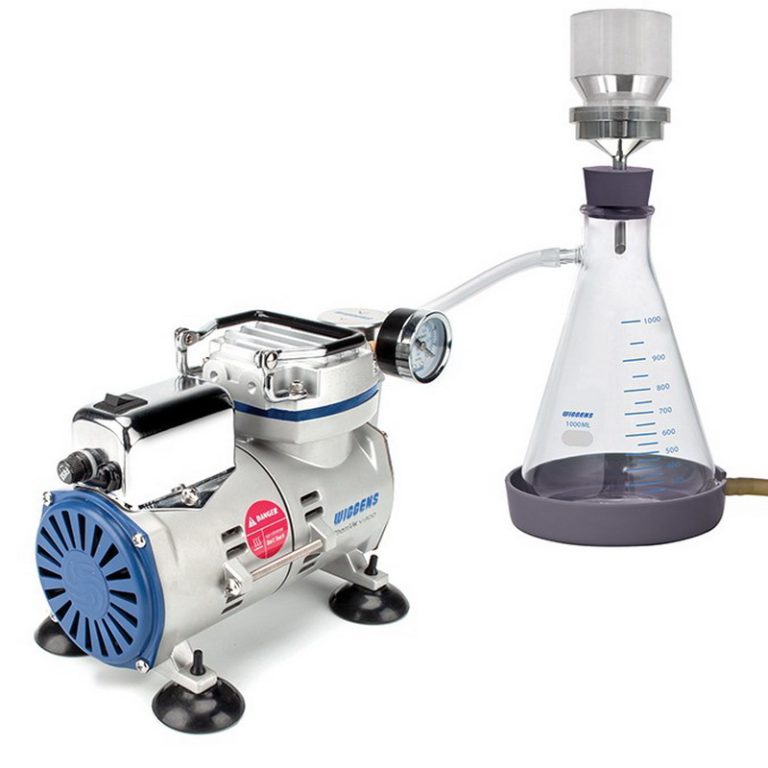
A vacuum pump for filtration accelerates liquid-solid separation in the lab. Featuring chemically resistant, oil-free options for easy maintenance. Find the ideal pump for your lab applications today.
There’s a piece of laboratory equipment that sits quietly in the corner of almost every serious analytical laboratory, pharmaceutical quality control department, and industrial filtration setup — doing essential work that nobody really notices until it stops working.
The vacuum pump.
And specifically for filtration applications — Buchner funnel filtration, membrane filtration, vacuum filtration of pharmaceutical suspensions, solvent filtration for HPLC analysis, microbiological filtration, and dozens of other applications — choosing the right vacuum pump matters more than most buyers realize when they’re first making this decision.
The wrong pump for your specific filtration application creates problems that aren’t always immediately obvious. Insufficient vacuum depth means slow, incomplete filtration. Wrong pump type means solvent vapors contaminating and destroying the pump mechanism. Inadequate flow rate means extended filtration times that create bottlenecks in your analytical workflow. Poor vacuum stability means inconsistent filtration results that compromise your data quality.
This guide covers what you actually need to know before you buy Vacuum Pump for Filtration equipment — whether you’re equipping a university analytical laboratory, setting up a pharmaceutical QC department, running an environmental testing facility, or managing industrial filtration operations in Pakistan.
Why Filtration Applications Are Specifically Demanding for Vacuum Pumps
Filtration seems straightforward — pull liquid through a filter medium using vacuum. But the specific demands this application places on vacuum pump equipment are worth understanding before you start comparing products and Vacuum Pump price in Pakistan quotations.
Chemical Compatibility Is Everything
Filtration in analytical and pharmaceutical laboratories almost always involves chemical solvents. HPLC mobile phase filtration. Solvent filtration before analytical use. Pharmaceutical product filtration involving organic solvents in formulations. Environmental sample filtration involving various matrix chemicals.
If your vacuum pump is not chemically compatible with the vapors being pulled through the filtration system, the pump mechanism degrades — sometimes rapidly and catastrophically. Oil-sealed rotary vane pumps — the most common general industrial vacuum pump type — are seriously damaged by solvent vapors. The solvents dissolve in the pump oil, reducing its viscosity and lubrication properties, and eventually contaminating and damaging the pump internals.
This chemical compatibility requirement is the single most important technical factor in selecting filtration vacuum pump equipment. It’s why the Vacuum Pump for Filtration manufacturers who understand laboratory applications specifically offer chemically resistant pump designs for these environments.
Vacuum Level Requirements Vary by Application
Different filtration applications require different vacuum depths:
HPLC solvent filtration: Moderate vacuum levels — typically 100-300 mbar absolute — are adequate. Very deep vacuum isn’t necessary for filtering particulates from solvents.
Buchner funnel filtration: Varies with the filter medium resistance and the liquid being filtered. Most applications work well at 100-500 mbar absolute.
Membrane filtration for microbiological testing: Moderate vacuum, controlled carefully to avoid filter damage or breakthrough.
Vacuum drying after filtration: May require deeper vacuum levels — 10-50 mbar absolute — to achieve adequate drying.
Gel filtration and chromatography: Specific vacuum requirements depending on the column and mobile phase.
Buying a pump that provides more vacuum depth than you need isn’t always better — very deep vacuum can damage filter membranes, cause solvent degassing that disrupts filtration, or create safety issues with volatile solvents. Matching vacuum level capability to your application requirements is part of a good equipment decision.
Flow Rate Determines Filtration Speed
Vacuum depth tells you how much pressure differential the pump can create. Flow rate tells you how fast it can move gas through the filtration system. For filtration applications, both matter — but flow rate is often the limiting factor for filtration throughput.
A pump with excellent vacuum depth but inadequate flow rate will achieve the right vacuum level but take a long time to get there, and will struggle to maintain that vacuum level as gas bleeds through the filter medium or from dissolved gas evolving from the liquid being filtered.
Vacuum Stability Affects Result Consistency
For analytical laboratory filtration — HPLC solvent preparation, sample preparation filtration, microbiological membrane filtration — consistent vacuum level throughout the filtration process produces more reproducible results than fluctuating vacuum. Pump pulsation and instability affect filtration rate consistency and can affect filter integrity.
When you buy Vacuum Pump for Filtration equipment for analytical applications, vacuum stability is a performance criterion worth evaluating explicitly — not just ultimate vacuum depth.
The Main Types of Vacuum Pumps for Filtration Applications
Understanding the main pump types and their suitability for different filtration applications is the foundation of a good buying decision.
Diaphragm Pumps
Diaphragm pumps use a flexible membrane driven by an eccentric mechanism to create alternating compression and expansion in a pumping chamber. They’re oil-free — the pumping mechanism contains no lubricating oil that can be contaminated by solvent vapors.
This oil-free operation makes diaphragm pumps the natural choice for laboratory filtration applications involving organic solvents. Solvent vapors that would destroy an oil-sealed pump simply pass through a diaphragm pump without causing significant harm — particularly when the pump is manufactured from chemically resistant materials (PTFE heads and valves being the standard for chemical resistance).
Diaphragm pumps typically achieve vacuum levels down to around 1-10 mbar ultimate vacuum depending on the number of pump stages. Single-stage diaphragm pumps are adequate for most filtration applications. Two-stage pumps reach deeper vacuum if your application requires it.
Flow rates for laboratory diaphragm pumps range from around 1 liter per minute for small single-user laboratory pumps to 20-30 liters per minute for larger models suitable for multiple simultaneous filtration setups.
Best for: HPLC solvent filtration, Buchner funnel filtration with organic solvents, pharmaceutical QC laboratory filtration, membrane filtration for microbiological testing, general analytical laboratory filtration.
Oil-Sealed Rotary Vane Pumps
The workhorse of general vacuum applications. Rotating vanes sweep a crescent-shaped pumping chamber, drawing gas in and compressing it against the oil-sealed chamber walls. Oil provides both sealing and lubrication.
These pumps achieve very deep vacuum — routinely below 0.1 mbar ultimate vacuum — and are available in large flow rate configurations suitable for industrial applications. They’re robust, reliable, and well-understood technology.
The critical limitation for filtration applications is the oil. Solvent vapors contaminate the oil, degrading pump performance and potentially causing pump damage. For filtration applications involving organic solvents, oil-sealed rotary vane pumps require either a cold trap upstream (to condense and capture solvent vapors before they reach the pump) or they’re simply not appropriate for the application.
Best for: Applications requiring very deep vacuum where solvent exposure is not a concern. Industrial filtration of aqueous systems. Vacuum ovens and drying applications. Distillation under vacuum.
Not recommended for: Direct filtration of organic solvents without cold trap protection.
Water Aspirator Pumps
The simplest and lowest-cost vacuum source — water flowing through a Venturi constriction creates vacuum through jet action. No moving parts, no electricity beyond the water pump, no maintenance.
Vacuum level is limited by the vapor pressure of water at the operating temperature — typically around 20-30 mbar absolute at room temperature. Flow rate is moderate.
Water aspirators work for simple filtration applications where deep vacuum isn’t required, chemical resistance isn’t a concern, and simplicity and low cost are priorities. They waste significant quantities of water during operation, which is an environmental and cost consideration in high-usage facilities.
Best for: Simple aqueous filtration in cost-constrained settings. Educational laboratories. Applications where electricity supply is a concern.
Peristaltic Pump-Based Vacuum Systems
Peristaltic pumps can be configured as vacuum sources for filtration applications. They offer the advantage of complete separation between the pumped gas and the pump mechanism — the gas path never touches the pump mechanism beyond the tubing. This makes them inherently compatible with aggressive chemical environments.
Vacuum capability and flow rate are more limited than dedicated vacuum pumps, but for specific applications where chemical compatibility is the primary concern, peristaltic vacuum systems are worth considering.
Scroll Pumps
Scroll pumps use two spiral elements — one fixed, one orbiting — to compress gas from the inlet to the outlet. They’re oil-free, mechanically simple, quiet, and reasonably chemically resistant depending on the materials used in the scroll elements and tip seals.
Scroll pumps achieve deeper vacuum than diaphragm pumps — typically down to 0.01-0.1 mbar — while remaining oil-free. This makes them useful when both chemical compatibility and deep vacuum are required. They’re generally more expensive than diaphragm pumps of comparable flow rate.
Best for: Applications requiring both chemical compatibility and deep vacuum. Research laboratories. Vacuum distillation. Freeze-drying support.
Matching Pump Type to Your Specific Application
Rather than a generic recommendation, here’s how to think about matching pump type to your specific filtration context:
Pharmaceutical QC Laboratory
HPLC mobile phase filtration is one of the most common analytical laboratory vacuum filtration applications. The solvents involved — methanol, acetonitrile, water, buffer solutions — require a chemically resistant pump. A PTFE-head diaphragm pump is the standard choice. Look for a two-stage model if your lab also does vacuum manifold SPE sample preparation or other applications requiring deeper vacuum than simple filtration.
When you buy Vacuum Pump for Filtration for pharmaceutical QC specifically, also consider whether you need a pump that supports multiple simultaneous filtration positions — some QC workflows involve running several filter assemblies simultaneously.
Microbiological Testing Laboratory
Membrane filtration for water testing, environmental monitoring, and pharmaceutical microbiology uses vacuum at moderate levels — the critical parameter is vacuum stability and controllability to avoid damaging the membrane. A diaphragm pump with a vacuum regulator and gauge gives you the control needed for these applications.
University and Research Laboratories
Research labs typically have diverse filtration requirements — solvent filtration one day, aqueous filtration another, occasional vacuum drying, sometimes vacuum distillation. A good two-stage chemically resistant diaphragm pump with a vapor trap handles most of this range adequately. For applications requiring deeper vacuum, a scroll pump or oil-sealed pump protected by a cold trap might also be needed.
Environmental Testing Facilities
Environmental sample filtration involves varied matrices — water samples, soil extracts, various environmental matrices. Chemical compatibility requirements depend on the extraction solvents used. In most environmental testing contexts, a diaphragm pump provides adequate vacuum and chemical compatibility.
Industrial Filtration Applications
Industrial scale filtration — filter press support, Nutsche filter operations, large-scale pharmaceutical manufacturing filtration — requires significantly larger flow rates than laboratory applications. Liquid ring pumps or large oil-sealed rotary vane pumps are typically appropriate for these applications, selected based on the specific chemicals involved and the scale of the operation.
Key Specifications to Evaluate When Buying
When you’re comparing products and evaluating Vacuum Pump price in Pakistan from different Vacuum Pump for Filtration manufacturers, these are the specifications that actually matter:
Ultimate Vacuum
The deepest vacuum level the pump can achieve under ideal conditions with no flow. Expressed in mbar or mmHg absolute pressure. Match this to your application requirements — deeper isn’t always better for filtration applications.
Free Air Displacement (Flow Rate)
The volume of gas the pump moves per unit time at atmospheric pressure. Expressed in L/min or m³/hr. This determines filtration speed and whether the pump can maintain vacuum against the leakage and gas evolution typical in your specific filtration setup.
Chemical Resistance
What materials are the pump head, valves, diaphragm, and gas path components made from? PTFE-headed pumps with PTFE valves and diaphragms offer the broadest chemical resistance. Understand what specific solvents you’ll encounter and confirm compatibility before purchasing.
Noise Level
Relevant for laboratory environments. Vacuum pumps can be surprisingly noisy, particularly at higher flow rates. For laboratory environments where concentration and communication matter, pump noise level is worth considering.
Power Requirements
Single-phase 220V for laboratory equipment in Pakistan. Confirm voltage and frequency compatibility. For larger industrial pumps, three-phase power may be required.
Inlet and Outlet Connection Sizes
Match to your filtration system components. Standard sizes vary by pump type and manufacturer. Ensure you have appropriate tubing and fittings for connection.
Vacuum Gauge and Regulation
Many filtration applications benefit from vacuum regulation — the ability to set and maintain a specific vacuum level rather than running at maximum vacuum. Some pumps include integrated vacuum gauges and regulators; others require these to be added separately.
Vacuum Pump Price in Pakistan — What to Realistically Expect
The Vacuum Pump price in Pakistan varies significantly with pump type, specification level, flow rate, and supplier. Here’s a realistic framework:
Entry-Level Laboratory Diaphragm Pumps
Small single-stage diaphragm pumps for basic laboratory filtration. Adequate for HPLC solvent filtration and simple Buchner filtration in moderate-use settings. The most accessible Vacuum Pump price in Pakistan in the filtration pump category.
Mid-Range Chemical-Resistant Diaphragm Pumps
Two-stage PTFE-head chemically resistant pumps suitable for demanding analytical laboratory environments. Broader chemical compatibility, better vacuum depth, and higher flow rates. This is the right specification level for most pharmaceutical QC and analytical research laboratory filtration applications.
Scroll Pumps
Higher investment for oil-free deep vacuum capability. Appropriate for research applications requiring both chemical compatibility and deep vacuum.
Oil-Sealed Rotary Vane Pumps
Price varies significantly with flow rate. Small laboratory models at the accessible end; large industrial models at the substantial investment end. Appropriate where chemical compatibility is not a concern or where cold trap protection is provided.
Industrial Liquid Ring Pumps
Significant capital investment for large-scale industrial filtration. Priced based on flow capacity and specific application engineering.
What drives price differences between comparable pumps:
Material specification — PTFE throughout the gas path costs more than partial PTFE or alternative polymer construction. Flow rate — larger pumps cost more. Control features — integrated vacuum regulation and digital display add cost. Brand and documentation — pumps with calibration certificates and supporting documentation cost more than those without. Local versus imported — import duties and logistics add cost to international supply.
Why Sourcing From Local Manufacturers and Suppliers Matters
When you’re ready to buy Vacuum Pump for Filtration equipment, the question of where to source it deserves more thought than just finding the lowest listed price.
After-Sales Support Reality
Vacuum pumps require maintenance — diaphragm replacement, valve maintenance, oil changes for oil-sealed pumps. Access to local service support and spare parts determines whether this maintenance is manageable or becomes a prolonged equipment downtime situation.
Calibration and Documentation
For pharmaceutical QC and regulated laboratory environments, vacuum pump calibration records and equipment qualification documentation may be required. Local Vacuum Pump for Filtration manufacturers and suppliers familiar with pharmaceutical laboratory requirements are more likely to provide appropriate documentation support.
Application Support
Matching the right pump to your specific application requires understanding your filtration setup, the chemicals involved, and your operational requirements. Local suppliers who have application knowledge provide this support in ways that online-only international suppliers cannot.
TOPTEC Scientific — Laboratory Furniture and Equipment for Pakistani Facilities
Here’s the thing about laboratory equipment purchases that often gets overlooked.
The vacuum pump sits on a bench. Or next to a filtration manifold on a workbench. Or under a fume hood in your QC laboratory. The quality of that surrounding furniture — the stability of the bench, the chemical resistance of the surface, the accessibility for maintenance — directly affects how well your vacuum filtration setup works and how easy it is to maintain.
TOPTEC Scientific is a Pakistan-based manufacturing company producing high-specification laboratory furniture and equipment for analytical laboratories, pharmaceutical facilities, research institutions, environmental testing laboratories, and industrial operations throughout Pakistan. Everything they manufacture is produced locally — with direct technical support, fast delivery without import complications, and pricing that reflects local manufacturing economics.
For laboratory facilities investing in vacuum filtration capability, TOPTEC Scientific manufactures the surrounding infrastructure that makes your complete filtration setup work properly:
Chemical-Resistant Laboratory Workbenches
The workbench your filtration setup sits on needs to withstand the solvents and chemicals involved in your filtration work. TOPTEC Scientific manufactures laboratory workbenches with chemical-resistant surface materials — epoxy resin, phenolic resin, or stainless steel depending on your specific chemical environment — that maintain their integrity through years of solvent exposure and cleaning.
Stable, properly specified workbench surfaces improve filtration setup stability, support accurate work, and resist the surface degradation that compromises laboratory hygiene and equipment positioning over time.
Fume Hoods
Many filtration applications — particularly those involving volatile organic solvents — should be conducted inside a fume hood. TOPTEC Scientific manufactures ducted fume hoods with appropriate airflow specifications for laboratory environments. Chemical-resistant interior surfaces, sash designs that support convenient filtration work, and service connections for vacuum, gas, and water supply integrated into the fume hood structure.
A properly specified fume hood for your filtration work protects operators from solvent vapor exposure, reduces the chemical contamination burden on the surrounding laboratory environment, and provides the controlled airflow that makes HPLC solvent filtration and other analytical filtration work more consistent.
Laminar Flow Cabinets
For microbiological filtration applications — where the filtration is being conducted to capture microorganisms from water or environmental samples for culture and counting — the surrounding air quality during the filtration operation matters. TOPTEC Scientific manufactures vertical and horizontal laminar flow cabinets that provide ISO 5 (Class 100) environments for sensitive microbiological work.
Pass-Through Boxes
For pharmaceutical facilities where materials need to move between different environmental zones — transferring filtered samples from production areas to QC laboratories, for example — TOPTEC Scientific manufactures static and dynamic pass-through boxes appropriate for different cleanroom grade differentials.
Mobile Laboratory Trolleys
For filtration setups that need to be repositioned — moved between laboratory benches, transported to different laboratory areas, or set up temporarily for specific campaigns — properly designed mobile trolleys with chemical-resistant surfaces and stable castors provide safe transport without risking equipment damage.
Storage Systems and Cabinets
Storage for filtration consumables — filter membranes, filter papers, Buchner funnels, vacuum flask assemblies — needs to be organized, accessible, and appropriate for the laboratory environment. TOPTEC Scientific manufactures laboratory storage cabinets and shelving systems in stainless steel and other appropriate materials for laboratory environments.
Solvent Storage Cabinets
For laboratories using significant quantities of organic solvents in filtration work, proper solvent storage cabinets — ventilated, fire-resistant, appropriately sized — protect laboratory personnel and comply with laboratory safety requirements. TOPTEC Scientific manufactures solvent storage solutions appropriate for Pakistani laboratory safety standards.
Sink and Wash Stations
Laboratory sink stations for cleaning filtration glassware — vacuum flasks, Buchner funnels, filter holders — are part of the complete laboratory infrastructure. TOPTEC Scientific manufactures stainless steel sink benches appropriate for laboratory environments with appropriate chemical resistance and drainage provisions.
The practical advantage of sourcing complete laboratory infrastructure from TOPTEC Scientific is straightforward: local manufacturer, direct communication, no import delays, local installation and technical support, and comprehensive capability to furnish complete laboratory spaces rather than individual pieces.
Common Mistakes When Buying Filtration Vacuum Pumps
These patterns come up regularly when laboratories and facilities make filtration vacuum pump purchasing decisions they later regret:
Buying an oil-sealed pump for solvent filtration without cold trap protection
This is probably the most common filtration vacuum pump mistake. Oil-sealed rotary vane pumps are readily available and often lower cost than chemical-resistant alternatives. But without cold trap protection, solvent vapors destroy the pump oil — sometimes within months of installation. The pump repair or replacement cost quickly exceeds the savings from the lower initial purchase price.
Underestimating flow rate requirements
Buying a pump with adequate ultimate vacuum but insufficient flow rate for your filtration volume results in frustratingly slow filtration and inability to maintain vacuum during filtration of large volumes. Flow rate requirements are often underestimated in initial purchasing.
Ignoring noise in laboratory environments
A pump that’s perfectly adequate technically but unacceptably loud for a shared analytical laboratory creates real operational problems. Measure noise levels in decibels and consider the operating environment before purchasing.
Not planning for maintenance consumables
Diaphragm pumps require diaphragm replacement periodically. Oil-sealed pumps require oil changes. Valves wear. Planning for these maintenance consumables — and confirming they’re available locally — is part of a complete purchasing decision.
Buying without application-specific advice
Generic “laboratory vacuum pump” purchases without matching the pump specification to specific filtration application requirements frequently result in performance disappointment. Engage with knowledgeable suppliers who can provide application-specific guidance.
Neglecting the surrounding laboratory infrastructure
Buying a quality vacuum pump and setting it up on an inadequate workbench, without proper fume hood protection for solvent work, creates safety and performance problems that the pump itself can’t solve.
A Quick Decision Framework
For those who want a straightforward summary for making this decision:
For pharmaceutical QC laboratory filtration (HPLC solvents, sample preparation):
Two-stage PTFE-head chemically resistant diaphragm pump. Vacuum regulator included or added separately. Vapor trap upstream of pump recommended for heavy solvent use.
For microbiological membrane filtration:
Single or two-stage diaphragm pump with vacuum regulation capability. Chemical resistance is less critical; vacuum stability is important.
For general analytical research laboratory:
Two-stage chemically resistant diaphragm pump covers most needs. Consider a scroll pump if deep vacuum is also required for some applications.
For industrial aqueous filtration:
Oil-sealed rotary vane pump sized for required flow rate. Chemical compatibility not the concern; flow rate and vacuum depth are primary criteria.
For industrial filtration involving solvents:
Liquid ring pump or chemically resistant pump with appropriate sizing for industrial flow rates. Application engineering support recommended.
When you’re ready to buy Vacuum Pump for Filtration equipment in Pakistan, engage with Vacuum Pump for Filtration manufacturers and suppliers who can have this application-specific conversation with you — not just quote a price from a catalog.
Final Thoughts
The Vacuum Pump price in Pakistan you’re evaluating isn’t just a number — it represents a piece of equipment that will run in your laboratory or production facility every day, affecting the quality and efficiency of your filtration work for years.
Getting this decision right means matching pump type to your specific chemical environment, ensuring adequate flow rate for your filtration throughput requirements, selecting appropriate vacuum depth for your applications, and buying from Vacuum Pump for Filtration manufacturers and suppliers who provide genuine application support and local service capability.
And when you’re building or upgrading the complete laboratory environment around your vacuum filtration setup, TOPTEC Scientific provides the laboratory furniture, fume hoods, workbenches, storage systems, and complete laboratory infrastructure that makes your filtration operation work properly — manufactured locally in Pakistan, with the support advantages that brings.
The complete investment — right pump, right surrounding infrastructure, right supplier relationships — is the investment that actually serves your filtration operation well.
For chemical-resistant laboratory workbenches, fume hoods, laminar flow cabinets, laboratory storage systems, sink benches, and complete laboratory furniture manufactured locally in Pakistan, contact TOPTEC Scientific — equipping Pakistan’s laboratories with properly specified, locally manufactured infrastructure.
