

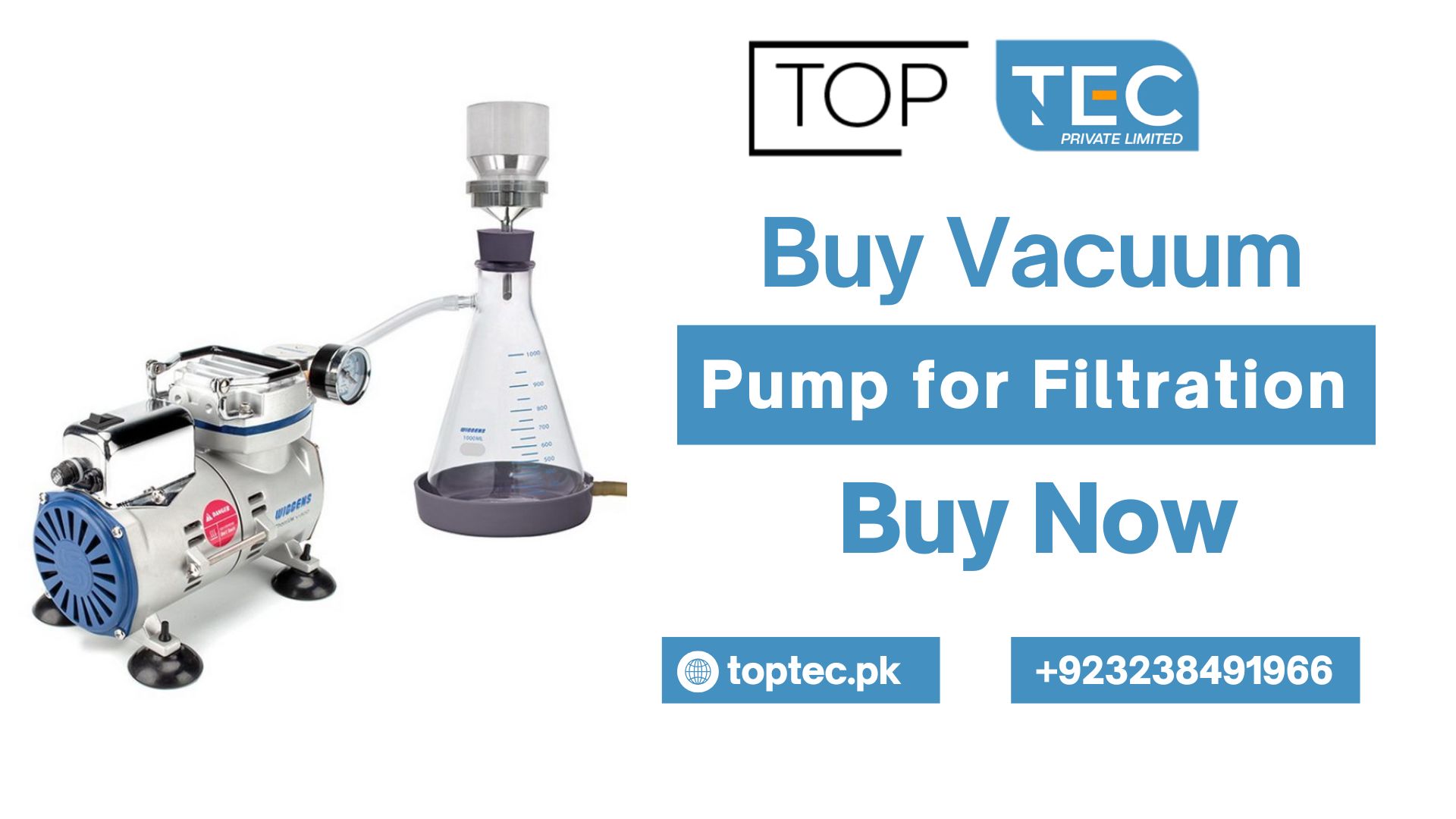
Buy vacuum pump for filtration from leading manufacturers. Explore single-stage and two-stage diaphragm pumps for vacuum filtration. Request a free quote today!
Buying laboratory equipment online has become genuinely normal over the past several years. And for straightforward commodity items — beakers, pipettes, standard glassware — it works perfectly well. You know what you need, you find a verified supplier, you place the order.
Vacuum pumps for filtration are a different story.
Not because buying them online is impossible or even inadvisable — it’s become a legitimate procurement channel for many facilities. But because the gap between a vacuum pump that’s right for your specific filtration application and one that’s wrong for it is enormous, and that gap isn’t visible from a product photograph or a specification table.
The wrong pump connected to your Filtration Assembly doesn’t just underperform. It can contaminate your samples, destroy itself within months through solvent damage, fail to maintain adequate vacuum for your filter medium, or expose your laboratory operators to chemical vapors that a properly selected pump would have contained.
So this guide exists to help you buy Vacuum Pump for Filtration equipment — whether new or used, online or through direct supplier engagement — with enough understanding of what actually matters to make a decision you won’t regret.
Why Vacuum Pump Selection for Filtration Is More Nuanced Than It Looks
Let’s start here because it explains everything that follows.
When someone searches to buy Vacuum Pump for Filtration equipment online, they typically encounter a fairly wide range of products that all describe themselves as “laboratory vacuum pumps” or “filtration pumps.” The specification tables look similar. The prices vary. And it’s genuinely difficult to understand what’s actually different between them.
Here’s what’s actually different, and why it matters:
The Chemical Compatibility Problem
Filtration in analytical and pharmaceutical laboratories almost always involves chemical solvents. HPLC mobile phase preparation — filtering acetonitrile, methanol, water, buffer mixtures. Sample preparation filtration. Pharmaceutical formulation filtration involving organic solvents. Solvent removal filtration.
The vacuum pump connected to your Filtration Assembly pulls gas — including solvent vapors — through its mechanism. If that mechanism isn’t chemically compatible with your solvents, the pump degrades. Sometimes slowly, sometimes rapidly.
Oil-sealed rotary vane pumps — the most common general-purpose vacuum pump type — are seriously damaged by organic solvent vapors. The solvents dissolve into the pump oil, reducing its viscosity and lubrication properties, and degrading the pump’s vacuum performance. Continue long enough and you’re replacing internal components or the entire pump.
This is the single most common filtration vacuum pump purchasing mistake made when facilities buy Vacuum Pump for Filtration equipment based on price or general specification without thinking specifically about chemical compatibility.
The Flow Rate vs. Vacuum Depth Confusion
These are two different performance parameters that both appear on pump specification sheets and both matter — but for different reasons.
Ultimate vacuum (or maximum vacuum) tells you how deep a vacuum the pump can create with no flow. This determines whether the pump can reach the vacuum level your filtration application requires.
Free air displacement (or pumping speed) tells you how fast the pump moves gas. This determines how quickly your Filtration Assembly reaches operating vacuum and how well it maintains that vacuum against leakage and gas evolution from the liquid being filtered.
Many buyers focus on ultimate vacuum and don’t pay adequate attention to flow rate. The result is a pump that can theoretically achieve the required vacuum depth but takes a long time to get there and struggles to maintain it during actual filtration — producing slow, frustrating filtration performance.
Vacuum Stability for Analytical Applications
For analytical laboratory filtration — HPLC solvent preparation, microbiological membrane filtration, sample preparation — consistent, stable vacuum throughout the filtration process matters for result reproducibility. A pump that pulses or fluctuates creates inconsistent filtration rates that can affect analytical outcomes.
Understanding the New vs. Used Equipment Decision
When you’re looking to buy Vacuum Pump for Filtration equipment, you’ll encounter both new and used equipment options — particularly through online channels. The decision between them deserves honest consideration.
The Case for New Equipment
Known history: New equipment has no operational history that might include solvent contamination, improper storage, or previous misapplication. For pharmaceutical QC and regulated analytical applications where equipment qualification documentation is required, new equipment from Vacuum Pump for Filtration manufacturers provides a clean starting point for qualification activities.
Full documentation: New equipment comes with manufacturer documentation — operating manuals, specifications, sometimes calibration certificates and material certificates. For pharmaceutical and regulated laboratory environments, this documentation supports your equipment qualification requirements.
Warranty coverage: New equipment from reputable Vacuum Pump for Filtration manufacturers comes with warranty protection against manufacturing defects. Used equipment typically carries no warranty or very limited coverage.
Current specification: Laboratory vacuum pump technology has evolved. New equipment at a given price point may offer significantly better chemical resistance, lower noise, better vacuum stability, and more convenient maintenance features than used equipment of the same category from several years ago.
The Case for Used Equipment
Price: The most obvious argument. Quality used laboratory vacuum pumps can be available at significantly lower prices than new equivalents — sometimes 40-60% lower for well-maintained equipment.
Immediate availability: In Pakistan’s import-dependent laboratory equipment market, lead times for new equipment can be significant. Used equipment available locally can be operational much faster.
Proven performance: A used pump that’s been functioning reliably in a similar application is a known quantity in some respects. It’s survived operational conditions.
What to Watch for With Used Equipment Online
Buying used equipment online introduces risks that buying new equipment doesn’t carry:
Unknown chemical exposure history: A used pump that was previously used with incompatible solvents may have internal damage that isn’t apparent from external inspection or basic operation testing.
Missing documentation: For pharmaceutical and regulated laboratory applications, a used pump without manufacturer documentation creates equipment qualification challenges.
No local support: Used equipment purchased from online platforms may have no local service support — no spare parts, no technical assistance when something goes wrong.
Misrepresented condition: Online descriptions of used equipment don’t always accurately represent the actual condition. “Good working order” can mean different things to different sellers.
Verification difficulty: Verifying supplier credibility for used equipment purchases through online channels requires more diligence than buying new from established Vacuum Pump for Filtration manufacturers.
If you’re considering used equipment, prioritize local sources where you can inspect the pump in person, verify its operating condition with your own assessment, and understand the terms of any support offered.
The Complete Filtration Assembly — Understanding What Works Together
Here’s something that often gets overlooked when buyers focus exclusively on the vacuum pump itself. The pump is one component of a complete Filtration Assembly. The performance of the complete system depends on how all the components work together — and buying the right pump for a poorly designed Filtration Assembly doesn’t solve all your filtration problems.
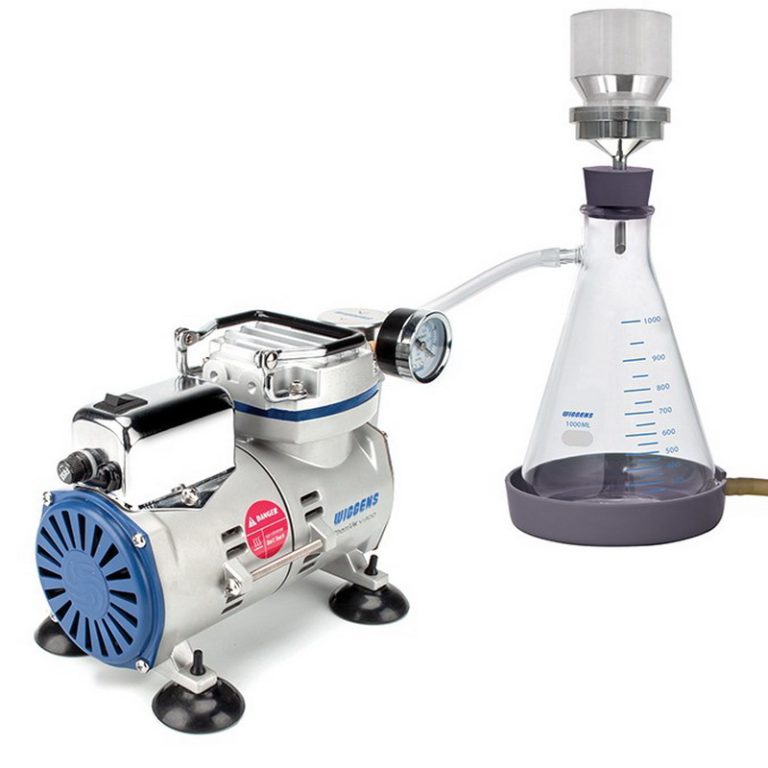
A complete vacuum Filtration Assembly for laboratory use typically includes:
Vacuum Pump
The primary vacuum source. Selection as discussed above — type, chemical compatibility, vacuum depth, flow rate, all matched to your specific application.
Vacuum Flask (Buchner Flask or Filter Flask)
The heavy-walled glass or polymer flask that collects filtrate and must withstand vacuum without imploding. Standard sizes range from 500ml to 5L or larger. The flask must be in good condition — any crack, chip around the neck, or stress fracture creates a vacuum leak and potential implosion hazard.
The connection between the vacuum flask and the pump is a critical interface in the Filtration Assembly. Proper vacuum tubing — thick-walled vacuum tubing, not thin-walled standard laboratory tubing — must be used for all vacuum connections.
Buchner Funnel or Filter Holder
The filter element holder. Buchner funnels use circular filter paper or membrane filters. Membrane filter holders (typically 47mm or 90mm diameter for laboratory applications) use supported membrane filters for HPLC solvent filtration, microbiological filtration, and other applications.
Filter Medium
Filter paper, membrane filters, or other filter media appropriate for your application. For HPLC mobile phase filtration, 0.45µm or 0.22µm membrane filters in appropriate chemistry (nylon, PVDF, or cellulose acetate depending on solvent compatibility) are standard. For microbiological filtration, 0.45µm membranes are typical.
Vacuum Trap
An important safety component often omitted from basic filtration setups. The vacuum trap sits between the filter flask and the vacuum pump, capturing liquid that might be drawn into the pump if the filter flask becomes overfull or if backflow occurs. It also captures solvent vapors before they reach the pump — particularly important for oil-sealed pumps but valuable for diaphragm pumps as well.
Vacuum Gauge and Regulator
A vacuum gauge allows you to monitor the vacuum level during filtration — useful for troubleshooting, for controlled-vacuum applications where very deep vacuum might damage the filter, and for confirming the pump is performing correctly.
A vacuum regulator allows you to set and maintain a specific vacuum level rather than running at maximum vacuum — important for applications where controlled, consistent vacuum is required.
Vacuum Tubing and Connections
All connections in the Filtration Assembly must use proper vacuum-rated tubing. Thin-walled tubing collapses under vacuum, restricting flow and potentially failing. All connections must be secure — vacuum leaks at any connection point reduce system vacuum and can introduce air contamination into the filtration setup.
Understanding the complete Filtration Assembly — not just the pump — helps you evaluate whether a vacuum pump purchase comes with appropriate accessories or whether you need to budget separately for complete system components.
Pump Types for Different Filtration Applications — Practical Guide
For HPLC Mobile Phase Filtration
Standard analytical laboratory requirement. You’re filtering organic solvents — methanol, acetonitrile, THF, various buffer mixtures — through 0.45µm or 0.22µm membranes before use in HPLC systems.
What you need: A PTFE-head, two-stage chemically resistant diaphragm pump. Oil-free operation is essential — solvent vapors must not contact oil. PTFE construction throughout the gas path provides compatibility with essentially all HPLC solvents. Vacuum depth around 1-5 mbar is more than adequate. Flow rate of 10-20 L/min handles the typical HPLC laboratory filtration workload comfortably.
When you buy Vacuum Pump for Filtration for this application, chemical resistance is the primary specification requirement — not ultimate vacuum depth.
For Pharmaceutical QC Laboratory Filtration
Similar requirements to HPLC mobile phase filtration, plus potentially:
- Sample preparation filtration before analysis
- Dissolution testing filtration
- API solution filtration for potency testing
What you need: Two-stage chemically resistant diaphragm pump with PTFE components. Consider models with integrated vacuum regulation for controlled-vacuum applications. For pharmaceutical QC, documentation support — calibration records, material certificates — is important for equipment qualification.
The Vacuum Pump price in Pakistan for properly specified pharmaceutical QC laboratory diaphragm pumps reflects the PTFE material specification and documentation support. This is appropriate investment for regulated laboratory environments.
For Microbiological Membrane Filtration
Water testing, environmental monitoring, pharmaceutical microbiology. Filtering aqueous samples through 0.45µm membranes to capture microorganisms for culture and enumeration.
What you need: Chemical resistance is less critical since you’re primarily working with aqueous samples. A good-quality single or two-stage diaphragm pump with vacuum regulation capability is appropriate. Vacuum stability matters more than ultimate depth for consistent membrane filtration.
For pharmaceutical microbiological testing, the surrounding Filtration Assembly — including the laminar flow environment for the filtration work — is as important as the pump specification.
For Research Laboratory Vacuum Filtration
Research laboratories have diverse needs — aqueous filtration one day, solvent filtration another, occasional vacuum drying or distillation.
What you need: A versatile two-stage chemically resistant diaphragm pump covers most general needs. If deep vacuum is also required for some applications, consider a scroll pump that combines oil-free operation with deep vacuum capability. Having a vapor trap in the Filtration Assembly is particularly important in research settings where varied and sometimes unexpected chemicals may be used.
For Industrial-Scale Filtration
Large-scale pharmaceutical manufacturing filtration, filter press operations, Nutsche filter operations, large-scale vacuum filtration.
What you need: Significantly higher flow rates than laboratory applications. Pump selection depends heavily on the specific chemicals involved and the scale of the operation. Liquid ring pumps, large oil-sealed rotary vane pumps with cold trap protection, or specifically engineered industrial vacuum systems depending on the application. This is where engaging with experienced Vacuum Pump for Filtration manufacturers who can provide application engineering support is particularly important.
Verifying Suppliers Online — What “Verified Supplier” Should Actually Mean
The phrase “verified supplier” gets used loosely online. When you’re looking to buy Vacuum Pump for Filtration equipment through online channels, here’s what verification should actually involve:
Physical Business Presence
A verified supplier has a real physical presence — not just a website. Can you find their address? Can you visit? Legitimate Vacuum Pump for Filtration manufacturers and distributors have real premises with real inventory.
Demonstrated Technical Knowledge
A verified supplier can answer technical application questions — not just quote specifications from the product sheet. Can they explain the difference between diaphragm and rotary vane pumps in the context of your specific application? Can they advise on Filtration Assembly component compatibility? Technical competence is a supplier quality indicator.
Existing Customer References
Can they connect you with existing customers in similar laboratory or industrial environments? Real-world references from comparable applications are far more valuable than manufacturer-supplied testimonials.
After-Sales Capability
What happens when something goes wrong? Local spare parts availability, local technical service capability, and clear warranty terms are what separate a genuine supplier from a transaction-only vendor. The Vacuum Pump price in Pakistan comparison should factor in this after-sales reality.
Documentation Capability
For pharmaceutical and regulated laboratory applications, can the supplier provide calibration certificates, material certificates, and documentation that supports your equipment qualification requirements? Suppliers familiar with pharmaceutical and regulated laboratory markets have this documentation capability. General industrial suppliers often don’t.
Return and Warranty Policy
For online purchases specifically, clear return and warranty policies that are actually honored protect you if the equipment doesn’t meet specifications or arrives damaged.
Vacuum Pump Price in Pakistan — Realistic Expectations
The Vacuum Pump price in Pakistan range for filtration applications spans from quite modest to substantial depending on type, specification, and capacity. Here’s a realistic framework:
Entry-Level Single-Stage Diaphragm Pumps
Adequate for basic laboratory filtration where chemical resistance requirements are modest and flow rate demands are low. The most accessible Vacuum Pump price in Pakistan in the category. Suitable for educational laboratories and simple aqueous filtration.
Quality Two-Stage Chemically Resistant Diaphragm Pumps
The appropriate specification for most pharmaceutical QC, analytical research, and professional laboratory filtration. PTFE construction throughout gas path. This is the investment level where most professional laboratories should be. The Vacuum Pump price in Pakistan at this specification level represents meaningful but appropriate investment for the performance and chemical resistance provided.
Scroll Pumps
Higher investment for oil-free deep vacuum capability. Appropriate for research applications requiring both chemical compatibility and deep vacuum. Less common in standard filtration applications but genuinely useful for research environments.
Oil-Sealed Rotary Vane Pumps
Varies widely with flow rate. Small laboratory models are moderately priced; larger industrial models are substantial capital investments. Appropriate where chemical compatibility is addressed through cold trap protection.
Industrial Vacuum Systems
Significant capital investment scaled to specific flow rate and application requirements. Typically involves application engineering rather than catalog selection.
Import Considerations
Most vacuum pumps available in Pakistan’s laboratory market are imported. Import duties, shipping costs, and currency exchange exposure add to the effective Vacuum Pump price in Pakistan compared to manufacturer list prices. Local sourcing from suppliers with established import channels often provides better effective pricing than individual import procurement.
TOPTEC Scientific — Laboratory Furniture and Infrastructure for Your Filtration Setup
When you buy Vacuum Pump for Filtration equipment and set up your complete Filtration Assembly, the surrounding laboratory infrastructure matters more than most buyers initially consider.
The workbench your filtration setup sits on. The fume hood you conduct solvent filtration inside. The storage for filtration consumables. The sink station for cleaning filtration glassware. The safety cabinet for solvent storage. All of these affect how safely, efficiently, and reproducibly your vacuum filtration operation functions.
TOPTEC Scientific is a Pakistan-based manufacturing company producing high-specification laboratory furniture and equipment for analytical laboratories, pharmaceutical QC departments, research institutions, environmental testing facilities, and industrial laboratories throughout Pakistan. Everything they manufacture is produced locally in Pakistan — which means faster delivery, direct technical communication, no import delays, local installation support, and pricing structured around Pakistani market realities.
For facilities investing in vacuum filtration capability, TOPTEC Scientific manufactures the complete surrounding infrastructure:
Chemical-Resistant Laboratory Workbenches
The workbench your vacuum Filtration Assembly sits on needs to withstand chemical spills, solvent exposure, and the vibration of an operating vacuum pump without surface degradation. TOPTEC Scientific manufactures workbenches with chemical-resistant surface materials — epoxy resin tops, phenolic resin, or stainless steel — appropriate for different laboratory chemical environments.
Properly specified benches provide stable, level surfaces that support accurate filtration setup positioning. Chemical resistance protects the bench surface through years of laboratory use. Appropriate height and depth support ergonomic working conditions for operators conducting repetitive filtration work.
Fume Hoods for Solvent Filtration
Any vacuum filtration work involving volatile organic solvents should be conducted inside a properly specified fume hood. TOPTEC Scientific manufactures ducted fume hoods with appropriate airflow performance, chemical-resistant interior surfaces (typically epoxy resin or polypropylene), sash designs that support convenient filtration work, and service connections for vacuum, gas supply, and electrical services.
Working inside a fume hood during HPLC solvent filtration and other volatile solvent filtration work protects operators from vapor exposure, protects the surrounding laboratory environment from contamination, and creates more consistent filtration conditions by controlling the local air environment around the filter assembly.
Laminar Flow Cabinets for Microbiological Filtration
For microbiological membrane filtration work — environmental monitoring, water testing, pharmaceutical microbiology — conducting the filtration inside a laminar flow cabinet provides the ISO 5 (Class 100) local environment that protects samples and membranes from environmental contamination during the filtration procedure.
TOPTEC Scientific manufactures vertical and horizontal laminar flow cabinets with HEPA filtration systems appropriate for microbiological laboratory applications. The clean airflow environment inside these cabinets significantly improves the reliability of microbiological filtration results by reducing the environmental contamination burden during the critical filtration step.
Laboratory Storage Systems
Filtration consumables — membrane filters, filter papers, Buchner funnels, vacuum flasks, tubing, and connectors — need organized, accessible, properly specified storage. TOPTEC Scientific manufactures laboratory storage cabinets and shelving in stainless steel and other appropriate materials for laboratory environments. Organized consumable storage improves laboratory workflow efficiency and ensures that filtration components are stored in conditions that maintain their integrity.
Solvent Storage Safety Cabinets
For laboratories with significant organic solvent inventory for filtration applications, proper solvent storage cabinets — ventilated, fire-resistant construction, appropriate capacity — are a safety requirement. TOPTEC Scientific manufactures safety storage cabinets appropriate for laboratory solvent storage, protecting personnel and meeting laboratory safety requirements.
Sink and Glassware Washing Stations
Vacuum flasks, Buchner funnels, filter holders, and tubing from completed filtrations need proper cleaning. TOPTEC Scientific manufactures stainless steel sink benches with appropriate drainage, chemical resistance, and ergonomic design for laboratory glassware cleaning operations. Properly designed sink stations simplify the cleaning workflow and maintain glassware in the condition needed for reproducible filtration results.
Pass-Through Boxes
For pharmaceutical facilities where filtered samples move between different environmental zones — from production areas to QC laboratories, for example — TOPTEC Scientific manufactures static and dynamic pass-through boxes appropriate for different cleanroom grade differentials.
Mobile Laboratory Trolleys
For filtration setups that need to be repositioned between laboratory areas, or for transporting filtration consumables and equipment within facilities, TOPTEC Scientific manufactures properly specified mobile laboratory trolleys with chemical-resistant surfaces and appropriate load ratings.
The comprehensive nature of TOPTEC Scientific‘s local manufacturing capability means you can source your complete laboratory infrastructure — from individual workbenches to completely furnished laboratory spaces — from a single local supplier with direct technical support and no import complications.
Building a Complete Online Procurement Strategy for Filtration Equipment
For laboratory and facility managers who are genuinely using online channels to procure filtration equipment, here’s a practical strategy for doing this well:
Research Thoroughly Before Shortlisting
Use online resources to understand your requirements — pump type, chemical compatibility needs, flow rate and vacuum depth requirements, Filtration Assembly component requirements. Build your own specification before evaluating suppliers rather than letting supplier descriptions define your requirements.
Shortlist Verified Local Suppliers First
For equipment with significant after-sales support requirements — which vacuum pumps definitely have — local suppliers from Vacuum Pump for Filtration manufacturers with physical presence and demonstrated technical capability should be your first shortlist. The Vacuum Pump price in Pakistan from verified local suppliers may be slightly higher than the lowest online listing price, but the total cost of ownership over the equipment’s life is almost always lower.
Request Technical Conversation Before Purchase
Before committing to any significant equipment purchase through online channels, have a direct technical conversation with a supplier representative. Their ability to engage with your specific application requirements — rather than just confirming catalog specifications — is a strong indicator of supplier quality and post-purchase support capability.
Inspect Before Paying for Used Equipment
If you’re considering used equipment, prioritize local sources where physical inspection is possible. Remote purchase of used vacuum pumps based on online descriptions alone carries significant risk of receiving equipment in worse condition than described or unsuitable for your application.
Confirm Documentation Availability
Before finalizing purchase for regulated laboratory applications, confirm what documentation the supplier provides and ensure it meets your equipment qualification requirements. This is particularly important for pharmaceutical QC and regulated analytical laboratory applications.
Factor in Complete System Cost
Budget for the complete Filtration Assembly — not just the pump. Vacuum flask, filter holder, filter media, trap, tubing, gauge, and regulator all contribute to total system cost. Some online pump listings are priced attractively but come with no accessories, making total system cost higher than initially apparent.
Safety Considerations That Must Not Be Overlooked
Vacuum filtration systems involve several genuine safety considerations that deserve explicit discussion:
Implosion Risk
Glass vacuum flasks under vacuum can implode if they have any damage — chips, cracks, or stress fractures. Always inspect vacuum glassware before use. Never use damaged vacuum glassware. Use plastic vacuum flasks for applications where breakage risk is elevated.
Solvent Vapor Exposure
Volatile solvent filtration generates vapor that needs to be managed. Fume hood operation for volatile solvent filtration is a safety requirement, not just good practice.
Pump Backflow
If vacuum is released rapidly or if the filter flask becomes overfull, liquid can be drawn into the vacuum pump. A vacuum trap between the flask and pump prevents this. Never operate a vacuum filtration system without an adequate trap.
Chemical Compatibility
Operating a pump with incompatible solvents doesn’t just damage the pump — it can create hazardous situations if pump oil becomes contaminated and releases vapors or if pump mechanism failure occurs during operation.
Proper Tubing Selection
Thin-walled tubing collapses under vacuum and can fail suddenly. Use only properly rated vacuum tubing throughout your Filtration Assembly.
Questions Worth Asking Any Supplier
Before you buy Vacuum Pump for Filtration equipment — from any supplier, online or direct — these questions help you evaluate whether you’re dealing with a genuinely knowledgeable supplier:
What pump type do you recommend specifically for my application involving these solvents at this scale?
What materials are the product-contact surfaces made from, and can you provide compatibility data for my specific solvents?
What flow rate and ultimate vacuum does this pump achieve in real operating conditions rather than theoretical specification?
What maintenance does this pump require and how often? Are consumables and spare parts available locally?
What documentation comes with this pump and does it support equipment qualification for regulated laboratory applications?
What is your warranty terms and how are warranty claims handled?
Can you provide references from existing customers using this pump in similar applications?
Suppliers who answer these questions specifically and confidently are suppliers worth working with. Those who deflect, provide vague answers, or redirect to marketing materials are telling you something important about what your post-purchase experience will look like.
Closing Thoughts
When you buy Vacuum Pump for Filtration equipment — whether new or used, online or through direct supplier engagement — the decision quality depends entirely on how clearly you understand your specific application requirements and how thoroughly you evaluate suppliers against those requirements.
The Vacuum Pump price in Pakistan that genuinely represents value accounts for chemical compatibility with your solvents, adequate flow rate for your filtration throughput, appropriate vacuum depth for your applications, documentation that supports your regulatory requirements, and local after-sales support from Vacuum Pump for Filtration manufacturers and suppliers who will still be engaged when you need maintenance support or technical assistance two years from now.
And when you’re building the complete filtration environment — the workbenches, fume hoods, laminar flow cabinets, storage systems, and complete laboratory infrastructure around your vacuum Filtration Assembly — TOPTEC Scientific manufactures this infrastructure locally in Pakistan, with direct technical support, no import complications, and comprehensive capability to furnish complete laboratory spaces properly.
Make the complete investment thoughtfully. Your filtration results — and your operators’ safety — depend on it.
For chemical-resistant laboratory workbenches, fume hoods, laminar flow cabinets, laboratory storage systems, safety cabinets, sink benches, and complete laboratory furniture manufactured locally in Pakistan, contact TOPTEC Scientific — building properly specified laboratory environments for Pakistan’s scientific and pharmaceutical community.
