

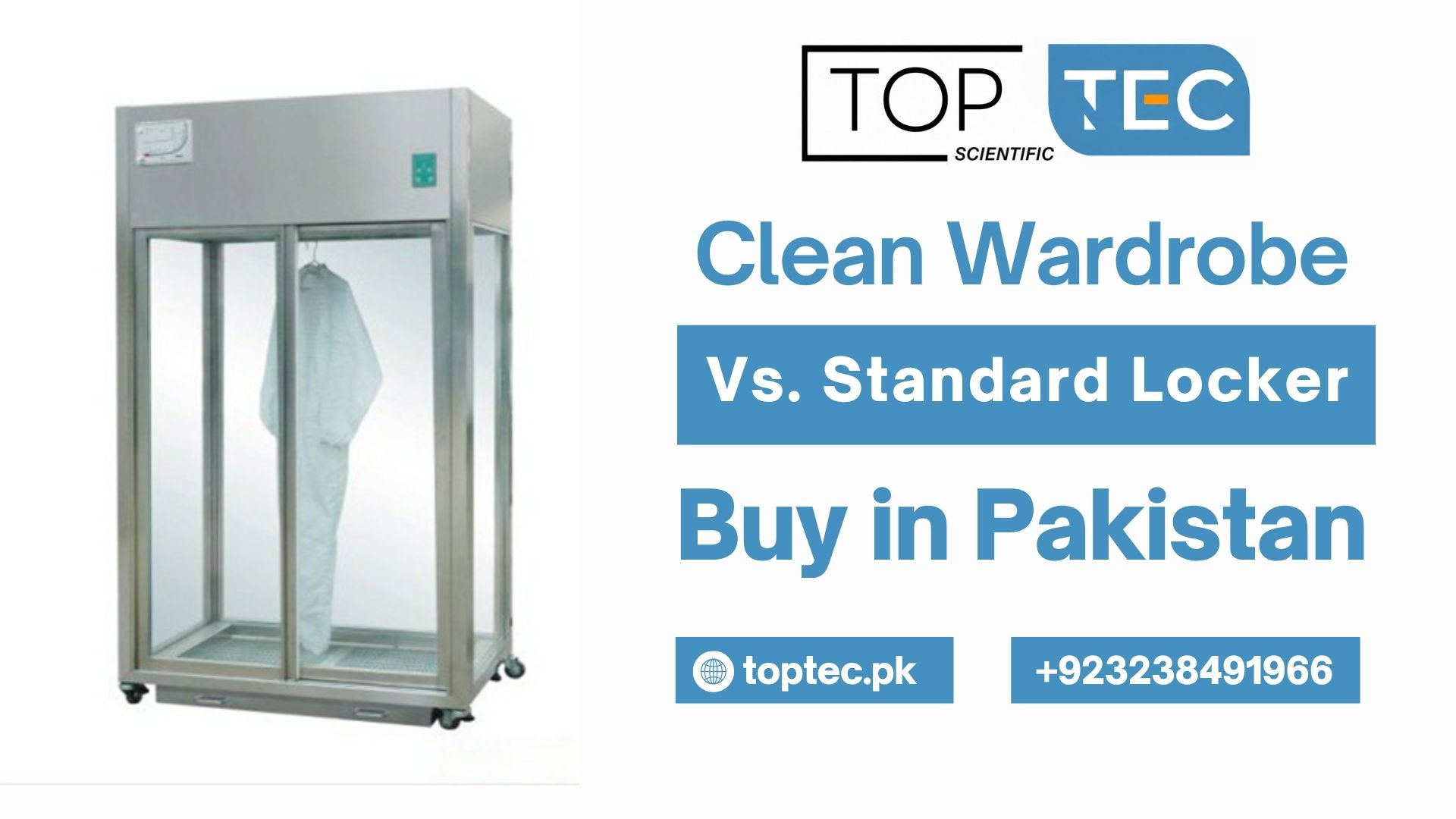
Buy clean wardrobe cabinets with HEPA filtration efficiency up to 99.99% at 0.3μm and positive pressure airflow. Available in SS304/316 stainless steel with transparent doors, UV sterilization, and adjustable shelving. Explore models for pharmaceutical and semiconductor cleanrooms.
A pharmaceutical facility invests heavily in building a cleanroom — proper HVAC, HEPA ceiling filters, epoxy flooring, pressure differentials monitored around the clock. Everything by the book. Then during a routine internal audit, someone notices the cleanroom garments are stored in basic metal lockers outside the gowning area. The kind you’d find in a school gymnasium.
That’s not an exaggeration. It happens more often than people in the industry like to admit. And it’s the kind of detail that turns a successful audit into a corrective action report.
The difference between a stainless steel clean wardrobe and a standard locker isn’t just about aesthetics or material quality. It’s about whether your contamination control strategy actually holds together end to end — or falls apart at the garment storage stage.
This article breaks down exactly what separates these two types of storage, why it matters for regulated and controlled environments, and how TOPTEC Scientific — a Pakistani manufacturer — is making it more accessible than ever to buy clean wardrobe solutions without the usual procurement headaches.
Starting with the Basics: What Are We Actually Comparing?
Before getting into specifics, it’s worth being clear about what each product actually is.
A standard locker is a general-purpose storage enclosure. Metal, wood, or laminate construction. No filtration. No contamination control features. Designed for storing personal items, tools, clothing — anything really. The air inside is the same air that’s in the surrounding room. Whatever particles, microbes, or contaminants are floating around in that environment settle inside the locker too.
A clean wardrobe — specifically a stainless steel clean wardrobe with HEPA filtration — is an entirely different category of equipment. It’s an actively managed storage environment. The interior is continuously purged with HEPA-filtered air. It’s built from materials that don’t generate particles or harbor contamination. Every design decision, from corner construction to door sealing, is made with one goal in mind: keeping what’s stored inside genuinely clean.
These two products exist in completely different universes in terms of purpose and performance. Comparing them directly might seem unnecessary — until you realize how many facilities are still using one when they absolutely need the other.
Difference #1: Air Quality Inside the Cabinet
This is the most fundamental difference, and it’s worth spending real time on.
Inside a standard locker, the air is completely uncontrolled. Open the door, and you’re exposing everything inside to whatever’s in the surrounding environment. Dust particles, microbial contaminants, volatile compounds — all of it can settle on garments stored inside. Close the door, and those particles just sit there. There’s no airflow, no filtration, no mechanism to remove contamination that has already entered.
Inside a properly built SS304 clean wardrobe, something very different is happening. A built-in fan draws air through an H14-rated HEPA filter — capturing 99.995% of particles at 0.3 microns — and circulates that filtered air continuously through the cabinet interior. This creates a positive pressure environment inside the wardrobe, which means air is always trying to push outward rather than allowing outside air to flow in.
The result? Garments stored in a stainless steel clean wardrobe are sitting in air that’s cleaner than most cleanrooms. That’s not marketing language — that’s what HEPA H14 filtration actually delivers when it’s properly implemented.
For pharmaceutical, semiconductor, or biotech facilities, this distinction is the difference between a contamination control system that works and one that has a gap you might not discover until something goes wrong.
Difference #2: Surface Materials and Particle Generation
Here’s something that doesn’t get discussed enough when people are comparing storage options for cleanroom environments.
The surfaces inside your storage cabinet are themselves a potential contamination source. Every material sheds particles at some rate — the question is how many, and whether that rate is acceptable in your environment.
Standard lockers are typically made from mild steel with powder coating or paint finishes. Initially, the surface looks fine. But cleanroom environments involve frequent cleaning with IPA, hydrogen peroxide solutions, or other disinfectants. Over time, those chemicals attack the paint or powder coat. Micro-cracks form. Paint chips. In some cases, rust develops. All of that material has to go somewhere — and in a storage environment, it goes onto your garments.
An SS304 clean wardrobe is built from Grade 304 stainless steel — non-porous, corrosion resistant, and chemically stable under the cleaning agents used in regulated environments. The surface doesn’t chip, doesn’t rust, and doesn’t degrade the way painted surfaces do. With a brushed or electropolished finish, particle shedding from the surface itself is minimal.
This matters because when you buy clean wardrobe solutions for a regulated facility, you’re not just buying a container — you’re buying a surface that will be in contact with critical garments day after day for years. The material integrity of that surface directly affects the cleanliness of what’s stored inside.
Difference #3: Construction Quality and Cleanability
Pull apart the construction details of a standard locker and a purpose-built SS304 clean wardrobe, and you’ll find differences that go beyond obvious material choices.
Standard lockers are designed for convenience and cost efficiency. Corners are typically folded or bolted. Seams may be open or filled with sealant that eventually breaks down. The interior has angles and recesses that are genuinely difficult to clean thoroughly. For general use, none of this matters much. For cleanroom applications, it matters enormously.
A properly manufactured stainless steel clean wardrobe is built with cleanability as a primary design requirement:
Welded corners instead of bolted joints eliminate the particle-trapping gaps that bolted construction creates. In a cleanroom cabinet, every joint is a potential contamination accumulation point if it’s not properly sealed.
Coved internal corners — where the walls meet the floor of the cabinet in a smooth, radiused curve rather than a sharp angle — make complete cleaning possible. Sharp internal corners cannot be fully cleaned. That’s not an opinion; it’s a physical reality that cleanroom design standards have acknowledged for decades.
Continuous sealed seams throughout the cabinet construction prevent particle ingress and make surface decontamination straightforward.
Smooth internal surfaces without unnecessary protrusions, shelving brackets, or hanging rails that aren’t part of the design intent — these all reduce the surface area available for particle accumulation.
When you buy clean wardrobe units for regulated environments, these construction details are what separates a cabinet that looks suitable from one that actually is.
Difference #4: Door Design and Sealing
Open a standard locker door. There’s no seal. Air moves freely in and out as the door opens and closes — and even when the door is closed, the fit is loose enough that air exchange happens constantly.
Clean wardrobe door design is fundamentally different. The goal is to maintain the positive pressure inside the cabinet while making access straightforward for users.
Hinged door designs on a stainless steel clean wardrobe typically incorporate compression gaskets or magnetic seals that create a meaningful barrier between the cabinet interior and the outside environment. Sliding door designs achieve a similar result with overlapping seals at the edges.
The practical implication is this: when someone opens a clean wardrobe door to retrieve a garment, the positive pressure inside the cabinet helps push outward, reducing the amount of ambient air that flows in during that brief moment of access. Close the door again, and the filtration system quickly restores the clean internal environment.
With a standard locker, every door opening is an invitation for contamination to enter and settle. There’s no recovery mechanism. Whatever came in stays in.
Difference #5: Regulatory Compliance
This is the one that usually ends the conversation when facility managers are weighing whether to buy clean wardrobe solutions versus using standard lockers.
In pharmaceutical manufacturing environments governed by GMP — whether FDA, WHO, EU GMP, or local regulatory equivalents — cleanroom garment storage is not an unregulated area. GMP guidelines address contamination control comprehensively, and garment storage is part of that picture. Auditors look at how garments are stored between uses. A standard locker fails that assessment in any serious GMP audit.
For semiconductor and electronics manufacturing operating under ISO 14644 cleanroom standards, contamination control documentation needs to cover garment management — including storage.
For medical device manufacturers working under FDA 21 CFR Part 820 or EU MDR requirements, quality system documentation for contamination control needs to reflect actual practice. Storing sterile or clean garments in standard lockers creates a gap between documented procedure and actual performance.
When you buy laboratory furniture — including clean wardrobes — from a supplier who can provide proper material certifications, construction documentation, and filter performance data, you’re building an audit trail that supports your compliance position. A standard locker gives you none of that.
Difference #6: Long-Term Durability in Cleanroom Conditions
Cleanroom environments are hard on equipment. The cleaning protocols alone — frequent wiping with disinfectants, occasional fumigation, controlled humidity — create conditions that accelerate degradation of standard materials.
A standard locker in a cleanroom gowning area might look acceptable for the first year. By year three, the paint is compromised, the hinges are corroding, and you’re either replacing it or working around its deteriorating condition.
An SS304 clean wardrobe is built for exactly these conditions. Grade 304 stainless steel handles repeated chemical cleaning without surface degradation. The BLDC motor (if specified) runs reliably for years without significant maintenance. HEPA filters are replaced on a scheduled basis — typically every 12 to 24 months — as a straightforward maintenance task.
Over a five to ten year operational period, the total cost of ownership comparison between a standard locker and a proper stainless steel clean wardrobe is often closer than people expect, particularly when you factor in the cost of regulatory non-compliance, product failures traced to contamination, or the simple cost of replacing degraded standard lockers more frequently.
Where TOPTEC Scientific Fits Into This Picture
If you’re based in Pakistan and you’ve been reading this thinking “all of this makes sense, but where do I actually source proper clean wardrobe solutions without paying imported prices?” — that’s where TOPTEC Scientific becomes directly relevant.
TOPTEC is a Pakistani manufacturer — not an importer, not a trading company — that actually manufactures laboratory and cleanroom furniture locally. Their range includes SS304 clean wardrobe units with HEPA filtration built to genuine cleanroom standards, along with a full range of other laboratory furniture.
Why Local Manufacturing Changes the Equation
When you buy laboratory furniture from international suppliers, the total cost calculation looks something like this: product price + international freight + import duties + customs clearance fees + currency conversion risk + 12-16 week lead time + overseas technical support complications.
When you buy laboratory furniture from TOPTEC, that calculation simplifies considerably. No international freight. No import duties on locally manufactured goods. No currency risk on the product itself. Lead times that are manageable. And when you need technical support — someone can actually show up.
For a single stainless steel clean wardrobe, the savings are meaningful. For a full laboratory or cleanroom fit-out — clean wardrobes, laminar flow cabinets, fume hoods, laboratory benches, safety storage — the aggregate difference is substantial. Facilities that have equipped full cleanrooms through TOPTEC have reported cost savings of 40 to 60 percent compared to equivalent imported product specifications.
Customization as Standard Practice
One frustration that comes up repeatedly with international laboratory furniture suppliers is the catalog limitation. Standard sizes, standard configurations, take it or leave it. Special orders are expensive and take even longer.
TOPTEC handles customization as part of normal manufacturing. If your gowning area has non-standard dimensions, if you need a specific number of compartments, if you have a particular door configuration requirement — these are engineering conversations TOPTEC’s team can accommodate, not premium-priced exceptions.
Build Quality Worth Scrutinizing
Their SS304 clean wardrobe units are welded at corners — not bolted. Internal corners are coved. Seams are sealed. Door mechanisms are designed to maintain cabinet integrity. Filter documentation and airflow test data are provided as part of delivery.
This isn’t a cabinet that looks good in a brochure and falls short in practice. It’s built for environments where an audit could happen tomorrow and where contamination events have real consequences.
Making the Right Decision for Your Facility
Here’s a straightforward way to think about this decision.
If you’re storing personal items, work clothes, or general equipment in a break room, warehouse, or non-controlled environment — a standard locker is fine. It’s what it was designed for.
If you’re storing cleanroom garments, sterile apparel, or any items that enter a controlled environment — and if your facility operates under GMP, ISO cleanroom standards, FDA requirements, or any comparable regulatory framework — then a standard locker is not just inadequate. It’s a documented compliance risk.
The choice to buy clean wardrobe solutions for these environments isn’t really about preference. It’s about whether your contamination control strategy has integrity from beginning to end.
Practical Checklist Before You Buy
Whether you’re approaching TOPTEC Scientific or evaluating any other supplier, here are the specifications worth confirming:
Filter grade — H14 HEPA minimum for pharmaceutical-grade applications. Don’t accept vague “HEPA certified” language without the grade specified.
Material certification — SS304 material certification should be available. For critical applications, ask for mill certificates.
Construction method — Welded corners confirmed, not bolted assembly.
Internal surface finish — Coved corners, smooth surfaces, no unnecessary protrusions.
Motor type — BLDC preferred for longevity and quiet operation.
Airflow velocity data — Should be documented at 0.3–0.5 m/s internally.
Door seal type — Compression gasket or magnetic seal, confirmed.
Filter replacement access — Understand the process and ongoing cost before purchasing.
Documentation provided — Material certs, filter performance data, airflow test results.
When you buy clean wardrobe units from TOPTEC, their team covers all of this in the pre-purchase consultation. But knowing what to ask is useful regardless of who you’re buying from.
Final Thoughts
The gap between a standard locker and a stainless steel clean wardrobe isn’t a small technical detail. It’s the difference between a contamination control system that holds together and one that has a fundamental gap at the garment storage stage.
For facilities in pharmaceutical manufacturing, semiconductor production, medical device manufacturing, biotechnology research, or healthcare sterile environments, this gap has real consequences — regulatory, operational, and financial.
TOPTEC Scientific provides Pakistani facilities with a genuine, locally manufactured option to buy clean wardrobe solutions — specifically their SS304 clean wardrobe range — that meets actual cleanroom standards without the cost and complexity of international procurement. When you’re ready to buy laboratory furniture for a controlled environment, the choice between a clean wardrobe and a standard locker shouldn’t be driven by upfront cost alone. It should be driven by what the environment actually requires.
And in cleanroom environments, what’s required is clear.
