

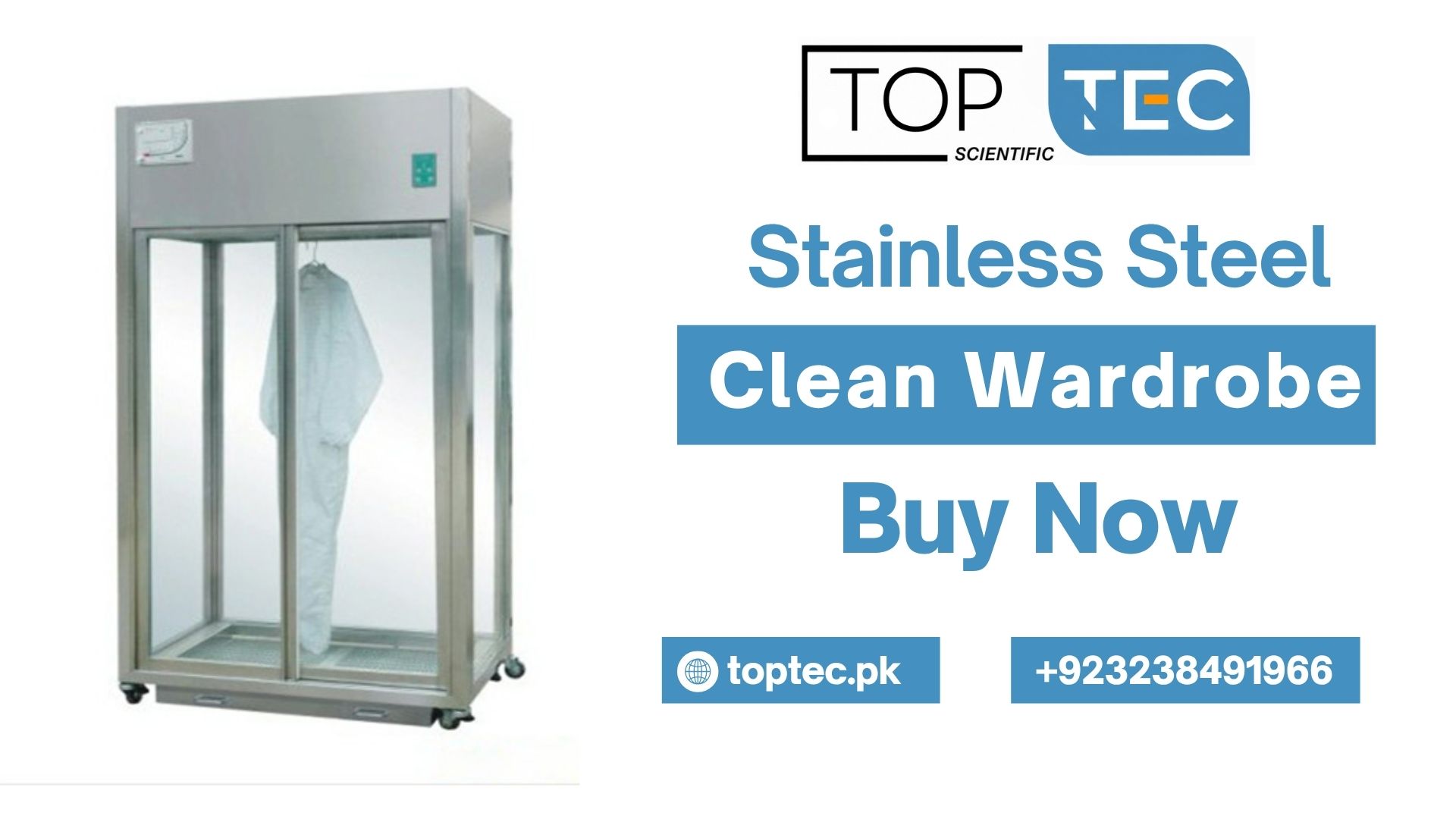
Discover stainless steel clean wardrobes with HEPA filtration for ISO/GMP cleanrooms. Featuring 304/316L stainless steel, ISO Class 5 airflow, and capacities for up to 50 garments. Request a quote from verified manufacturers today.
There’s a particular kind of frustration that comes with GMP audits — the kind where an inspector points at something you hadn’t thought twice about and suddenly it becomes the centerpiece of your corrective action report.
Garment storage is one of those things.
Facilities spend serious money on cleanroom construction, environmental monitoring systems, personnel training, and process validation. Then someone stores the gowning apparel in a painted steel cabinet that’s been sitting in the ante-room for six years, slowly corroding at the hinges. The audit finding practically writes itself.
I’ve had conversations with quality managers who described almost exactly this scenario. Not because they didn’t care about contamination control — they clearly did, given everything else they’d invested in — but because garment storage felt like a secondary concern. Something to sort out later.
Later has a way of arriving at inconvenient times.
This article is about getting that part right — specifically, understanding why a proper stainless steel clean wardrobe built from 304 or 316 grade steel is a GMP requirement in practice, even when regulations don’t spell it out in precise product terms. We’ll also talk about TOPTEC Scientific, a Pakistani manufacturer that builds these cabinets locally, which matters more practically than you might initially assume.
Why GMP Environments Demand More Than Standard Storage
GMP — Good Manufacturing Practice — is fundamentally about control. Control over materials, processes, environments, and people. Every element in a GMP facility is either contributing to contamination control or creating a risk of contamination. There isn’t really a neutral category.
Garment storage sits squarely in that framework. Cleanroom gowns, coveralls, hoods, shoe covers, and gloves are critical control items. They’re the physical barrier between personnel and the controlled environment. If those garments pick up contamination during storage, they carry it directly into the cleanroom when worn.
Standard storage — painted lockers, laminate cabinets, unfiltered metal enclosures — fails the GMP framework for several interconnected reasons:
Uncontrolled internal air environment. Whatever particles and microbes are present in the surrounding room settle freely inside a standard cabinet. The garments inside are exposed to that contamination continuously.
Surface materials that degrade. Paint chips. Powder coating cracks under repeated chemical cleaning. Rust develops at seams and hinges. Every degraded surface becomes a particle source and a potential contamination reservoir.
Construction that resists thorough cleaning. Sharp internal corners, bolted joints, open seams — these are features that make complete surface decontamination impossible. Contamination accumulates in places that can’t be reached.
A stainless steel clean wardrobe with active HEPA filtration addresses all three of these failure points directly. That’s not coincidence — it’s what the product was designed to do.
304 vs. 316: Understanding the Steel Grade Decision
When you start looking seriously at options and decide to buy clean wardrobe solutions for a GMP facility, one of the first technical questions you’ll encounter is the grade of stainless steel. This decision matters more than it might initially seem.
SS304: The Standard for Most GMP Applications
Grade 304 stainless steel — also written as 18/8, referring to its 18% chromium and 8% nickel composition — is the workhorse of cleanroom and laboratory furniture. An SS304 clean wardrobe gives you:
Corrosion resistance adequate for pharmaceutical cleaning agents, including IPA, quaternary ammonium compounds, hydrogen peroxide solutions, and most standard disinfectants used in GMP environments.
Non-porous surface that doesn’t absorb moisture, bacteria, or chemical residue. This is fundamental for any surface in a GMP environment — you need to be able to decontaminate it completely and confirm that decontamination.
Chemical stability under repeated cleaning cycles. Unlike painted or powder-coated surfaces that degrade over months of aggressive cleaning, SS304 maintains its surface integrity for the operational life of the cabinet.
Minimal particle shedding with a brushed or electropolished finish. This is critical — your storage cabinet shouldn’t itself be a particle source.
Weldability that allows proper cleanroom construction methods — continuous welded seams rather than bolted assemblies that create particle traps.
For the vast majority of pharmaceutical manufacturing, biotech research, medical device production, and semiconductor applications, an SS304 clean wardrobe is exactly the right specification. It handles the cleaning protocols, it doesn’t corrode under normal GMP conditions, and it provides the surface integrity that contamination control requires.
SS316: When You Need More
Grade 316 stainless steel adds molybdenum (typically 2-3%) to the 304 composition. That addition dramatically improves resistance to chloride-induced corrosion — a specific failure mode where chloride ions penetrate the passive oxide layer on stainless steel and initiate pitting corrosion.
When does this actually matter for a clean wardrobe?
If your facility uses sodium hypochlorite (bleach) solutions as part of regular cleaning or disinfection protocols, chloride exposure is significant and SS316 becomes worth considering — at least for high-contact surfaces and components.
If your environment involves marine or coastal conditions where chloride levels in ambient air are elevated, SS316 provides meaningful additional protection.
If your facility handles active pharmaceutical ingredients or processes that involve chloride-containing compounds at concentrations that might contact storage surfaces, SS316 is the more conservative choice.
For most standard pharmaceutical GMP environments, the corrosion resistance of SS304 clean wardrobe construction is entirely adequate. SS316 is available and appropriate for specific applications — but choosing it as a default for every application is often unnecessary expenditure.
The honest answer is: start with what your cleaning protocols actually involve, and choose the grade that matches that reality rather than automatically defaulting to the higher specification.
The HEPA Filtration Component: Not Optional in GMP Settings
A stainless steel cabinet alone — even with perfect SS304 or SS316 construction — is not a clean wardrobe without active HEPA filtration. The filtration system is what elevates the product from high-quality storage furniture to a genuine contamination control tool.
Here’s what’s happening inside a properly designed stainless steel clean wardrobe with HEPA filtration:
A brushless DC fan draws air through an H14-rated HEPA filter. H14 captures 99.995% of airborne particles at 0.3 microns — the most penetrating particle size for HEPA media. That filtered air is distributed through the cabinet interior at a controlled velocity, typically 0.3 to 0.5 meters per second, maintaining a positive pressure differential between the inside of the cabinet and the surrounding environment.
What positive pressure actually means in practice: air is continuously trying to push outward from the cabinet interior. When the door is opened briefly to retrieve a garment, the pressure differential reduces the amount of ambient air that flows in. When the door closes again, the filtration system rapidly restores the clean internal environment.
The result is that garments stored in a properly functioning stainless steel clean wardrobe are sitting in an air environment that meets ISO Class 5 or better standards continuously — better than the cleanrooms those garments will eventually be worn in.
For GMP facilities, this means garments are protected not just during cleanroom operations but during the periods between uses — overnight, across shift changes, during weekend shutdowns — when contamination events are actually most likely without proper storage.
Construction Details That Matter in GMP Environments
When you’re evaluating options to buy clean wardrobe units for a GMP facility, the headline specifications — material grade, filter rating — are the starting point. But the construction details are where real-world performance is determined.
Welded vs. Bolted Assembly
This distinction is fundamental. Bolted assembly creates joints — gaps between components that accumulate particles and resist complete cleaning. In a GMP environment, you need to be able to decontaminate every surface in your clean wardrobe. Bolted joints make that impossible.
Continuous welded seams, properly finished to eliminate surface discontinuities, create a cabinet that can be thoroughly wiped down in its entirety. This is non-negotiable for GMP-grade clean wardrobe construction.
Coved Internal Corners
A flat internal corner — where two surfaces meet at 90 degrees — creates a zone that cannot be completely cleaned. The geometry prevents a cleaning cloth from reaching the very edge of the joint. Over time, contamination accumulates there regardless of cleaning frequency.
Coved corners — where the junction between surfaces is a smooth, radiused curve — eliminate that problem. A cleaning cloth follows the curve completely, and the surface can be fully decontaminated. Every GMP-grade SS304 clean wardrobe should have coved internal corners as a standard construction feature.
Door Sealing Mechanisms
The door design on a stainless steel clean wardrobe needs to do two things: provide easy access for users and maintain the internal pressure environment when closed.
Compression gaskets or magnetic seals achieve this when properly specified. The seal needs to be consistent around the entire door perimeter — any gap creates a point where the positive pressure advantage is lost.
Sliding door designs can be appropriate for space-constrained gowning areas, but the sealing mechanism at door edges needs the same attention as hinged door designs.
Internal Lighting
Low-heat LED lighting inside the cabinet serves a practical purpose beyond visibility — it allows users to confirm garment condition and identification without bringing items out of the controlled cabinet environment unnecessarily. LED fixtures in clean wardrobe applications should be sealed against particle ingress from the fixture itself.
Filter Access Design
Replacing HEPA filters on a scheduled basis is a maintenance requirement, not an option. The design of the clean wardrobe should make filter replacement straightforward — accessible without tools if possible, and designed so that a filter change doesn’t require disturbing stored garments.
Ask any supplier you’re considering how filter replacement is performed in their specific design. The answer tells you a lot about how much thought went into the product’s operational reality.
Introducing TOPTEC Scientific: GMP-Grade Manufacturing in Pakistan
If you’re based in Pakistan and working through what it would actually take to properly equip a GMP facility with stainless steel clean wardrobe units, you’ve probably already encountered the standard options: international suppliers with attractive specifications, significant import costs, long lead times, and support arrangements that look less appealing once you’re past the sales process.
TOPTEC Scientific is a Pakistani manufacturer — genuinely manufacturing, not importing and rebranding — that produces laboratory and cleanroom furniture including their SS304 clean wardrobe range. Their production facility builds to specifications aligned with international GMP cleanroom furniture requirements.
The Local Manufacturing Advantage Is Real
When you buy laboratory furniture from an overseas supplier, the economics look like this: product price, international freight (which has been unpredictable for years), import duties, customs clearance fees, currency risk on USD or EUR pricing, and a 12 to 16 week lead time that assumes nothing goes wrong at any point in the chain.
When you buy laboratory furniture from TOPTEC, those additional costs largely disappear. No international freight. No import duties on locally produced goods. No currency conversion exposure on the product itself. Lead times that are measured in weeks rather than months.
For a single SS304 clean wardrobe, the savings compared to an equivalent imported unit are meaningful. For a complete GMP facility fit-out — clean wardrobes, laminar flow cabinets, fume hoods, laboratory benches, safety storage cabinets, and other furniture — the aggregate difference has been significant enough for facilities to redirect that budget toward other compliance requirements.
Construction That Holds Up to GMP Scrutiny
TOPTEC’s stainless steel clean wardrobe units are welded at corners — not bolted. Internal corners are coved. Seams are continuous and sealed. HEPA filter specification, airflow velocity data, and material certifications are provided with delivery.
These aren’t details added for marketing purposes. They’re the construction requirements for GMP-compliant garment storage, and TOPTEC builds them into their standard product.
Customization Without the Premium
Facility layouts don’t always conform to catalog standard dimensions. Gowning areas have specific space constraints. Garment loads vary by user count and shift overlap patterns. Number of compartments, door configuration, cabinet height — these are specifications that TOPTEC handles as part of normal manufacturing, not as expensive special orders.
When you approach TOPTEC to buy clean wardrobe units for a specific facility, the conversation starts with your actual requirements rather than which catalog item is closest to what you need.
After-Sales Support That’s Actually Accessible
This is something that deserves more attention than it typically gets in procurement decisions. Filter replacement schedules, motor servicing, technical questions during operation — with an international supplier, accessing support for these matters involves time zone differences, email chains, and occasionally shipping components internationally.
With TOPTEC being locally based in Pakistan, technical support is genuinely accessible. When filter replacement is due, replacement media is available locally. When a technical question arises during operation, someone can provide an answer or visit the facility. That operational reality is worth considering alongside initial purchase price.
Who Needs a GMP-Grade Clean Wardrobe?
Let’s be direct about which facilities are operating below standard if they’re not using proper stainless steel clean wardrobe solutions for garment storage.
Pharmaceutical Manufacturing Facilities
Any facility producing medicines under GMP — whether regulated by DRAP in Pakistan, FDA, EMA, or WHO standards — needs to demonstrate comprehensive contamination control. Garment storage is examined during GMP audits. A standard locker in a gowning area is an audit finding. A properly specified SS304 clean wardrobe with documentation is a demonstration of systematic contamination control.
API Manufacturing Plants
Active Pharmaceutical Ingredient manufacturing typically involves even stricter contamination control requirements than finished dosage form production. The argument for proper garment storage is stronger, not weaker, in these environments.
Medical Device Manufacturing
Both FDA 21 CFR Part 820 and EU MDR requirements for sterile or clean medical device production facilities include contamination control as a quality system requirement. Garment storage is part of the contamination control chain.
Biotechnology Research Facilities
Cross-contamination in biotech research — between cell lines, between batches, between experiments — can invalidate months of work. Garment storage that introduces contamination is a research integrity issue, not just a regulatory one.
Semiconductor and Electronics Manufacturing
Particle contamination in semiconductor fabrication has direct yield implications. Operators who store cleanroom suits in uncontrolled environments between shifts introduce particle risk that controlled garment storage would eliminate.
Hospital Sterile Processing Departments and Operating Theatres
Healthcare environments with laminar flow operating rooms or sterile processing departments handle garment management as part of infection control protocols. Clean wardrobe solutions support those protocols in ways that standard storage cannot.
What a GMP Audit Actually Looks For
Understanding what inspectors examine around garment storage helps clarify why the specifications discussed in this article matter in practice.
During a GMP audit related to contamination control and personnel hygiene, inspectors typically examine:
Documented procedures for garment management — how garments are stored, how storage conditions are maintained, how storage equipment is cleaned and maintained.
Evidence that practice matches procedure — do the physical arrangements in the facility reflect what the procedures describe?
Equipment suitability — is the storage equipment appropriate for the controlled environment context? Can it be cleaned and decontaminated? Does it maintain the cleanliness of stored garments?
Maintenance records — for active systems like HEPA-filtered clean wardrobes, filter replacement records and performance verification documentation.
A stainless steel clean wardrobe from a manufacturer who provides material certifications, filter performance documentation, and maintenance records support creates an audit trail that addresses each of these areas. When you buy clean wardrobe units with proper documentation, you’re building the evidence package that GMP compliance requires.
Specifications Reference: What to Confirm Before Purchase
For anyone actively in the process of evaluating options, here’s a practical reference of specifications to confirm with any supplier:
| Specification | GMP-Grade Requirement |
|---|---|
| Material grade | SS304 minimum; SS316 for chloride-heavy environments |
| HEPA filter rating | H14 (99.995% at 0.3 microns) |
| Internal airflow velocity | 0.3–0.5 m/s documented |
| Corner construction | Continuous welded, not bolted |
| Internal corner finish | Coved (radiused), not sharp angle |
| Door sealing | Compression gasket or magnetic seal, full perimeter |
| Motor type | BLDC preferred for longevity |
| Material documentation | Mill certificates available |
| Filter change interval | Documented by manufacturer |
| Surface finish | Brushed or electropolished |
When you approach TOPTEC Scientific to buy clean wardrobe units or any other laboratory furniture, these specifications form the basis of the technical conversation. Their team can provide documentation for each of these points as part of the standard delivery package.
Frequently Asked Questions
Is SS304 genuinely sufficient for pharmaceutical GMP environments, or should I always specify SS316?
For most pharmaceutical GMP applications, an SS304 clean wardrobe is entirely appropriate. SS316 becomes relevant when cleaning protocols involve significant chloride exposure — sodium hypochlorite solutions in particular — or when the ambient environment has elevated chloride levels. Review your actual cleaning agent specifications and make the grade decision based on that, rather than defaulting to SS316 for all applications.
How does HEPA filter replacement work in practice, and how does it affect operations?
Filter replacement in a properly designed stainless steel clean wardrobe is straightforward — typically 30 to 60 minutes per unit, depending on design. Most facilities schedule filter changes during planned maintenance periods rather than during production. TOPTEC supplies replacement filters locally, which avoids the lead time complications of international sourcing.
Can clean wardrobes be installed in ante-rooms rather than inside the cleanroom itself?
Yes, and this is common practice. The cabinet maintains its internal HEPA-filtered environment regardless of where it’s installed. Many facilities locate clean wardrobes in the gowning ante-room, which is actually logistically sensible — garments are accessible at the point of gowning without requiring entry into the cleanroom itself.
What maintenance does a clean wardrobe require beyond filter replacement?
Regular external and internal surface cleaning using appropriate disinfectants, periodic motor and fan performance checks, door seal inspection, and filter integrity testing. TOPTEC provides a maintenance schedule with their units.
Does TOPTEC supply across Pakistan or only in specific regions?
TOPTEC Scientific supplies and installs across Pakistan. Their team handles delivery and installation for facilities in major cities and provincial locations.
Making the Decision
Here’s where this comes together practically.
If you’re running a pharmaceutical facility, biotech operation, medical device plant, or any other regulated manufacturing or research environment in Pakistan, the question isn’t really whether you need a stainless steel clean wardrobe for garment storage. GMP expectations and contamination control logic answer that question clearly.
The practical questions are: which specification is right for your specific environment (304 or 316, H13 or H14 filter, what configuration), and where do you source it in a way that delivers quality, documentation, and ongoing support without the complications and costs of international procurement?
TOPTEC Scientific addresses the second question directly. Their SS304 clean wardrobe range — and their broader laboratory furniture offering — is manufactured locally in Pakistan to international GMP-aligned standards. When you buy laboratory furniture from TOPTEC, you’re getting documented quality, accessible support, and procurement economics that make sense for Pakistani facilities.
If you’re ready to buy clean wardrobe solutions that will hold up to GMP scrutiny, support your contamination control system genuinely, and last through years of cleanroom conditions — TOPTEC is the conversation worth having.
Closing Thought
GMP compliance is only as strong as its weakest element. A facility that has invested in every other aspect of contamination control but stores its cleanroom garments in inadequate conditions has a gap — and gaps in GMP systems have a way of surfacing at the worst possible moments.
A properly specified stainless steel clean wardrobe, built from SS304 or SS316 as appropriate to your environment, with genuine H14 HEPA filtration and GMP-grade construction, closes that gap. It makes your contamination control system complete rather than almost complete.
That’s worth taking seriously — and worth investing in properly.
