

Most people who work with a cleanroom air shower every day don’t think much about what’s actually happening inside the cabinet when the cycle runs. The doors close, the air blasts, the timer counts down, the inner door releases. It’s routine. You stop thinking about the engineering behind it fairly quickly.
But when something goes wrong — when the cycle seems weaker than usual, when the alarm keeps triggering, when the annual qualification test reveals face velocity below specification — suddenly understanding what’s inside the air shower and how each component contributes to the overall system performance becomes very important, very fast.
And for anyone specifying a Pharmaceutical Air Shower for a new facility, or evaluating a quotation for a cleanroom air shower upgrade, understanding the components is what separates an informed procurement decision from a purchase based entirely on price and a photograph in a catalog.
This article is a complete technical walkthrough of every major component in an air shower system — what each one does, why its specification matters, what failure looks like, and what to look for when you’re ready to Buy Air Shower equipment for your pharmaceutical, research, or industrial cleanroom facility in Pakistan.
At TOPTEC Scientific, we manufacture and supply cleanroom equipment and laboratory infrastructure locally in Pakistan. We build air shower systems and have these component-level conversations with facility managers regularly. This is the written version of that conversation.
Why Component Knowledge Matters Before You Buy
Here’s the honest reality of the Pakistani laboratory and cleanroom equipment market: air shower systems are available across a wide price range, and a significant portion of the price variation reflects differences in component quality that are invisible from the outside. Two air showers can look nearly identical in a photograph while having meaningfully different HEPA filter grades, blower capacities, nozzle materials, and control system sophistication.
A pharmaceutical QC manager who understands component specifications can look at a quotation or a technical datasheet and immediately identify where corners have been cut. One who doesn’t has to rely entirely on the supplier’s word — which in a market with variable quality standards, is a risky position to be in.
So let’s go through the components properly.
Component 1: The HEPA Filter System
If the air shower is a decontamination system, the HEPA filter is the component that makes the decontamination permanent rather than temporary. Without HEPA filtration, a high-velocity air shower would simply redistribute particles — dislodging them from the gown and blowing them around the chamber before they settle back on surfaces or are carried through the inner door.
How the HEPA Filter Functions in an Air Shower
Air showers typically have two HEPA filter positions in the airflow circuit:
Supply HEPA filter: Positioned upstream of the nozzle system, filtering the air before it’s delivered to the nozzles. This ensures that the air blasting against the gown is clean — not carrying contamination from the chamber or recirculation path.
Return/exhaust HEPA filter: Positioned in the return air path, capturing particles that have been dislodged from the gown and swept into the return airflow. This is the critical capture step — particles removed from the gown must be captured here permanently, not recirculated back into the chamber or discharged into the room.
Both filters work together. The supply filter ensures clean decontamination air. The return filter ensures captured particles stay captured. A system with only one HEPA position is compromised.
HEPA Filter Grades: H13 vs. H14
H13 HEPA (99.95% at 0.3 microns): The minimum appropriate specification for cleanroom air shower systems serving pharmaceutical controlled environments. Captures the overwhelming majority of particles dislodged from gowns, including particles in the size range most relevant to pharmaceutical contamination control.
H14 HEPA (99.995% at 0.3 microns): The preferred specification for Pharmaceutical Air Shower systems serving Grade A/B adjacent areas and ISO Class 5 environments. The additional order of magnitude improvement in fine particle capture provides meaningful additional assurance for high-classification pharmaceutical cleanroom entry.
When you Buy Air Shower equipment for a pharmaceutical application, always confirm the HEPA filter grade for both supply and return positions — and ask for documentation of filter integrity testing, not just efficiency specification. A filter can meet efficiency specification while having installation-related bypass leaks that allow unfiltered air through at specific points.
Pre-Filters: The HEPA Protection Layer
Most well-designed cleanroom air shower systems include a pre-filter — a coarser filter (typically G4 or F7 grade) positioned upstream of the HEPA filter. The pre-filter captures larger particles before they reach the HEPA media, extending HEPA filter life significantly.
Without a pre-filter, large particles from heavily loaded gowns load the HEPA filter directly — shortening its service life, increasing differential pressure more quickly, and eventually reducing airflow as filter resistance climbs. A Pharmaceutical Air Shower without pre-filters has higher HEPA filter replacement frequency and higher operating cost over its service life.
Pre-filters are the consumable component in the filtration system — they should be inspected monthly and replaced when differential pressure readings indicate loading. Neglecting pre-filter maintenance is one of the most common causes of air shower performance degradation in pharmaceutical facilities.
HEPA Filter Integrity Testing
For GMP pharmaceutical applications, HEPA filter integrity testing — confirming no bypass leaks in the installed filter assemblies — should be part of both initial commissioning qualification and annual requalification. This testing uses an aerosol challenge upstream of the filter with photometer scanning of the downstream face, identifying any penetration through pinhole defects or frame edge leaks.
This is the same approach used for biosafety hood HEPA filter certification under NSF/ANSI 49 — pharmaceutical facilities familiar with biological safety cabinet certification will recognize the methodology. The difference is that air shower HEPA certification isn’t yet as formally standardized as biosafety cabinet certification, which means the onus is on the facility to include it in their qualification protocol rather than relying on a standard external certification program.
Component 2: The Blower System
The blower is the mechanical heart of the cleanroom air shower — the component that generates the airflow that powers both the supply nozzles and the return filtration system. Its specification directly determines whether the air shower achieves the air velocities needed for effective particle dislodgement.
Blower Types in Air Shower Applications
Centrifugal blowers (forward-curved or backward-curved impellers): The most common blower type in cleanroom air shower systems. Centrifugal blowers handle the pressure rise needed to force air through HEPA filters and nozzle restrictions efficiently. Backward-curved impeller designs are generally preferred for cleanroom applications — they’re more energy-efficient, less prone to overloading, and generate lower noise levels than forward-curved equivalents.
EC (electronically commutated) motors: Modern air shower systems increasingly use EC motor-driven blowers — variable-speed blowers that adjust their speed in response to filter loading. As pre-filters and HEPA filters load with particles over time, resistance in the airflow circuit increases. A fixed-speed blower can’t compensate — face velocity drops as resistance climbs. An EC motor-driven blower automatically increases speed to compensate, maintaining consistent nozzle velocity throughout the filter service life. For pharmaceutical facilities where validated cycle performance must be maintained between annual requalification events, EC motor blowers offer a meaningful performance advantage.
Blower Capacity and Nozzle Velocity
The relationship between blower capacity and nozzle velocity is not linear — it depends on the entire airflow circuit design including duct sizing, filter resistance, nozzle count and diameter, and chamber volume. This means blower motor wattage alone is not a reliable indicator of nozzle velocity performance.
The only reliable confirmation of nozzle velocity is measured data — velocity measurements taken at each nozzle position with a calibrated anemometer. When evaluating a Pharmaceutical Air Shower quotation, ask for factory test data showing measured nozzle velocities, not calculated estimates from blower specifications.
The effective decontamination range for pharmaceutical air shower applications is 20 to 25 meters per second at the nozzle outlet. Below 20 m/s, the turbulence generated by the air jets isn’t consistently sufficient to overcome the adhesion forces holding particles to gown fabric surfaces. Above 25 m/s, there are diminishing returns on decontamination effectiveness and increasing noise and energy consumption.
Blower Maintenance
Blower bearings are the primary wear component in the blower system. Bearing degradation causes progressive reduction in blower speed, which causes progressive reduction in nozzle velocity — a performance degradation that happens gradually and isn’t visible without measurement.
Annual blower inspection — including bearing condition assessment, drive belt condition (for belt-driven systems), and electrical connection integrity — should be part of the planned maintenance program for every cleanroom air shower in a pharmaceutical facility. Early identification of bearing wear allows planned replacement before failure; unexpected bearing failure during production hours causes unplanned downtime.
Component 3: The Nozzle System
Nozzles transform the high-volume, moderate-velocity airflow from the blower into the high-velocity, directional jets that dislodge particles from gown surfaces. Their design, material, positioning, and condition have a direct effect on how comprehensively the air shower covers all surfaces of a gowned person.
Nozzle Design Principles
A nozzle accelerates airflow by reducing the cross-sectional area through which air passes — the same volume of air forced through a smaller opening exits at higher velocity. The shape of the nozzle — specifically the inlet radius, throat diameter, and exit angle — determines the velocity profile of the exiting jet and how quickly that velocity decays with distance from the nozzle.
For air shower applications, nozzles should be designed to:
- Achieve the target outlet velocity (20-25 m/s) at the blower pressures the system generates
- Maintain jet coherence (not disperse into turbulent eddies immediately after exit) so that velocity is maintained across the distance to the gown surface
- Direct the jet at the appropriate angle to cover the intended body zone effectively
Nozzle Material Specification
For Pharmaceutical Air Shower applications, nozzle material is a GMP surface specification decision — the same logic that governs cleanroom furniture and equipment surface materials in pharmaceutical environments.
Stainless steel nozzles (304 or 316L grade): The correct specification for pharmaceutical cleanroom air shower applications. Chemically resistant to pharmaceutical disinfectants including IPA, quaternary ammonium compounds, and chlorine-based agents. Smooth surface that doesn’t trap particles or support biofilm formation. Durable under frequent cleaning.
Plastic (ABS or polypropylene) nozzles: Acceptable for lower-grade applications but may degrade over time with aggressive pharmaceutical disinfectants. Surface texture of some plastic formulations can accumulate deposits that alter nozzle geometry and affect airflow.
Powder-coated metal nozzles: Acceptable for Grade C/D applications with appropriate coating quality. The coating must resist chipping and chemical degradation from pharmaceutical cleaning agents.
When you Buy Air Shower equipment for a pharmaceutical GMP application, confirm the nozzle material specification. Stainless steel nozzles throughout are the specification that stands up to pharmaceutical cleaning protocols and to audit scrutiny.
Nozzle Coverage and Distribution
How nozzles are distributed across the chamber determines whether all surfaces of a gowned person are exposed to effective decontamination airflow. Coverage gaps are where particles escape the decontamination cycle.
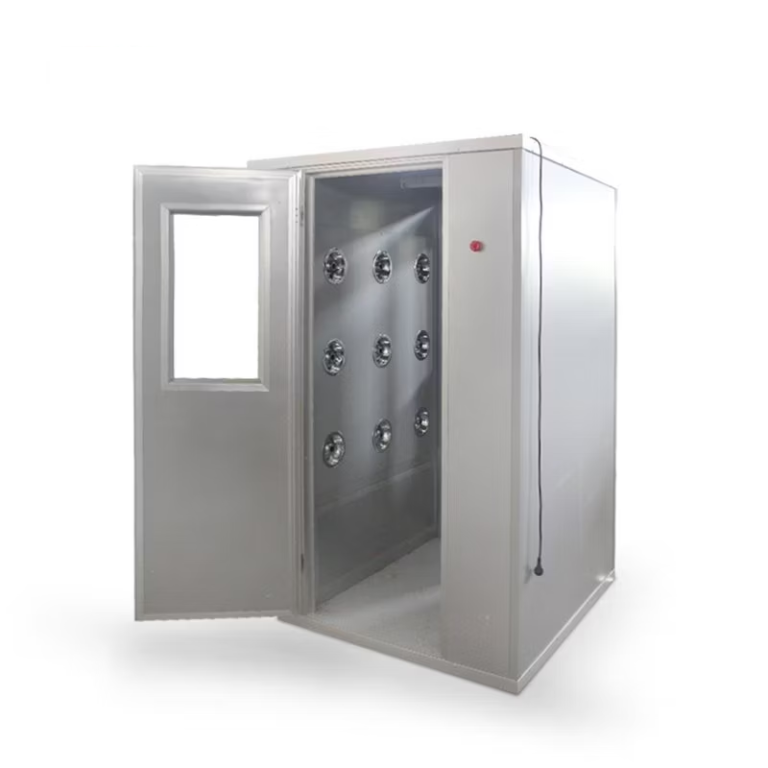
Side wall nozzles at multiple heights: The primary nozzle banks in most air shower designs. Banks at torso height (approximately 100-140 cm), mid-body height (approximately 60-100 cm), and lower body height (approximately 20-60 cm) provide coverage across the full standing height of a gowned person.
Ceiling nozzles: Top-down airflow from ceiling-mounted nozzles addresses the head, shoulders, and upper torso — areas that receive limited coverage from side wall nozzles. Ceiling coverage is particularly important for pharmaceutical applications where head and shoulder contamination from donning hairnets and face covers can be significant.
Floor-level nozzles: Low-mounted nozzles at floor height address shoe covers, ankles, and the lower hem of coveralls — the areas most exposed to floor contamination during transit from the gowning room. For Pharmaceutical Air Shower systems serving Grade B adjacent areas where floor-to-gown particle transfer is a meaningful contamination pathway, floor-level nozzle coverage is a valuable specification addition.
Adjustable nozzle angles: Nozzles with adjustable angular positioning allow the airflow direction to be optimized for coverage — directing jets at the specific zones where contamination is most likely based on the gowning protocol and manufacturing process characteristics. Fixed-angle nozzles are simpler but less adaptable.
Component 4: The PLC Control System
The PLC (Programmable Logic Controller) is the brain of a modern cleanroom air shower — managing the operational sequence, monitoring performance parameters, controlling the interlock system, and providing the data logging capability that pharmaceutical GMP documentation requirements increasingly demand.
What a PLC Does in an Air Shower System
In a basic air shower, a simple relay-logic timer could manage the cycle. But modern Pharmaceutical Air Shower systems in GMP pharmaceutical applications require considerably more sophisticated control than a timer relay can provide. A PLC enables:
Programmable cycle management: Cycle duration, fan speed ramp-up and ramp-down sequences, timing of interlock releases — all programmable and adjustable through the HMI (Human Machine Interface) rather than requiring hardware changes. For pharmaceutical facilities where different cleanroom grades may require different cycle parameters, a PLC-controlled system allows multiple validated protocols to be stored and selected.
Continuous performance monitoring: Modern PLCs can receive inputs from airflow sensors positioned in the nozzle plenum or at the chamber face, providing real-time monitoring of air velocity. If velocity drops below the minimum effective threshold — from filter loading, blower fault, or any other cause — the PLC can trigger an alarm, prevent the inner door from releasing until the fault is resolved, and log the event for maintenance records.
Interlock logic management: The door interlock sequence — outer door locks when inner door opens, inner door cannot open until cycle completion, fail-safe behavior on power interruption — is managed by the PLC logic. PLC-based interlock control is more reliable and more auditable than mechanical interlock systems, and allows more sophisticated interlock behaviors including time-delay sequencing and integration with building access control systems.
Usage data logging: For pharmaceutical GMP facilities where equipment use records are part of the quality system, a PLC can log every air shower cycle — timestamp, cycle duration, operator identification (when integrated with access control), and any alarm events. This usage log is a quality record that supports equipment qualification documentation and provides the data for any investigation triggered by an environmental monitoring excursion.
Fault detection and diagnostics: PLCs can monitor multiple parameters simultaneously and provide specific fault codes that help maintenance technicians identify the cause of performance issues quickly — rather than requiring systematic manual investigation of every possible failure mode.
HMI (Human Machine Interface)
The HMI is the touchscreen or display panel through which operators interact with the PLC control system. For pharmaceutical applications, the HMI should provide:
- Clear display of current system status (ready, cycle running, fault)
- Real-time display of remaining cycle time
- Airflow status indication — confirming that airflow is at the required level
- Fault codes with meaningful descriptions rather than just error numbers
- Password-protected access to cycle parameter settings — preventing unauthorized changes to validated cycle configurations
For GMP pharmaceutical facilities, parameter change access control is important. The validated cycle duration is a quality system parameter — it should not be adjustable by production operators without formal change control documentation. PLC systems with password-protected parameter access enforce this control electronically rather than relying on administrative procedures alone.
21 CFR Part 11 Considerations
For pharmaceutical facilities operating under FDA oversight — or facilities targeting US market pharmaceutical export — the electronic records and electronic signature requirements of 21 CFR Part 11 may apply to air shower usage data if that data is used as a GMP record. PLC systems with audit trail functionality, timestamped records, and electronic signature capability support compliance with these requirements for facilities where they apply.
Component 5: The Interlock Door System
The door interlock is the contamination control mechanism that gives the air shower its zone separation function — the physical barrier that prevents a direct air path between the cleanroom and the outside environment during personnel entry.
How the Interlock Works
Most modern pharmaceutical air shower interlocks operate on a simple principle: only one door can be in the open state at any time. When the outer door is open, the inner door is locked. When the inner door is open, the outer door is locked. During the cycle, both doors are locked.
The mechanical implementation of this principle has evolved from simple rod-and-latch mechanical systems to electronic door strikes controlled by the PLC. Electronic interlocks offer advantages in reliability, auditability, and integration with broader access control and monitoring systems.
Magnetic door strikes: Electromagnetic strikes that lock doors by magnetic force when energized. The fail-safe configuration for pharmaceutical cleanroom applications is fail-locked — power removed means the strike remains in the locked state, preventing doors from opening during power interruptions rather than defaulting to open.
Pneumatic locking systems: Some air shower designs use pneumatic door locking — compressed air-powered locking mechanisms that engage when the sequence requires door locking. These are less common than electromagnetic systems but provide very high physical locking forces that are difficult to overcome manually.
Door Sealing for Cleanroom Performance
The door itself — beyond its interlock function — contributes to the air shower’s pressure management performance. Poorly sealed doors allow air to flow between the chamber and adjacent spaces during the cycle, disturbing the internal pressure balance and potentially reducing nozzle velocity.
Pharmaceutical air shower doors should have perimeter compression gaskets — continuous sealing elements that compress against the door frame when the door closes, creating an airtight seal. Gasket condition should be inspected regularly — compression-set gaskets that no longer create positive sealing contact reduce the air shower’s pressure containment performance.
Component 6: The Chamber Construction
The chamber itself — walls, floor, ceiling, and all interior surfaces — is a GMP surface specification decision that affects both performance and compliance.
Interior Surface Materials
Stainless steel panels (304 or 316L): The premium interior specification for Pharmaceutical Air Shower applications. Smooth, non-porous, chemically resistant to pharmaceutical disinfectants, easy to inspect for contamination, and durable under frequent cleaning with aggressive agents.
Powder-coated mild steel panels: Acceptable for Grade C/D applications with appropriate coating quality. The coating must be hard, smooth, and resistant to the specific disinfectants used in the facility. Chipped or deteriorated powder coating creates particle-trapping surface defects and exposes the underlying steel to corrosion.
HPL (High-Pressure Laminate) interior panels: Some air shower designs use HPL-faced interior panels — smooth, non-porous, and available in pharmaceutical white or other cleanroom-appropriate finishes. Compatible with standard pharmaceutical disinfectants.
Floor Construction
The air shower floor takes the most mechanical loading — foot traffic, the weight of the person during the cycle, trolley wheels in pass-through configurations. The floor must be:
- Smooth and non-porous — no joints or surface irregularities that trap particles or cleaning agent residue
- Slip-resistant — the floor may be wet during or after cleaning; slip resistance matters for operator safety
- Load-rated for the intended use
- Coved at wall junctions — coved transitions eliminate particle-trapping corners
For pass-through air showers handling trolleys or equipment, the floor must also be rated for the trolley load and fitted with appropriate guide channels or ramps that protect floor surface integrity during equipment movement.
Component 7: Sensors and Monitoring Systems
Modern cleanroom air shower systems for pharmaceutical GMP applications include sensors that provide real-time and logged performance data — supporting both the operator safety function (alerting to performance failures) and the documentation requirements of GMP quality systems.
Airflow Velocity Sensors
Airflow sensors — hot-wire anemometers or differential pressure sensors positioned in the air supply plenum — provide continuous measurement of the airflow parameter that drives decontamination performance. The PLC reads this sensor output and can:
- Display current airflow status on the HMI
- Trigger an alarm when velocity drops below the minimum specification threshold
- Prevent inner door release if velocity is below specification during the cycle — preventing the cycle from being treated as a completed decontamination event when the airflow was inadequate
For pharmaceutical GMP facilities, having sensor-based airflow monitoring integrated with the PLC — rather than relying on periodic manual verification — provides continuous quality assurance of air shower performance between scheduled requalification events.
Filter Differential Pressure Monitoring
Differential pressure sensors across the pre-filter and HEPA filter positions monitor the pressure drop that develops as filters load with captured particles. Rising differential pressure indicates increasing filter loading — providing advance warning of impending performance degradation before it reaches the point of airflow specification failure.
PLC integration of differential pressure monitoring allows the system to log filter condition data over time, provide maintenance alerts when replacement is approaching, and provide a historical record of filter loading rate that can inform preventive maintenance scheduling.
Usage Counters and Cycle Logging
Even in the absence of sophisticated airflow sensors, a basic cycle counter and timestamp logger provides useful data for maintenance planning and pharmaceutical quality records — total cycles since last maintenance, cycles per shift, date and time of each cycle, and any fault events logged during cycles.
Putting It Together: What a Complete GMP Air Shower Specification Looks Like
For a pharmaceutical facility setting up a new cleanroom entry system or upgrading an existing one, here’s what a complete GMP-appropriate Pharmaceutical Air Shower specification should include across all the components covered in this article:
HEPA filtration: H14 supply and return HEPA (Grade A/B adjacent); H13 acceptable for Grade C/D entry. Pre-filters in both supply and return paths. Annual integrity testing protocol included in IQ/OQ documentation.
Blower: Appropriate capacity for the nozzle configuration and filter pressure drop. EC motor drive preferred for sustained velocity maintenance across filter service life. Measured nozzle velocity data (not calculated estimate) provided at commissioning.
Nozzles: Stainless steel 304 throughout. Banks on both side walls at minimum three heights. Ceiling nozzles for head and shoulder coverage. Floor-level nozzles for Grade A/B adjacent applications. Measured velocity 20-25 m/s at all nozzle positions.
PLC control: Full cycle management with programmable cycle duration. Real-time airflow monitoring with alarm function. Interlock management with fail-safe door locking. Usage data logging. Password-protected parameter access.
Interlock: Electronic door strikes, fail-locked configuration. Physical prevention (not just alarm) of simultaneous door opening. Cycle completion required before inner door release.
Chamber: Stainless steel interior panels (304 minimum). Coved floor-wall junctions. Smooth, flush door surfaces. Perimeter door gaskets in serviceable condition.
Sensors: Airflow velocity monitoring. Differential pressure monitoring across filter positions. Cycle counter and event logging.
How TOPTEC Scientific Delivers on These Specifications
When pharmaceutical manufacturers, research institutions, and cleanroom facility managers in Pakistan look to Buy Air Shower equipment, they deserve the same component quality and specification transparency that international pharmaceutical equipment standards require — without the import overhead and support limitations that sourcing internationally creates.
TOPTEC Scientific manufactures cleanroom air shower and Pharmaceutical Air Shower systems in Pakistan, specifying components to GMP pharmaceutical standards and providing the commissioning and qualification support that pharmaceutical quality systems require.
When you Buy Air Shower equipment from TOPTEC Scientific:
- Every component specification is documented and provided as part of the supply — not just the overall system specification
- Measured nozzle velocity data is provided at commissioning — not just calculated estimates
- HEPA filter specifications (H13 or H14) are confirmed with filter manufacturer documentation
- PLC control systems include appropriate pharmaceutical features — cycle logging, password-protected parameters, airflow alarm integration
- IQ/OQ protocol templates are provided in formats appropriate for pharmaceutical GMP quality systems
- Annual requalification coordination is available as an ongoing service
When you Buy Laboratory Furniture from TOPTEC Scientific alongside air shower equipment — gowning room furniture, pharmaceutical QC laboratory benching, biological safety cabinets, and supporting cleanroom infrastructure — the complete facility fit-out is designed and delivered as a coordinated project.
Our complete pharmaceutical facility range includes:
- Single and double-person Pharmaceutical Air Shower systems with full GMP component specification
- Cleanroom air shower systems for Grade B, C, and D area entry
- Pass-through material air showers for equipment decontamination
- Gowning room furniture — benches, lockers, PPE dispensers
- Pharmaceutical QC laboratory furniture — stainless steel and epoxy resin benching
- Class II biological safety cabinets for QC microbiology and sterility testing
- Complete cleanroom furniture packages
When you Buy Laboratory Furniture and air shower systems together from TOPTEC Scientific, you get one design team, one delivery, and one quality documentation package for your complete facility fit-out — a genuinely simpler procurement experience for complex pharmaceutical facility projects.
Final Thoughts
Every component in a cleanroom air shower — the HEPA filters, the blower, the nozzles, the PLC, the interlock doors — contributes to whether the system actually delivers the personnel decontamination performance that pharmaceutical GMP requires. A system that looks complete but has sub-specification components somewhere in the chain isn’t providing the protection it appears to provide.
Understanding the components is what allows you to evaluate quotations intelligently, specify systems appropriately for your cleanroom classification, and maintain performance reliably after installation. It’s also what allows you to have a productive conversation with your equipment supplier — asking the right questions and getting meaningful answers rather than accepting generic specifications at face value.
When you’re ready to Buy Air Shower equipment for your pharmaceutical facility in Pakistan — or to Buy Laboratory Furniture and complete your cleanroom infrastructure — reach out to TOPTEC Scientific. We’ll go through the component specifications with you before the purchase, not after the installation.
📞 Contact TOPTEC Scientific
TOPTEC Scientific — Cleanroom Equipment & Laboratory Furniture Manufacturers, Pakistan 📧 Contact us for air shower component specifications, pharmaceutical cleanroom equipment, and laboratory furniture 📍 Serving pharmaceutical manufacturers, research institutions, and hospital facilities across Pakistan
