

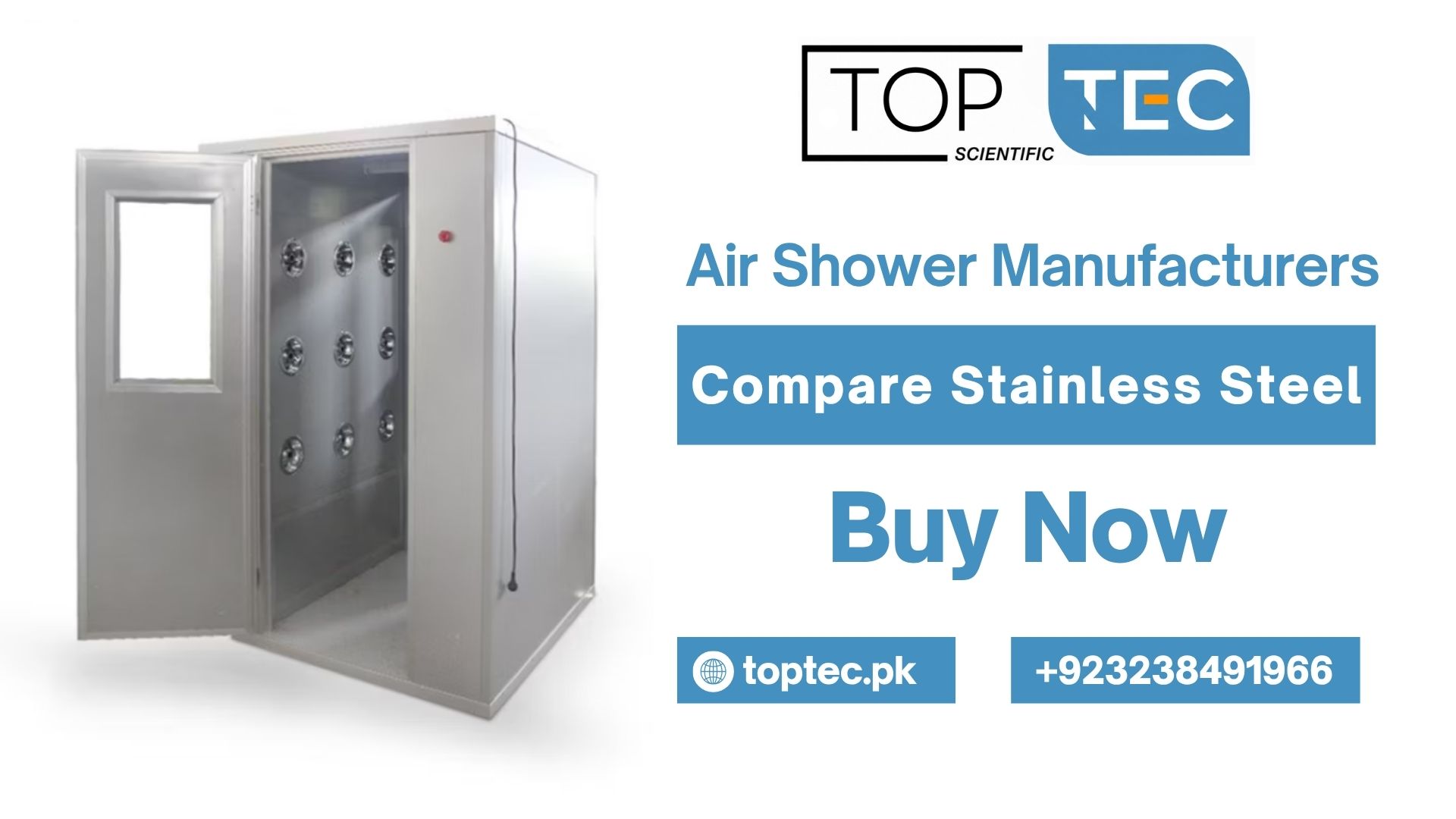
Shopping for a cleanroom air shower in Pakistan in 2026 is a different experience from what it was even five years ago. The market has grown considerably — more suppliers, more configurations, more materials, more price points. Which sounds like a good thing. More options, more competition, better prices. And in some ways that’s true.
But it also means more opportunities to make a purchase that looks right on paper, arrives looking professional, and then underperforms in ways you don’t discover until the first pharmaceutical audit observation or the first annual performance test reveals face velocity below specification.
The material comparison — stainless steel versus powder-coated models — is where a lot of procurement decisions in Pakistan’s pharmaceutical and cleanroom sector get made incorrectly. Not because the decision is complicated, but because it’s usually made on price alone rather than on a genuine understanding of what each material offers, where each is appropriate, and what the real cost difference looks like over the operational life of the equipment.
This article is going to cover that comparison properly. We’ll talk about what the material choice actually means for GMP compliance, performance, maintenance, and total cost — and we’ll give you a framework for evaluating manufacturers and models that goes beyond surface aesthetics.
At TOPTEC Scientific, we manufacture cleanroom air shower systems locally in Pakistan in both stainless steel and powder-coated configurations. We’re not going to tell you that one material is always better. We’re going to help you figure out which one is right for your specific application — which is actually more useful.
Why Material Choice Matters More Than Most People Think
The material of an air shower chamber interior affects three things that matter directly for pharmaceutical and cleanroom applications: surface cleanability, chemical resistance to disinfectants, and long-term durability under the cleaning regimes used in controlled environments.
An air shower is cleaned regularly — sometimes daily, sometimes between every shift change depending on the facility’s housekeeping protocol. The cleaning agents used in pharmaceutical cleanrooms are genuinely aggressive: 70% IPA, quaternary ammonium compounds, sodium hypochlorite solutions, hydrogen peroxide-based agents in some high-specification facilities. The interior surfaces of the air shower are exposed to these agents repeatedly over the equipment’s operational life, which can easily span 10 to 15 years.
A surface that looks smooth and clean when the equipment is new but develops micro-cracks, surface degradation, or corrosion after two years of pharmaceutical cleaning protocols is not delivering what it appeared to deliver at installation. And in a pharmaceutical GMP context, a surface that can’t be effectively cleaned and decontaminated is a contamination source — exactly what the air shower is supposed to prevent.
So the material decision isn’t about aesthetics or first impressions. It’s about what the surface can reliably deliver over the equipment’s full service life under pharmaceutical operating conditions.
Stainless Steel Air Showers: The Premium Specification
What Stainless Steel Actually Provides
Stainless steel’s pharmaceutical appeal comes from properties that are intrinsic to the material itself rather than dependent on a coating or finish: corrosion resistance from the passive chromium oxide layer that forms on the surface; a smooth, non-porous surface achievable through appropriate finishing processes; chemical resistance to the full range of pharmaceutical disinfectants including aggressive chloride-based agents; and mechanical durability that doesn’t depend on coating integrity.
For Pharmaceutical Air Shower applications specifically, the relevant stainless steel grades are 304 and 316L:
Grade 304 (18/8 stainless): 18% chromium, 8% nickel. Excellent corrosion resistance to most pharmaceutical cleaning and disinfection agents. Suitable for Pharmaceutical Air Shower applications using standard pharmaceutical disinfectants — IPA, quaternary ammonium compounds, dilute sodium hypochlorite. The standard pharmaceutical equipment stainless steel grade.
Grade 316L (marine grade): 16-18% chromium, 10-14% nickel, plus 2-3% molybdenum. The molybdenum addition dramatically improves resistance to chloride-induced pitting corrosion — the failure mode that affects 304 stainless when exposed to concentrated chloride solutions or marine environments. For Pharmaceutical Air Shower applications where aggressive chloride-based sporicidal agents or VHP fumigation is used regularly, 316L provides meaningfully better long-term surface integrity.
Surface Finish: Why It’s Not Just About Appearance
Stainless steel surface finish — expressed as Ra (average roughness) value — determines how effectively the surface can be cleaned and whether it harbors microorganisms in surface valleys.
2B finish (mill finish): Ra approximately 0.5 to 1.0 μm. The standard commercial stainless finish — smooth to the touch but with visible directionality from the rolling process. Acceptable for Grade C/D cleanroom air shower applications.
Brushed/satin finish (No. 4): Ra approximately 0.5 to 0.8 μm. One of the most commonly specified finishes for pharmaceutical equipment — smooth enough for effective cleaning, with a consistent brushed appearance that hides minor scratches from cleaning operations. Standard for pharmaceutical cleanroom air shower interior surfaces.
Electropolished finish: Ra ≤ 0.5 μm. The smoothest available stainless finish, achieved by electrochemical removal of surface material that levels micro-peaks in the surface topology. Most effective at minimizing surface area where microorganisms can harbor. Used for Grade A/B pharmaceutical environments where the highest surface quality is warranted.
Stainless Steel Air Shower Applications
Grade A/B adjacent entry systems: For Pharmaceutical Air Shower installations serving aseptic manufacturing areas — filling lines, lyophilization suites, sterile formulation rooms — stainless steel is effectively the regulatory expectation. DRAP inspectors and international auditors expect to see surfaces in pharmaceutical Grade A/B environments that unambiguously meet GMP surface quality requirements. Stainless steel interior construction meets this expectation clearly and documentably.
High-frequency cleaning facilities: Facilities that clean their cleanroom air shower interiors multiple times per day with pharmaceutical-grade disinfectants benefit significantly from stainless steel’s coating-independent durability. Where powder-coated surfaces accumulate damage from frequent chemical exposure over time, stainless steel maintains its surface characteristics indefinitely.
Facilities with aggressive disinfection regimes: Any facility using VHP fumigation, high-concentration sodium hypochlorite, or other particularly aggressive cleaning agents should specify stainless steel — particularly 316L — for their cleanroom air shower interior. These agents can degrade powder coat finishes over repeated exposure in ways that are gradual and not immediately visible.
Long operational life requirements: A stainless steel Pharmaceutical Air Shower in appropriate pharmaceutical service should last 15 to 20 years with normal maintenance. The operational life of a powder-coated unit depends heavily on the specific coating quality and the facility’s cleaning regime, but typically is shorter — 8 to 12 years before surface condition raises GMP concerns.
The Cost Reality of Stainless Steel
Stainless steel air shower models cost more — significantly more in some configurations. The material cost of 304 or 316L stainless steel sheet is considerably higher than mild steel, and the fabrication requirements (welding, grinding, polishing) are more demanding. For a standard single-person Pharmaceutical Air Shower, the premium for stainless steel interior construction over quality powder-coated mild steel is meaningful in absolute terms.
This premium needs to be evaluated in context:
Total cost of ownership: A stainless steel unit that lasts 18 years versus a powder-coated unit that needs interior refinishing or replacement at year 10 may actually be less expensive per year of service, even at higher initial cost.
Regulatory risk cost: A powder-coated surface that develops visible degradation before the end of its service life may trigger a GMP audit observation — and the cost of that observation (regulatory response, possible production suspension, corrective action documentation) can significantly exceed the cost differential between stainless and powder-coated at time of purchase.
Application appropriateness: For Grade A/B applications, the stainless steel premium is not really a choice — it’s the appropriate specification for the risk level. Saving money on interior surface material in a Grade A/B entry system is a poor risk management decision.
When TOPTEC Scientific clients Buy Air Shower equipment for Grade A/B pharmaceutical applications, we specify stainless steel 304 interior construction as the standard — not as a premium option.
Powder-Coated Air Showers: The Cost-Effective Alternative for Appropriate Applications
What Powder Coating Is and How It Works
Powder coating is an electrostatic dry coating process — finely ground polymer powder particles are electrostatically charged and sprayed onto a prepared metal substrate (typically mild steel or galvanized steel), then cured at elevated temperature where the powder flows and fuses into a continuous coating film.
A properly applied pharmaceutical-grade powder coat on an appropriately prepared substrate produces a smooth, hard, continuous surface with:
- Ra surface roughness of approximately 0.8 to 1.6 μm — within the range acceptable for GMP pharmaceutical surfaces in Grade C/D environments
- Good resistance to standard pharmaceutical disinfectants (IPA, QACs) at appropriate concentrations and contact times
- A hard, impact-resistant surface that withstands normal laboratory use without chipping
- Visual cleanability appropriate for pharmaceutical housekeeping
The key words in that description are “properly applied” and “appropriately prepared.” Powder coat quality is highly dependent on surface preparation (shot blasting, zinc phosphate treatment, primer application) and application process (coating thickness uniformity, curing temperature and duration). A poorly applied powder coat on inadequately prepared steel produces a surface that looks acceptable initially but fails early — chipping, delaminating, and developing edge corrosion that creates particle-trapping surface defects.
When evaluating powder-coated cleanroom air shower models from any manufacturer — including when you Buy Air Shower equipment from TOPTEC Scientific — the surface preparation and application process specification matters as much as the coating material itself.
Powder-Coated Air Shower Applications
Grade C and D pharmaceutical manufacturing areas: This is the primary application zone where powder-coated cleanroom air shower models deliver appropriate GMP compliance at meaningfully lower cost than stainless steel. Grade C encompasses most pharmaceutical solid dosage form manufacturing — granulation, compression, coating, non-aseptic filling. Grade D includes packaging, material staging, gowning rooms, and support areas. For entry to these areas, quality powder-coated air showers with smooth, chemically resistant coatings meet GMP surface requirements appropriately.
Research and university laboratories: Academic research cleanrooms, university pharmaceutical science laboratories, and research facility controlled environments typically don’t operate under the same GMP intensity as licensed pharmaceutical manufacturing. Powder-coated cleanroom air shower models are entirely appropriate for these applications and represent significantly better value than stainless steel systems that provide performance margin beyond what research applications require.
Electronics and semiconductor cleanrooms: Many electronics cleanroom applications focus on particulate control rather than pharmaceutical GMP compliance. Powder-coated air shower systems are widely used in electronics manufacturing cleanrooms at ISO Class 6, 7, and 8 classifications — providing effective particle removal from personnel at cleanroom entry without the pharmaceutical GMP premium of stainless steel construction.
Food processing and controlled production areas: Food industry cleanrooms, particularly for ready-to-eat food production and controlled atmosphere packaging, use air showers to reduce personnel-borne contamination. Powder-coated systems with food-grade coating materials are appropriate for these applications.
Multi-site cost optimization: For pharmaceutical manufacturers with facilities that include both high-grade areas (requiring stainless) and lower-grade areas (where powder-coat is appropriate), a mixed specification strategy — stainless steel at Grade A/B entry, powder-coated at Grade C/D entry — delivers appropriate contamination control across the facility while optimizing the overall capital investment.
Quality Indicators for Powder-Coated Models
Not all powder-coated air showers are equivalent. When evaluating models for cleanroom air shower applications, these quality indicators differentiate appropriate pharmaceutical-grade construction from lower-specification commercial construction:
Substrate preparation: Ask specifically about the surface preparation process — shot blasting removes mill scale and creates a clean anchor profile; zinc phosphate treatment provides corrosion inhibition and improves coating adhesion; primer application creates a bondable base for the topcoat. Missing steps in this preparation sequence result in compromised long-term coating adhesion.
Coating thickness: Pharmaceutical-grade powder coat should achieve a minimum dry film thickness of 60 to 80 microns — measured with an appropriate dry film thickness gauge. Thinner coatings chip more easily and provide less barrier against moisture ingress at the substrate.
Edge sealing: The edges of sheet metal panels — where the substrate is exposed at cuts and bends — are the most vulnerable points for corrosion initiation. Quality powder-coated pharmaceutical air shower construction pays specific attention to edge coating or sealing, preventing the edge corrosion that propagates under the coating from cut or bent metal edges.
Coating chemistry: Not all powder coat formulations have equal pharmaceutical disinfectant resistance. Epoxy-polyester hybrid formulations offer better chemical resistance than pure polyester coatings. For pharmaceutical applications, confirm that the specific coating formulation has been evaluated against the disinfectants used in your facility.
Side-by-Side Comparison: Stainless Steel vs. Powder-Coated
| Feature | Stainless Steel (304/316L) | Quality Powder-Coated |
|---|---|---|
| GMP Grade Application | Grade A, B, C, D | Grade C, D primarily |
| Surface Roughness | Ra ≤ 0.5-0.8 μm | Ra ≤ 0.8-1.6 μm |
| Chemical Resistance | Excellent (all pharma agents) | Good (standard agents) |
| VHP/Aggressive Sporicide | ✅ Excellent (316L) | ⚠️ Limited |
| Surface Durability | ✅ Independent of coating | ✅ Dependent on coating quality |
| Cleaning Frequency | ✅ High frequency OK | ✅ Moderate frequency |
| Operational Life | 15-20 years | 8-12 years |
| Capital Cost | Higher | Lower |
| Total Cost of Ownership | Competitive over lifecycle | Lower initial, may increase |
| Audit Standing | ✅ Strongest for Grade A/B | ✅ Appropriate for Grade C/D |
| TOPTEC Scientific Supply | ✅ Available | ✅ Available |
What to Look for When Comparing Manufacturers
The material comparison is important. But material specification alone doesn’t determine air shower quality — manufacturing execution, component specifications, and after-sales support are equally important differentiators between manufacturers.
HEPA Filtration Specification
Ask specifically: what is the HEPA filter grade — H13 or H14? Are both supply and return HEPA positions fitted? Are pre-filters included? Can the manufacturer provide filter integrity test data from commissioning?
A Pharmaceutical Air Shower with stainless steel casing but H11-grade HEPA filtration provides excellent surface quality but inadequate particle capture — a mismatch that delivers compliance in one specification dimension while failing in another. Both matter.
Measured Nozzle Velocity Data
The 20 to 25 m/s nozzle outlet velocity specification for effective pharmaceutical air shower decontamination should be supported by measured data — not calculated estimates from blower motor specifications. Ask for factory test records showing measured velocity at multiple nozzle positions. Manufacturers who can’t provide this data haven’t verified their product’s core performance claim.
Nozzle Material
For pharmaceutical applications, stainless steel nozzles throughout the chamber are the appropriate specification — even in a powder-coated chamber where budget drives the shell material choice. Plastic nozzles in a system serving pharmaceutical Grade C environments are a specification inconsistency.
Control System Capability
For GMP pharmaceutical facilities, PLC-based control with cycle logging, airflow alarm integration, and password-protected parameter access is the appropriate control system specification. Simple relay-timer controls are adequate for research and electronics applications but fall short of pharmaceutical GMP documentation requirements.
Interlock Quality
Is the interlock physical prevention or just an alarm? Does it fail safe (fail locked) on power interruption? Can the inner door be manually forced open mid-cycle? These questions distinguish genuinely reliable interlock systems from those that provide the appearance of zone separation rather than the reality.
Commissioning and Qualification Support
For pharmaceutical GMP facilities, the air shower must be qualified before use — IQ/OQ documentation, measured performance data, HEPA filter integrity test results. Does the manufacturer support this process, or do they deliver the box and leave qualification to you? For smaller pharmaceutical manufacturers in Pakistan without in-house cleanroom qualification expertise, this support is a meaningful differentiator.
The Local Manufacturing Advantage in Pakistan
Here’s a conversation that happens regularly in Pakistan’s pharmaceutical sector: a procurement team gets quotations from international air shower manufacturers through local agents, compares them to local manufacturer quotations, and focuses primarily on the price difference per unit. The international unit is often more expensive. The local unit — if the local manufacturer is TOPTEC Scientific — often looks more competitive.
What the price comparison misses is the total cost picture that only becomes visible after purchase:
Import lead times: International manufacturers typically quote 12 to 16 weeks for custom-specified cleanroom air shower systems. In a pharmaceutical facility construction project where the cleanroom entry system is on the critical path for commissioning, a 16-week wait can delay the entire project — with production revenue implications that dwarf the price differential between manufacturers.
Import duties and freight: Customs duties, import taxes, freight, and insurance add 15-25% or more to the invoice price of imported cleanroom equipment in Pakistan. These costs don’t appear in the quotation comparison but are very real in the landed cost calculation.
Commissioning support: An international manufacturer’s commissioning support for a Pakistani facility is typically remote — documentation provided, phone support available, but physical on-site commissioning support is limited. Local manufacturers can physically attend commissioning, which matters for pharmaceutical qualification that requires witnessed performance testing.
After-sales service: Annual performance testing, HEPA filter replacement, blower maintenance, interlock servicing — all of this is considerably more accessible with a local manufacturer. When you Buy Air Shower equipment from TOPTEC Scientific, our technical team is a phone call and a same-day site visit away. International manufacturer service is a multi-week process.
Documentation for DRAP: Technical specifications, commissioning test records, and qualification documentation from international manufacturers aren’t always formatted for DRAP submission requirements. TOPTEC Scientific documentation is produced with Pakistani regulatory requirements in mind.
TOPTEC Scientific’s Air Shower Range
When pharmaceutical manufacturers, research institutions, and industrial cleanroom operators in Pakistan Buy Air Shower equipment from TOPTEC Scientific, they choose from a range that covers both material specifications and multiple configurations — with the component quality and documentation support that GMP pharmaceutical applications require.
Stainless Steel Pharmaceutical Air Shower Models
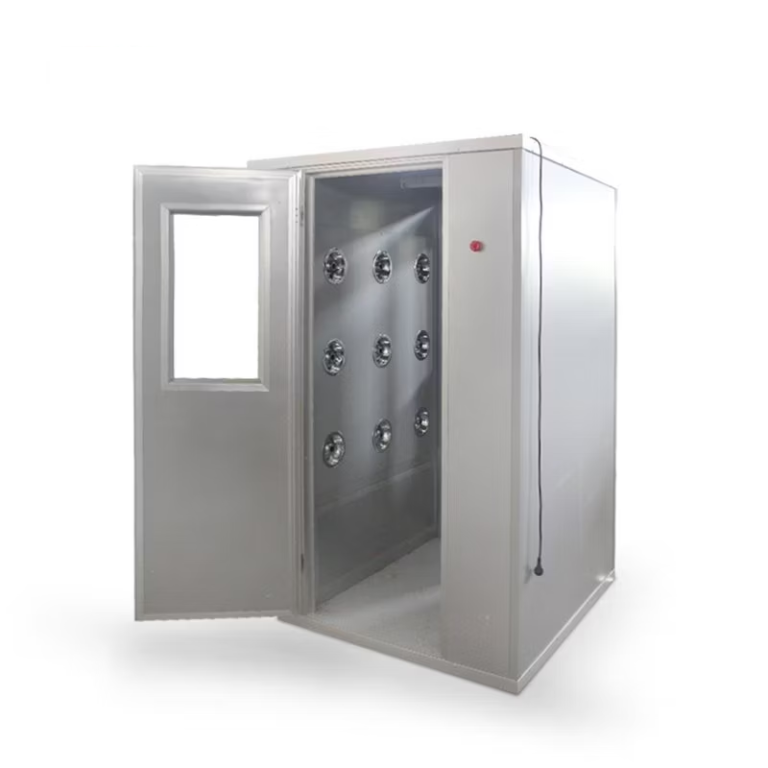
Our stainless steel Pharmaceutical Air Shower range uses 304-grade stainless steel interior panels with brushed pharmaceutical finish (Ra ≤ 0.8 μm), and 316L specification is available for facilities with aggressive disinfection regimes. Interior nozzles are stainless steel throughout. HEPA filtration is H14 grade as standard for pharmaceutical applications, with H13 available for research and industrial applications.
Control systems are PLC-based with HMI touchscreen operation, cycle logging, airflow alarm integration, and password-protected parameter configuration. Interlock systems are electronic fail-locked configuration. Available in single-person, double-person, and pass-through configurations, with standard and corner-entry door orientations.
Powder-Coated Cleanroom Air Shower Models
Our powder-coated cleanroom air shower range uses cold-rolled mild steel with full surface preparation — shot blast, zinc phosphate treatment, epoxy primer, and epoxy-polyester topcoat in pharmaceutical white (RAL 9016) as standard. Coating thickness minimum 60 microns. HEPA filtration H13 standard, H14 available. Nozzles are stainless steel throughout — we don’t compromise on nozzle material even in our cost-optimized range.
These models are appropriately specified for Grade C/D pharmaceutical entry, research laboratory cleanrooms, electronics manufacturing, and food processing controlled environments.
Complete Pharmaceutical Facility Supply
When clients Buy Laboratory Furniture from TOPTEC Scientific alongside their air shower systems, the complete facility fit-out is coordinated as a single project. Our facility supply range includes:
- Pharmaceutical Air Shower systems — stainless and powder-coated in all configurations
- Gowning room furniture — benches, lockers, shoe change facilities, PPE dispensers
- Pharmaceutical QC laboratory benching — stainless steel and epoxy resin surfaces
- Class II biological safety cabinets for QC microbiology and sterility testing
- Pass-through boxes for material transfer between cleanroom zones
- Cleanroom wall panels and doors for complete controlled environment construction
- Chemical storage and reagent cabinets
When you Buy Laboratory Furniture and air shower systems from TOPTEC Scientific together, you get one project team managing design, delivery, installation coordination, and commissioning documentation across your complete facility fit-out.
Making the Right Choice: A Decision Guide
Choose stainless steel Pharmaceutical Air Shower if:
- Your facility serves pharmaceutical Grade A or B manufacturing areas
- You use VHP, high-concentration sodium hypochlorite, or aggressive sporicidal agents regularly
- Your cleaning protocol involves high-frequency disinfection — multiple times daily
- Your facility is pursuing EU GMP, WHO prequalification, or US FDA inspection readiness
- Your operational life requirement is 15+ years without surface quality concerns
- The additional capital cost is justified by your risk assessment for the area being protected
Choose powder-coated cleanroom air shower if:
- Your facility serves pharmaceutical Grade C or D areas
- Standard pharmaceutical disinfectants (IPA, QACs) are your primary cleaning agents
- You’re operating a research laboratory, university facility, electronics cleanroom, or food processing controlled area
- Budget optimization across a multi-door, multi-entry facility is a priority
- You’re comfortable with the shorter surface life expectancy and will factor in lifecycle replacement in your total cost planning
Ask TOPTEC Scientific for a consultation if:
- You’re unsure which specification fits your specific GMP grade and cleaning regime
- You have mixed cleanroom grades and want to optimize specification and cost across the facility
- You need both air shower systems and Buy Laboratory Furniture for a complete facility fit-out and want coordinated design and supply
Final Thoughts
The stainless steel versus powder-coated decision in cleanroom air shower procurement is ultimately a risk-grade-cost optimization problem. The right answer depends on your cleanroom classification, your cleaning regime, your budget, and your operational life expectations — not on a generic recommendation that stainless steel is always better or that powder-coated is always adequate.
What’s non-negotiable regardless of material choice is component specification — appropriate HEPA filter grade, verified nozzle velocity, reliable interlock systems, appropriate control capability, and the manufacturer support to qualify the equipment properly before use and maintain it correctly throughout its service life.
In Pakistan’s pharmaceutical and cleanroom equipment market in 2026, TOPTEC Scientific offers both material options in appropriately specified configurations — with the local manufacturing advantages, technical expertise, and after-sales support that international suppliers simply cannot match for Pakistani facility projects.
When you’re ready to Buy Air Shower equipment — stainless steel or powder-coated, single or double person, pharmaceutical or research specification — or when you need to Buy Laboratory Furniture and complete your cleanroom facility infrastructure, reach out to TOPTEC Scientific. We’ll help you get the specification right and the facility built properly.
📞 Contact TOPTEC Scientific
TOPTEC Scientific — Cleanroom Equipment & Laboratory Furniture Manufacturers, Pakistan 📧 Contact us for air shower specifications, material comparisons, and complete cleanroom facility consultation 📍 Serving pharmaceutical manufacturers, research institutions, and industrial cleanrooms across Pakistan
