

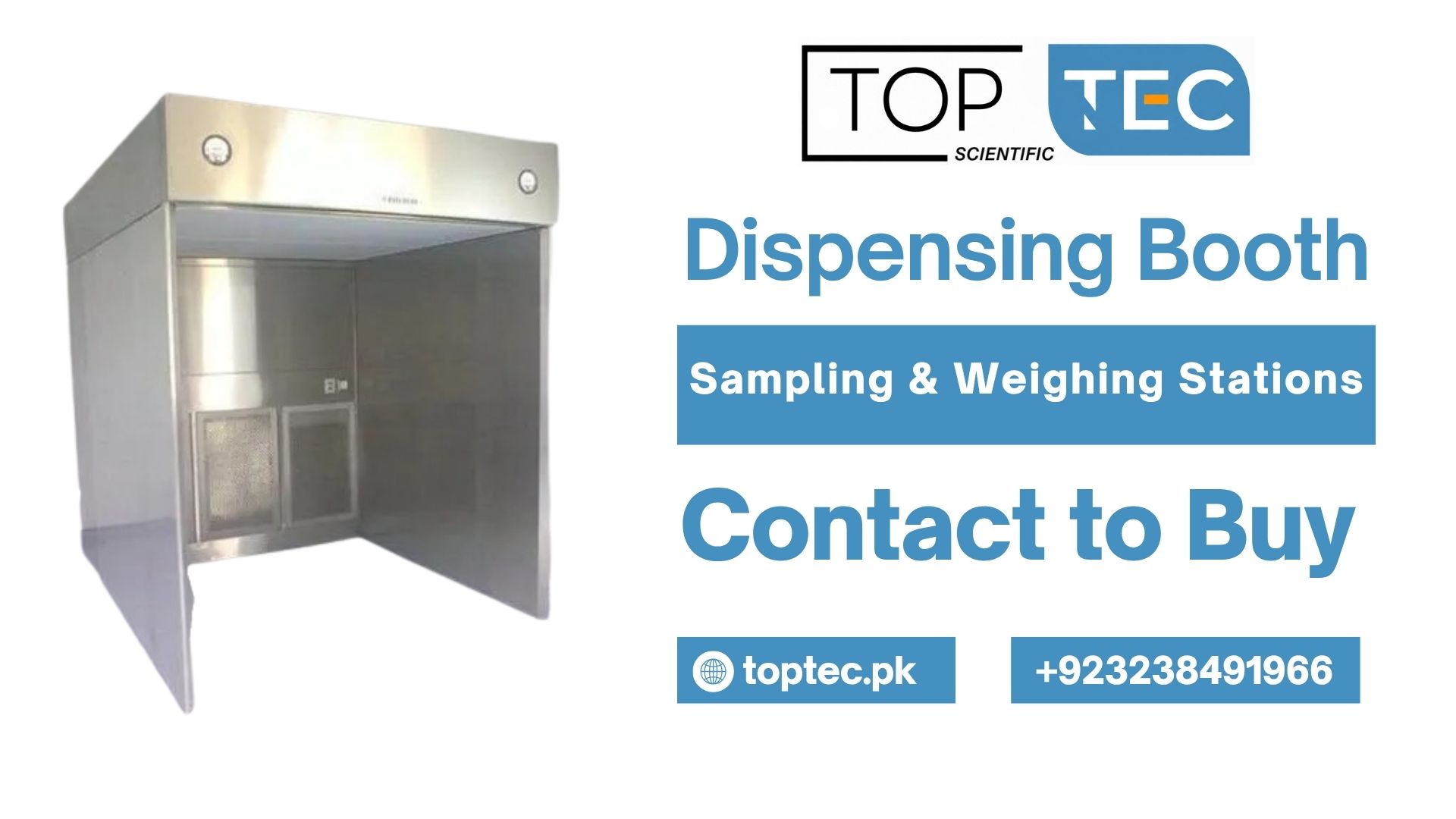
Discover dispensing booths with 3-stage filtration, 0.45 m/s airflow, and UV sterilization. Designed for powder containment, weighing, and sampling in GMP cleanrooms. Request a quote.
A few years back, I visited a pharmaceutical unit outside Lahore that had a problem nobody wanted to talk about directly. Their raw material area had powder floating in the air—you could actually see it whenever someone cracked open a drum to weigh out ingredients. Workers went home covered in fine dust most days. Nobody had really flagged it because, well, that’s just how it had always been done. It took a regulatory inspection pointing out cross-contamination risks before they finally looked into proper containment. That visit stuck with me, honestly, because I’ve since seen the same story play out at facility after facility across Pakistan.
If your operation handles powders, active ingredients, or anything that kicks up particles when you’re weighing or sampling it, you really need to think about whether to Buy Dispensing Booth equipment. This isn’t just about satisfying some inspector’s checklist—though that matters too. It’s about your workers’ lungs, your product’s integrity, and frankly your whole operation’s credibility. At TOPTEC Scientific we build these units here in Pakistan, and I want to walk through what they actually do and why they’re worth the investment.
What a Dispensing Booth Actually Is
Simply put, it’s an enclosed station built for weighing, sampling, or dispensing powders in a way that keeps airborne particles contained. Picture it as a mini containment system that pulls particles away from whoever’s working before they can drift into the rest of your facility.
Here’s the basic problem it solves: crack open a container of powder to weigh it out, and fine particles go airborne immediately. Without something capturing that, particles settle on every nearby surface, get breathed in by the operator, and can easily cross-contaminate other products if you’re handling multiple materials in that same space. A decent dispensing booth for pharma setup uses controlled airflow to pull those particles away and filter them before the air gets recirculated or exhausted outside.
I’ve been in facilities with and without these systems, and honestly the difference is obvious within seconds of walking in. No booth, and you sometimes notice a faint haze hanging near the weighing station. With a proper booth running, the air stays clean even during active work. That visual tells you everything about what’s happening to the particles—whether they’re getting captured or ending up somewhere they shouldn’t be.
Why This Matters So Much for Pharma Operations
Pakistan’s pharmaceutical sector has grown a lot over the past decade, and regulators—both local and international—have gotten correspondingly stricter. If you’re exporting anything, you’re dealing with FDA standards, EU-GMP, or similar frameworks that specifically address how you contain materials during handling.
Worker health is where I get genuinely bothered by this topic. I’ve talked with workers in facilities lacking proper booths who deal with constant respiratory irritation. Some active ingredients aren’t just mildly annoying to breathe—they’re genuinely harmful with repeated exposure over years. One company in Karachi I worked with only switched to proper booths after an employee developed a sensitization reaction to a compound they handled regularly. The retrofit wasn’t cheap, but their own management admitted afterward they wished they’d done it years sooner, before someone actually got hurt.
Then there’s cross-contamination, which is its own quality nightmare. If you’re running multiple products through the same facility, particles from one compound settling into a different batch isn’t theoretical—I’ve personally seen batch rejections traced directly back to exactly this. A well-designed booth keeps material contained to its working zone, runs it through HEPA filtration, and stops it from settling where it could later ruin an unrelated batch.
And then there’s the compliance angle. Manufacturers hoping to export or partner internationally increasingly can’t skip this. GMP guidelines specifically address containment during material handling. I sat in on part of an EU-GMP inspection once where the inspector spent a good chunk of time just in the raw material dispensing area—checking airflow, filter logs, operator procedures. Facilities without real containment just don’t pass that kind of scrutiny anymore.
The Different Types You’ll Encounter
Not every dispensing booth works the same way, and knowing the differences matters before you buy.
Vertical laminar flow units pull air downward through the working zone and exhaust it below or behind. This downward pattern works well because gravity’s already pulling particles down too—airflow and gravity cooperate instead of fighting each other. Most pharma operations I’ve worked with here prefer this setup for standard powder handling.
Horizontal flow booths move air sideways or front-to-back instead. These work fine for certain tasks but can struggle with powder containment specifically, since lighter particles don’t always follow a horizontal airflow path predictably.
Downflow booths with perforated work surfaces are becoming pretty popular because the surface itself pulls air down right where the operator’s hands are working. This gives you really effective capture right at the source, which is exactly where you want it. A facility in Islamabad I consulted with switched to this exact design after their old booth wasn’t catching fine particles during their trickiest operations. Problem solved almost immediately.
There’s also the question of ducted versus recirculating systems. Ducted exhausts air completely outside the building—generally the better choice for more hazardous materials. Recirculating filters the air and sends it back into the room, which is fine for less dangerous materials but demands more careful filter upkeep since you’re putting that air back into your workspace. Think carefully about what you’re actually handling before deciding which way to go.
What Actually Separates Good Units From Mediocre Ones
Airflow needs to be right, not just strong. Too weak and particles escape capture entirely—I’ve seen booths that give operators false confidence because the suction simply isn’t adequate. Too strong, and you end up blowing light powders around unpredictably, which somehow makes things worse, not better. Most pharmaceutical applications land somewhere around 0.5 to 0.7 meters per second face velocity, though it depends on your specific materials.
HEPA filtration is non-negotiable for serious pharma work—you want 99.97% efficiency at minimum for particles down to 0.3 microns. Filter access matters too. I’ve seen booths where changing a filter practically requires disassembling the whole unit, which means people put it off longer than they should, and filters end up working well past their useful life.
Construction matters more than people expect. Stainless steel is standard for good reason—easy to clean, resists chemical corrosion, doesn’t harbor residue the way painted surfaces can. Work surfaces should be smooth, no crevices where powder collects and becomes a pain to clean properly.
Lighting and visibility get overlooked constantly, but operators need to actually see what they’re doing. Decent LED lighting positioned to avoid shadows, maybe a good viewing window so supervisors can check on things without hovering directly at the booth.
Ergonomics matter too, honestly. People spend real time at these stations. If the height’s wrong or the working space is cramped, operators get uncomfortable, start finding workarounds, and eventually compliance suffers because nobody’s following procedure properly when they’re fighting the equipment itself.
Before You Actually Buy
Take time to genuinely figure out what you need before shopping. What materials are you handling, exactly? What volumes? How often will this get used, and by how many people?
A small specialty manufacturer in Multan making low-volume formulations has completely different needs than a large generic manufacturer in Karachi running tons of material weekly. What works perfectly for one would be either inadequate or wildly overbuilt for the other.
Space matters too—not just room for the booth itself, but space for the operator to actually move, room for incoming and outgoing containers, and potentially ductwork if you’re going the ducted exhaust route. I worked with a facility that bought a booth without properly measuring available space first. They ended up needing ceiling and electrical modifications they hadn’t budgeted for, which delayed their whole project.
As for cost—pricing varies quite a bit depending on size and features. Basic units for smaller operations might start around PKR 250,000. Larger systems with advanced filtration and ducted exhaust can run anywhere from PKR 800,000 up past PKR 1,500,000. When you Buy Laboratory Furniture including dispensing booths, remember the cheapest option isn’t automatically the smart choice. A booth that doesn’t actually contain particles properly can lead to regulatory problems, worker health issues, or failed batches—costs that blow past whatever you saved upfront.
Why Building Locally Actually Helps You
At TOPTEC Scientific we build these units here in Pakistan, and that genuinely matters for a few practical reasons, not just as a sales pitch.
Delivery and installation happen faster when you’re not waiting on international shipping. If your operation needs to get compliant quickly, that timeline difference is real money and real time saved.
We also understand Pakistani regulatory context already—our equipment gets designed around these requirements from the start rather than trying to retrofit something built for a different market’s rules.
Support is responsive because we’re actually here. I’ve talked to companies that bought imported booths and then spent weeks trying to get help for relatively small issues simply because there wasn’t local support infrastructure to call on.
And customization works better too. Every facility’s slightly different. When you Buy Dispensing Booth equipment from a local manufacturer, we can adjust dimensions and configurations to actually fit your operation instead of forcing you to adapt your processes around a standardized import.
Sampling Stations Deserve a Quick Mention
Worth noting—sampling stations and dispensing booths aren’t quite the same thing, even though people sometimes conflate them. Sampling stations are generally used for pulling small representative samples from larger quantities for quality testing. They share containment principles with dispensing booths but tend to be smaller, built for precise extraction rather than the bulk weighing work a dispensing booth typically handles.
Plenty of facilities in Pakistan actually need both—a larger booth for bulk handling, plus a separate smaller station for QC sampling. Worth factoring into your planning if you haven’t already.
This Equipment Doesn’t Work in Isolation
Your dispensing booth is just one piece of a bigger puzzle. Many pharma facilities also need reliable environmental equipment like a laboratory incubator for microbial testing as part of their quality control process. If you’re checking raw materials or finished products for contamination, you’ll need incubation equipment working alongside your dispensing setup.
At TOPTEC Scientific we manufacture a broad range of laboratory equipment, so when you Buy Laboratory Furniture from us, you’re not stuck piecing together equipment from different suppliers—you can work with one manufacturer who understands how your dispensing booths, sampling stations, incubators, and other equipment all need to function together.
Keeping It Running Properly
Once you’ve invested in a good booth, maintenance keeps it performing the way it’s supposed to.
Filters don’t last forever—check them monthly and plan replacement based on usage, typically somewhere between 6 months and 2 years depending on how hard you’re running the unit and what you’re handling.
Airflow needs periodic verification too. Fan motors wear down, ductwork can develop small leaks, filters partially clog—none of this is necessarily obvious just from looking at the booth, but it all affects actual containment even when everything seems fine on the surface.
Regular surface cleaning matters as well, obviously, to prevent buildup that could create problems for future dispensing work. I worked with one facility that had excellent initial installation but basically ignored routine maintenance afterward. Eighteen months later, their airflow had quietly degraded enough that a routine audit caught it—something scheduled maintenance would’ve flagged much earlier.
A Few Real Examples
A small manufacturer in Faisalabad producing specialty formulations in modest batches went with a compact recirculating booth, appropriately sized for their lower volume. Total cost landed around PKR 320,000 including installation—handles their needs without paying for capacity they’d never use.
A mid-size generic manufacturer in Lahore handling bigger volumes across several product lines invested in two separate booths—one ducted for their more hazardous compounds, one recirculating for less potent materials. Combined cost was roughly PKR 1,400,000, but it let them properly separate their containment approach based on actual hazard levels rather than using one-size-fits-all equipment.
A larger export-focused facility in Karachi, prepping for international certification, needed comprehensive containment across multiple stations plus supporting lab equipment. Their total investment topped PKR 3,500,000—significant, but essential for the compliance they needed to actually access export markets.
Bringing It Together
When you’re ready to Buy Dispensing Booth equipment, work through this systematically. Be honest about what you actually handle and how hazardous it is. Think through your space and infrastructure realistically before committing. Set a budget that accounts for total ownership cost, not just the sticker price.
And work with someone who actually understands both the engineering side and the regulatory context you’re operating in. At TOPTEC Scientific, we’ve helped facilities across Pakistan—from small specialty operations to large export-focused manufacturers—figure out and implement the right containment solution for their specific situation.
Final Thoughts
A good dispensing booth isn’t just another piece of equipment sitting in your facility—it’s protecting your people, your product, and your standing with regulators. Whether you’re building new pharmaceutical capability or upgrading something outdated, understanding what these systems actually do and how to choose correctly makes a real difference to your operation’s safety and compliance posture.
When you Buy Dispensing Booth equipment from TOPTEC Scientific, you’re getting something built locally with Pakistani operations specifically in mind, backed by support that actually shows up and customization that imported alternatives generally can’t offer.
Whether you need something compact for a smaller setup or a full containment system for large-scale manufacturing, get in touch and let’s talk through what you actually need. We’ll help you find the right dispensing booth for pharma application that protects your workers while meeting whatever regulatory and operational demands you’re facing.
