

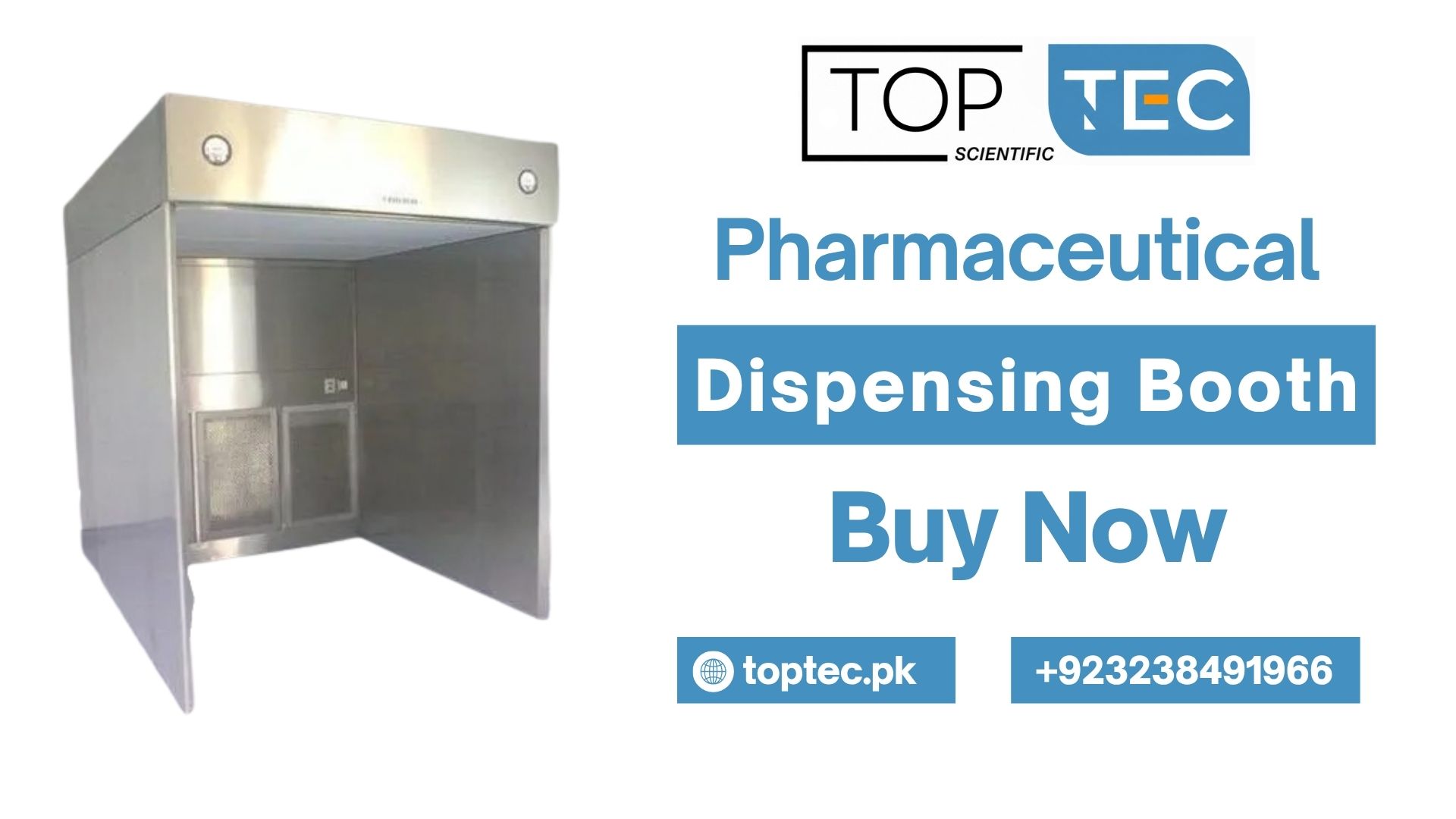
Looking for a dispensing booth? Explore ISO Class 5 booths with reverse laminar airflow, HEPA H14 filters, and SS304/316 construction. Request a free quote today.
Got a call last year from a manufacturer in Sialkot. They were panicking, honestly. FDA pre-approval inspection in six weeks, and someone on their quality team had just realized their weighing area wasn’t going to pass. No proper booth. Just an open bench, operators weighing active ingredients with basic masks and crossed fingers. They needed a fix fast. This kind of scramble happens more than it should across Pakistan’s pharma sector.
If you’re running pharmaceutical manufacturing, you probably already know GMP compliance isn’t optional these days, especially with international markets in play. But containment during weighing and sampling is one of those things that gets ignored until it’s suddenly a crisis. A real Pharmaceutical Dispensing Booth isn’t just equipment taking up floor space—it’s basic infrastructure now if you’re serious about manufacturing standards. We build these at TOPTEC Scientific here in Pakistan, and I want to talk through what actually makes one compliant, versus just being a box with a fan stuck on it.
What “GMP-Compliant” Actually Means
People assume any enclosure moving air counts as proper containment. It doesn’t. When regulators say compliance for material handling, they mean specific documented standards—airflow velocities, filtration rates, construction, operational procedures written down somewhere. Not “there’s airflow, so we’re fine.”
A proper Pharmaceutical Dispensing Booth needs documented airflow, usually around 0.5 to 0.7 meters per second at the face. HEPA filtration, 99.97% minimum. Stainless steel construction that actually cleans properly and doesn’t hold onto contamination between batches. And paperwork—validation records, airflow checks, maintenance logs an inspector can sit down and actually go through.
Worked with a facility in Lahore that bought what they thought was compliant gear. Found out during a mock audit they had zero validation documentation. Booth was fine mechanically! But no IQ, OQ, PQ anywhere. Without that paperwork, you can’t prove compliance no matter how good the hardware looks. This gap catches people off guard constantly.
Why Weighing and Sampling Matter So Much
Think about what’s happening during weighing. You’re handling active ingredients at their most concentrated, before any dilution into tablets with excipients. This is the point in your whole process where exposure and contamination risk peak out.
Buying a dispensing booth for this step means you’re addressing arguably the riskiest part of raw material handling. Quality managers have told me, almost word for word, that their weighing room is “the thing that keeps me up at night.” Makes sense—it’s where hands are right next to undiluted material.
Sampling carries similar risk, usually smaller quantities though. QC teams pulling samples for testing, done without containment, creates the same problem just at a smaller scale each time. There’s a company in Faisalabad where sampling kept causing minor cross-contamination between unrelated products—open shared bench, multiple technicians, different products all day. Got a dedicated booth with real cleaning protocols, and that problem mostly went away.
The Regulatory Picture
Pakistani manufacturers eyeing exports need to know which framework actually applies, because requirements shift depending on your target market.
US-bound product falls under FDA’s 21 CFR Part 211, covering containment during manufacturing. European markets mean EU-GMP—Annex 1 for sterile stuff, general chapters otherwise for cross-contamination prevention. Even domestic-only manufacturers aren’t exempt. DRAP’s been tightening expectations for years, partly to align better internationally.
Sat through a DRAP inspection in Karachi a couple years ago. Inspector spent almost an hour just in the dispensing area—questions about airflow schedules, training records, cleaning validation. One facility had invested properly and sailed through. Another hadn’t, and walked away with a long list of findings.
Design Elements That Actually Matter
A few things aren’t really negotiable if you want genuine compliance, not just the look of it.
Stainless steel, 304 or 316 grade depending on your chemicals, forms the base. Smooth surfaces, no crevices, welded seams ground flush—not for looks, but to stop material buildup that creates contamination risk and makes cleaning impossible.
Airflow pattern has to work and be documented. Most compliant units go vertical laminar downflow, or perforated work surfaces pulling air down right where hands work. Not arbitrary design choices—based on years of engineering research on what actually captures particles versus what just seems like it should.
HEPA filtration, properly rated, housing you can actually get to for inspection and replacement. Some facilities with highly potent compounds need carbon filtration added, sometimes double-HEPA setups.
Pressure differential matters too. Negative pressure contains hazardous material, positive pressure protects sensitive product from room air. Get this backward and you’ve got a real problem. Saw a facility install positive pressure when they needed negative containment for a moderately hazardous compound. Didn’t catch it until validation testing. Expensive fix.
Don’t Forget the Person Standing There
Compliance isn’t only about the product—it covers the people running this equipment every single day. A booth that technically contains particles but exhausts operators over a long shift isn’t fully doing its job.
Right working height, enough room to move, decent visibility, reasonable reach to scales and containers—matters for compliance and for just getting through the day comfortably. I’ve watched operators invent workarounds for badly designed booths. Propping doors open. Reaching around barriers. Because following correct procedure got physically annoying.
If you’re shopping around, genuinely bring your operators into the conversation. They catch workflow problems that spec sheets miss entirely.
Documentation Is Where Things Fall Apart
Usually not because equipment is bad—because the paperwork behind it is thin. Real compliance needs proof on paper, not just functional hardware sitting in the room.
IQ confirms correct installation. OQ verifies actual performance—airflow, filtration, alarms, tested and recorded. PQ shows consistent performance under real conditions with real people running it.
This should come with the equipment, not something you cobble together yourself later. We provide complete qualification packages with installations at TOPTEC Scientific, because Pakistani manufacturers need this for their own submissions and inspection readiness.
Worked with a company that bought equipment years back from a supplier who gave them basically nothing documentation-wise. When international audit prep came up, they had to retroactively qualify equipment that had already been running for years. Much harder and pricier than doing it right the first time.
It Connects to Everything Else
A dispensing booth doesn’t sit on its own island. It ties into your SOPs, training records, maintenance schedules, your whole contamination control approach.
Lots of facilities also need something like a dependable laboratory incubator for microbial testing on materials and finished product, as part of the same overall quality picture. If you’re testing material handled through your dispensing booth for contamination afterward, that incubator becomes part of the same story regulators look at.
When you buy laboratory furniture across your whole facility—booths, incubators, sampling stations—you’re building something coherent instead of piecing together gear from different suppliers with inconsistent paperwork and support.
Gaps We Keep Seeing
A few issues show up over and over.
Cleaning validation gets skipped constantly. Plenty of facilities have booths but never actually validated cleaning between products. Big problem if multiple compounds run through one booth without proof residue isn’t carrying over.
Airflow verification schedules disappear too. Validated fine at install, never checked again regularly. Airflow degrades—filter loading, worn fans, ductwork issues—and without checks, you don’t notice until it’s already a problem.
Training documentation is another gap. Good equipment doesn’t help if operators weren’t properly trained and nobody wrote it down. Inspectors ask for records tied to the specific equipment.
And SOPs that don’t match what’s actually happening. If your procedure describes old equipment but you’ve upgraded since, that mismatch becomes a finding on its own. There’s a facility in Multan with great equipment but SOPs untouched for nearly five years, despite replacing their booth twice in that span. Inspector’s problem wasn’t the hardware—it was the gap between paper and practice.
What This Costs, Roughly
Compliant equipment costs more upfront than basic containment, though the comparison isn’t really fair since they’re solving different problems.
Basic booths without full documentation support run maybe PKR 300,000 to 500,000. Fully compliant units with complete qualification, proper materials, real filtration typically land PKR 600,000 to 1,500,000+ depending on size and extras like ducted exhaust.
If you’re manufacturing for export or serious domestic compliance, that extra spend on documentation and validated performance isn’t padding—it’s basically what you’re paying for. Equipment without that backing isn’t solving your compliance problem, no matter how functional it looks sitting there.
I’ve watched manufacturers try to save money, buying basic gear and planning to “add documentation later.” Rarely works out. Retroactive qualification is harder and pricier than doing it properly from day one.
Why Local Manufacturing Helps
Building locally gives real advantages for compliance, not just convenience.
We know DRAP requirements firsthand, operating in this environment ourselves. Documentation comes formatted for Pakistani submissions already, not generic paperwork needing rework.
Re-validation and periodic verification—which should happen regularly, not just once—stays accessible without delays of arranging international service.
Customization gets easier too. Handling something particularly hazardous? We work directly with your quality team on a booth that fits your exact situation instead of adapting some standardized import.
A Few Real Examples
A generic manufacturer in Lahore, prepping for their first EU-GMP inspection, got two dedicated booths—one negative pressure for higher-potency compounds, one standard for regular materials. With full documentation, total spend landed around PKR 1,800,000. Passed inspection with only minor findings, none related to dispensing.
A smaller specialty manufacturer in Rawalpindi, mostly domestic, went more modest—one compliant booth around PKR 650,000, but made sure the documentation was solid despite smaller scale. Paid off when DRAP ran a routine inspection and specifically dug into material handling records.
A bigger export operation in Karachi, building a new facility from scratch, spent over PKR 4,200,000 across multiple dispensing and sampling stations. Treated it as foundational, not something to cut corners on.
Figuring Out If You Should Invest
If you’re weighing this decision, start honest. Where are your gaps right now? Thinking about export or stricter markets down the line? Had inspection findings touching material handling before? Does your actual daily practice still match what’s written down, or has it drifted?
Find a manufacturer who gets both the engineering and the documentation burden real compliance demands. We’ve walked manufacturers across Pakistan through exactly this at TOPTEC Scientific—equipment plus the paperwork that actually makes it useful when regulators show up.
Final Thought
A properly built, properly documented dispensing booth is one of the smarter investments a manufacturer can make toward real GMP compliance. Not about looking compliant on paper—about having documented, validated containment protecting your workers, your product, and your standing with regulators, all at the same time.
Whether you’re fixing specific findings, prepping for international certification, or building infrastructure from scratch, we’re here to help. Get in touch and let’s figure out what your operation actually needs.
