

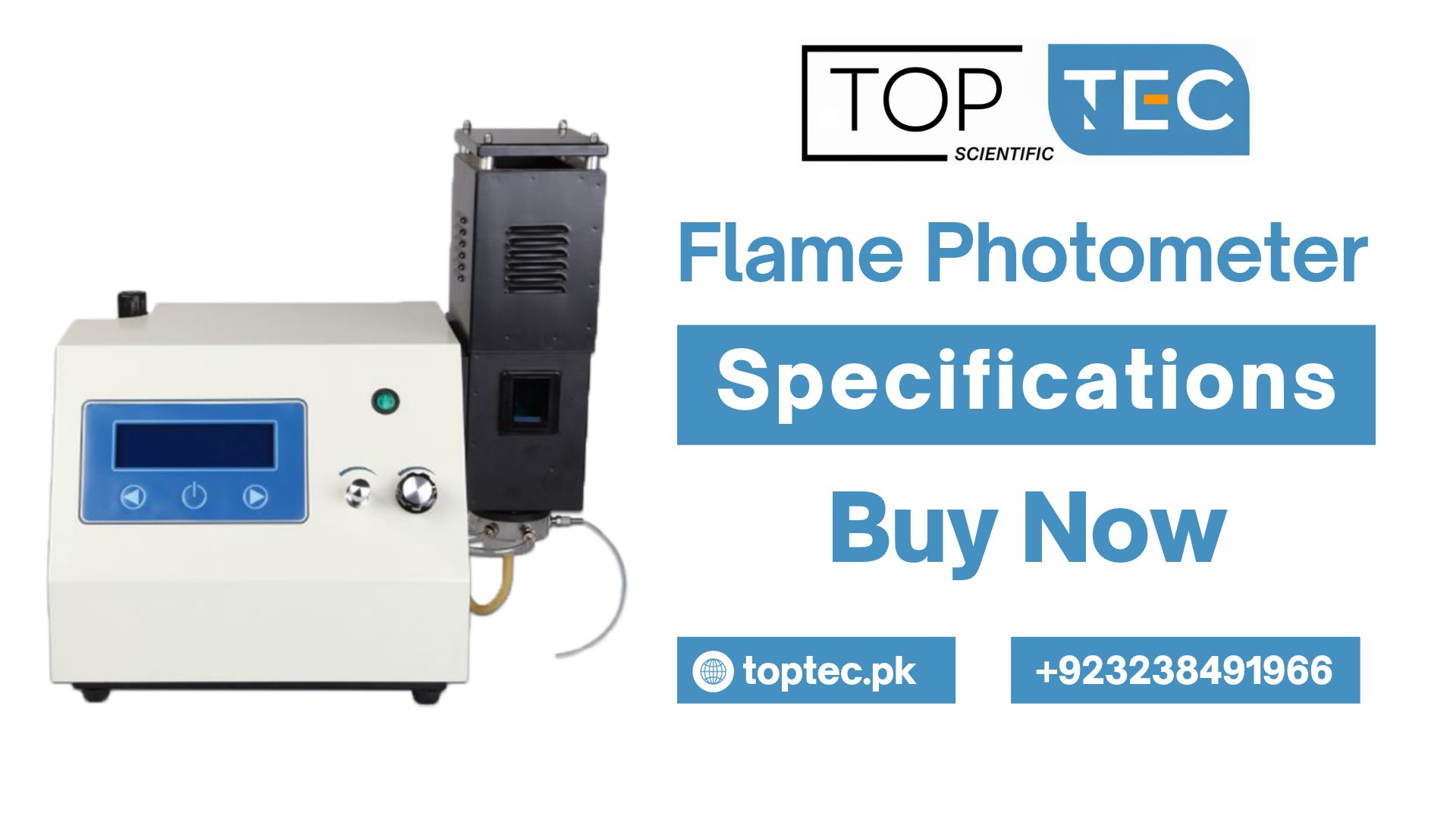
Compare flame photometer specifications, including detection limits, measurement channels and calibration range. Learn what to check before buying for your lab.
A flame photometer can be a practical instrument for laboratories that routinely measure sodium, potassium and certain other elements. But two instruments that look similar on a catalogue page may perform quite differently once they reach the lab.
One model may measure a single element at a time. Another may offer multiple channels. Detection limits, calibration ranges, sample uptake and fuel requirements can also vary. If you’re comparing equipment for a pharmaceutical, water-testing, food or research laboratory, those details are worth checking before you request a quote.
This guide explains the specifications in plain language and offers a checklist for comparing flame photometer manufacturers. It also covers workspace planning for laboratories that want to Buy Laboratory Furniture from TOPTEC Scientific in Pakistan.
How Does a Flame Photometer Work?
A Flame Photometer measures light emitted by certain elements when a sample is introduced into a flame.
The liquid sample is drawn into a nebulizer, which forms a fine mist. The mist enters the flame, where atoms of the target element are excited. As they return to a lower energy state, they emit light at characteristic wavelengths. The instrument measures the light and relates its intensity to concentration using calibration standards.
This technique is called flame emission spectroscopy. It is commonly used for alkali and some alkaline-earth elements, including sodium, potassium, lithium and calcium, depending on the instrument configuration.
The instrument does not identify every element automatically. Its filters, detectors and calibration setup determine which measurements it can perform.
Which Elements Can a Flame Photometer Measure?
Many flame photometer manufacturers offer models configured for sodium and potassium. Some instruments can also measure lithium, calcium or barium with suitable filters or channels.
| Element | What to confirm before purchase |
|---|---|
| Sodium (Na) | Measurement range, detection limit and calibration requirements |
| Potassium (K) | Measurement range, detection limit and calibration requirements |
| Lithium (Li) | Whether the filter or channel is included or optional |
| Calcium (Ca) | Whether the instrument supports the required method and concentration range |
| Barium (Ba) | Model compatibility and any required accessory |
An advertised five-element capability does not necessarily mean that all five channels are included in the base price. Ask for an itemized quotation and confirm which filters, standards and accessories are supplied.
Detection Limit: How Low Can the Instrument Measure?
The detection limit is one of the first specifications buyers notice. It describes the lowest amount or concentration that can be distinguished from the background under the stated test conditions.
However, a detection limit is not the same as a reliable reporting limit. A signal may be detectable at a very low concentration without being accurate or precise enough for your laboratory’s routine results.
When reviewing a Flame Photometer specification, ask:
- Is the detection limit stated in ppm, mg/L or another unit?
- Which element does the figure apply to?
- Was it measured in a clean standard solution or a real sample?
- What calibration and test conditions were used?
- Does the value meet the reporting requirement in your method?
In flame emission spectroscopy, real samples may contain substances that affect the measurement. A detection limit quoted for a clean laboratory standard should not automatically be treated as the reporting limit for wastewater, food extracts or pharmaceutical samples.
Detection limit vs. quantitation limit
The limit of detection indicates that an analyte can be distinguished from the background. The limit of quantitation is concerned with measuring it at an acceptable level of precision and accuracy under defined conditions.
If your lab reports results close to a regulatory or customer limit, discuss both values with the supplier and verify performance using your own method and samples.
Measurement Range: Match It to Your Samples
The measurement range tells you the concentrations an instrument can measure under specified conditions. The useful range may differ by element and model.
For example, a laboratory testing relatively concentrated potassium solutions will have different needs from one measuring low sodium levels in purified water. A Flame Photometer that performs well for one application is not automatically the best choice for the other.
When comparing flame photometer manufacturers, request the working range separately for each element you intend to test. Also check:
- Whether the stated range is linear.
- How many calibration standards the instrument supports.
- Whether high-concentration samples need dilution.
- How often calibration must be checked.
- Whether the instrument alerts the user when a result is outside range.
Dilution is a normal part of many laboratory methods, but it introduces another step that must be performed and documented correctly. An instrument with a suitable working range can make the workflow easier.
Single-Channel vs. Multi-Channel Instruments
A channel is the measurement path used to detect an element’s emitted light. Depending on the design, a Flame Photometer may measure one element at a time or support measurements on multiple channels.
Single-channel instruments
A single-channel model may suit a lab that mainly measures one element or has a modest sample workload. If more than one element is required, the analyst may need to select or change the relevant filter and repeat part of the measurement.
Multi-channel instruments
A multi-channel model may offer a more convenient workflow when the lab routinely reports several elements. That said, the phrase “multi-element” can mean different things across products.
Ask the supplier whether channels operate simultaneously or whether the instrument switches between measurements. Also confirm how many channels are included and whether each one has its own stated performance specifications.
For laboratories using flame emission spectroscopy throughout the day, this distinction can affect sample throughput and analyst time.
Calibration and Standards
A flame photometer result is only as useful as the calibration behind it. The analyst prepares standards of known concentration, measures them and uses the instrument’s response to establish a calibration relationship.
Before selecting a Flame Photometer, check how calibration is performed:
- How many calibration points can be entered?
- Can the instrument store separate calibrations for different elements?
- Does it display the calibration curve or quality information?
- How are calibration checks recorded?
- Can results be exported or printed?
For GMP or other regulated work, calibration procedures, standards, records and acceptance criteria need to fit the laboratory’s quality system. Ask flame photometer manufacturers what documentation and data-handling features are available for the specific model.
Other Specifications Worth Checking
Detection limits and channels are important, but they are not the whole purchase decision. The following details can have a real effect on daily use.
Precision and repeatability
Ask how repeatability was tested and at what concentration. A percentage quoted without the test concentration or conditions can be difficult to compare between products.
For flame emission spectroscopy, confirm that the stated performance is relevant to the elements and concentration levels your lab measures.
Sample uptake and volume
Check how much sample the instrument uses and whether the required volume fits your workflow. This is especially important when samples are limited or need extensive preparation.
Fuel and air supply
Different instruments may have different fuel and air requirements. Confirm the permitted fuel, supply pressure, connections, ventilation and site preparation with the manufacturer.
A Flame Photometer uses a flame, so installation should follow the manufacturer’s instructions and your laboratory’s safety assessment. Do not assume an existing gas connection is suitable without checking it.
Maintenance and consumables
Nebulizers, tubing, filters and burner components need inspection and maintenance. Ask which parts are consumable, how often they are normally serviced, and whether replacement parts are available locally.
Data and connectivity
A lab using paper records may have different needs from one using electronic data systems. Ask flame photometer manufacturers about printing, data export, user access and software support for the exact model.
A Practical Comparison Checklist
Use this checklist when requesting quotations:
| Specification | Information to request |
|---|---|
| Elements | Included channels and optional filters |
| Detection limits | A separate figure and test conditions for each element |
| Working range | Range and linearity for each intended measurement |
| Channels | Single, sequential or simultaneous measurement |
| Calibration | Number of points, stored methods and calibration checks |
| Sample requirements | Uptake rate, minimum volume and preparation needs |
| Utilities | Fuel, air, electrical and ventilation requirements |
| Documentation | Manuals, calibration information and qualification support |
| Service | Warranty, training, maintenance and spare parts |
Send the same requirements to several flame photometer manufacturers or suppliers. Comparing written responses against the same checklist is more useful than comparing brochure headlines.
Planning the Laboratory Workspace
Before installing a Flame Photometer, consider the entire workstation. The instrument needs a suitable surface, access to utilities, space for standards and samples, and appropriate ventilation.
If you plan to Buy Laboratory Furniture, obtain the instrument’s installation requirements first. Share the dimensions with the furniture supplier and leave enough clearance for maintenance and safe operation.
Also consider where analysts will prepare standards and handle samples. A clear workflow between preparation, measurement and waste handling can make routine testing easier.
For a busy flame emission spectroscopy bench, useful planning questions include:
- Where will standards and sample containers be placed?
- Is there enough space to access the nebulizer and burner?
- Are gas cylinders or other supplies positioned according to the site’s safety requirements?
- Is the worktop compatible with the chemicals used nearby?
- Are power connections protected from spills?
The laboratory should confirm these details through its own risk assessment and the instrument manufacturer’s instructions.
Laboratory Furniture from TOPTEC Scientific in Pakistan
TOPTEC Scientific manufactures laboratory furniture in Pakistan. If you are preparing a new analytical laboratory or upgrading an existing one, you can contact the company to discuss your bench layout, storage and utility requirements.
When you Buy Laboratory Furniture for a flame photometry area, provide TOPTEC Scientific with the equipment dimensions, expected sample-preparation activities and any requirements specified by the instrument supplier.
TOPTEC’s furniture manufacturing does not establish that it supplies every instrument discussed in this article. Check Flame Photometer availability, specifications and after-sales support directly with the relevant supplier.
Questions to Ask Before Placing an Order
Before choosing between flame photometer manufacturers, send each supplier a short description of your application:
- Which elements will you measure?
- What concentration ranges do you expect?
- What sample types and sample volumes will you use?
- How many samples will you test each day?
- Do you need simultaneous measurements?
- What documentation does your quality system require?
- What gas, air and electrical services are available?
- Who will provide installation, training and maintenance?
If possible, ask whether the supplier can demonstrate the instrument using representative samples. A demonstration can reveal practical issues that are easy to miss on a specification sheet.
Frequently Asked Questions
Is a lower detection limit always better?
Not necessarily. A lower limit is useful only if it supports your actual reporting requirement. Also review precision, sample compatibility, calibration and service support.
Are all channels measured simultaneously?
No. Some instruments measure channels simultaneously, while others use sequential selection. Ask the supplier to explain how the specific Flame Photometer operates.
Can one calibration cover every sample type?
Not automatically. Sample composition can affect flame emission spectroscopy measurements. Your method should establish whether the calibration approach is suitable for the samples you report.
Where can I buy laboratory furniture in Pakistan?
TOPTEC Scientific manufactures laboratory furniture in Pakistan. Contact the company with your room dimensions and equipment requirements when you are ready to Buy Laboratory Furniture.
Final Thoughts
The best instrument is not necessarily the one with the most impressive detection limit on its brochure. It is the one that measures your required elements over the right range, fits your methods and can be supported throughout its working life.
Compare flame photometer manufacturers using the same sample and performance requirements, then confirm installation and service details before ordering. For the surrounding workspace, TOPTEC Scientific can be contacted when you need to Buy Laboratory Furniture manufactured in Pakistan.
