

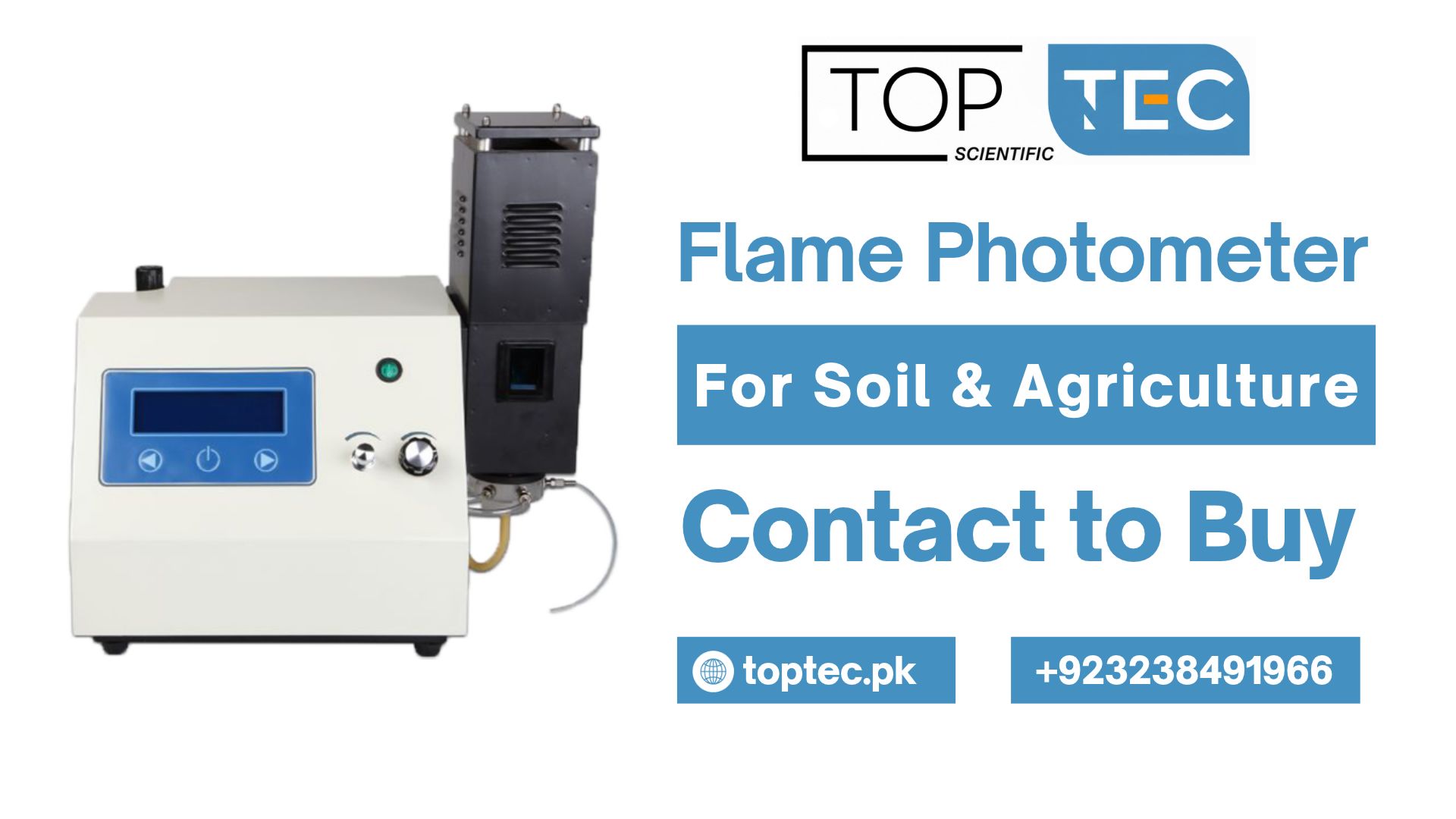
Find the right flame photometer for your lab. Ideal for clinical sodium and potassium testing, soil nutrient analysis, and water quality monitoring. Learn more.
You know what’s frustrating? Trying to figure out why crops are underperforming when you don’t have real numbers to work with. Farmers guess. Agronomists estimate. And everyone argues about what the soil actually needs.
That’s basically why I got interested in soil nutrient analysis in the first place. And after years of working around lab equipment, I can tell you — if you’re measuring sodium, potassium, calcium in soil extracts, there’s one instrument that just works. No drama. No steep learning curve. Does its job.
The Flame Photometer.
Is it the most advanced piece of technology in the lab? No. Does it need to be? Also no. It measures what it needs to measure, and for soil and agricultural work, that’s usually enough.
Soil Isn’t Just Dirt — And That Changes Everything
Look, I’ve seen a lot of people treat soil testing like some background task. Take a sample, send it to a lab, wait for a report. But what’s actually happening in that report — the sodium content, the potassium levels, the calcium concentrations — those numbers drive real decisions. Fertilizer application rates. Soil amendment choices. Crop selection for the next season.
If the numbers are wrong, farmers waste money. They over-fertilize or under-fertilize. Soil health degrades. Yields drop. It compounds over years.
So getting those numbers right matters more than most people realize.
Now, there are several methods to measure these elements. But when you need fast, reliable results for Na, K, Ca across dozens or hundreds of soil samples — a Flame Photometer is honestly hard to beat. I’ve watched labs process 80+ samples in an afternoon with one operator running the machine. Try doing that with some of the more “sophisticated” techniques and you’ll be waiting until next week.
The Science Behind It — Flame Emission Spectroscopy Made Simple
OK so let’s talk about what’s actually happening inside the instrument. The technique is called flame emission spectroscopy, and the principle is surprisingly straightforward.
You take your soil extract — usually a solution made by dissolving soil in something like calcium chloride or ammonium acetate — and you spray it into a flame. Propane or butane flame, mixed with air. When the solution hits the flame, the elements get hot. Really hot. Electrons in those atoms get kicked up to higher energy levels.
Then they fall back down. When they do, they give off light. Each element gives off light at its own specific wavelength. That’s the key part. Sodium screams yellow at 589 nanometers. Potassium shows up in the violet region around 766. Calcium glows orange-red. Lithium — deep red.
The instrument catches that light, filters it down to the wavelength you care about, and measures how bright it is. Brighter light means more of that element in your sample. That’s flame emission spectroscopy in a nutshell.
What I really like about flame emission spectroscopy is how predictable it is. Once you calibrate properly, the relationship between concentration and signal intensity is pretty linear over a wide range. For soil extracts, that range is exactly where you need it to be.
Why This Instrument Sticks Around
I know there are fancier options out there. ICP-OES. ICP-MS. Atomic absorption. All of them have their place. But I keep seeing Flame Photometer units in agricultural labs across Pakistan — in Punjab, in Sindh, up north in KPK — and there are solid reasons for that.
For one, speed. Flame emission spectroscopy gives you a reading almost instantly. No long digestion steps. No complicated sample prep beyond getting the soil extract ready. You pour, you aspirate, you read. Done.
Cost is the other big factor. A Flame Photometer costs a fraction of what an ICP system runs you. And operating expenses are minimal. The fuel is basic. Reagents are cheap. A technician can handle maintenance without calling in a specialist every time something needs cleaning.
And honestly, for the elements it measures — Na, K, Ca, maybe Li — the accuracy is perfectly fine. We’re talking about concentrations in soil extracts that range from milligrams per liter up to hundreds of ppm. Flame emission spectroscopy covers that entire range comfortably.
I’ve talked to lab managers who’ve told me they run both advanced instruments and a Flame Photometer side by side. The advanced systems handle rare elements and trace-level analysis. But for routine soil nutrient work? They grab the Flame Photometer every time. Because it’s faster, cheaper, and honestly, just less hassle.
What to Look for When Buying
Alright, so you’ve decided you need one. Here’s what I’d pay attention to before pulling the trigger.
First off — how many elements can it measure at once? Some older or budget models only do Na and K. For soil work, you want Na, K and Ca at minimum. Having lithium or barium as extra channels is a nice bonus for certain specialized tests.
Sensitivity range matters a lot. Soil extracts can vary wildly depending on the soil type — sandy soils versus clay, acidic versus alkaline, all of that changes your expected concentrations. You need an instrument that handles a broad linear range without constant dilution.
Digital readouts, automatic zeroing, baseline stability — these things sound like minor details but they save so much time during routine work. A Flame Photometer with good electronics means less manual adjustment and more consistent results day to day.
And the flame head design. This matters more than people think. Some flame heads are optimized for trace-level work. Others handle higher concentrations better. For soil analysis where you’re often looking at moderate to high concentrations, make sure the burner design matches your application.
Sourcing — Who Makes These Things?
There are quite a few flame photometer manufacturers around the world. Some are big international names with all the marketing behind them. Others are smaller companies doing genuinely good work without the corporate budget.
When I help someone choose an instrument, I always tell them the same thing — don’t get hypnotized by a brand name. Read the specs. Compare the actual performance. Look at the real-world sensitivity, the number of channels, what fuel it needs, and most importantly, what happens when something breaks.
Here’s what I’ve noticed about flame photometer manufacturers serving agricultural markets specifically — they tend to build instruments that are more forgiving. More robust. Designed for technicians who aren’t necessarily analytical chemists. That’s not a weakness, that’s smart design.
Some flame photometer manufacturers in South Asia and nearby regions also build equipment with local conditions in mind. Dust. Humidity. Unreliable power. Limited access to specialty gases. An instrument designed for a pristine European lab might not survive a year in a non-air-conditioned soil testing facility in rural Balochistan.
Good flame photometer manufacturers understand this. They test their products under realistic conditions. They offer support in local languages. They stock spare parts regionally. Those details count when you’re running a lab that needs to keep producing results every single day.
Your Lab Environment — The Stuff Nobody Wants to Talk About
I know this isn’t the exciting part. But walk into a bad lab and tell me equipment performance isn’t affected.
A Flame Photometer generates open flame. It needs proper ventilation. It needs a stable, level surface. The soil extraction chemicals — acids, solvents — need safe, organized storage. Standards and calibration solutions have to be kept in conditions where they don’t degrade.
I’ve been in agricultural labs where a perfectly good Flame Photometer was sitting on a rickety old table in a room with no exhaust ventilation. Standards were shoved in a random cabinet with no temperature control. Results were inconsistent, and everyone blamed the instrument.
The instrument wasn’t the problem.
If you’re setting up a soil testing lab or upgrading an existing one, flame emission spectroscopy work needs a proper environment. Chemical-resistant benchtops that won’t warp or stain. Fume hoods for extraction work. Storage cabinets that actually seal. These aren’t luxury items — they’re basic requirements.
When you Buy Laboratory Furniture designed for analytical work, your instruments perform better and last longer. Period. When you Buy Laboratory Furniture that’s cheap and flimsy, you’ll spend more fixing problems than you saved on the purchase. I’ve seen it happen too many times.
TOPTEC Scientific — Made in Pakistan, For Pakistani Labs
This is where TOPTEC comes in. They’re based in Pakistan and they manufacture laboratory furniture and equipment right here. Not imported from overseas with a big markup. Built locally.
I’ve been recommending them to soil testing labs and agricultural research stations for a while now. When you Buy Laboratory Furniture from TOPTEC, you get lab benches, fume hoods, storage units — all built with materials that can handle chemical exposure and daily use. Their fume hoods actually move air properly. Their benches don’t swell up after six months of acid spills. Small things, but they matter.
Think about your soil analysis setup. Soil samples come in. Extraction happens at the bench with acid solutions. Standards are prepared nearby. The Flame Photometer sits ready. All of this needs a workspace that’s clean, organized, and safe. When you Buy Laboratory Furniture from TOPTEC, that’s what you get.
And because they manufacture in Pakistan — no import duties, no shipping delays, no customs headaches. Faster delivery. Local support if something needs adjusting. Pricing that makes sense for agricultural labs running on tight budgets.
Honestly, when you Buy Laboratory Furniture from TOPTEC, you’re also keeping money in the local economy. Supporting Pakistani manufacturing. That matters too.
Practical Stuff — Tips From Running Soil Analysis Day After Day
A few things that actually help in real-world situations.
Stick with one extraction method throughout your study. If you’re using ammonium acetate for one batch and calcium chloride for another, your results won’t be comparable. Pick a method — usually guided by your soil type and what you’re measuring — and use it consistently.
Calibrate before every session. Flame emission spectroscopy can drift a little over the course of a day. Run your standards, check the response, adjust if needed. Then spot-check periodically. Takes barely any time but catches problems before they wreck your data.
Keep the nebulizer clean. Soil extracts have particulates that can clog the aspiration system fast. Flush with deionized water between samples. If throughput drops unexpectedly mid-run — check for blockages. It’s almost always blockages.
Watch the flame. Seriously, just look at it occasionally. A steady, clean flame = stable readings. If it’s flickering or looks off-color, something’s wrong with your gas supply or the burner head needs attention.
Document your conditions. Ambient temperature, instrument settings, reagent lot numbers. When results look weird three weeks later, these details save you from going crazy.
Where This Fits in the Bigger Picture
Pakistan’s agricultural sector is massive. Millions of farming families depend on it. But soil degradation is a real and growing problem. Nutrient depletion, salt buildup, improper fertilizer use — all of it traces back to poor soil management.
Soil testing changes that picture. When a farmer knows their soil has excess sodium but depleted potassium, they stop blindly throwing urea at the problem. They make informed choices.
Every soil report that goes out — every recommendation made — often starts with numbers produced by flame emission spectroscopy on a Flame Photometer somewhere in a lab. It’s not glamorous work. But it feeds into decisions that affect real people’s livelihoods.
Flame photometer manufacturers keep improving these instruments. Better stability. Easier calibration. Digital interfaces. All while keeping them affordable enough for the labs that actually need them — agricultural testing stations, university research labs, regional soil health centers across Pakistan.
And the labs where these instruments work every day? They need proper furniture and infrastructure. When you Buy Laboratory Furniture from a company like TOPTEC Scientific, you’re building the physical foundation that all of this analysis stands on.
Wrapping Up
The Flame Photometer isn’t new technology. It’s not cutting-edge. But for soil nutrient analysis — measuring Na, K, Ca in agricultural samples — it remains one of the most practical, reliable, and affordable tools available. Flame emission spectroscopy does its job efficiently, and modern instruments from good flame photometer manufacturers make the whole process smoother than ever.
If you’re outfitting a soil testing lab or upgrading your current setup, think about the complete picture. Good instrument. Proper lab environment. When you Buy Laboratory Furniture from TOPTEC Scientific, you get Pakistani-made quality that holds up to real conditions — at prices that won’t eat your whole equipment budget.
Agriculture feeds 230 million people here. Soil analysis helps make that sustainable. The right tools and the right lab setup — both matter more than people give them credit for.
