

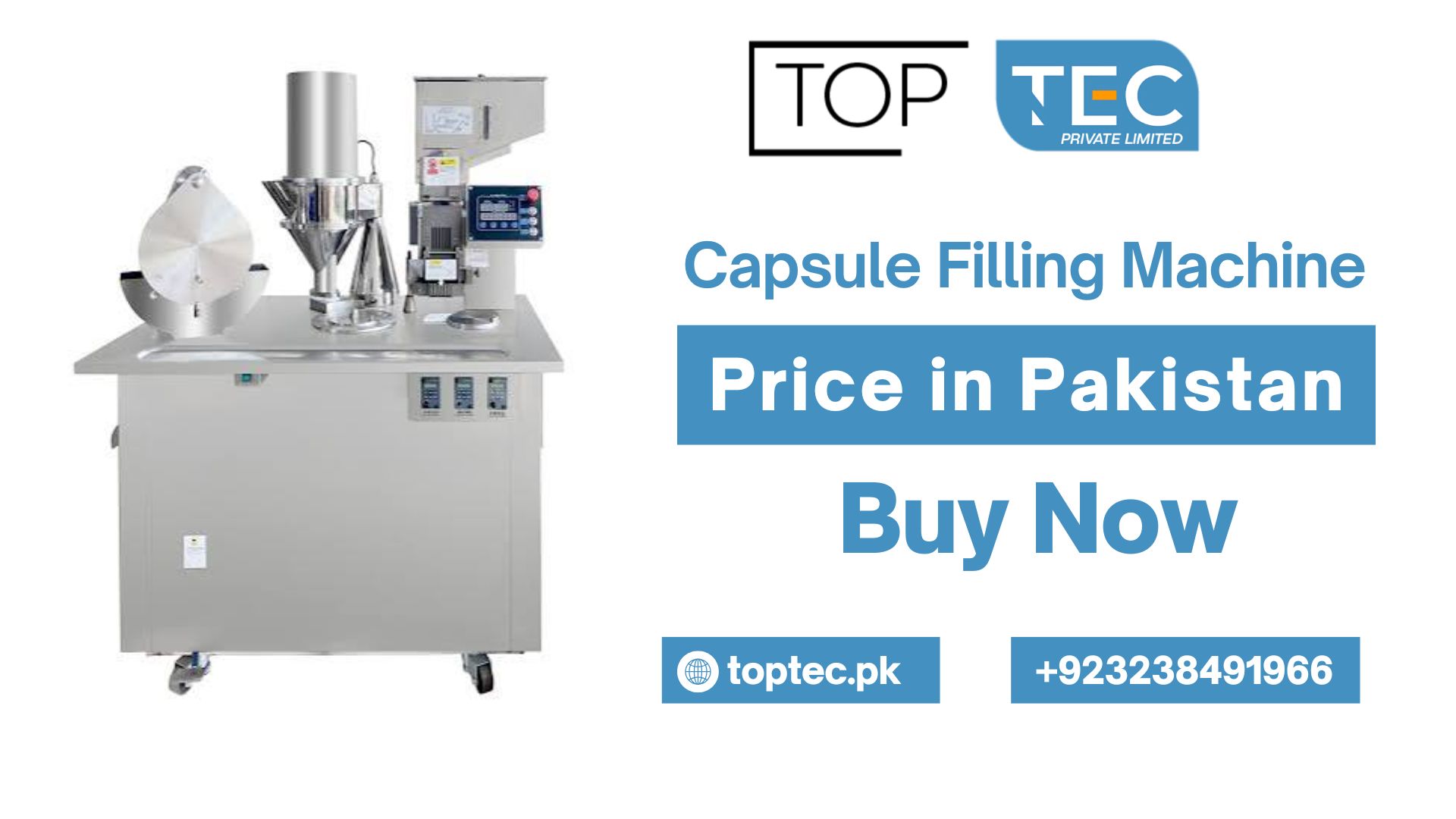
Shop premium capsule filling machines from top pharma manufacturers. Manual, semi-auto, and fully automatic systems available for 000#–5# capsules. Request a free quote and get pricing for your production capacity today.
Okay, so you’ve decided it’s time to stop filling capsules by hand — or maybe you’re setting up a new production line from scratch and trying to figure out where to even begin. Either way, you’ve probably already discovered that searching for capsule filling equipment online in Pakistan throws up a confusing mix of imported machinery listings, vague pricing, and suppliers who seem more interested in closing a sale than actually helping you find the right equipment.
That frustration is completely valid. And it’s exactly why this guide exists.
Before you buy Capsule Filling Machine equipment — whether you’re a small herbal medicine startup, a mid-sized nutraceutical manufacturer, or an established pharmaceutical company expanding production capacity — there are things you genuinely need to understand first. Not marketing fluff. Not spec sheets designed to impress rather than inform. Real, practical information that helps you make a decision you won’t regret six months into production.
Let’s work through this properly.
First Things First — Why Does the Machine Choice Matter So Much?
Capsule filling sounds straightforward until you’re actually doing it at any kind of meaningful scale.
Powder formulations behave in unpredictable ways. Some flow beautifully through dosing mechanisms. Others clump, bridge, and stick to every surface they touch. Capsule shells are more fragile than they look — the wrong amount of mechanical force during separation or closing cracks them, creating rejects and wasted API. Fill weights need to be consistent across every single capsule in a batch, not just the ones the machine fills when it’s running smoothly and the operator is paying close attention.
Getting this right requires equipment that’s matched to your specific formulation characteristics, your production volume requirements, and your regulatory environment. A machine that works brilliantly for one manufacturer can be genuinely unsuitable for another — even if they’re both filling the same capsule size.
So when you’re ready to buy Capsule Filling Machine equipment, the starting point isn’t browsing product listings. It’s understanding your own requirements clearly enough to evaluate what you’re looking at.
Understanding the Three Main Types Before You Buy
The Manual Capsule Filling Machine
A manual capsule filling machine is a hand-operated filling tray — typically an acrylic or aluminum plate system with holes sized to hold a specific capsule size. You load empty capsule bodies into the tray, spread your powder formulation across the surface, tamp it into the capsule bodies, load the caps, and press the closure plate to seal all capsules simultaneously.
It’s simple. It requires no electricity. It’s easy to clean. And for what it is, a well-made manual capsule filling machine does its job reliably.
Typical output falls somewhere between 100 and 500 capsules per filling cycle depending on tray size — which translates to a few thousand capsules per hour for an experienced operator working at a consistent pace.
Who actually needs a manual capsule filling machine?
Honestly, more people than you’d think. Small herbal medicine producers. Nutraceutical startups still developing their product range. Pharmaceutical compounding pharmacies filling custom prescriptions. Research facilities producing clinical trial material in small quantities. University departments running formulation studies.
For all of these applications, the simplicity and low entry cost of a manual system is an advantage rather than a limitation. The Capsule Filling Machine price in Pakistan for quality manual systems is accessible to virtually any small operation, and there’s no point in automating a process you’re only running at small scale.
Semi-Automatic Capsule Filling Machines
Step up from manual operation and you’re into semi-automatic territory. These machines add mechanical dosing, automatic capsule orientation, and controlled filling to the process while still requiring an operator to manage loading, monitoring, and unloading functions.
Output ranges from around 5,000 to 25,000 capsules per hour depending on the specific model. For medium-scale operations — the category that covers a large proportion of Pakistani pharmaceutical and nutraceutical manufacturers right now — semi-automatic machines hit a genuinely productive sweet spot.
They’re more consistent than manual filling. They significantly reduce operator fatigue. They achieve fill-weight accuracy that manual tray filling simply can’t match. And the Capsule Filling Machine price in Pakistan for semi-automatic systems, while higher than manual equipment, is considerably more accessible than full automation.
Fully Automatic Capsule Filling Machines
Full automation handles everything without meaningful operator involvement at the filling stage. Capsules are fed from bulk hoppers, oriented mechanically, separated into cap and body, filled through precision dosing mechanisms, closed, polished, and discharged in a continuous automated sequence.
Output on commercial automatic systems ranges from 25,000 capsules per hour on smaller models to well over 150,000 per hour on high-speed industrial equipment.
These machines are built for large-scale pharmaceutical production where batch documentation, validated fill weights, and continuous high-volume output are daily requirements. The investment is significant — but for operations running at this scale, the production economics justify it clearly.
The Powder Problem — Why Formulation Characteristics Drive Equipment Choice
This is the part that doesn’t get discussed enough in most buying guides.
Every pharmaceutical and nutraceutical powder has its own personality. Some are cooperative — they flow smoothly through dosing mechanisms, sit predictably in capsule bodies, and produce consistent fill weights with minimal effort. Others are genuinely difficult — they’re cohesive and sticky, they bridge across openings, they segregate during filling, or they absorb moisture from the air and change their flow properties mid-run.
The reason this matters so much when you’re looking to buy Capsule Filling Machine equipment is that different machine designs handle difficult powders differently. And buying a machine that’s not matched to your specific formulation is one of the most expensive mistakes in pharmaceutical equipment procurement.
Two main filling mechanisms dominate the market:
Dosator Systems: A cylindrical pin compresses a plug of powder inside a dosator tube, then ejects the plug into the capsule body. These systems work well with free-flowing powders that compress predictably. They’re common in many semi-automatic and automatic machines and are relatively straightforward to operate and maintain.
Tamping-Pin Systems: Progressive tamping stations build a powder plug through a series of compression steps before the plug is transferred into the capsule body. These systems generally handle a wider range of powder flow characteristics, including more cohesive formulations that dosator systems struggle with.
When you approach Capsule Filling Machine manufacturers for quotations, don’t just describe what you want to fill. Describe how your powder behaves. Does it flow freely or does it tend to clump? What’s its bulk density? Is it hygroscopic? These questions should lead to a proper technical conversation — and if a supplier can’t engage with them, that tells you something important.
What Capsule Sizes Do You Need to Work With?
Standard capsule sizes run from 000 (the largest, with fill volumes around 1.37ml) down to size 5 (the smallest, with fill volumes around 0.13ml). The most commonly used sizes in Pakistani pharmaceutical and nutraceutical manufacturing are typically 0, 1, and 2.
Most capsule filling machines are designed around specific size ranges. Some models accommodate multiple sizes through interchangeable parts — different filling plates, dosators, or tooling sets that can be swapped during changeover. If your product range requires multiple capsule sizes, this flexibility matters significantly.
Before you buy Capsule Filling Machine equipment, list every capsule size your current and planned products require. Then ask specifically about changeover time and process. In facilities with multiple products running on the same machine, changeover efficiency has a direct impact on your actual production capacity — sometimes more than the machine’s rated output.
GMP Compliance — What the Regulations Actually Require
For pharmaceutical manufacturers operating under DRAP oversight in Pakistan, your capsule filling equipment needs to meet Good Manufacturing Practice standards. This isn’t just a regulatory box-ticking exercise — GMP requirements exist because they correlate directly with product quality and patient safety.
From a practical equipment perspective, GMP compliance for capsule filling means:
Material Specifications: All surfaces that come into contact with product — filling plates, dosator bodies, tamping pins, hoppers — must be manufactured from pharmaceutical-grade stainless steel. SS316L is the preferred specification for direct product contact. SS304 is acceptable for some ancillary components.
Design for Cleanability: Machines must be designed without hollow spaces, blind channels, or inaccessible crevices where powder residue can accumulate between batches. Ideally, cleaning should be achievable without complete disassembly.
Equipment Qualification: Before a capsule filling machine can be used in validated pharmaceutical production, it must go through Installation Qualification (IQ), Operational Qualification (OQ), and Performance Qualification (PQ). This requires proper documentation from your equipment supplier — not just a user manual, but formal protocol templates and supporting technical data.
Fill Weight Verification: GMP requires that fill weights be monitored during production and that records demonstrate consistent compliance with specifications. The machine must be capable of achieving the fill weight tolerances specified in your product documentation.
Calibration Records: All measurement instruments on the machine — including any integrated check-weighing systems — must have current calibration certificates from traceable standards.
When you’re comparing Capsule Filling Machine price in Pakistan across different suppliers, remember that this documentation requirement has a real cost. A supplier providing a full GMP documentation package will quote differently from one who provides only basic operational manuals. The difference in purchase price is typically far less than the cost of generating missing documentation retrospectively before a regulatory inspection.
Capsule Filling Machine Price in Pakistan — Honest Numbers
Let’s address the budget question directly, because vague answers to pricing questions are genuinely unhelpful.
The Capsule Filling Machine price in Pakistan varies across a wide range depending on machine type, capacity, specification level, and whether you’re buying from a local manufacturer or importing. Here’s a realistic framework:
Manual Systems: Entry-level manual capsule filling machine trays for basic small-scale operation fall at the most accessible end of the price range. Even properly specified manual systems with quality acrylic or aluminum construction are affordable for small businesses and startups.
Semi-Automatic Systems: This is where the price range becomes wider and more dependent on specification. Basic semi-automatic models with simpler dosing mechanisms sit at the lower end of this range. Higher-specification models with servo-driven dosing, integrated check-weighing, and full GMP documentation packages sit considerably higher. Both are semi-automatic — but they’re genuinely different investments.
Fully Automatic Systems: Significant capital investment territory. The specific price depends heavily on output capacity, control system sophistication, and specification level. For Pakistani manufacturers considering this investment, it’s worth spending time understanding total cost of ownership rather than focusing purely on the purchase price.
What drives price differences between suppliers:
Local versus imported equipment pricing reflects different cost structures. Imported machines carry shipping, import duties, and currency exchange costs. Local manufacturers’ pricing reflects their production economics without these additions. For comparable specifications, local equipment from established Capsule Filling Machine manufacturers often represents better value when you factor in after-sales support.
Documentation quality affects price. As mentioned above, proper GMP qualification documentation takes real engineering time to produce and is priced accordingly.
After-sales terms affect the effective cost of ownership. A machine with no local spare parts support and no local service capability has a higher total cost of ownership than its purchase price suggests.
Why Buying Online Requires Extra Caution
The convenience of online procurement is real — you can compare multiple suppliers, review specifications, and request quotations without traveling anywhere. For a straightforward commodity purchase, this works well.
Capsule filling equipment is not a straightforward commodity purchase.
When you buy Capsule Filling Machine equipment online without proper technical evaluation, several things can go wrong:
Specification misrepresentation: Online listings sometimes describe machines in ways that are technically accurate but misleading. Output figures quoted at theoretical maximum rather than realistic operating conditions. Material specifications described in vague terms. Documentation packages described as included when they’re actually optional extras at additional cost.
Formulation incompatibility: As discussed earlier, the machine that looks right on paper may not suit your specific powder formulation. This is very difficult to evaluate from a product listing — it requires a proper technical conversation with people who understand both the machine and pharmaceutical powder behavior.
After-sales reality check: Online suppliers sometimes look more capable than they actually are. A professional website and responsive pre-sales communication doesn’t necessarily mean reliable technical support after your machine is installed and running.
No opportunity for facility inspection: When you buy Capsule Filling Machine equipment from an online-only interaction without visiting the supplier’s manufacturing facility, you’re taking their claims about manufacturing quality on faith.
None of this means online research isn’t valuable — it clearly is. Use it for initial comparison and shortlisting. But before you finalize any purchase decision, have a real technical conversation with the supplier, verify their manufacturing credentials, and check references from existing customers.
The Infrastructure Around Your Filling Machine — Why It Matters
Here’s something that gets overlooked constantly when pharmaceutical manufacturers are focused on equipment procurement: the environment your capsule filling machine operates in directly affects its performance and your product quality.
Capsule filling generates powder dust. This dust needs to be contained and managed — both for operator health protection and to prevent cross-contamination between products. Proper dust extraction, cleanable surfaces, and well-designed workstations aren’t optional extras; they’re part of a functional capsule filling setup.
Your filling machine also needs properly specified surrounding furniture — workbenches that are cleanable and don’t generate particulate contamination, storage systems for bulk powders and packaging materials, weighing stations for in-process checks, and potentially sampling equipment for quality control.
This is where TOPTEC Scientific becomes directly relevant.
TOPTEC Scientific — Laboratory Furniture and Cleanroom Equipment, Made in Pakistan
TOPTEC Scientific is a Pakistan-based manufacturing company producing high-specification laboratory furniture and cleanroom equipment for pharmaceutical, nutraceutical, research, and industrial facilities. Everything they produce is manufactured locally — which matters for the same practical reasons that local capsule filling equipment matters: faster delivery, no import complications, local technical support, and pricing that makes sense for Pakistani operations.
If you’re setting up or upgrading a capsule filling operation, TOPTEC Scientific can supply the surrounding infrastructure that makes your production environment actually work:
Stainless Steel Workbenches and Production Tables
Manufactured from SS304 or SS316 with seamless welded construction and smooth, fully cleanable surfaces. These aren’t generic steel tables — they’re specifically designed for pharmaceutical production environments where contamination control and chemical resistance to cleaning agents are daily requirements. No painted finishes that chip and contaminate product. No hollow sections that harbor powder residue. Properly specified pharmaceutical-grade work surfaces.
Dispensing and Weighing Stations
Purpose-designed stations for raw material dispensing and in-process weighing operations. Good weighing station design includes anti-vibration features, properly specified surfaces, and ergonomic layouts that reduce operator fatigue during repetitive weighing tasks.
Pass-Through Boxes
Static and dynamic configurations for material transfer between different environmental zones — moving raw materials from warehouse areas into production cleanrooms, or finished product out, without compromising the environmental controls inside.
Mobile Trolleys and Transport Systems
Pharmaceutical-grade stainless steel trolleys for moving materials, tooling, and equipment within facilities. Well-designed trolleys are easier to clean, more maneuverable in tight cleanroom corridors, and more durable than standard alternatives.
Storage Systems
Properly specified shelving and storage for pharmaceutical environments — materials that don’t shed particles, resist cleaning chemicals, and can be organized to support FIFO (first-in, first-out) inventory management.
Fume Hoods and Ventilated Enclosures
Essential for facilities handling potent APIs, solvent-based formulations, or any materials where vapor or dust exposure requires engineering controls.
Gowning Room Furniture
Benches, lockers, and storage systems for personnel gowning areas — the often-overlooked transitional spaces where contamination control begins before anyone enters the production area.
The practical advantage of sourcing this furniture from TOPTEC Scientific rather than importing is the same advantage that applies to any locally manufactured pharmaceutical equipment: shorter lead times, direct communication, local technical support, and pricing that reflects local manufacturing costs rather than international export margins.
Finding Reliable Capsule Filling Machine Manufacturers in Pakistan
When you’re shortlisting Capsule Filling Machine manufacturers to evaluate, the process deserves more rigor than most buyers apply to it. Here’s what actually differentiates reliable suppliers from ones who look good until something goes wrong:
Real Manufacturing Capability
Can you visit their facility and see capsule filling machines being built? Legitimate manufacturers welcome factory visits. If a supplier is reluctant to show you their manufacturing setup, there’s usually a reason — and it’s not usually a good one.
Genuine Technical Competence
Have a technical conversation about your specific formulation and requirements. Can their engineering team engage meaningfully with questions about powder flow behavior, dosing mechanism selection, and fill-weight validation? Or do they redirect everything back to catalog specifications? The depth of technical conversation you can have with a supplier before purchase is usually a good predictor of the quality of support you’ll receive after purchase.
Documented Quality Systems
Do they have a quality management system? Can they provide material certificates for stainless steel components? Do they have calibration records for testing equipment used in machine commissioning? These aren’t bureaucratic boxes — they’re indicators of whether this supplier can genuinely support pharmaceutical GMP requirements.
Customer References
Ask for references from existing customers operating in comparable manufacturing environments. If a supplier can’t provide any, or provides references that you can’t actually contact, that’s worth noting.
Spare Parts Commitment
What critical spare parts do they stock? What’s the lead time for components that aren’t in stock? For a production machine running daily, spare parts availability directly affects your operational risk.
Before You Click “Purchase” — A Final Checklist
Whether you’re buying a manual capsule filling machine for a small herbal operation or a fully automatic system for pharmaceutical production, run through these points before finalizing any purchase:
☐ Have you tested your actual powder formulation with the machine, or at least provided detailed flow characterization data to the supplier?
☐ Do you know exactly which capsule sizes you need, and have you confirmed the machine handles all of them?
☐ Have you asked about changeover time if you’re running multiple sizes or products?
☐ Is the documentation package adequate for your regulatory requirements? IQ/OQ protocols, material certificates, calibration records?
☐ Have you evaluated after-sales support capability — local spare parts, technical service, response time commitments?
☐ Have you factored total cost of ownership rather than just purchase price into your comparison?
☐ Have you assessed your surrounding infrastructure needs — workbenches, weighing stations, storage, cleanroom furniture — alongside the machine itself?
☐ Have you visited the manufacturer’s facility or at least verified their manufacturing credentials through references?
If you can answer yes to all of these, you’re making this decision with your eyes open. If there are gaps, address them before committing.
Wrapping This Up
Finding the right place to buy Capsule Filling Machine equipment in Pakistan doesn’t have to be as complicated as the online landscape makes it look. The key is approaching it systematically — understanding your requirements before evaluating machines, evaluating machines before comparing prices, and comparing prices with total cost of ownership in mind rather than just purchase price.
The Capsule Filling Machine price in Pakistan that actually makes sense for your operation is the one that accounts for everything: the right machine for your formulation and volume requirements, adequate documentation for your regulatory environment, reliable after-sales support from Capsule Filling Machine manufacturers who will still be engaged and helpful two years after you’ve paid the invoice, and properly specified surrounding infrastructure from suppliers like TOPTEC Scientific who understand what pharmaceutical production environments actually need.
Get that equation right and you’re making an investment that genuinely serves your operation. Get it wrong by focusing too narrowly on purchase price or convenience, and you’re setting yourself up for problems that cost far more than the savings you thought you were making.
