

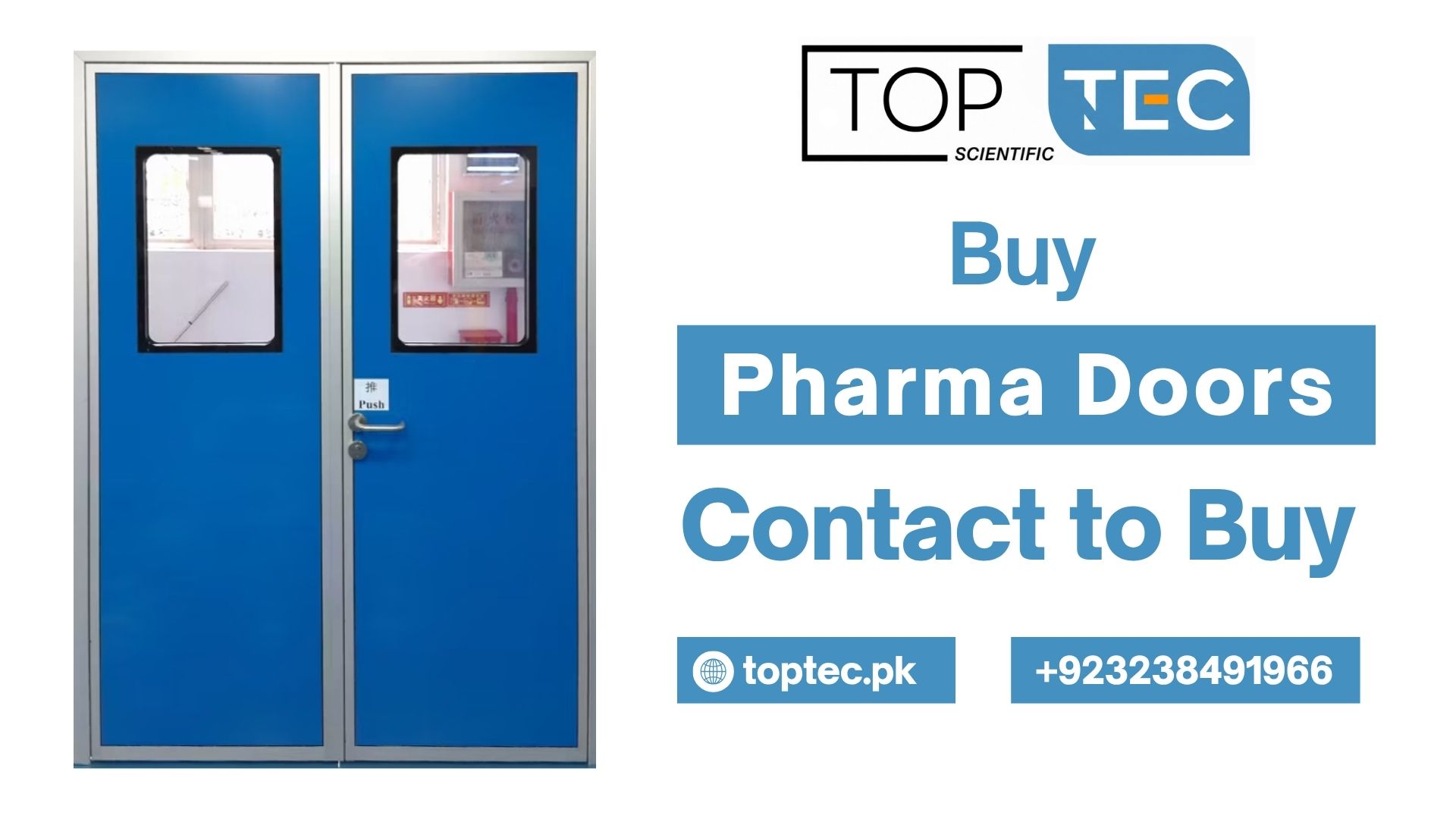
Looking for GMP-compliant pharma doors? Explore GI steel, HPL, and stainless steel options with airtight sealing, flush surfaces, and optional vision panels. Designed for ISO 5-8 cleanrooms. Request a free quote from verified suppliers today.
If you’ve ever been part of a pharmaceutical facility setup — whether as a project manager, a QA professional, a procurement specialist, or a facility engineer — you already know that the decisions that seem straightforward on paper rarely are in practice. Doors are a perfect example of this. On the surface, it sounds like a simple enough decision. You need doors. You buy doors. Done.
Except it’s nowhere near that simple in a pharmaceutical environment. The moment GMP enters the conversation, every material choice, every surface finish, every seal configuration, every hardware specification becomes a compliance decision — not just an engineering one. Get it wrong and you’re looking at failed audits, contamination risks, and the kind of corrective action reports that nobody wants to write.
So when it’s time to Buy Pharma Doors for your facility — whether you’re setting up a new manufacturing plant, upgrading an existing one, or expanding into new product categories — understanding your material options, their respective strengths and limitations, and how they map onto GMP requirements is absolutely essential.
At TOPTEC Scientific, we manufacture and supply pharmaceutical doors in Pakistan — stainless steel, galvanized iron (GI), and high-pressure laminate (HPL) configurations — all built to GMP standards and customized to your facility’s specific requirements. This article is going to walk you through all three material options honestly and thoroughly, so you can make a genuinely informed decision.
Let’s get into it.
Why Pharma Doors Are a Completely Different Category
Before we compare materials, it’s worth stepping back and understanding what makes pharma cleanroom doors fundamentally different from any other type of industrial or commercial door.
In a pharmaceutical manufacturing facility, every surface — every wall, ceiling, floor, bench, and yes, every door — is part of your contamination control environment. GMP guidelines don’t just recommend that these surfaces be clean-able. They require it. They mandate specific surface properties, specific material characteristics, and specific design features that make contamination control achievable and demonstrable.
GMP guidelines, particularly relevant in pharmaceutical settings, dictate that doors must be easy to clean and maintain, with non-wood materials to prevent microbial growth. Doors in pharmaceutical environments must have smooth, non-porous surfaces that don’t trap particles, microorganisms, or cleaning agent residue. They must withstand the chemical disinfectants used in pharmaceutical cleaning programs — quaternary ammonium compounds, isopropyl alcohol, chlorine-based agents, and in some environments, vaporized hydrogen peroxide — without degrading, discoloring, or losing structural integrity.
Additionally, pharmaceutical doors must contribute to pressure differential control between zones, which means airtight sealing is non-negotiable. They must be designed with flush surfaces — no exposed rebates, no visible fixings, no gaps or crevices that can harbor contamination. Hardware must be corrosion-resistant and easy to disinfect.
All of this adds up to a product category that genuinely requires specialized manufacturing knowledge — not just general door fabrication skills. And it’s precisely why when you Buy Pharma Doors, you need to work with a manufacturer who understands pharmaceutical environments from the inside out, not just a door supplier who happens to be willing to coat their standard products with a cleanroom label.
The Three Primary Material Options for Pharma Cleanroom Doors
When you start the process to Buy Pharma Doors in Pakistan or anywhere else in the world, you’ll quickly discover that the market offers three primary material categories for GMP pharmaceutical door construction. Each has its engineering rationale, its appropriate applications, its cost profile, and its limitations. Let’s examine each one in detail.
Option 1: Stainless Steel Pharmaceutical Doors
Stainless steel is the premium standard in pharmaceutical door construction — and for applications where the highest performance is genuinely required, it fully earns that status.
What Makes Stainless Steel the Gold Standard?
Stainless steel owes its corrosion resistance to a passive chromium oxide layer that forms on its surface when chromium content exceeds approximately 10.5%. This passive layer is self-repairing — if it’s scratched or damaged, exposure to oxygen causes it to reform. It’s this property that makes stainless steel uniquely suited to environments where aggressive chemical disinfection is a daily reality.
In pharmaceutical manufacturing, there are two grades that matter most for door construction:
Grade 304 Stainless Steel — The most widely used grade in pharmaceutical applications. It contains 18-20% chromium and 8-10.5% nickel, giving it excellent corrosion resistance against most common pharmaceutical cleaning agents, good surface finish characteristics, and strong mechanical properties.
Grade 316L Stainless Steel — The higher-specification choice for the most demanding applications. The addition of 2-3% molybdenum dramatically improves resistance to chloride-based disinfectants — particularly relevant in environments using sodium hypochlorite or VHP fumigation regularly. The “L” designation indicates low carbon content, which reduces sensitization during welding and improves corrosion resistance in welded components.
For pharma cleanroom doors in Grade A and B zones — aseptic filling areas, lyophilization suites, sterile formulation rooms — stainless steel doors in 316L grade are effectively the regulatory expectation. When DRAP, WHO, EU GMP, or US FDA auditors walk into your most critical cleanroom zones, they expect to see surfaces — including doors — that unambiguously communicate your commitment to contamination control.
Key Features of TOPTEC’s Stainless Steel Pharmaceutical Doors
At TOPTEC Scientific, our stainless steel pharmaceutical doors are fabricated with:
- Cold-rolled 304 or 316L stainless steel door leaf — available in standard or custom thicknesses
- Fully welded stainless steel frame with continuous perimeter seal groove
- Brushed or electropolished surface finish — Ra ≤ 0.8 μm for pharmaceutical applications
- Full perimeter silicone or neoprene gasket seal for airtight closure
- Flush-mounted vision panel with flush glazing on both sides — no rebates or particle traps
- Concealed hinges in corrosion-resistant stainless steel
- Lever handle and lock set in matching stainless steel grade
- Automatic door closer with adjustable closing force and speed
- Interlocking options for airlock configurations
The surface finish specification matters considerably more than most buyers initially appreciate. A polished surface below Ra 0.8 μm is not just aesthetically cleaner — it’s microscopically smoother, with fewer surface valleys where microorganisms can shelter from cleaning agents. For Grade A/B zones, electropolished finishes (Ra ≤ 0.5 μm) provide the highest level of surface cleanability.
When to Specify Stainless Steel Pharma Doors
- Grade A and Grade B cleanroom zones (ISO Class 5)
- Aseptic filling, lyophilization, and sterile formulation areas
- Environments using VHP, H₂O₂-based, or aggressive chloride sporicidal disinfectants
- Areas subject to wash-down procedures with high-pressure water
- Facilities targeting EU GMP Annex 1 compliance for sterile product manufacturing
- High-humidity environments where corrosion resistance is a structural requirement
The Cost Reality
Stainless steel pharmaceutical doors — particularly in 316L grade — represent the highest capital cost in the pharmaceutical door material category. For Pakistani pharmaceutical manufacturers operating under budget constraints, this cost premium is a real consideration. Over-specifying stainless steel doors in Grade C and D zones where they’re not required by GMP is a common and unnecessary budget drain. This is where the alternative materials — GI and HPL — make a genuinely compelling case.
Option 2: GI (Galvanized Iron) Pharmaceutical Doors
Galvanized iron — commonly referred to as GI — is a significantly more affordable alternative to stainless steel for pharmaceutical door construction. It’s the middle-ground option that offers solid structural performance and adequate GMP compliance characteristics for lower-grade zones at a fraction of the stainless steel cost.
What Is GI and How Does It Work?
Galvanized iron is mild steel that has been coated with a layer of zinc through a hot-dip or electrolytic galvanizing process. The zinc layer provides a sacrificial protective coating — it corrodes preferentially to the underlying steel, giving the steel substrate protection from oxidation. When combined with a powder-coat or epoxy topcoat for pharmaceutical applications, GI doors can deliver good corrosion resistance and acceptable surface smoothness for Grade C and D pharmaceutical zones.
GI steel pharmaceutical doors are constructed from galvanized steel sheeting that provides resistance to corrosion and is coated with powder-coat or epoxy finishes to achieve the smooth, non-porous surface properties required for GMP compliance in lower-grade cleanroom zones. These doors offer significantly better cost-efficiency compared to stainless steel while maintaining acceptable contamination control performance in Grade C and Grade D pharmaceutical environments.
Surface Treatment and Finishing
The performance of a GI pharmaceutical door depends heavily on the quality of its surface treatment. For pharmaceutical applications, electrostatic powder coating is the standard finishing approach. A properly applied electrostatic powder coat on a GI substrate produces a hard, smooth, non-porous surface that:
- Resists common pharmaceutical disinfectants including quaternary ammonium compounds and IPA
- Can be cleaned to pharmaceutical housekeeping standards
- Doesn’t trap particles or microorganisms in visible surface features
- Maintains appearance through repeated cleaning cycles
The critical caveat: the coating must be applied correctly — proper surface preparation, appropriate primer adhesion, correct topcoat thickness, and quality edge sealing. A poorly applied powder coat on a GI door will chip, delaminate, and develop edge corrosion that creates particle trap sites and fails GMP surface requirements quickly.
At TOPTEC Scientific, our GI pharmaceutical doors go through a rigorous surface preparation and coating process. Every door is shot-blasted, zinc phosphated, primed, and powder-coated with electrostatic application — not spray-painted, not brush-coated — to ensure the surface quality that GMP environments demand.
Key Features of TOPTEC’s GI Pharmaceutical Doors
- Cold-rolled galvanized steel door leaf — 18-gauge minimum for structural rigidity
- Rockwool or CFC-free PU foam core for structural integrity and thermal insulation
- Electrostatic powder-coat finish in pharmaceutical white or custom RAL color
- Full perimeter neoprene/PVC gasket seal for airtight closure
- Flush surface design with no exposed fixings or rebates
- Optional flush-mounted vision panel — double-glazed for thermal performance
- Concealed hinges in zinc-plated or stainless steel
- Heavy-duty door closer with adjustable speed and power
- Corrosion-resistant hardware throughout
When to Specify GI Pharma Doors
- Grade C and Grade D pharmaceutical manufacturing zones
- ISO Class 7 and Class 8 cleanroom areas
- Tablet, capsule, and granulation production areas
- Packaging zones and general manufacturing corridors
- Storage areas for pharmaceutical materials
- Non-sterile manufacturing environments
- Facilities with moderate cleaning agent requirements (no VHP or aggressive sporicides)
- Projects where budget optimization across multiple door zones is a priority
The Cost Advantage
For most Pakistani pharmaceutical facilities — where the majority of manufacturing floor area comprises Grade C and D zones — GI pharmaceutical doors with quality powder-coat finish offer the optimum balance of GMP compliance and cost efficiency. When you Buy Pharma Doors for a full facility across multiple zones, the savings from specifying GI in appropriate zones versus unnecessary stainless steel specification can be substantial — and those savings can be redirected to higher-specification doors in the zones that genuinely require them.
Option 3: HPL (High-Pressure Laminate) Pharmaceutical Doors
HPL — High-Pressure Laminate — is a composite material that has gained significant traction in pharmaceutical door applications over the past two decades. It’s made by compressing multiple layers of resin-impregnated paper under high heat and pressure to create a dense, rigid panel with specific surface properties.
What Makes HPL Suitable for Pharma Environments?
HPL’s pharmaceutical appeal comes from several characteristics that are inherent to its material structure rather than dependent on coatings or surface treatments:
Intrinsically smooth surface — HPL panels are manufactured with an inherently smooth surface that doesn’t require any coating to achieve GMP-acceptable surface characteristics. Unlike GI doors where the surface quality depends on the coating process, HPL’s smoothness is built into the material itself.
Non-porous structure — HPL is a dense, non-porous material that doesn’t absorb liquids or harbor microorganisms in surface features. This makes it inherently resistant to microbial contamination at the surface level.
Chemical resistance — HPL is resistant to a broad range of pharmaceutical disinfectants and cleaning agents. It handles quaternary ammonium compounds, IPA, dilute chlorine solutions, and many other common pharmaceutical cleaners without degrading.
Dimensional stability — HPL maintains its dimensions and surface flatness across a wide range of temperature and humidity conditions — an important property in cleanroom environments where temperature and humidity control is part of the environmental specification.
No corrosion — Unlike steel substrates, HPL doesn’t corrode. This makes it particularly suitable for environments with higher ambient humidity where even galvanized steel may eventually experience edge corrosion if the coating system is compromised.
High-pressure laminate pharmaceutical doors are constructed using HPL panels bonded to a structural core — typically aluminum honeycomb or rigid foam — and set within aluminum or stainless steel frames. The result is a lightweight but rigid door that offers excellent surface characteristics for pharmaceutical Grade C and D environments, as well as specific Grade B applications where product risk assessment supports the material choice.
Key Features of TOPTEC’s HPL Pharmaceutical Doors
At TOPTEC Scientific, our HPL pharma cleanroom doors are manufactured to pharmaceutical specifications:
- HPL face panels — minimum 0.8mm thickness, pharmaceutical grade with smooth matte finish
- Structural core — aluminum honeycomb or high-density rigid foam for rigidity without excessive weight
- Aluminum or stainless steel frame — fully sealed, flush with door leaf surface
- Full perimeter compression gasket — silicone or neoprene for airtight sealing
- Flush vision panel — flush-mounted on both faces, double-glazed option available
- No exposed fixings or visible frame rebates on door leaf surface
- Concealed hinges — stainless steel, adjustable in three axes
- Door closer — surface-mounted or concealed, adjustable
- Available colors — pharmaceutical white standard, custom HPL colors available
When to Specify HPL Pharma Doors
- Grade B, C, and D pharmaceutical zones (risk-assessment dependent for Grade B)
- Areas where lighter door weight is preferred — reduces hinge wear and door closer load
- Environments with elevated ambient humidity where corrosion risk is a concern
- Facilities where a specific aesthetic finish is required — HPL is available in a range of colors and textures
- Applications where dimensional stability across temperature/humidity cycles is important
- Corridors, offices within controlled zones, and utility areas
- Facilities seeking the combination of non-metallic surface characteristics with pharmaceutical-grade performance
HPL vs. GI: Which Is Better for Grade C/D Zones?
This is a question we field regularly from clients who are trying to finalize their Buy Pharma Doors specification for Grade C and D zones. The honest answer is that both materials are appropriate for these zones when properly specified — the decision comes down to specific application factors:
Choose HPL when: Humidity is a concern, weight matters (lighter doors reduce hardware wear), non-metallic surface characteristics are preferred, or a specific aesthetic appearance is required.
Choose GI when: Higher mechanical robustness is needed (GI doors generally handle impact better than HPL), budget is the primary driver, or the chemical cleaning regime is within the standard pharmaceutical disinfectant range.
Both options deliver GMP-compliant pharmaceutical doors for the appropriate zone classifications when manufactured to the standard that TOPTEC Scientific applies to every door we produce.
GMP Design Requirements That Apply to ALL Pharma Door Materials
Regardless of which material you choose when you Buy Pharma Doors — stainless steel, GI, or HPL — there are core GMP design requirements that apply universally. These are non-negotiable regardless of material, and any door that doesn’t meet them isn’t genuinely GMP-compliant regardless of what material it’s made from.
✅ Flush Surface Design — No Particle Traps
This is perhaps the most important GMP design requirement for pharmaceutical doors. Every surface feature that creates a ledge, a recess, a joint gap, or a crevice is a potential particle trap — a location where contamination can accumulate and resist cleaning.
GMP-compliant pharma cleanroom doors must have:
- Fully flush door leaf surfaces on both sides — no surface-mounted frame members visible from the cleanroom side
- Flush-mounted vision panels — glazing flush with both door leaf faces, not recessed
- No visible screw heads, bolt heads, or exposed fixings
- Frame-to-wall junction coved or sealed to prevent particle accumulation at junctions
- Door leaf edge sealed — no open edge profiles that expose the door core material
✅ Airtight Perimeter Sealing
Pharmaceutical cleanrooms operate at specific pressure differentials between zones — typically 10 to 15 Pascals between adjacent zones, with higher differentials in critical aseptic areas. This pressure differential is essential for preventing contamination migration between zones.
Doors are the largest single opening in a cleanroom wall — and without proper perimeter sealing, they become the primary pathway for pressure differential loss and particle migration. All pharma cleanroom doors must be equipped with continuous perimeter gasket seals — typically silicone or neoprene — that compress against the frame face when the door is closed, creating a genuine airtight seal.
For Grade A and B zones, automatic door bottom seals — which rise when the door opens and drop to seal when it closes — are typically specified to seal the critical gap at the door’s bottom edge.
✅ Door Hardware — Corrosion Resistance and Hygiene
All hardware components on pharmaceutical doors — hinges, handles, lock mechanisms, door closers, and strike plates — must be manufactured from corrosion-resistant materials with smooth, non-porous surfaces that can be thoroughly cleaned and disinfected.
In pharmaceutical environments, the minimum standard for hardware is zinc-plated steel for Grade D applications and stainless steel (304 grade minimum) for Grade C and above. Plastic or aluminum hardware is generally not appropriate for pharmaceutical environments where regular chemical disinfection is the standard.
Lever handles are preferred over knob handles in pharmaceutical environments — they can be operated with an arm or forearm when hands are gloved or occupied, reducing touch contamination of handle surfaces.
✅ Vision Panels — Where Required
Most pharmaceutical doors in manufacturing and laboratory areas include vision panels — small glazed windows that allow visual communication between zones and enable personnel to check for occupants before opening a door that swings into a busy area.
For pharmaceutical applications, vision panels must be flush-mounted on both faces of the door leaf, double-glazed (for insulated cleanrooms), and set in frames that don’t create rebates or ledges on the cleanroom face of the door.
✅ Interlocking for Airlock Configurations
Many pharmaceutical facilities include airlock configurations — sequences of two or three doors that form a pressure-controlled transition zone between cleanroom areas of different grades. In these configurations, it’s critical that both doors cannot be open simultaneously — a requirement that’s enforced by an electronic or mechanical interlock system.
All pharma cleanroom doors specified for airlock use must be supplied with compatible interlock systems — and the interlock must fail-safe: if there’s a power failure or system fault, the interlocking behavior must default to a safe state, not to an open state.
Comparing the Three Material Options: A Complete Reference Table
| Feature | Stainless Steel | GI + Powder Coat | HPL |
|---|---|---|---|
| GMP Zone | Grade A, B, C, D | Grade C, D | Grade B, C, D |
| ISO Class | ISO 5-8 | ISO 6-8 | ISO 6-8 |
| Surface Smoothness | Ra ≤ 0.5-0.8 μm | Ra ≤ 1.6 μm (coated) | Ra ≤ 1.2 μm |
| Corrosion Resistance | Excellent (316L) | Good (with coating) | Excellent (no metal) |
| VHP/Sporicide Resistance | ✅ Excellent | ⚠️ Limited | ✅ Good |
| Chemical Resistance | ✅ Excellent | ✅ Good (standard agents) | ✅ Good |
| Impact Resistance | ✅ Excellent | ✅ Very Good | ✅ Good |
| Weight | Heavy | Moderate | Light |
| Humidity Resistance | ✅ Excellent | ⚠️ Good (coating dependent) | ✅ Excellent |
| Dimensional Stability | ✅ Excellent | ✅ Good | ✅ Excellent |
| Capital Cost | ❌ Highest | ✅ Lowest | ✅ Moderate |
| Maintenance Cost | ✅ Very Low | ✅ Low | ✅ Low |
| Customizability | ✅ High | ✅ High | ✅ High |
| Local Pakistan Supply | ✅ TOPTEC Scientific | ✅ TOPTEC Scientific | ✅ TOPTEC Scientific |
Understanding GMP Zone Requirements and Door Material Mapping
One of the most valuable things we do at TOPTEC Scientific when clients come to us to Buy Pharma Doors is help them zone their facility correctly and map the appropriate door material to each zone. This zone-by-zone approach prevents both under-specification (compliance risk) and over-specification (unnecessary cost).
Here’s how the mapping typically works for a conventional pharmaceutical manufacturing facility in Pakistan:
Grade A (ISO Class 5) — Critical Aseptic Zone
Required Door Material: Stainless Steel 316L
Grade A zones — filling lines, aseptic assembly areas, lyophilization loading areas — have zero tolerance for contamination. EU GMP Annex 1 and US FDA aseptic processing guidelines both set expectations that cannot be met with lower-specification door materials. Stainless steel 316L with electropolished surface finish and silicone perimeter gasket sealing is the standard.
Recommendation: When you Buy Pharma Doors for Grade A zones, do not compromise on stainless steel 316L. The compliance risk of under-specifying in your most critical zones far outweighs any capital cost saving.
Grade B (ISO Class 5 Background) — Aseptic Background Environment
Required Door Material: Stainless Steel 304 or 316L
Grade B is the background environment for Grade A operations — the surrounding cleanroom within which Grade A points are located. It requires essentially the same surface standards as Grade A itself.
Recommendation: Stainless steel 304 is typically appropriate for Grade B doors unless the cleaning regime involves aggressive sporicides that warrant 316L. When you Buy Pharma Doors for Grade B zones, maintain the stainless steel specification.
Grade C (ISO Class 7) — Non-Critical Manufacturing
Required Door Material: GI Powder Coat or HPL — Stainless Steel Optional
Grade C encompasses most of the general pharmaceutical manufacturing floor — granulation, compression, coating, non-aseptic filling. The GMP surface requirements are clear but the regulatory expectation for door material is satisfied by GI with quality powder-coat or HPL construction.
Recommendation: This is the primary zone where GI and HPL pharmaceutical doors deliver maximum value — full GMP compliance at significantly lower cost than stainless steel. When you Buy Pharma Doors for Grade C zones, specify GI or HPL confidently.
Grade D (ISO Class 8) — Lowest Grade Controlled Environment
Required Door Material: GI Powder Coat or HPL — Most Cost-Effective Appropriate Option
Grade D zones include packaging areas, material staging areas, gowning rooms, and ancillary manufacturing areas. GMP requirements are the least demanding within the controlled environment classification, and GI or HPL doors are perfectly appropriate.
Recommendation: Grade D zones are where the most significant budget savings can be realized through appropriate material specification. When you Buy Pharma Doors for Grade D zones, GI powder-coat doors represent the most cost-effective compliant option.
Special Configurations and Options for Pharma Cleanroom Doors
Beyond the basic material choice, pharmaceutical doors for GMP environments come in a range of configurations that address specific facility design requirements. When you Buy Pharma Doors from TOPTEC Scientific, all of these configurations are available as custom fabrication options:
Single-Swing Doors
The standard configuration — a single door leaf that swings on one side. Used for standard personnel entry points, equipment access, and material flow paths where traffic volume doesn’t require a wider opening.
Double-Swing Doors
Two door leaves sharing a common frame, each swinging on its respective side. Used where wider clear opening widths are required — typically for equipment access, trolley and cart movement, or high-traffic personnel entry points.
Double-Action (Push-Pull) Doors
Doors configured to swing in both directions — useful in high-traffic corridors where personnel flow is bi-directional. Note that double-action doors require careful gasket design to maintain adequate sealing in the closed position.
Sliding Pharma Cleanroom Doors
For applications where floor space adjacent to the door opening is limited, sliding door configurations — typically suspended overhead sliding systems — provide the required clear opening width without consuming floor space with a door swing arc. Sliding pharma cleanroom doors require careful design of the sliding track and seal system to maintain contamination control performance.
Automatic Sliding Doors
For high-traffic cleanroom entry points where hands-free operation is required — particularly in areas where personnel may be carrying materials or operating equipment — automatic sliding pharmaceutical doors with sensor activation provide both convenience and contamination control. The automatic operation eliminates the need to touch door hardware.
Interlocked Airlock Doors
For pharmaceutical airlock configurations — two or three-door sequences — interlocked door sets with electronic interlock controllers prevent simultaneous opening and maintain zone integrity. TOPTEC Scientific supplies complete interlocked door sets with control panel, audible and visual indicators, and fail-safe interlock logic.
Fire-Rated Pharmaceutical Doors
Where building regulations or risk assessments require fire resistance at a pharmaceutical cleanroom door location, TOPTEC Scientific can supply fire-rated pharmaceutical doors in appropriate GMP-compliant configurations — maintaining both fire performance and GMP surface requirements.
Pass-Through Hatches Integrated with Doors
In some pharmaceutical zone designs, a small pass-through hatch is integrated into the wall adjacent to the main door — allowing small items, documents, or samples to be transferred without opening the main door and disturbing the pressure differential. These can be supplied as part of a complete door and wall system.
The Pakistani Pharmaceutical Industry Context: Why Local Manufacturing Matters
Pakistan’s pharmaceutical sector is one of the country’s most significant industrial sectors — and it’s growing. With DRAP tightening GMP enforcement, more Pakistani manufacturers pursuing WHO prequalification, and an increasing number of facilities targeting export markets, the regulatory expectations for facility infrastructure — including pharma cleanroom doors — are rising steadily.
Against this backdrop, the decision about where to Buy Pharma Doors and the broader question of where to Buy Laboratory Furniture and cleanroom infrastructure carry practical implications beyond just product quality.
Import Lead Times: Importing pharmaceutical doors from overseas suppliers — even established European or American manufacturers — typically involves lead times of eight to sixteen weeks for custom orders. In a pharmaceutical construction project where the finish-out schedule is tight, that lead time can delay commissioning and impact the revenue ramp from a new facility. Locally manufactured doors from TOPTEC Scientific can typically be delivered on significantly shorter lead times — weeks, not months.
Customs and Import Duties: Imported pharmaceutical doors attract customs duties and import taxes that can add 20-30% or more to the product cost. For a full facility fit-out involving dozens of doors, that import cost premium is substantial. Locally manufactured doors from TOPTEC Scientific carry no import duty — what you see in the quote is what you pay.
After-Sales Support: Imported doors from overseas manufacturers come with very limited after-sales support options in Pakistan. If a gasket needs replacement, a door closer needs adjustment, or an interlock component fails, you’re at the mercy of spare parts availability and international shipping timelines. When you source from TOPTEC Scientific, technical support and spare components are available locally — a phone call rather than an international freight order away.
GMP Documentation: For DRAP inspections and international audit purposes, you need documentation — material certificates, technical specifications, and compliance declarations. TOPTEC Scientific provides full technical documentation for our pharmaceutical doors that supports your facility’s quality system and audit readiness.
Facility-Specific Customization: No two pharmaceutical facilities have exactly the same dimensional requirements, hardware specifications, or zone configurations. TOPTEC Scientific custom-fabricates every door to your exact drawings — no compromising on dimensions to fit a standard catalog size.
When you Buy Pharma Doors locally from TOPTEC Scientific, every one of these practical advantages comes with your purchase — not as extras, but as the natural consequence of working with a committed local manufacturer.
How to Specify Pharma Doors for Your DRAP and GMP Audit
If you’re preparing for a DRAP inspection or an international GMP audit, your pharma cleanroom doors specification needs to be defensible — not just adequate. Here’s what auditors typically look for:
Technical Documentation
Auditors expect to see material specifications — what exactly are the doors made from, what are the surface treatment specifications, what grade of hardware is used. When you Buy Pharma Doors from TOPTEC Scientific, we supply full technical documentation including material specifications, surface finish specifications, and hardware specifications in a format that integrates with standard GMP documentation systems.
Risk Assessment Justification
For each zone, your GMP documentation should include a justification for the door material choice — why stainless steel in Grade A/B, why GI or HPL in Grade C/D. This risk assessment should reference your contamination control strategy and the GMP grade requirements of each zone.
Cleaning Validation Compatibility
Your cleaning validation documentation should demonstrate that the door surface materials are compatible with your validated cleaning and disinfection procedures. Surface material specifications from TOPTEC Scientific support this documentation requirement.
Pressure Differential Verification
Installation qualification testing should include pressure differential verification at each door location — confirming that the as-installed door with its perimeter gasket seal maintains the required pressure differential between zones.
Maintenance Procedures
Your planned maintenance system should include documented procedures for door seal inspection and replacement, hardware inspection and lubrication, surface cleaning verification, and interlock function testing. TOPTEC Scientific provides standard maintenance procedure documentation that can be adapted to your quality system format.
Common Mistakes to Avoid When You Buy Pharma Doors
Over the years of manufacturing and supplying pharma cleanroom doors in Pakistan, TOPTEC Scientific has seen a range of specification and procurement mistakes that create problems down the line. Here are the most common ones — and how to avoid them:
❌ Mistake 1: Specifying Stainless Steel Everywhere “To Be Safe”
Over-specifying is expensive and doesn’t deliver any additional GMP compliance benefit for the extra cost. A 316L stainless steel door in a Grade D packaging corridor delivers exactly the same GMP performance as an appropriate GI or HPL door — at two to three times the cost. Zone-appropriate specification is both smarter and more defensible in audit.
❌ Mistake 2: Buying Non-Pharma Doors and Calling Them GMP-Compliant
This happens more than it should in the Pakistani market. Standard industrial doors with a coat of white paint are not pharmaceutical doors. The flush surface requirement, the airtight gasket sealing, the GMP-compliant hardware, and the documented material specifications are what make a door genuinely GMP-compliant — not the color of the paint. When you Buy Pharma Doors, insist on technical documentation that demonstrates genuine GMP design compliance.
❌ Mistake 3: Ignoring the Frame and Hardware in the Specification
The door leaf gets all the attention, but the frame, hardware, and sealing system are equally important for GMP compliance and operational performance. A high-quality door leaf undermined by a poorly sealed frame or inappropriate hardware fails GMP surface requirements just as surely as an inadequate door leaf material.
❌ Mistake 4: Not Planning for Maintenance Access
Gaskets wear. Door closers need adjustment. Interlock components require periodic testing. If your door installation doesn’t include provisions for maintenance access — and if your facility doesn’t have a planned maintenance program for door systems — you’ll find your doors drifting out of GMP compliance over time. Build maintenance into your specification from the start.
❌ Mistake 5: Treating Doors as an Afterthought in Facility Design
Doors should be integrated into the facility design from the beginning — not added as an afterthought after walls and finishes are already decided. Door frame dimensions affect rough opening sizes in wall construction. Door swing arcs affect equipment placement and personnel flow design. Interlock wiring needs to be planned into the electrical rough-in. Involve your door supplier early in the design process. When you Buy Laboratory Furniture and cleanroom infrastructure from TOPTEC Scientific, we offer design consultation from the early project stages — not just supply when construction is already underway.
Why TOPTEC Scientific for Your Pharma Door Requirements
At this point, you have a thorough understanding of the material options, the GMP requirements, the zone-specific specifications, and the common pitfalls in pharmaceutical door procurement. So let’s talk about why, when you’re ready to Buy Pharma Doors in Pakistan, TOPTEC Scientific should be your first and only call.
We’re not just a door supplier. We’re a pharmaceutical facility infrastructure manufacturer — and there’s a real difference. When you come to us with a facility project, we understand the regulatory context you’re operating in, the documentation requirements you face, and the practical constraints of building and commissioning a pharmaceutical facility in Pakistan’s current economic and regulatory environment.
Here’s what you get when you choose TOPTEC Scientific:
🇵🇰 100% Local Manufacturing Every door we supply is manufactured in Pakistan, from sourced materials, to your exact specifications. No import delays. No customs complications. No freight surprises.
📐 Complete Customization We don’t sell from a standard catalog and tell you to make your project fit our sizes. Every door is custom-fabricated — leaf dimensions, frame configuration, swing direction, hardware specification, vision panel size and position, interlock requirements — exactly to your project drawings.
🔬 Full Material Range Stainless steel 304 and 316L, GI with powder coat, and HPL — all three material options available from a single manufacturer. You can source your entire facility’s door requirement — across all zone grades — from TOPTEC Scientific and get consistent quality and documentation across every door in the building.
📋 GMP Documentation Package Every door order is accompanied by full technical documentation — material specifications, surface finish data, hardware specifications, and compliance statements — in a format that integrates with your quality system and audit documentation.
💰 Competitive Local Pricing Our local manufacturing model eliminates the import cost premium. You get doors that meet international GMP standards at Pakistani local manufacturing prices — a combination that’s genuinely hard to beat in the current market.
🛠️ Installation and Commissioning Support We don’t just deliver doors to site and walk away. Our team supports installation, commissioning, and initial operational testing — and we provide installation qualification documentation to support your validation program.
🤝 Long-Term Partnership We’re a local manufacturer with a permanent presence in Pakistan’s laboratory and pharmaceutical equipment market. When you need additional doors for facility expansion, replacement gaskets or hardware, or technical support two years after installation, we’re here.
🏭 Complete Facility Solution Doors are just the beginning of what TOPTEC Scientific supplies. When you Buy Laboratory Furniture from us, you access our complete range — lab benches, fume hoods, biosafety cabinets, laminar flow units, storage systems, cleanroom furniture, air showers, pass boxes, and more. Your entire facility infrastructure, from a single trusted Pakistani manufacturer.
Frequently Asked Questions About Pharma Doors
Q: What is the minimum GMP requirement for pharmaceutical doors?
A: At minimum, pharmaceutical doors must be constructed from non-wood materials, have smooth non-porous surfaces that are easy to clean and disinfect, be equipped with airtight perimeter sealing, and have no surface features (rebates, exposed fixings, visible joints) that create particle traps. The specific material grade depends on the cleanroom zone classification.
Q: Can I use HPL doors in Grade B zones?
A: HPL can be used in Grade B zones where a risk assessment supports the material choice. For environments using aggressive sporicidal agents or VHP fumigation regularly, stainless steel remains the more defensible choice for Grade B. Discuss your specific cleaning regime and risk assessment with TOPTEC Scientific’s technical team.
Q: How often do the perimeter gaskets on pharmaceutical doors need replacement?
A: Gasket life depends on the frequency of door use, the chemical agents used in cleaning, and the quality of the gasket material. As a general guideline, gaskets should be inspected annually and replaced when they show signs of compression set, cracking, or seal failure. High-traffic doors may require more frequent inspection.
Q: Do TOPTEC Scientific pharmaceutical doors come with GMP documentation?
A: Yes. Every pharmaceutical doors order from TOPTEC Scientific is accompanied by a full technical documentation package including material specifications, surface finish data, hardware specifications, and compliance statements. Additional validation support documentation is available on request.
Q: How long does it take to manufacture and deliver custom pharma doors?
A: Lead times depend on order quantity and specification complexity. Contact TOPTEC Scientific with your project requirements for a specific lead time estimate. Our local manufacturing model typically delivers significantly shorter lead times than imported alternatives.
Q: When I Buy Laboratory Furniture from TOPTEC Scientific, can I also source all my pharma doors from the same order?
A: Absolutely. TOPTEC Scientific manufactures and supplies both pharmaceutical doors and a complete range of laboratory and cleanroom furniture. When you Buy Laboratory Furniture and doors from us together, you benefit from coordinated project management, consistent documentation, and simplified procurement. Contact our team to discuss your complete facility requirements.
Q: Are TOPTEC Scientific doors suitable for DRAP GMP inspections?
A: Yes. Our pharma cleanroom doors are designed and manufactured to GMP standards applicable to pharmaceutical facilities in Pakistan and internationally. The technical documentation we supply supports DRAP inspection readiness and international audit compliance.
Final Thoughts: Get Your Door Specification Right From the Start
Here’s what years of manufacturing pharmaceutical facility infrastructure teaches you: the decisions that seem minor in the early stages of a project — like what material to specify for doors in different zones — have a disproportionate impact on long-term compliance, maintenance costs, and audit outcomes.
Stainless steel where it’s genuinely needed. GI or HPL where it delivers full GMP compliance at appropriate cost. Proper sealing, flush surfaces, compliant hardware, and full technical documentation throughout. That’s the specification framework that produces pharmaceutical facilities that pass audits, resist contamination, and perform reliably over many years of operation.
When you’re ready to Buy Pharma Doors for your facility — whether you’re planning a new build, upgrading an existing plant, or expanding into new product categories — reach out to TOPTEC Scientific. We’re Pakistan’s trusted local manufacturer of GMP-compliant pharmaceutical doors and complete laboratory and cleanroom infrastructure.
And when you Buy Laboratory Furniture and facility equipment from TOPTEC Scientific, you’re choosing a manufacturer who understands that pharmaceutical facilities are systems — where every component, from the pharma cleanroom doors to the lab bench to the fume hood, needs to work together toward a single goal: consistent, compliant, contamination-controlled manufacturing.
