

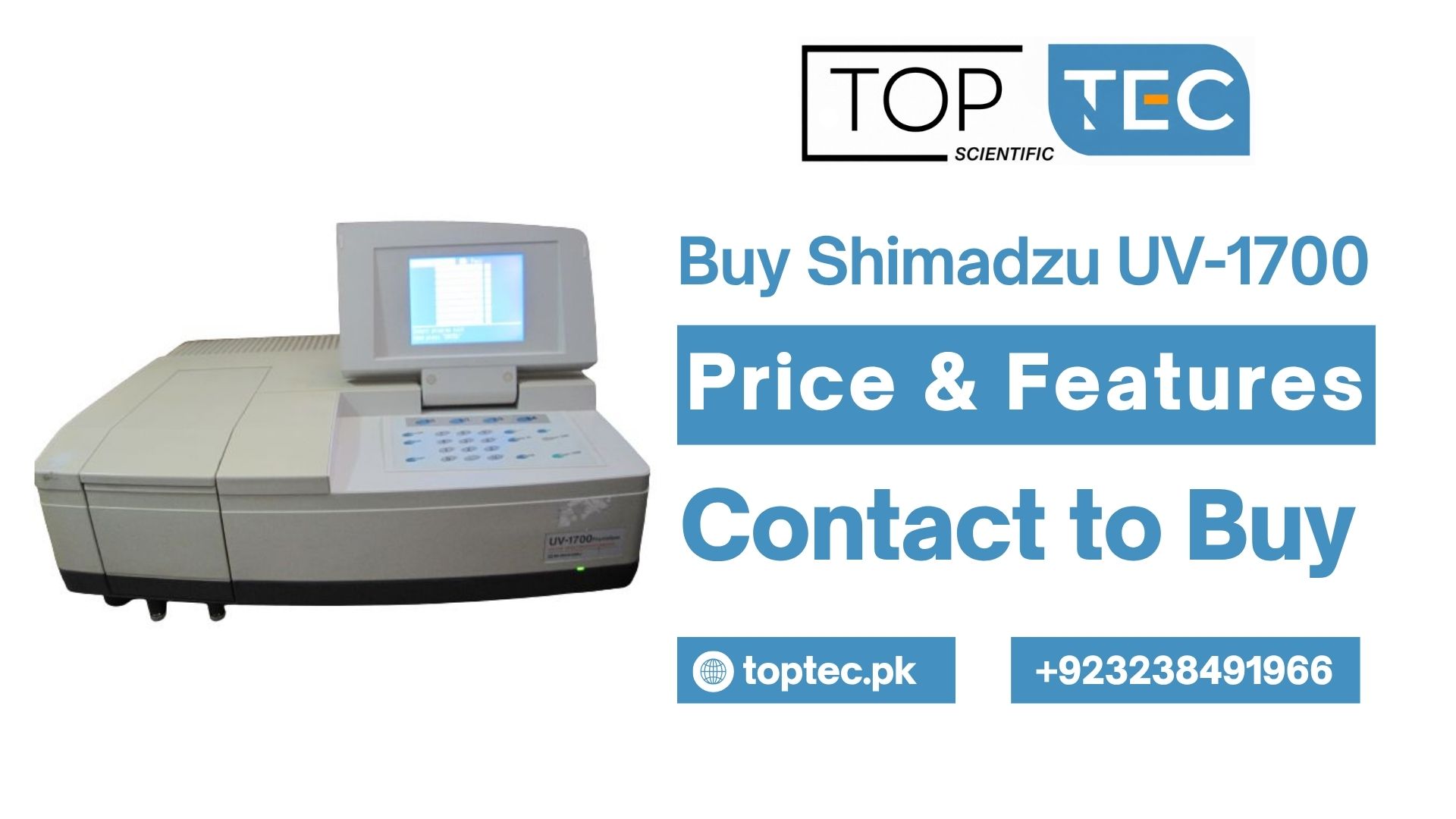
Discover the Shimadzu UV-1700 Spectrophotometer: a benchtop double-beam UV-Vis system delivering 1nm resolution, ±0.3nm wavelength accuracy, and reliable performance for precise quantitative analysis.
I’ve been working with pharmaceutical and research labs across Pakistan for years, and I can tell you that choosing the right UV spectrophotometer is one of those decisions that genuinely affects your lab’s capabilities. I’ve seen facilities make good choices and bad choices, and honestly, the difference comes down to understanding what the equipment actually does, what features matter for your specific work, and where to actually buy quality equipment that will be properly supported.
When I first started helping labs evaluate spectrophotometer options, I realized there’s a lot of confusion about the Shimadzu UV-1700 Spectrophotometer. Some people think all UV spectrophotometers are basically the same. Others don’t realize that features vary significantly between models. And most people don’t know where to actually source quality equipment in Pakistan with proper support and pricing.
So I’m writing this comprehensive guide about the Shimadzu UV-1700 – what it actually does, what makes it good for pharmaceutical and research applications, what features matter, realistic pricing in Pakistan, and where you can actually source it. While this article focuses on a specific instrument, I also want to mention that quality lab equipment sourcing goes hand in hand with quality lab infrastructure from manufacturers like TOPTEC Scientific, which produces Buy Laboratory Furniture solutions that work well alongside quality analytical equipment.
Understanding UV Spectrophotometry Basics
Before diving into the Shimadzu UV-1700 Spectrophotometer specifically, let me explain what UV spectrophotometry actually does and why it matters.
A UV spectrophotometer measures how much light a sample absorbs at different ultraviolet wavelengths. This is fundamental for:
- Pharmaceutical analysis – measuring drug concentration in solutions
- Quality control – verifying purity and composition of products
- Research – studying molecular properties and reactions
- Clinical diagnostics – analyzing biological samples
- Environmental testing – analyzing water and other samples
- Chemical analysis – identifying and quantifying compounds
The instrument basically shines UV light through a sample and measures how much light comes out the other side. Different compounds absorb different amounts of light, which tells you about what’s in the sample.
I worked with a pharmaceutical quality control lab that was using an old spectrophotometer. When they upgraded to a Shimadzu UV 1700, the improvement in accuracy and reliability was noticeable. Their testing became faster and more consistent. That’s the kind of difference quality equipment makes.
Introduction to Shimadzu UV-1700 Spectrophotometer
The Shimadzu UV-1700 Spectrophotometer is a UV-Vis spectrophotometer made by Shimadzu, a Japanese company that’s been making analytical instruments for decades.
This particular model is popular in pharmaceutical labs, research facilities, and diagnostic labs because it balances performance, reliability, and cost reasonably well. It’s not the most advanced model Shimadzu makes, but it’s well-suited for many applications.
When I talk to lab directors about choosing equipment, they often ask about the Shimadzu UV-1700 specifications. That’s the right question – understanding what the instrument can actually do is critical to deciding whether it’s right for your needs.
Key Features of Shimadzu UV-1700 Spectrophotometer
Let me walk through the main features that make the Shimadzu UV 1700 work for pharmaceutical and research applications.
Wavelength Range
The Shimadzu UV-1700 Spectrophotometer covers wavelengths from 190 to 1100 nanometers. This range includes:
- UV region (190-400nm) – where many pharmaceutical compounds absorb
- Visible region (400-700nm) – where colored compounds absorb
- Near-IR region (700-1100nm) – extending capability beyond basic visible range
This wavelength range covers most pharmaceutical and research applications. If you’re doing work that requires these wavelengths, the Shimadzu UV-1700 specifications match your needs.
I’ve worked with labs doing pharmaceutical analysis, and most of their work falls within what the Shimadzu UV 1700 covers. Extended range is nice but not essential for most applications.
Spectral Resolution
The instrument provides good spectral resolution – basically, how finely it can distinguish between different wavelengths. For pharmaceutical applications, this resolution is adequate for:
- Identifying compounds – different compounds have different absorption patterns
- Quantitative analysis – measuring concentration accurately
- Kinetic studies – measuring how reactions progress over time
- Stability testing – monitoring product degradation
The resolution isn’t the highest available, but it’s appropriate for the applications this instrument targets.
Accuracy and Precision
The Shimadzu UV-1700 Spectrophotometer provides:
- Absorbance accuracy – typically ±0.002 absorbance units or better
- Wavelength accuracy – typically ±1 nanometer
- Repeatability – consistent results from measurement to measurement
For pharmaceutical quality control and research applications, this accuracy level is generally adequate. When I’ve worked with labs using this instrument, they report confidence in their results.
Sample Compartment
The sample area accommodates:
- Standard cuvettes – 1cm path length (most common)
- Microcells – for smaller sample volumes
- Large cells – for specialized applications
- Temperature control (optional) – if you add a thermostat
The flexible sample area means you can adapt the instrument to different applications.
Speed and Throughput
The Shimadzu UV-1700 Spectrophotometer provides reasonable analysis speed – important for labs doing volume testing. It’s not the fastest instrument available, but for most pharmaceutical quality control applications, speed is adequate.
I worked with a diagnostic lab that was concerned about throughput. The Shimadzu UV 1700 handled their daily testing volume fine. They weren’t being slowed by the instrument.
Data Collection and Software
The instrument includes:
- USB connectivity – for data transfer to computers
- Built-in data storage – can store measurements
- Software options – Shimadzu provides different software packages
- Method storage – can save and repeat standard procedures
Software and data handling are important for pharmaceutical labs that need documentation and traceability.
Shimadzu UV-1700 Specifications Summary
Let me compile the key Shimadzu UV-1700 specifications:
- Wavelength range: 190-1100 nm
- Wavelength accuracy: ±1 nm
- Spectral bandwidth: Typically 1-2 nm
- Absorbance range: 0-4 A
- Absorbance accuracy: ±0.002 A
- Baseline flatness: Good
- Light source: Deuterium lamp (UV) and tungsten lamp (visible/NIR)
- Detector: Silicon photodiode
- Sample compartment: Standard configuration with optional accessories
- Data connectivity: USB
- Dimensions: Typical bench-top size
- Power requirements: Standard electrical connection
- Weight: Approximately 50+ kg (substantial instrument)
These specifications make the Shimadzu UV 1700 suitable for pharmaceutical quality control, research, and clinical applications.
Applications for Shimadzu UV-1700 Spectrophotometer
What can you actually do with the Shimadzu UV-1700 Spectrophotometer?
Pharmaceutical Quality Control
This is probably the most common application. The Shimadzu UV-1700 specifications support:
- Assay testing – determining drug concentration in tablets or solutions
- Purity testing – verifying absence of impurities
- Stability testing – monitoring how products degrade over time
- Content uniformity – verifying consistent drug amount
Most pharmaceutical testing methods are written for this type of instrument.
Research Applications
Researchers use the Shimadzu UV 1700 for:
- Kinetic studies – measuring how reactions proceed over time
- Chemical analysis – identifying compounds and measuring concentrations
- Protein studies – measuring protein concentration and properties
- Spectral analysis – analyzing absorption characteristics of compounds
The instrument’s capabilities support many research applications.
Clinical and Diagnostic Testing
Diagnostic labs use the Shimadzu UV-1700 Spectrophotometer for:
- Biochemistry testing – measuring analytes in blood or other samples
- Enzyme assays – measuring enzyme activity
- Glucose measurement – and other clinical analytes
- Sample screening – initial testing of patient samples
Clinical labs rely on instruments like this for routine testing.
Educational Institutions
Universities and colleges use the Shimadzu UV 1700 for:
- Teaching analytical chemistry – students learning spectrophotometry
- Research projects – undergraduate or graduate research
- Demonstrations – showing how spectrophotometry works
- Practical training – hands-on experience with analytical instruments
Educational applications benefit from the instrument’s reliability and relative simplicity.
Shimadzu UV-1700 Specifications vs. Alternatives
How does the Shimadzu UV-1700 Spectrophotometer compare to alternatives?
Higher-end Shimadzu models:
- More features, faster speed, higher price
- If you need advanced capabilities, consider UV-1800 or UV-1900
Lower-cost alternatives:
- Less expensive but fewer features
- May lack durability or support
- Consider whether cost savings justify capability loss
Competing brands:
- Other manufacturers make similar instruments
- Differences are often in support, pricing, features
- Shimadzu has good reputation for reliability
The Shimadzu UV-1700 Spectrophotometer occupies a good middle ground – not budget equipment, not top-tier. It’s solid, reliable, appropriate for most pharmaceutical and research applications.
Shimadzu UV-1700 Price in Pakistan
Okay, let’s talk about actual pricing, which is what most people really want to know.
Typical Price Range
The Shimadzu UV-1700 Spectrophotometer typically costs:
- International pricing – USD 10,000-15,000 (approximately)
- Pakistan pricing – approximately 2,500,000-3,500,000 PKR
- Price variation – depends on supplier, package options, services included
Pricing varies based on:
- Who you buy from – direct supplier vs. distributor
- What’s included – just instrument vs. complete package with software and accessories
- Services – installation, training, warranty, maintenance
- Market conditions – currency fluctuations, supply availability
- Customs and import – if importing, duties and taxes affect final cost
What’s Usually Included
A typical purchase package might include:
- The instrument itself – the spectrophotometer
- Basic accessories – sample cuvettes, covers, initial consumables
- Software – data collection and analysis software
- Documentation – manual, specifications, application notes
- Installation – professional setup at your facility
- Training – staff training on operation
- Warranty – typically 1-2 years
Additional Costs to Consider
Beyond the purchase price:
- Cuvettes and accessories – supplies for running samples
- Maintenance and service – periodic maintenance extends life
- Calibration verification – periodic checks ensure accuracy
- Software updates – may be available
- Repairs – if something breaks beyond warranty
Over 5-10 years of operation, these additional costs add up.
Where to Source in Pakistan
This is probably the most practical question. Where can you actually Buy Laboratory Furniture and analytical equipment like the Shimadzu UV-1700 Spectrophotometer in Pakistan?
Finding Shimadzu Equipment in Pakistan
There are several ways to source the Shimadzu UV 1700 in Pakistan.
Official Shimadzu Distributors
Shimadzu has official distributors in Pakistan:
- Direct representation – company with official Shimadzu account
- Full support – warranty, maintenance, spare parts
- Pricing – official pricing, though may be higher
- Reliability – buying from official source assures authenticity
- Training – manufacturer-backed training available
Official distributors are reliable but typically charge premium pricing.
Authorized Dealers
Authorized dealers are:
- Verified by Shimadzu – authorized to sell their products
- Good support – can provide warranty and service
- Competitive pricing – often lower than direct distributor
- Local presence – easier to work with locally
- Knowledgeable staff – understand the products
Authorized dealers are a good middle ground.
Equipment Suppliers
General laboratory equipment suppliers:
- Broader product range – not just Shimadzu
- Competitive pricing – shop around
- Variable support – depends on supplier
- Verify authenticity – make sure they’re authorized
- Check references – see what other labs say
General suppliers work if they’re authorized and reputable.
International Sourcing
Some labs consider importing directly:
- Lower purchase price – buying internationally might be cheaper
- Customs and duties – add significant costs
- Warranty issues – international warranty might not cover Pakistan
- Support challenges – getting local service for imported equipment
- Logistics – shipping, handling, delivery complexity
International sourcing can save money but creates support challenges.
How to Evaluate Suppliers
When looking for the Shimadzu UV-1700 Spectrophotometer in Pakistan:
Verify Authorization
- Ask for proof – is the supplier authorized?
- Check with Shimadzu – verify they’re legitimate
- Look for certificates – authorized dealer certificates
- Ask for references – what labs have they sold to?
Don’t buy from unauthorized sources – you might get counterfeit equipment.
Understand What’s Included
- What’s in the package? – just the instrument or complete system?
- What accessories come with it? – cuvettes, software, etc.
- What training is provided? – how will your staff learn to use it?
- What warranty is included? – coverage period and what’s covered
- What support is available? – maintenance, repairs, spare parts
Get everything in writing before purchasing.
Compare Total Cost
Not just equipment price:
- Installation cost – who does it, what’s included?
- Training cost – separate or included?
- Software cost – separate purchase or included?
- Warranty cost – included or additional?
- Service agreements – what’s available for maintenance?
Calculate total cost of ownership.
Check References
Before buying from any supplier:
- Ask for lab references – other facilities that have purchased from them
- Contact those labs – ask about their experience
- Ask about support – how responsive is the supplier?
- Ask about reliability – has equipment worked well?
- Ask about resale – would they buy from them again?
References tell you a lot about a supplier.
Integration with Your Lab Infrastructure
When you acquire the Shimadzu UV-1700 Spectrophotometer, it needs to fit into your lab infrastructure.
Physical Setup
The instrument needs:
- Bench space – sturdy, vibration-free surface
- Proper furniture – stable workbench or dedicated stand
- Electrical supply – proper grounding, adequate power
- Environmental control – stable temperature and humidity
- Access – space around it for operation and maintenance
Quality lab furniture from manufacturers like TOPTEC Scientific can provide the proper foundation for analytical instruments.
Software Integration
The instrument connects to:
- Computer systems – for data collection and storage
- LIMS (Laboratory Information Management System) – if you have one
- Data backup – important for regulatory compliance
- Network security – if connected to facility network
Software integration needs planning.
Space Planning
When you Buy Laboratory Furniture and place analytical instruments:
- Group related equipment – spectrophotometer with other analytical instruments
- Support infrastructure – sample preparation area nearby
- Traffic flow – instrument in logical workflow position
- Safety – emergency equipment accessible, proper ventilation
- Compliance – space supports regulatory requirements
Lab layout affects how well equipment is used.
Training and Competency
When you get the Shimadzu UV-1700 Spectrophotometer, your staff needs training:
Operational Training
Covers:
- Basic operation – how to turn on, initialize, perform basic tests
- Sample preparation – how to properly prepare samples for analysis
- Method development – creating test methods for your applications
- Data collection – running samples and collecting data
- Troubleshooting – what to do if things go wrong
Good training is essential for proper equipment use.
Maintenance Training
Staff should understand:
- Routine maintenance – daily and weekly tasks
- Cuvette cleaning – proper cleaning procedures
- Lamp management – when lamps need replacement
- Calibration – how and when to calibrate
- When to call service – recognizing problems requiring professional service
Maintenance training extends equipment life.
Method Validation
Developing validated test methods:
- Creating procedures – documented step-by-step procedures
- Validation studies – proving the method works
- Documentation – records supporting regulatory compliance
- Training staff – ensuring consistent performance
Validated methods are critical for pharmaceutical work.
Maintenance and Support
Once you have the Shimadzu UV-1700 Spectrophotometer, ongoing support matters:
Warranty Coverage
Typical warranty includes:
- Period – usually 1-2 years from purchase
- Coverage – what’s included (usually parts and labor)
- Exclusions – what’s not covered (usually user damage)
- Extended warranty – available options for longer coverage
Understand your warranty completely.
Service Agreements
Beyond warranty, consider:
- Preventive maintenance – scheduled service to keep equipment working
- Repair service – when equipment needs fixing
- Spare parts – availability of replacement components
- Technical support – help with problems via phone or email
- Response time – how quickly service arrives
Good service agreements reduce downtime and extend equipment life.
Parts Availability
Important considerations:
- Lamp replacement – lamps wear out and need replacing
- Cuvettes – consumables that wear out
- Filters or optical components – if they need replacement
- Electronics – if components fail
- Software updates – availability of updates
Ensure parts are available in Pakistan or easily obtained.
Performance Verification
Over time, you should verify your instrument is performing properly:
Calibration Checks
- Wavelength calibration – verify accurate wavelength readings
- Absorbance calibration – verify accurate absorbance measurements
- Baseline flatness – ensure baseline remains flat
- Frequency – typically quarterly or semi-annually for pharmaceutical labs
Regular calibration verification ensures reliable results.
Reference Standards
Use standard materials to verify performance:
- Absorbance standards – solutions with known absorbance
- Wavelength standards – materials for verifying wavelength accuracy
- Reference compounds – standards for your specific applications
Running reference standards regularly catches problems early.
Documentation
Keep records of:
- Calibration results – documented checks over time
- Performance trends – is accuracy drifting?
- Maintenance performed – what work has been done
- Issues encountered – problems and how resolved
- Repairs – what was fixed and when
Documentation supports compliance and helps troubleshoot problems.
Regulatory Compliance Considerations
If you’re using the Shimadzu UV-1700 Spectrophotometer for pharmaceutical or clinical work:
GMP Compliance
Pharmaceutical quality control requires:
- Validated methods – test methods proven to work
- Proper equipment – suitable for the testing
- Documentation – records of all testing
- Calibration records – proving instrument is accurate
- Personnel training – staff qualified to operate
The Shimadzu UV 1700 can support GMP-compliant testing with proper procedures.
ISO Compliance
If required by your accreditation:
- Equipment qualification – proving it works as specified
- Method validation – proving test methods are reliable
- Quality assurance – documentation and records
- Competency – trained, qualified personnel
Equipment like the Shimadzu UV-1700 Spectrophotometer supports ISO-compliant testing.
Data Integrity
Important for pharmaceutical and clinical work:
- Data storage – secure, reliable data storage
- Audit trails – recording who did what and when
- Backup – protection against data loss
- Traceability – linking data to samples and analysis
Modern spectrophotometers like the Shimadzu UV 1700 support these requirements.
Cost-Benefit Analysis
When considering purchasing the Shimadzu UV-1700 Spectrophotometer:
Return on Investment
- Improved accuracy – better results justify the cost
- Time efficiency – faster analysis increases throughput
- Compliance support – regulatory compliance has real value
- Reliability – less downtime than older equipment
- Reputation – better testing supports facility reputation
Calculate whether investment makes sense for your volume and applications.
Alternatives to Consider
- Newer models – might have additional features
- Other manufacturers – different equipment at different prices
- Used equipment – previously owned instruments (risk factors)
- Leasing – renting instead of buying (if available)
- Outsourcing – sending samples to contract labs
Evaluate all options before deciding.
Conclusion
The Shimadzu UV-1700 Spectrophotometer is a solid, reliable analytical instrument well-suited for pharmaceutical quality control, research, and diagnostic applications.
Key features – wavelength range, accuracy, sample flexibility make it appropriate for most pharmaceutical applications
Specifications – adequate for quality control, research, and clinical testing needs
Pricing in Pakistan – typically 2,500,000-3,500,000 PKR depending on supplier and package
Where to source – authorized Shimadzu distributors in Pakistan, authorized dealers, or reputable equipment suppliers
Support – ensure you choose a supplier providing installation, training, and ongoing service
When you source analytical equipment like the Shimadzu UV 1700 for your facility, combine it with quality lab infrastructure from manufacturers like TOPTEC Scientific who produce Buy Laboratory Furniture solutions designed to support analytical work properly.
Proper placement on quality workbenches, adequate space for operation, and organized lab layout all contribute to getting the best performance from your equipment.
Invest in quality equipment from reputable sources, ensure proper training and maintenance, and your facility will have reliable analytical capabilities for years to come.
