


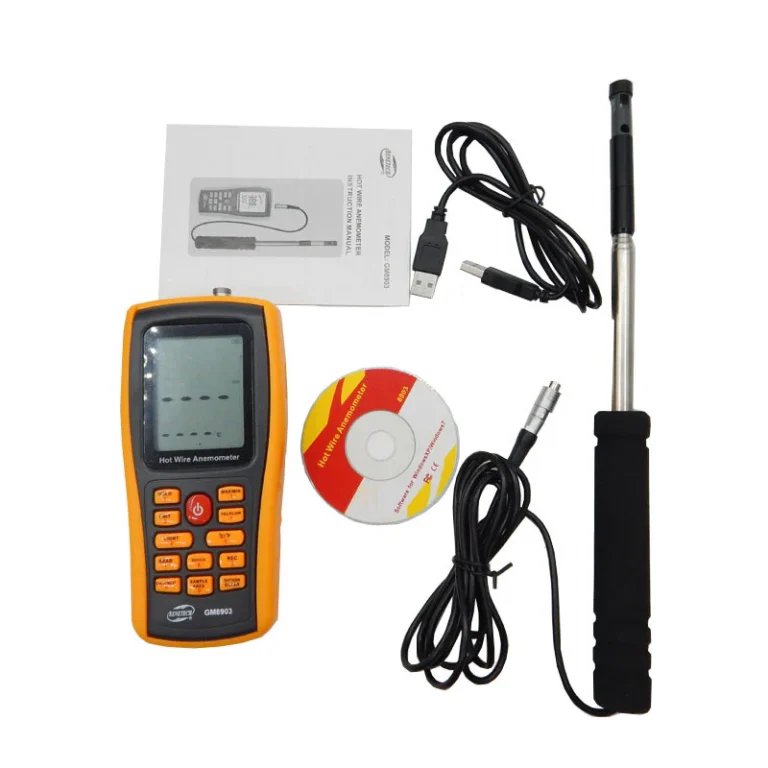
Hot wire anemometers represent the pinnacle of precision air velocity measurement technology, offering unparalleled accuracy in detecting even the most subtle changes in fluid flow dynamics. We recognize these sophisticated instruments as essential tools across numerous industries, from aerospace engineering to HVAC system optimization. The fundamental principle underlying hot wire anemometry involves a heated sensing element that experiences cooling when exposed to moving air, with the rate of heat transfer directly correlating to the velocity of the fluid stream.
The thermal exchange mechanism at the heart of these devices operates on well-established principles of convective heat transfer. When air flows across the heated wire sensor, it removes thermal energy at a rate proportional to the flow velocity, creating measurable changes in either the wire’s temperature or the electrical power required to maintain constant temperature. This relationship enables extraordinarily precise measurements across a remarkably wide range of flow velocities.
Modern hot wire anemometer systems incorporate advanced electronics and signal processing capabilities that dramatically enhance measurement accuracy and reliability. We utilize cutting-edge microprocessor technology to compensate for ambient temperature variations, barometric pressure changes, and humidity fluctuations that might otherwise compromise measurement precision. These sophisticated compensation algorithms ensure consistent, repeatable results across diverse operating environments.
Core Operating Principles of Hot Wire Anemometers
The constant temperature anemometer (CTA) configuration represents the most widely adopted operational mode in contemporary hot wire systems. In this arrangement, we maintain the sensing wire at a fixed temperature above ambient conditions through a feedback control circuit that continuously adjusts the heating current. The electrical power required to sustain this constant temperature directly indicates the cooling effect of the airflow, providing an immediate measure of velocity.
Alternatively, constant current anemometry (CCA) operates by supplying a steady electrical current to the sensing element while monitoring temperature-induced resistance changes. We observe that this approach offers certain advantages in applications involving extremely high-frequency fluctuations, though it generally provides slower response times compared to constant temperature systems. The choice between these operational modes depends entirely on specific application requirements and measurement objectives.
The physical characteristics of the sensing wire profoundly influence measurement performance and application suitability. We typically employ tungsten, platinum, or platinum-coated tungsten wires with diameters ranging from 2 to 5 micrometers and lengths between 0.5 and 2 millimeters. These microscopic dimensions yield extremely low thermal mass, enabling frequency response capabilities extending into the kilohertz range for capturing turbulent flow phenomena.
Advanced Sensor Configurations and Design Variations
Single-wire probes constitute the simplest hot wire anemometer configuration, measuring velocity magnitude along one axis perpendicular to the wire orientation. We utilize these straightforward designs for applications requiring unidirectional flow measurement where flow direction remains known and relatively stable. Their simplicity translates to excellent reliability and straightforward calibration procedures that minimize operational complexity.
Cross-wire and triple-wire probes expand measurement capabilities to capture two or three velocity components simultaneously, enabling comprehensive characterization of complex three-dimensional flow fields. We position multiple sensing elements at specific angular orientations, with sophisticated signal processing algorithms resolving the individual velocity vector components from the combined sensor responses. These multi-wire configurations prove indispensable for turbulence research and detailed aerodynamic investigations.
Film sensors represent an alternative approach where we deposit thin metallic films onto insulating substrates rather than using free-standing wires. These robust sensors withstand higher flow velocities and demonstrate improved durability in challenging measurement environments. We particularly favor film sensors for industrial applications where mechanical ruggedness outweighs the slightly reduced frequency response compared to wire-based designs.
Calibration Methodologies for Maximum Accuracy
Primary calibration procedures establish the fundamental relationship between sensor output and actual flow velocity under controlled reference conditions. We conduct these calibrations in specialized wind tunnels or flow benches equipped with highly accurate reference velocity measurement systems, typically employing laser Doppler velocimetry or particle image velocimetry as calibration standards. The resulting calibration curves account for nonlinear sensor response characteristics across the entire measurement range.
Multi-point calibration protocols involve measuring sensor response at numerous discrete velocity points spanning the anticipated operating range. We typically employ polynomial curve fitting or lookup table interpolation to characterize sensor behavior between calibration points. This comprehensive approach ensures accurate measurements across the full velocity spectrum while capturing any nonlinearities in sensor response characteristics.
Temperature compensation calibration addresses the significant influence of ambient temperature variations on hot wire anemometer performance. We determine correction factors by conducting calibrations at multiple ambient temperatures, establishing mathematical relationships that enable real-time compensation during field measurements. This meticulous attention to temperature effects proves absolutely critical for maintaining measurement accuracy in variable thermal environments.
Applications in Aerospace and Aeronautical Engineering
Wind tunnel testing constitutes perhaps the most demanding application for hot wire anemometers, where we measure boundary layer profiles, wake characteristics, and turbulence intensity around aircraft models and components. The exceptional spatial resolution of hot wire sensors enables detailed mapping of flow phenomena in regions where other measurement techniques prove inadequate or impractical. We capture velocity fluctuations at frequencies extending beyond 10 kilohertz for investigating transition phenomena and turbulent flow structures.
Engine intake flow characterization requires precise velocity measurements under conditions involving extreme temperature gradients and complex three-dimensional flow patterns. We deploy specialized high-temperature hot wire probes capable of withstanding elevated temperatures while maintaining calibration accuracy. These measurements inform computational fluid dynamics model validation and engine performance optimization efforts across the aerospace industry.
Flight test instrumentation incorporates miniaturized hot wire anemometer systems for measuring local airflow conditions around aircraft surfaces during actual flight operations. We integrate these sensors into wing surfaces, engine nacelles, and control surfaces to validate aerodynamic performance predictions and identify unexpected flow separation or turbulence phenomena. The compact size and rapid response of hot wire sensors make them ideally suited for these demanding in-flight measurement applications.
HVAC System Design and Performance Verification
Duct flow measurement represents a fundamental requirement in heating, ventilation, and air conditioning system design and commissioning. We utilize hot wire anemometers to verify airflow velocities throughout ductwork systems, ensuring design specifications are met and identifying potential airflow restrictions or imbalances. The ability to measure low velocities with high accuracy proves particularly valuable in critical applications such as hospital operating rooms and cleanroom facilities.
Terminal device testing involves measuring air velocities at diffusers, grilles, and registers to confirm proper air distribution throughout conditioned spaces. We conduct systematic velocity traverses across terminal openings, documenting velocity profiles and calculating volumetric flow rates for comparison against design values. Hot wire anemometers excel in these applications due to their directional sensitivity and rapid response to velocity variations.
Indoor air quality assessment relies on accurate velocity measurements to evaluate ventilation effectiveness and identify stagnant zones where contaminants may accumulate. We map three-dimensional velocity fields within occupied spaces, correlating airflow patterns with contaminant distribution and thermal comfort parameters. These comprehensive flow characterizations inform building design improvements and ventilation system modifications that enhance occupant health and comfort.
Industrial Process Monitoring and Control
Clean room certification demands rigorous verification of airflow patterns and velocities to ensure compliance with stringent contamination control standards. We perform detailed velocity measurements at critical locations including HEPA filter faces, work surfaces, and room air changes per hour calculations. Hot wire anemometers provide the measurement precision necessary for documenting compliance with ISO 14644 cleanroom classifications and pharmaceutical manufacturing requirements.
Drying process optimization benefits from precise airflow velocity control that directly influences moisture removal rates and product quality. We implement hot wire anemometer-based monitoring systems that provide real-time feedback for automated velocity control, ensuring consistent drying conditions throughout production runs. This level of process control minimizes product variability and reduces energy consumption through optimized airflow management.
Combustion air monitoring ensures proper fuel-to-air ratios in industrial burners and boilers, directly impacting combustion efficiency and emissions performance. We measure combustion air velocities at strategic locations within air delivery systems, enabling precise calculation of volumetric flow rates for combustion control systems. The temperature-compensated accuracy of hot wire anemometers proves essential for maintaining optimal combustion conditions across varying ambient conditions.
Environmental and Meteorological Measurement Applications
Microclimate studies require detailed characterization of airflow patterns within plant canopies, urban environments, and complex terrain features. We deploy arrays of hot wire anemometers to capture spatial and temporal variations in near-surface wind patterns that influence temperature distribution, moisture transport, and pollutant dispersion. The fast response characteristics of these sensors enable resolution of turbulent fluctuations that drive scalar transport processes.
Wind energy resource assessment utilizes hot wire anemometry for detailed turbulence characterization at potential wind farm sites. We measure turbulence intensity, integral length scales, and spectral energy distribution to evaluate potential turbine loading and power production variability. These detailed wind characterization studies inform turbine selection decisions and optimize wind farm layouts for maximum energy capture and minimal mechanical stress.
Atmospheric boundary layer research investigates the vertical structure of wind profiles and turbulence characteristics within the lowest portions of the atmosphere. We conduct profile measurements using hot wire anemometers mounted on meteorological towers or tethered balloon platforms, capturing velocity statistics at multiple heights. These observations advance our understanding of momentum and energy exchange between the atmosphere and underlying surfaces.
Laboratory Research and Academic Applications
Fundamental fluid mechanics research relies heavily on hot wire anemometry for investigating turbulent flow phenomena, transition mechanisms, and flow instability development. We conduct controlled experiments in research facilities worldwide, utilizing hot wire measurements to validate theoretical predictions and calibrate numerical simulation models. The combination of high spatial and temporal resolution makes hot wire anemometry indispensable for advancing fundamental understanding of fluid flow physics.
Combustion research applications employ specialized hot wire configurations capable of surviving high-temperature environments while measuring velocity fluctuations within flame zones. We investigate turbulence-chemistry interactions, flame stabilization mechanisms, and pollutant formation processes through detailed velocity measurements correlated with simultaneous temperature and species concentration data. These multi-parameter measurements provide comprehensive datasets for combustion model development and validation.
Biomedical flow studies utilize miniature hot wire probes to measure blood flow velocities in experimental cardiovascular research and respiratory airflow characterization. We employ these techniques to investigate flow patterns within artificial heart valves, vascular grafts, and respiratory airways. The minimally invasive nature and high accuracy of hot wire measurements enable detailed flow characterization without significantly disturbing the flows under investigation.
Technical Specifications and Performance Parameters
Velocity measurement range varies substantially across different hot wire anemometer models, with specialized instruments measuring flows from as low as 0.01 meters per second to maximum velocities exceeding 100 meters per second. We select appropriate sensor configurations and signal conditioning electronics to optimize performance within specific velocity ranges relevant to particular applications. Standard probes typically cover ranges from 0.05 to 50 meters per second with excellent linearity and resolution.
Frequency response characteristics represent a critical performance parameter for applications involving turbulence measurement or rapidly fluctuating flows. We achieve frequency responses extending beyond 50 kilohertz with properly designed wire sensors, enabling resolution of the smallest turbulent eddies in most practical applications. This exceptional temporal resolution distinguishes hot wire anemometry from alternative velocity measurement techniques that cannot capture high-frequency fluctuations.
Measurement accuracy specifications typically range from ±1% to ±3% of reading when properly calibrated and operated within appropriate environmental conditions. We achieve the highest accuracy levels through careful attention to calibration procedures, temperature compensation, and directional sensitivity considerations. The inherent precision of thermal-based velocity measurement combined with modern signal processing enables accuracy levels that meet or exceed requirements for most scientific and industrial applications.
Operational Considerations and Best Practices
Directional sensitivity requires careful probe positioning to ensure the sensing element remains perpendicular to the primary flow direction. We recognize that velocity measurements decrease substantially as flow angle relative to the wire deviates from perpendicular orientation, following a cosine relationship for small angles. Proper probe alignment proves essential for accurate measurements, particularly in applications involving complex three-dimensional flow fields where flow direction may vary significantly.
Contamination prevention protects delicate sensing elements from particle deposition and chemical attack that degrade performance or cause sensor failure. We implement protective measures including upstream filtration, probe positioning away from particle-laden flow regions, and regular sensor inspection and cleaning protocols. Accumulated contamination increases thermal mass and alters heat transfer characteristics, causing calibration drift and measurement errors that compromise data quality.
Temperature compensation requirements address the significant influence of ambient temperature variations on hot wire anemometer calibration. We employ integrated temperature sensors and sophisticated compensation algorithms that adjust velocity calculations based on real-time temperature measurements. Without proper temperature compensation, ambient temperature changes of just a few degrees can introduce measurement errors exceeding 10%, rendering data unsuitable for quantitative analysis.
Comparison with Alternative Velocity Measurement Technologies
Pitot-static tube measurements provide a well-established alternative for velocity measurement in many industrial applications, though they exhibit significantly lower spatial resolution and cannot resolve turbulent fluctuations. We recognize that hot wire anemometers offer superior performance in low-velocity applications and turbulence characterization, while pitot tubes prove more rugged and require less frequent calibration. The choice between these technologies depends on specific measurement objectives and environmental conditions.
Laser Doppler velocimetry systems deliver non-intrusive velocity measurements without introducing physical probes into the flow field, eliminating concerns about flow disturbance and sensor contamination. We acknowledge that LDV systems provide excellent accuracy and spatial resolution but require optical access, substantial investment, and specialized expertise for operation. Hot wire anemometry remains more accessible and practical for many routine measurement applications despite the intrusive nature of physical probes.
Ultrasonic anemometers measure wind velocity through acoustic time-of-flight measurements, offering three-dimensional vector capability without moving parts or delicate heated elements. We utilize ultrasonic instruments for outdoor meteorological applications where hot wire sensors would suffer from contamination and precipitation interference. However, ultrasonic anemometers exhibit lower frequency response and cannot match the spatial resolution achievable with hot wire probes for detailed turbulence measurements.
Maintenance Procedures and Sensor Care Requirements
Routine sensor inspection involves microscopic examination of wire condition to identify contamination, mechanical damage, or oxidation that compromises measurement performance. We conduct these inspections at regular intervals determined by application severity and environmental conditions, documenting sensor appearance and measuring resistance to detect degradation before complete failure occurs. Proactive sensor replacement based on inspection findings prevents data quality issues and unexpected measurement system downtime.
Cleaning procedures must be executed with extreme care to avoid damaging delicate sensing elements during contamination removal. We employ gentle techniques including low-velocity air jets, ultrasonic cleaning in appropriate solvents, or careful brushing with soft materials. Improper cleaning attempts frequently cause wire breakage or alter wire dimensions, necessitating complete probe replacement and system recalibration following cleaning operations.
Calibration verification confirms measurement accuracy through comparison against reference standards at regular intervals throughout the sensor operational lifetime. We perform these verification checks using portable calibration devices or by returning instruments to controlled laboratory facilities for comprehensive recalibration. Documentation of calibration history enables statistical process control of measurement systems and provides traceability required for quality management systems and regulatory compliance.
Future Developments and Emerging Technologies
Microelectromechanical systems integration enables fabrication of complete hot wire anemometer sensing and signal processing circuitry on single semiconductor chips. We anticipate these miniaturized systems will enable deployment of distributed sensor networks for comprehensive flow field characterization at dramatically reduced costs. MEMS-based hot wire anemometers already demonstrate performance approaching traditional wire sensors while offering superior ruggedness and manufacturing repeatability.
Wireless sensor networks incorporate hot wire anemometers with integrated data transmission capabilities that eliminate hardwired connections and enable flexible sensor placement. We envision these autonomous sensing nodes revolutionizing applications such as building airflow monitoring, industrial process control, and environmental research through deployment of dense sensor arrays that capture spatial flow variations previously unattainable due to wiring constraints.
Artificial intelligence integration promises enhanced measurement accuracy through machine learning algorithms that optimize compensation for environmental factors and automatically detect sensor degradation. We anticipate AI-enhanced hot wire anemometry systems will provide self-calibrating capabilities and intelligent data validation that reduces manual intervention requirements while improving data quality and reliability across diverse applications.
