

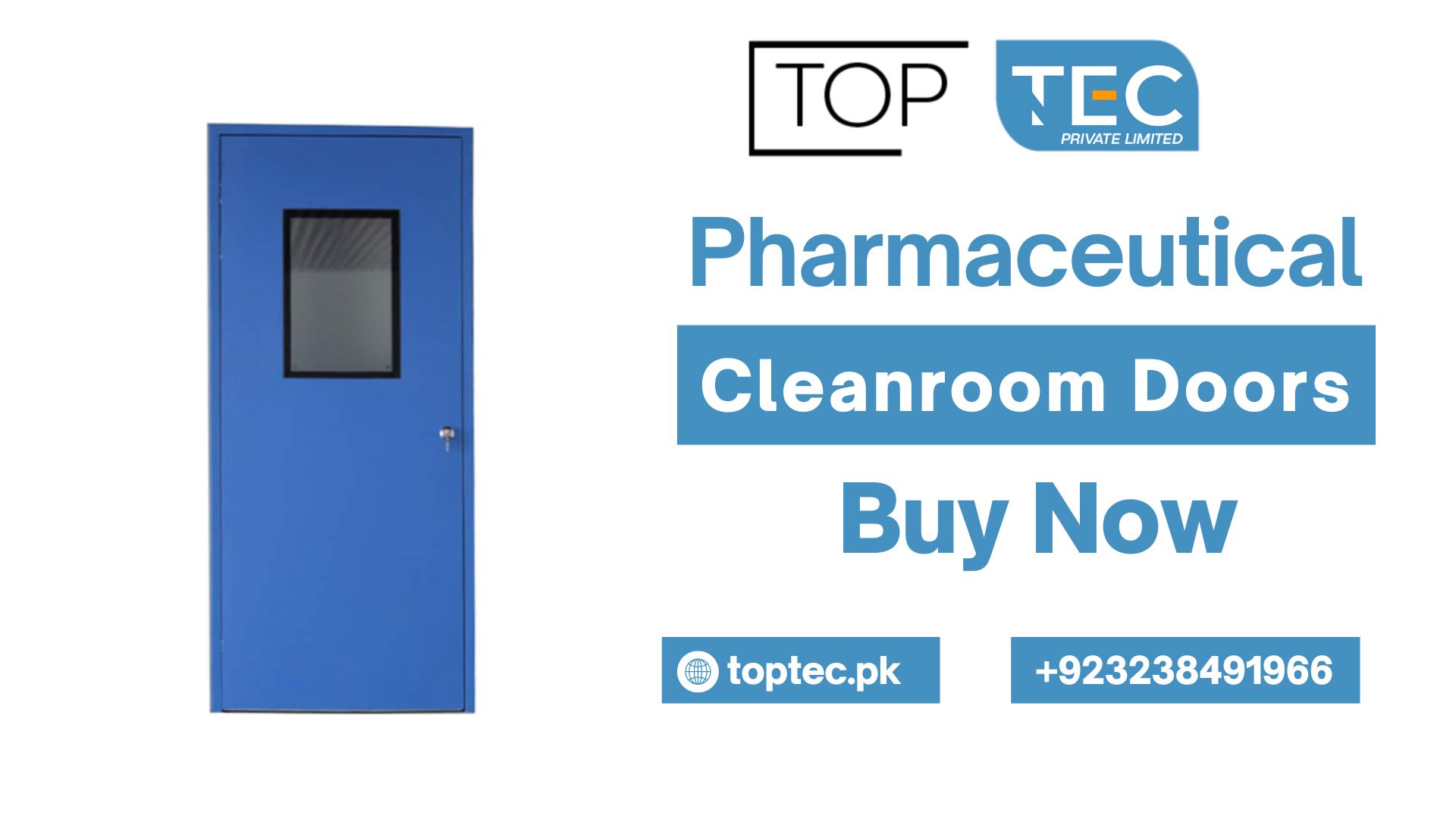
A Pharmaceutical Cleanroom Doors has a deceptively simple job: open when access is needed and close when it is not. In a pharmaceutical facility, however, that basic movement affects room pressure, airflow direction, contamination control and personnel safety.
A door that closes slowly may leave a controlled area exposed for too long. A damaged gasket can make the HVAC system struggle to maintain the required pressure differential. The wrong sliding mechanism may save floor space but allow more air leakage than the room can tolerate.
If you plan to buy Pharmaceutical Cleanroom Doors, the decision should begin with the application—not appearance alone. Swing, sliding and high-speed doors each solve a different access problem, and none is automatically the best choice for every cleanroom.
This guide explains how the three main door types work, where they are commonly used and what to check before placing an order.
Why Door Selection Matters in a Pharmaceutical Cleanroom
Cleanroom performance depends on several systems working together. HEPA-filtered air controls airborne particles, pressure differentials influence airflow direction, and cleaning procedures manage contamination on surfaces. Doors connect rooms with different classifications and pressure conditions.
Each time a door opens:
- The pressure differential temporarily drops
- Airflow patterns change
- Personnel movement creates turbulence
- Particles may travel between adjacent spaces
- Temperature and humidity may fluctuate
- The room needs time to recover after the door closes
The objective is not to eliminate these effects completely. That would be impossible in an operating facility. The goal is to keep door-opening events controlled, brief and consistent with the contamination-control strategy.
Facilities that buy Pharmaceutical Cleanroom Doors based only on price or surface finish often overlook sealing performance, closing speed, hardware life and access-control integration. Those details usually become visible later, when pressure alarms start appearing or operators begin holding difficult doors open.
1. Swing Cleanroom Doors
Swing doors are the most familiar and widely used option in pharmaceutical facilities. They may be single-leaf or double-leaf and can open in one direction or, less commonly, both directions.
A typical cleanroom swing door has a flush leaf, a matching flush frame, perimeter gaskets, stainless-steel hardware and an automatic door closer.
Where Swing Doors Are Used
Swing doors are commonly installed in:
- Personnel airlocks
- Gowning and changing rooms
- Quality-control laboratories
- Manufacturing corridors
- Sampling and dispensing rooms
- Microbiology laboratories
- Sterile production support areas
- Material airlocks with moderate trolley traffic
Advantages of Swing Doors
The main advantage is reliable compression sealing. As the leaf closes against the frame, it compresses the perimeter gasket. An automatic drop seal can close the gap at floor level.
Swing doors are also relatively easy to maintain. Hinges, closers, handles and gaskets are familiar components, and replacement parts are generally accessible.
Other benefits include:
- Straightforward interlock integration
- Good pressure-control performance
- Manual and automatic options
- Easy installation in modular wall panels
- Availability in fire-rated configurations
- Suitable designs for access-control systems
Limitations of Swing Doors
The door leaf needs clear floor space to open. That can be a problem in narrow corridors, compact airlocks or rooms where equipment is positioned close to the doorway.
Door-opening force is another concern. Pressure differential, gasket compression and closer resistance can combine to make a door difficult to use. Operators may then push it forcefully or leave it wedged open, which defeats the purpose of the cleanroom barrier.
When you buy Pharmaceutical Cleanroom Doors in a swing configuration, ask the manufacturer to assess the opening force, door closer and room-pressure direction as one system.
Single-Leaf or Double-Leaf?
Single-leaf doors suit routine personnel movement and smaller trolleys. Double-leaf doors are useful for equipment transfer, large containers and maintenance access.
For double-leaf designs, the inactive leaf should seal securely when not required. Flush bolts, astragals and meeting seals must not create difficult-to-clean recesses.
2. Sliding Cleanroom Doors
Sliding doors move parallel to the wall rather than swinging into the room. They are useful where floor space is limited or where a wide clear opening is needed for equipment and materials.
However, not every sliding door is suitable for a cleanroom. An ordinary warehouse-style door may leave significant gaps around the frame. Pharmaceutical applications generally need a purpose-designed cleanroom sliding system.
Standard Sliding vs. Hermetic Sliding
A standard sliding door moves sideways along a track. It may reduce drafts, but it does not necessarily compress against a gasket.
A hermetic sliding door follows a more controlled movement. During the final stage of closing, the leaf moves inward and sometimes slightly downward against the frame. This creates compression around the perimeter and improves leakage control.
Hermetic designs are commonly chosen for:
- Sterile corridors
- Hospital operating areas
- Material-transfer routes
- Equipment movement
- Rooms with restricted floor space
- High-traffic controlled environments
Advantages of Sliding Doors
Sliding cleanroom doors provide:
- No swing arc
- Wider openings without large projecting leaves
- Easier trolley and equipment movement
- Manual or automatic operation
- Touchless access options
- Reduced collision risk in narrow spaces
Automatic sliding doors can be connected to card readers, motion sensors, touchless switches or foot controls. For material movement, this can make a noticeable difference because operators do not need to release a trolley to operate the handle.
Limitations of Sliding Doors
Sliding systems have more mechanical components than basic hinged doors. Tracks, rollers, guides, drive belts, sensors and motors all need preventive maintenance.
The seal should receive particular attention. If the system does not create controlled compression at closure, the door may have a higher leakage rate than a swing door.
Before you buy Pharmaceutical Cleanroom Doors with a sliding mechanism, confirm whether the design is truly hermetic or simply described as “cleanroom compatible.” Ask for details of the gasket arrangement, closing movement and emergency-release system.
3. High-Speed Cleanroom Doors
High-speed doors are designed to open and close quickly, limiting the amount of time a doorway remains exposed. Depending on the design, the door curtain may be made from flexible reinforced material or rigid interlocking panels.
These doors are commonly associated with warehouses and logistics areas, but cleanroom-specific models are available for selected pharmaceutical applications.
Suitable Applications
High-speed doors may be used in:
- High-traffic material corridors
- Controlled warehouse areas
- Packaging zones
- Clean manufacturing support spaces
- Cold-room access routes
- Areas with frequent trolley or pallet movement
- Transitions where reducing open-door time is a priority
They are not automatically appropriate for every aseptic boundary. A flexible high-speed curtain may not offer the same static sealing performance as a properly designed hermetic swing or sliding door.
For critical Grade A or Grade B boundaries, the choice should be supported by a detailed risk assessment and demonstrated leakage performance.
Advantages of High-Speed Doors
Their main advantage is obvious: speed. A rapid operating cycle reduces the time available for uncontrolled airflow and helps the room recover more quickly.
Additional advantages may include:
- Hands-free operation
- Improved material flow
- Reduced heating and cooling loss
- Less pressure disturbance from prolonged openings
- Automatic reopening after minor impact in self-repairing designs
- Safety sensors for personnel and trolleys
Important Design Features
A cleanroom high-speed door should have:
- Smooth, cleanable surfaces
- An enclosed drive mechanism where practical
- Low-particle-generating movement
- Chemical-resistant curtain or panel material
- Safety light curtains or photocells
- Emergency manual release
- Adjustable opening and closing speeds
- Reliable bottom-edge detection
- Access-control and interlock compatibility
Companies that buy Pharmaceutical Cleanroom Doors for rapid material movement should compare both opening speed and closed-door leakage. A fast door that seals poorly may not support the room’s pressure strategy.
Swing, Sliding or High-Speed: Quick Comparison
| Feature | Swing Door | Sliding Door | High-Speed Door |
|---|---|---|---|
| Sealing performance | Usually very good | Very good with hermetic design | Varies by model |
| Floor-space requirement | Needs swing area | Low | Low |
| Traffic suitability | Low to moderate | Moderate to high | High |
| Equipment movement | Double-leaf option | Excellent | Excellent |
| Maintenance level | Low to moderate | Moderate | Moderate to high |
| Typical operation | Manual or automatic | Manual or automatic | Automatic |
| Interlock compatibility | Excellent | Excellent | Project-dependent |
| Common application | Personnel airlocks | Material and equipment routes | High-traffic corridors |
When organisations buy Pharmaceutical Cleanroom Doors, they often discover that a facility needs all three types. Swing doors may serve personnel airlocks, hermetic sliding doors may support equipment movement, and high-speed models may improve traffic flow in controlled logistics areas.
Pressure Differential and Door-Swing Direction
Room pressure is central to cleanroom door design. In sterile facilities, cleaner rooms are commonly maintained at a higher pressure than adjacent lower-grade spaces so that air flows outward when a door opens.
EU GMP Annex 1 gives a guidance value of at least 10 Pa between adjacent rooms of different grades, although the final pressure strategy should be determined through facility design and risk assessment.
A hinged door may be arranged to open toward the higher-pressure space so that room pressure helps press the closed leaf against its gasket. This can improve sealing, but it is not a universal rule. Emergency egress, fire codes, room layout and personnel safety take priority.
Before you buy Pharmaceutical Cleanroom Doors, provide the manufacturer with a room-pressure schedule showing the pressure on both sides of every opening. Without this information, the closer, gasket and operating direction may be selected incorrectly.
Materials, Cores and Surface Finishes
Cleanroom doors should have smooth, durable and non-porous surfaces. They must tolerate repeated exposure to cleaning and disinfection chemicals without rusting, peeling or developing cracks.
Common Door-Skin Materials
Powder-coated galvanized steel:
A cost-effective choice for general pharmaceutical areas. The coating must be uniform and resistant to the facility’s cleaning agents.
Stainless steel 304:
Common in production cleanrooms, laboratories and frequently sanitized areas. It offers good corrosion resistance and easy cleaning.
Stainless steel 316:
Suitable where aggressive disinfectants, high humidity or corrosive chemicals are present.
GRP or FRP:
Used in wet or corrosive environments where moisture resistance is important.
High-pressure laminate:
May suit selected laboratories and lower-risk areas, provided joints and edges are properly sealed.
Internal Core Options
Common cores include:
- Aluminium or paper honeycomb
- Polyurethane foam
- Mineral wool
- Fire-rated composite material
The core affects rigidity, insulation, weight and fire performance. A fire-rating claim should apply to the complete tested assembly—including leaf, frame, glazing, seals and hardware—not just the internal core.
Anyone preparing to buy Pharmaceutical Cleanroom Doors should request material declarations, finish details and fire-test documentation where a rated assembly is required.
Frames, Gaskets and Bottom Seals
The frame should integrate neatly with the cleanroom wall panels. Flush installation is preferred because ledges and projections collect dust and are harder to sanitize.
Perimeter gaskets are commonly manufactured from silicone or EPDM. A suitable gasket should:
- Recover after repeated compression
- Resist cleaning chemicals
- Remain securely attached
- Be replaceable
- Maintain consistent contact around the leaf
At floor level, an automatic drop seal is often more practical than a fixed sweep. The seal lowers as the door closes and retracts when it opens, reducing dragging and wear.
Gasket colour can also be useful. A contrasting gasket is easier for maintenance staff to inspect for tears, gaps and compression problems.
Interlocks, Access Control and Emergency Safety
Door interlocks are widely used in personnel and material airlocks. Their purpose is to prevent both doors from opening at the same time under normal operating conditions.
A typical interlock uses:
- Electromagnetic locks or electric strikes
- Door-position sensors
- A control panel or programmable relay
- Red and green status indicators
- Door-open alarms
- Emergency-release controls
When you buy Pharmaceutical Cleanroom Doors for an airlock, interlock design should be coordinated with access control, fire alarms and emergency evacuation requirements. A system that protects room pressure but prevents safe escape is not acceptable.
The required fail-safe or fail-secure behaviour should be decided through a documented risk assessment. Power-failure operation and battery backup must also be clearly defined.
GMP Qualification and Acceptance Testing
No door becomes GMP compliant simply because a brochure says so. Compliance comes from suitable design, proper installation and documented verification.
After installation, checks should include:
- Correct model, dimensions and location
- Frame alignment
- Smooth opening and closing
- Complete latching
- Uniform gasket contact
- Bottom-seal operation
- Door-closer speed
- Access-control function
- Interlock sequence
- Emergency release
- Door-open alarm
- Vision-panel sealing
- Surface condition and cleanability
Facilities that buy Pharmaceutical Cleanroom Doors for classified areas should include them in the cleanroom IQ and OQ program. Pressure trend reviews and smoke studies can show how door operation affects airflow and how quickly room conditions recover.
Acceptance criteria should be defined before testing, not written after results are available.
Cleaning and Preventive Maintenance
Door problems tend to develop gradually. A closer loses force, a gasket becomes permanently compressed, a sensor shifts slightly or a sliding track starts collecting debris. The door still operates, but its cleanroom performance declines.
A practical maintenance plan should include:
Daily or Routine Checks
- Clean handles, leaves and vision panels
- Confirm the door closes without assistance
- Look for visible damage
- Ensure the doorway is not obstructed
Monthly or Quarterly Checks
- Inspect gaskets and drop seals
- Check hinges, rollers and tracks
- Verify closer and latching action
- Test the interlock
- Confirm access-control operation
- Test door-open alarms
- Inspect sealant around the frame
Annual Checks
- Perform detailed mechanical servicing
- Replace worn seals
- Verify emergency-release functions
- Review alarm and access records
- Reassess leakage if pressure performance has changed
- Update spare-parts inventory
Companies should not buy Pharmaceutical Cleanroom Doors without also checking whether replacement seals, sensors, locks, closers and drive components are available locally.
TOPTEC PVT. LTD: Cleanroom Access and Laboratory Furniture in Pakistan
TOPTEC PVT. LTD manufactures cleanroom access solutions and laboratory furniture in Pakistan. Project-specific doors can be produced according to wall thickness, opening dimensions, room-pressure requirements and hardware needs.
When you buy Pharmaceutical Cleanroom Doors from TOPTEC PVT. LTD, you can discuss:
- Single and double-leaf swing designs
- Manual or automatic sliding arrangements
- High-traffic access requirements
- Stainless-steel and coated-steel finishes
- Vision panels
- Perimeter gaskets and drop seals
- Interlocking systems
- Access-control preparation
- Custom dimensions
- Installation and after-sales support
Local manufacturing reduces international freight, customs delays and dependence on overseas spare parts. It also makes custom sizing easier for renovation projects where existing openings do not match imported standard dimensions.
TOPTEC also manufactures laboratory workbenches, cleanroom furniture, fume hoods, biological safety cabinets, laminar-flow cabinets, pass boxes, chemical-storage cabinets, instrument benches, sinks and shelving systems.
Buyer’s Checklist
Before placing an order to buy Pharmaceutical Cleanroom Doors, confirm the following:
- Room classifications on both sides are documented
- Pressure differential and airflow direction are known
- Door type suits personnel or material traffic
- Clear opening is large enough for trolleys and equipment
- Surface material resists approved cleaning agents
- Gasket and bottom-seal arrangements are specified
- Interlock logic includes emergency release
- Fire-rating documentation is available if required
- Vision panels are flush and fully sealed
- Hardware is cleanroom-appropriate
- Spare parts are available in Pakistan
- Installation and qualification responsibilities are defined
- Maintenance instructions are included
- Approved drawings will be provided before manufacturing
Frequently Asked Questions
Which door type provides the best seal?
A well-designed swing door usually provides excellent compression sealing. Hermetic sliding doors can also achieve strong performance. High-speed doors vary significantly, so leakage data should be reviewed for the exact model.
Are high-speed doors suitable for Grade A or Grade B areas?
Not automatically. Their use at critical boundaries must be justified through risk assessment, sealing performance and qualification. A swing or hermetic sliding door may be more appropriate for critical airlocks.
Can sliding cleanroom doors be interlocked?
Yes. Automatic and manual sliding systems can be connected to interlock controls, provided reliable position sensors and suitable locking hardware are installed.
Is stainless steel 316 always required?
No. Stainless steel 304 is suitable for many pharmaceutical applications. Grade 316 is generally selected for more aggressive chemical, humidity or corrosion conditions.
Should cleanroom doors be completely airtight?
Absolute airtightness is not always required. The leakage rate must be low enough to support the designed pressure differential and contamination-control strategy.
How often should gaskets be replaced?
There is no universal replacement interval. Gaskets should be inspected regularly and replaced when they crack, tear, detach or lose compression recovery.
Final Thoughts
Swing, sliding and high-speed doors each have a valid role in pharmaceutical facilities. Swing doors offer reliable sealing and straightforward maintenance. Hermetic sliding doors save space and support equipment movement. High-speed systems reduce open-door time in busy material routes.
The best choice depends on room classification, pressure differential, traffic level, available space, cleaning chemicals and life-safety requirements. Door selection should always be coordinated with HVAC, wall panels, access control and the facility’s contamination-control strategy.
If you are ready to buy Pharmaceutical Cleanroom Doors for a new facility or renovation project in Pakistan, contact TOPTEC PVT. LTD. Local manufacturing, custom sizing and accessible technical support can make installation, maintenance and future spare-parts replacement considerably easier.
