

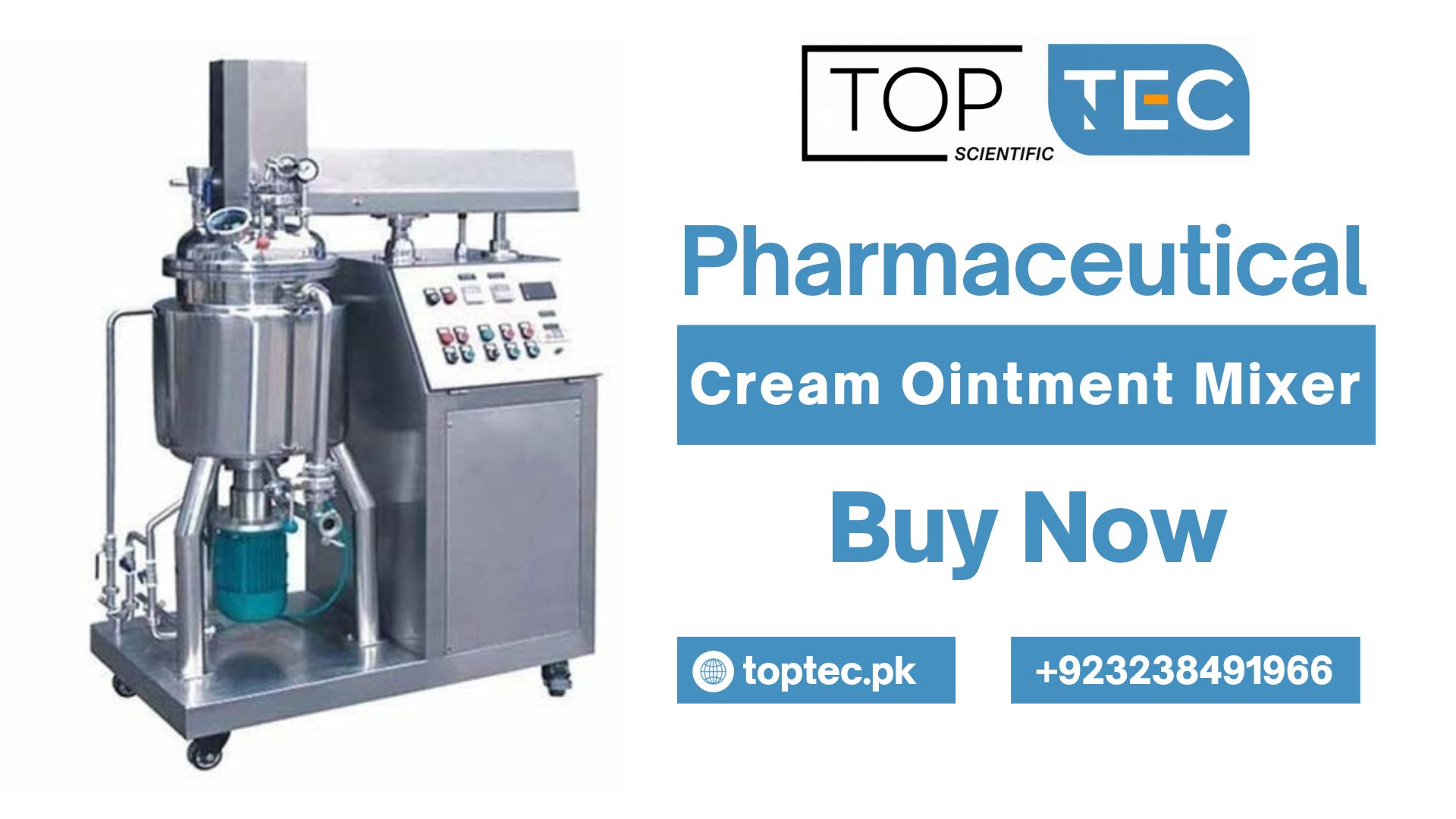
Discover GMP-compliant pharmaceutical cream ointment mixers. Features SS316L construction, vacuum emulsification, and CIP/SIP for sterile production. Get a quote.
If you spend enough time around semisolid manufacturing plants in Pakistan, you eventually witness the classic “separated emulsion” disaster. I remember standing in a plant down in Kot Lakhpat where 400 kilograms of skin cream had split into greasy white curd and cloudy water overnight.
The formulation was fine on paper, but the vessel they were using was an old, unsealed pot with an open propeller. If you want a stable, silky topical product that passes accelerated stability at 40°C, you cannot compromise on your core Cream Ointment Mixer. At the same time, whenever plant managers plan a line upgrade, they usually decide to Buy Laboratory Furniture to overhaul their in-process testing benches alongside the main tanks.
Topical semisolids are unforgiving. Whether you’re suspending zinc oxide or emulsifying heavy waxes, an underpowered cream mixer machine will leave microscopic dry agglomerates that gritty up the texture and ruin your viscosity curves. Regulators like DRAP won’t hesitate to flag a line if your ointment mixer shows surface pitting or traps air inside the product.
Sanitary Metallurgy: 316L or Walk Away
A true pharmaceutical Cream Ointment Mixer must have all wetted parts built from certified SS316L. It’s not just a buzzword; active ingredients, preservatives like parabens, and warm emulsifiers will pit ordinary steel within months. When an engineering team inspects a new cream mixer machine, they need to run an alloy analyzer on the dish and nozzles. It’s the same strict mindset required when QA teams look to Buy Laboratory Furniture for wet chemistry areas: you want genuine corrosion resistance, not just a superficial shine.
Inside the vessel, the surface roughness must sit below Ra 0.4 microns, fully electropolished. If an ointment mixer has rough, hand-buffed weld seams, cleaning validation becomes a nightmare. Microorganisms colonize the microscopic ridges, and no amount of hot sanitization will flush them out.
The Homogenizer: Getting Droplet Sizes Down to 2 Microns
The heart of any modern Cream Ointment Mixer is its high-shear homogenizer. To get an emulsion that won’t separate on a shelf in Multan during July, your oil droplets need to be sheared down into the 1 to 5 micron bracket. A high-spec cream mixer machine uses a bottom-mounted rotor-stator head running at around 3,000 RPM. As the rotor pulls product in and forces it through narrow stator teeth, hydraulic shear breaks the oil globules apart.
If your ointment mixer relies solely on a high-speed cowles disperser without a tight-tolerance stator, you simply won’t get uniform droplet distribution. The cream will look fine right out of the valve, but three months later, oil rings form on the surface. That’s why production heads who Buy Laboratory Furniture to set up micro-testing and droplet analysis labs know that consistent mechanical shear is everything.
Furthermore, the mechanical design of the Cream Ointment Mixer homogenizer must prevent product stagnation. In a poorly designed cream mixer machine, un-sheared lumps hide in the lower discharge neck. A proper sanitary ointment mixer solves this by using a flush-bottom diaphragm valve right below the shear head or an external recirculation loop that forces every drop through the rotor multiple times. Plant engineers who Buy Laboratory Furniture like laminar flow hoods look for smooth, dead-end-free airflow; your mixing skid demands the exact same continuous, dead-leg-free circulation.
Vacuum De-aeration and Thermal Control
Air bubbles inside a topical ointment are more than just an aesthetic issue. Air pockets carry oxygen that degrades sensitive actives, and they throw off your specific gravity during tube filling. That’s why a vacuum-rated Cream Ointment Mixer is practically mandatory for modern GMP manufacturing. When the cream mixer machine pulls at least -0.085 bar during the blending cycle, micro-bubbles collapse and get pulled out through the vacuum pump.
Without a dependable vacuum setup, an ointment mixer produces spongy, dull-looking creams that vary in weight when they hit the packaging line. The operators will constantly struggle with filling nozzles dripping or spitting air. Just as facilities Buy Laboratory Furniture designed to keep balance tables isolated from room vibrations, you need a vacuum system that keeps atmospheric air isolated from your product.
Heating and cooling cycles require equal attention. An industrial Cream Ointment Mixer relies on an insulated dimple jacket that can take low-pressure steam or hot water to melt waxes up to 80°C, followed by chilled water or glycol to cool the batch down rapidly. If the jacket on a cream mixer machine is sluggish, the cooling phase drags on for hours, encouraging large wax crystals to form and leaving your product with a gritty skin feel.
Controlling thermal shock is also a safety matter. If an ointment mixer lacks automated temperature throttling, sudden cold water injections can crack the inner tank welds. In the same way you Buy Laboratory Furniture built to withstand thermal abuse from autoclaves and hotplates, your process vessels need heavy-gauge jackets rated for repeatable thermal expansion.
Agitation Mechanics: Wall Scrapers and Anchor Sweeps
High-viscosity ointments cannot circulate by convection alone. Inside a commercial Cream Ointment Mixer, a slow-speed anchor sweep—usually turning between 15 and 45 RPM—does the heavy lifting of folding product from the vessel walls toward the center. This cream mixer machine anchor must be fitted with spring-loaded or hinged Teflon (PTFE) scraper blades.
If an ointment mixer doesn’t scrape the jacketed walls cleanly, two bad things happen: product burns onto the heated metal during wax melting, and during cooling, an insulating crust forms along the shell that stops heat transfer completely. When technicians Buy Laboratory Furniture for formulation development, they check that drawers and sliding sashes move without binding; in production tanks, those scraper blades must glide along the internal radius with perfect, balanced tension.
Many plants opt for contra-rotating paddles inside the Cream Ointment Mixer. While the outer anchor turns clockwise, an inner set of pitched blades turns counter-clockwise, creating axial turnover that prevents stratification. When your cream mixer machine handles materials with viscosities reaching 100,000 centipoise, those drive shafts endure massive torsional stress.
A flimsy gearbox on an ointment mixer will strip its gears or leak lube down the drive shaft into your batch. That’s why managers who Buy Laboratory Furniture with reinforced steel frames apply that same structural scrutiny to mixing gearboxes—you need oversized bearings and dual mechanical seals with sanitary water barrier flushes.
CIP and Cleaning Validation Realities
Cleaning an ointment tank is notoriously difficult because paraffin, petrolatum, and beeswax cling stubbornly to stainless steel. A modern Cream Ointment Mixer eliminates manual bucket-and-mop cleaning by using built-in 360-degree rotary spray balls. When running CIP cycles, the cream mixer machine uses high-pressure hot water and alkaline detergents to strip sticky residues off every baffle and seal face.
During regulatory audits, DRAP inspectors will want to see your cleaning validation data. If your ointment mixer has blind pipe stubs or unpolished agitator mounts, swab testing will turn up organic carbon peaks every single time. It mirrors what happens when companies Buy Laboratory Furniture made of cheap wood or unsealed laminate: chemical spills soak in, impossible to decontaminate. Stainless steel sanitary design is the only acceptable route.
The shaft seal itself is often where cleaning validation fails. A sanitary Cream Ointment Mixer must use a double mechanical seal with an external barrier fluid pot. If a cream mixer machine uses cheap braided packing rope, it will shed carbon strings straight into your formulation and leak oil down the agitator shaft.
An improperly sealed ointment mixer creates a direct vector for microbial contamination. In cleanroom environments, where operators Buy Laboratory Furniture like stainless pass boxes and dynamic air showers to block particulate ingress, you cannot allow a leaky mixing shaft seal to compromise your batch.
Local Pakistani Manufacturing vs. The Scrap Yard Gamble
A common temptation among mid-sized plant owners in Pakistan is scouring used machinery yards in Shershah or Misri Shah. You find an imported European Cream Ointment Mixer pulled out of a decommissioned plant in Europe, covered in dust, priced at what seems like scrap value. But once that used cream mixer machine lands on your floor, the hidden costs start piling up.
The internal jacket of that salvage ointment mixer might be choked with calcium scale or cracked from years of hard water use. Finding replacement mechanical seals or bespoke gear parts for a machine built in Germany thirty years ago can take months of import delays. Meanwhile, production sits idle. That is why smart Pakistani operations look to domestic engineering leaders—just as they Buy Laboratory Furniture from local specialists rather than importing bulky tables from abroad, sourcing process equipment locally guarantees fast service and parts availability.
This is where TOPTEC Scientific plays such a vital role in Pakistan’s industrial ecosystem. Known nationwide as a premier manufacturer when facilities need to Buy Laboratory Furniture, TOPTEC also understands the exacting demands of cleanroom fabrication and pharmaceutical stainless engineering. Integrating a heavy-duty Cream Ointment Mixer into an active cleanroom suite requires matching utility connections, pass boxes, balance tables, and sterile sampling stations.
When you source your auxiliary equipment and cleanroom furniture alongside a cream mixer machine, having a domestic manufacturer like TOPTEC Scientific in Pakistan means you don’t face customs clearance nightmares or rupee-dollar exchange shocks. Their engineering team can build an ointment mixer support platform, in-process testing desks, and storage setups to the exact same GMP criteria.
Automation, Safety Interlocks, and Batch Records
Manual valve turning belongs in the past century. A contemporary Cream Ointment Mixer should have its recipe steps controlled via an automated PLC touchscreen. This prevents an operator from turning on the high-shear homogenizer of the cream mixer machine while the tank is dry, or discharging the ointment before the batch has cooled to its validated packaging temperature.
Safety interlocks are equally vital. The hydraulic lid lift on an ointment mixer must never open while the vessel is pulling a vacuum or while the anchor is in motion. When safety-conscious managers Buy Laboratory Furniture and process machinery, they look for emergency cut-offs and physical interlocks that protect floor operators from catastrophic mechanical accidents.
Making the Right Investment
At the end of the day, topical manufacturing comes down to consistency. When you invest in a well-engineered Cream Ointment Mixer, your batch cycle times drop, your yields climb, and your regulatory audits stop being high-stress emergencies. A dependable cream mixer machine gives you predictable particle reduction, air-free formulations, and simple cleaning validation.
Don’t leave your semisolid line to chance with worn-out scrap or unsealed pots. Evaluate your vessel specifications, check the metallurgy, demand proper mechanical seals, and make sure your ointment mixer is engineered to survive daily industrial use. And when you are ready to complete your production suite or Buy Laboratory Furniture built specifically for Pakistani regulated environments, working with proven manufacturers like TOPTEC Scientific ensures your entire plant meets world-class GMP standards from the lab bench all the way to the bulk mixing floor.
