

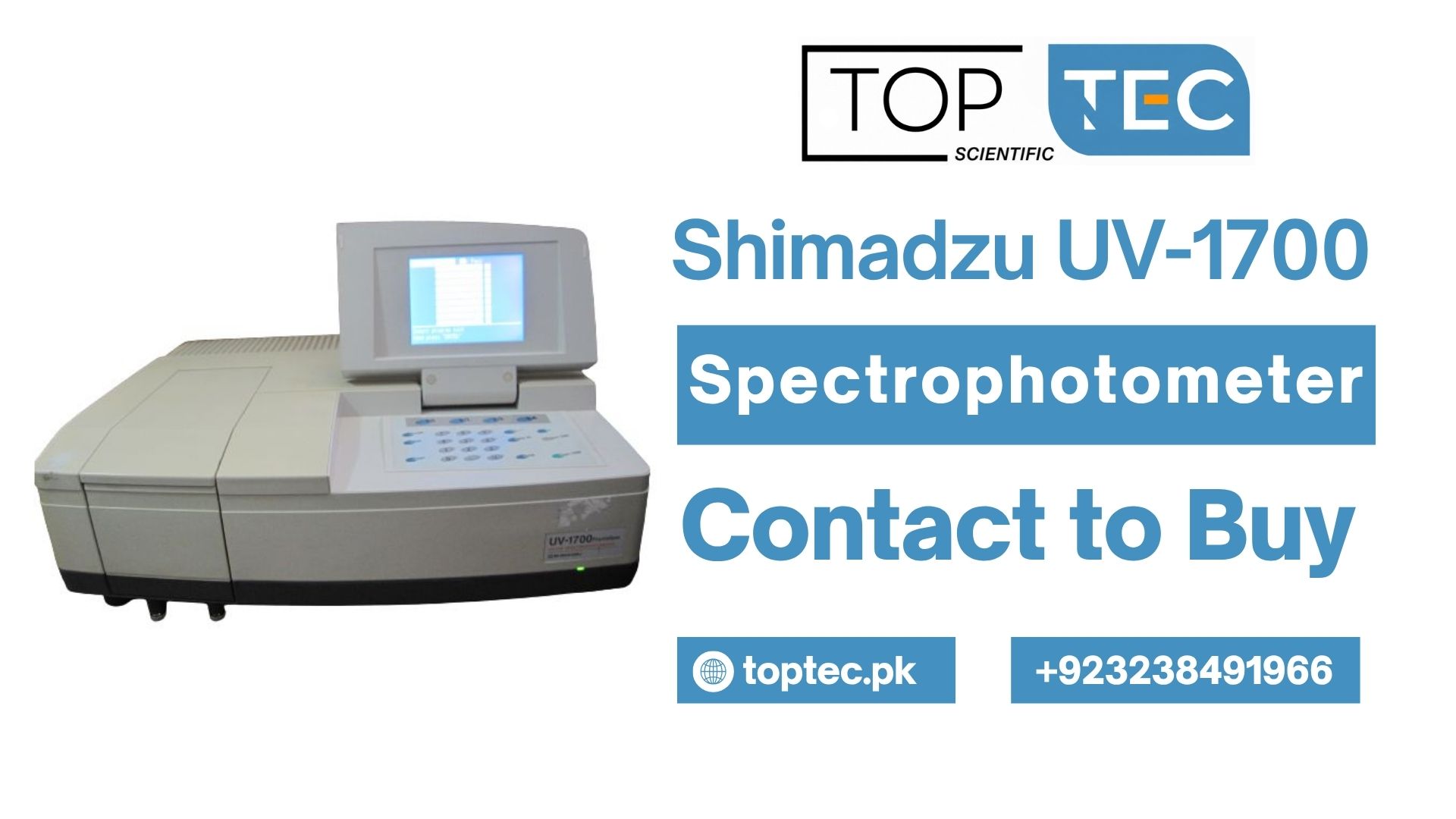
Ensure pharmacopoeia compliance with the Shimadzu UV-1700 PharmaSpec. Featuring double-beam optics, 1nm spectral bandwidth, and a wide 190-1100nm range for precise pharmaceutical testing.
I’ve spent a good chunk of time in labs and research facilities, and there’s this one instrument that just never seems to go away—the Shimadzu UV-1700. Everyone’s got one, or wants one, or is trying to figure out if they should buy new or save some cash on a refurbished unit. It’s reliable. It’s been around forever. And honestly, people trust it because it just… works.
Here’s the real situation though. Labs need good analytical equipment, but money’s always tight. New instruments aren’t cheap. So you end up weighing options—new, refurbished, pricing, specs, all of it. You need to actually understand what you’re getting into before you spend that money.
Let me break down what the Shimadzu UV 1700 Spectrophotometer actually does, what those specs mean in practical terms, what it costs in Pakistan right now, and where you can actually find one without getting ripped off.
What This Thing Actually Does
Basic concept first. A UV-visible spectrophotometer measures how much light a sample soaks up at different wavelengths. Sounds simple, but it’s genuinely fundamental for figuring out chemical composition, checking purity, measuring concentration—the list goes on.
The Shimadzu UV-1700 specifically has been around for a long time now. That’s actually a good thing. It means the kinks are worked out. People have used it in real conditions for years and it holds up. Pharma companies use it for QC work. Universities teach with it. It’s not flashy, but flashy isn’t always what you need in a lab.
What you want from analytical equipment is trust, basically. You need to know that when you run the same sample twice, you get the same answer. That when something’s gone wrong, it’s obvious, not hidden in some black box algorithm you can’t troubleshoot.
Looking at the Shimadzu UV-1700 specifications, you’ve got a wavelength range from 190 to 1100nm. That covers both UV and visible light, which honestly handles most of what people need to analyze in a typical lab setting.
Breaking Down the Specs (In Plain Language)
Okay so here’s what these numbers in the Shimadzu UV 1700 Spectrophotometer spec sheet actually mean for your day-to-day work.
Wavelength range, 190-1100nm: This is your UV through visible light coverage. Pharmaceuticals, organic compounds, a lot of biological samples—this range gets you there.
Wavelength accuracy, ±2nm: Set it to 254nm, and you’re really measuring somewhere between 252 and 256nm. Not perfect, but good enough for basically everything standard.
Wavelength reproducibility, ±1nm: Run the same sample twice, you’ll get results within 1nm of each other. That’s what you want—consistency.
Photometric accuracy, ±0.005A: Measures how accurately it reads absorbance. Fine for most applications.
Photometric reproducibility, ±0.003A: Same sample, multiple runs, consistent numbers. Good.
Light source: Deuterium lamp handles UV, tungsten lamp handles visible. This setup has been standard for decades. Nothing exotic, just reliable.
Detector: Silicon photodiode. Not cutting edge, but it works and it’s proven.
When you look at Shimadzu UV-1700 specifications against your actual needs, you’re basically asking: is this good enough for what I do? For most pharma QC, food testing, environmental work—yeah, it is.
What People Actually Use This For
The Shimadzu UV 1700 Spectrophotometer shows up in a surprising number of different applications.
Pharma companies lean on it heavily for testing drug purity, concentration, stability. It’s part of standard QC workflows at countless facilities.
Research labs use it to measure compound concentrations, track reactions as they happen. Pretty routine stuff but essential.
Environmental testing labs test water quality, check for pollutants, measure contaminants—all using this kind of spectrophotometry.
Food science folks test additives, check nutrient levels, do quality control checks.
Life science people measure protein levels, DNA concentration, enzyme activity. Spectrophotometry is kind of foundational to a lot of biology work.
And universities—obviously—teach spectroscopy fundamentals with this equipment while also using it for actual research.
I remember talking to a QC manager at a pharma company who said they run literally hundreds of tests a month on their Shimadzu UV 1700 Spectrophotometer. It’s their main instrument. That tells you something about how dependable this thing actually is.
The Money Talk: What New Units Cost
Let’s just be real about the price tag here because it matters a lot.
A brand new Shimadzu UV-1700 Spectrophotometer runs you somewhere around 8-12 lakh rupees, give or take, depending on your supplier, what’s included, shipping costs, installation fees. It adds up fast, honestly.
That’s a lot of money for most facilities. Teaching labs especially struggle to justify that kind of spend. Smaller research setups feel the pinch too. Even bigger, established labs pause before committing that kind of budget.
This is exactly why you need to know your options. New equipment isn’t always necessary. Refurbished units are a real alternative. Some places even do rentals or leasing if that fits your situation better.
It comes down to matching what you actually need against what you can actually spend. Cutting-edge research? Maybe you need new. Standard, routine analytical work that’s been done the same way for years? Refurbished probably does the job just fine.
When shopping for Shimadzu UV 1700 Spectrophotometer pricing, don’t just take the first quote. Compare a few suppliers. Ask exactly what’s bundled in—training, install, warranty coverage.
New or Refurbished? Here’s How I’d Think About It
This is where things get practical, and honestly refurbished deserves serious consideration.
New gear comes in mint condition, usually with a solid warranty, but you’re paying top dollar—sometimes for features you won’t even use.
Refurbished means someone owned it before, it’s been professionally restored and tested, and you save real money. Warranty’s usually shorter than new, but it’s still there.
Used, as-is equipment is the cheapest option but also the riskiest. Might not come with any warranty at all.
For something like the Shimadzu UV 1700 Spectrophotometer, refurbished often makes total sense. The underlying tech isn’t complicated or cutting-edge—it’s proven. If someone’s actually restored it properly and tested it thoroughly, it’ll work just as reliably as new.
You’re typically looking at 40-60% savings going refurbished instead of new. That’s not small change. For a lot of facilities, that’s the financially smart move while still getting dependable equipment.
Just make sure you’re buying from someone who actually tests their refurbished units properly. You want proof it’s been serviced, components checked, everything verified working.
TOPTEC Scientific: Your Local Option in Pakistan
Alright, so if you’re trying to track down Shimadzu UV-1700 specifications or pricing here in Pakistan, TOPTEC Scientific is worth checking out.
I keep coming back to TOPTEC because they’ve genuinely built real expertise in lab equipment. They’ve worked with facilities all over Pakistan and actually understand what local labs need and what they can afford.
Why local suppliers matter here: Looking at Shimadzu UV 1700 Spectrophotometer options, TOPTEC can walk you through choices—new versus refurbished, pricing breakdowns, what specs you actually need.
You can actually talk to a person: Instead of ordering blind from some website halfway across the world, you get to actually discuss your needs with someone who knows the equipment.
Support stays local: Buy equipment through them and you get installation, training, ongoing maintenance support right here. No waiting on international tech support that takes forever to respond.
They get Pakistani lab reality: Budget limits, import headaches, what facilities actually deal with day-to-day. They operate within that reality instead of ignoring it.
Pricing’s upfront: No hidden shipping surprises, no mystery fees tacked on later. What you see is what you pay.
When you buy laboratory furniture and equipment locally like this, you’re getting more than a product—you’re getting someone who’ll actually answer the phone when something goes wrong.
Cost Breakdown: New vs Refurbished
Let me put actual numbers against this because it really does matter.
New Shimadzu UV-1700 Spectrophotometer: roughly 10-12 lakh rupees. That typically covers shipping, install, a decent warranty (2-3 years usually), and training included.
Refurbished Shimadzu UV 1700 Spectrophotometer: around 4-6 lakh rupees. Properly restored, tested, comes with a shorter warranty (1-2 years), installation included.
Fully used, no-frills equipment: 2-4 lakh rupees. As-is. Usually zero warranty. You’re taking on risk here.
That gap between new and refurbished is huge—basically half price. That extra money can go toward chemicals, other instruments, maybe even hiring someone. It genuinely matters for smaller operations.
For most facilities I’ve talked to, going refurbished with the Shimadzu UV 1700 Spectrophotometer just makes sense financially without sacrificing reliability.
Specs That Actually Matter, Explained Simply
Let’s go through what Shimadzu UV-1700 specifications actually mean in practice.
190-1100nm wavelength range: Covers everything you’d normally need. UV (190-400nm) plus visible (400-1100nm). Most compounds you’d test absorb light somewhere in there.
Resolution: How well it tells different wavelengths apart. Better resolution equals more precise readings. This unit’s resolution is fine for typical work.
Sensitivity: How well it picks up weak signals. Matters more if you’re working with really dilute samples.
Baseline drift: How much readings shift without any sample in there. Lower is better—means your measurements stay stable over time.
Lamp lifespan: Affects how often you’re buying replacement parts. Typically 500-1000 hours before you need a new one.
Software: How it handles and analyzes your data. Newer units integrate better with computers; older ones sometimes mean more manual record-keeping.
Checking Shimadzu UV 1700 Spectrophotometer against this list tells you if it fits your actual analytical needs. For routine work, it checks all the boxes.
The Ongoing Costs Nobody Mentions Upfront
Here’s something people forget to factor in: the costs that keep coming after you buy the thing.
Owning a Shimadzu UV-1700 Spectrophotometer means budgeting beyond just that initial purchase price.
Lamps wear out: Deuterium and tungsten lamps need replacing eventually. Figure 15,000-25,000 rupees per lamp, lasting maybe 500-1000 hours depending on usage.
Regular servicing: Keeps things running smoothly. Expect 5,000-10,000 rupees annually for maintenance.
Cuvettes: You’ll need the right ones. Quartz costs more but you need it for UV work. Glass is cheaper, works fine for visible light only.
Cleaning materials: Proper solvents and cleaning products. Small cost but necessary.
Calibration services: Usually 5,000-8,000 rupees to keep accuracy where it should be.
Add it all up and you’re looking at maybe 30,000-50,000 rupees annually if you’re using it regularly. Plan for that when you’re doing your budget.
Getting It Installed and Your Team Trained
Once you’ve got your Shimadzu UV 1700 Spectrophotometer, setup and training aren’t optional extras—they matter.
Installation: Someone qualified needs to handle the electrical hookups, check ventilation, get it level and stable. Usually just a few hours of work.
Training: Your people need to actually know how to run samples, operate the equipment correctly, and handle basic maintenance. Good suppliers include this.
Keep the manuals: Operating guides, troubleshooting info, maintenance schedules—have these on hand and accessible.
Know who to call: If something breaks or acts weird, you need a contact who can actually help, ideally someone local.
TOPTEC handles install and training as part of their service. That’s a real help when you’re new to the equipment.
Keeping Things Calibrated
Calibration isn’t glamorous, but skipping it causes problems down the line.
Wavelength calibration: Check against known reference standards periodically—yearly is typical.
Photometric calibration: Verify absorbance readings using reference solutions at known concentrations.
Performance checks: Run standards regularly to confirm everything’s still working as expected.
Yeah, calibration costs something, but it’s what makes your data trustworthy. If you’re in pharma or food testing, this documentation is also what regulators want to see.
Owning a Shimadzu UV 1700 Spectrophotometer means staying on top of this stuff, not just running it and forgetting maintenance exists.
Where This Equipment Shows Up Across Pakistan
Here’s a look at who’s actually using this gear in Pakistani facilities.
Pharma companies rely on it for QC checks, product consistency testing.
University chemistry departments teach spectroscopy basics while also running research through these units.
Food and beverage companies test additives and nutrient content.
Environmental labs check water quality and test for pollutants.
Research institutions across chemistry and life sciences depend on it.
Some hospital labs use it too for various testing needs.
It’s everywhere in Pakistani labs because, frankly, it’s proven, it’s dependable, and compared to newer equipment, it’s actually affordable.
Where Does UV-1700 Fit Among Shimadzu’s Lineup
Shimadzu makes several spectrophotometer models, so it helps to know where the Shimadzu UV 1700 Spectrophotometer sits.
UV-1600 came before it—decent but less capable than the 1700.
UV-1700 sits comfortably in the middle. Proven, reliable, good value. This is the workhorse model in a lot of labs.
UV-1800 is newer with more features, costs more, better suited for advanced research.
UV-2600 is specialized, more sophisticated, significantly pricier.
UV-Visible 3600 is the top of the line, latest tech, premium price tag.
For most standard analytical needs, Shimadzu UV-1700 specifications cover what you need. Not the shiniest option, but definitely a smart, practical one.
Finding One to Buy in Pakistan
So where do you actually source a Shimadzu UV 1700 Spectrophotometer here?
International distributors can bring in new units but expect higher costs from shipping and duties.
Local suppliers like TOPTEC have access and offer support you can actually reach.
Specialized refurbished dealers often have good stock at better prices.
Going direct to manufacturers is possible but usually means dealing with import headaches and extra cost.
Used equipment markets exist online too—more risk, but cheaper.
When you buy laboratory furniture and lab equipment from local sources, you’re getting transparency and support that overseas options just can’t match.
Smart Buying Tips
A few practical things to think through before you buy.
Figure out exactly what you need first—what wavelengths, what accuracy level matters for your work.
Get quotes from a few different places. Compare what’s actually included.
Ask about warranty terms specifically—coverage length, how claims work.
If buying refurbished, request documentation showing what was tested and restored.
Confirm training is included, and ask for proper documentation.
Budget realistically for ongoing maintenance and lamp replacement.
Make sure there’s actual local support available if something goes wrong.
Taking these steps helps you make a smart purchase instead of just grabbing whatever’s cheapest.
Fitting It Into Your Actual Workflow
Getting a Shimadzu UV 1700 Spectrophotometer means thinking about how it fits into your existing setup.
Where’s it going to physically sit? You need power, maybe ventilation, a stable surface.
Can it connect to whatever lab information system you’re using?
Do you have proper sample prep—right cuvettes, solvents on hand?
How are you planning to verify ongoing accuracy?
What’s your documentation process for results, especially if regulators care?
Is your team actually trained on this specific unit?
Thinking through this stuff beforehand means you’ll actually use the equipment well instead of fighting with it.
Keeping Up With Compliance
If you’re doing regulated work—pharma, food, environmental—documentation becomes non-negotiable.
You need proof the equipment meets specs and performs as expected.
Calibration records showing accuracy is maintained.
Written procedures for proper operation.
Maintenance logs documenting service history.
Training records proving operators know what they’re doing.
Audit trails if you’re using computer systems, showing who ran what and when.
Regulators expect this stuff. Keep good records and it protects you later.
When Things Go Wrong: Common Problems
Even reliable equipment like the Shimadzu UV 1700 Spectrophotometer has occasional hiccups.
Drifting baseline readings usually point to lamp aging, calibration needs, or just needing a cleaning.
Weak light intensity is almost always an aging lamp that needs swapping out.
Wavelength errors might mean recalibrating or cleaning dust off optical parts.
Photometric errors usually trace back to calibration or cuvette problems.
Power issues mean checking your connections and supply.
Software acting weird? Try restarting first, check for updates.
Most problems have simple fixes once you know what to look for.
What You Should Expect From This Equipment
Using a Shimadzu UV-1700 Spectrophotometer properly, here’s what good performance looks like.
Consistent results every time you run the same sample.
Reasonably quick warm-up before it’s ready to use.
No random failures during normal operation.
Responsive support if problems come up.
Maintenance that doesn’t break the bank.
If you’re not seeing this, either something’s wrong with the unit or your supplier isn’t holding up their end.
Wrapping This Up
The Shimadzu UV-1700 Spectrophotometer earns its reputation. It’s not cutting-edge anymore, but it’s dependable, it’s proven, and it gets the job done day after day.
Whether you go new or refurbished really comes down to understanding your actual needs and budget. Refurbished saves serious money while still giving you reliable performance. New gives you peace of mind with longer warranty coverage.
Bottom line—make an informed choice. Know what you actually need. Compare suppliers. Get local support lined up. Plan ahead for ongoing costs.
Working with suppliers like TOPTEC Scientific when you buy laboratory furniture and analytical equipment means you’re not just buying a box—you’re getting someone who’ll actually help when you need it.
So if you’re in the market for a Shimadzu UV 1700 Spectrophotometer, new or refurbished, find people who know the equipment and understand what you’re trying to accomplish. Get trained properly. Budget for upkeep. Plan for the long haul.
