

Before any conversation about which syrup filling machine to buy, there’s one question that cuts through all the noise: what does your production actually need right now, and what will it realistically need in three years?
I’ve watched companies make expensive mistakes in both directions. A small herbal medicine company in Multan bought an 8,000 BPH fully automatic line because they planned to “scale up soon.” Two years later, that machine runs maybe 4 hours a day at 60% capacity because the demand growth didn’t happen on the timeline they projected. They’re maintaining and operating a machine far larger than their actual needs.
On the other end, a pharmaceutical company in Karachi bought a budget semi-automatic syrup filling machine to save upfront cost. Within eight months, they were running double shifts trying to keep up with orders, their rejection rate from inconsistent manual operations was hurting profitability, and they were already looking at replacing the machine they’d just bought.
Getting the capacity and automation level right from the beginning is more important than getting the brand right, the color right, or even the exact price right. This article helps you think through that decision properly — then covers what’s actually available at each capacity level, what distinguishes good equipment from mediocre equipment, and where to source quality filling solutions in Pakistan.
Understanding the BPH Ratings — What They Actually Mean
Every syrup filling machine you’ll encounter is rated in BPH — bottles per hour. This seems straightforward but conceals some important nuance.
BPH ratings are theoretical maximum throughput under ideal conditions: same bottle size, same fill volume, same product viscosity, no changeovers, no minor stoppages, perfect upstream bottle feeding, and optimal operator performance.
Real production conditions are never ideal. A realistic efficiency factor for a well-run pharmaceutical liquid line is 75-85% of theoretical throughput.
So a machine rated at 6,000 BPH will actually produce:
6,000 × 0.80 = 4,800 bottles per hour under realistic operating conditions on a good day.
Build this efficiency factor into every capacity calculation you make. If you need 4,000 bottles per hour of actual output, you need a machine rated for at least 5,000-5,500 BPH — not a 4,000 BPH machine.
Also worth knowing: BPH ratings typically apply to a specific reference bottle size and fill volume (often 100mL). Larger bottles and higher fill volumes slow cycle time. Smaller bottles and lower fill volumes may run faster than rated. Ask suppliers what their BPH rating is based on.
Semi-Automatic Models — 2,000 to 4,000 BPH
Who Semi-Automatic Is Actually For
Semi-automatic automatic syrup filler equipment occupies an interesting middle ground. Not purely manual, not fully automated. The operator is involved in the process — typically loading bottles, activating the fill cycle, and moving filled bottles away — but the fill measurement itself is handled by the machine.
This category makes sense for:
- Pharmaceutical startups and small manufacturers producing 1,000-3,000 bottles per shift and not ready for the capital investment of a full automatic line
- R&D and pilot production where flexibility matters more than throughput
- Contract manufacturers filling small batches of multiple products where frequent changeover and cleaning matter more than high speed
- Herbal and nutraceutical companies with lower regulatory requirements and moderate production volumes
What Semi-Automatic Actually Means in Practice
In a typical semi-automatic syrup filling machine setup, the operator places a bottle (or a small group of bottles) under the filling nozzle(s), activates the fill cycle (foot pedal or knee switch, keeping hands free), the machine dispenses the set volume, and the operator removes the filled bottle and places the next.
More sophisticated semi-automatic models have simple conveyors that move bottles through the fill position, reducing operator fatigue and improving cycle consistency. The operator feeds bottles at the input end and removes them (or they go to a simple manual capping station) at the output.
Semi-Automatic Throughput Reality
At 2,000-4,000 BPH theoretical, a realistic semi-automatic output on a pharmaceutical product with a skilled operator is 1,500-3,000 bottles per shift (8 hours). This isn’t a criticism of the technology — it’s just the math of semi-automatic operation with the human element in the loop.
Filling Technology in Semi-Automatic Models
Even in semi-automatic equipment, the filling mechanism matters. The best semi-automatic syrup filling machine units use piston-based volumetric filling — the same technology that dominates full automatic pharmaceutical lines. Fill volume accuracy should be ±1% or better.
Avoid semi-automatic gravity-fed equipment for pharmaceutical syrups. The fill accuracy limitations of gravity filling are the same regardless of whether the machine is semi-automatic or fully automatic — and those limitations (typically ±3-5%) are often inadequate for pharmaceutical products.
Automatic Models — 4,000 to 8,000 BPH
The Sweet Spot for Most Pakistani Pharmaceutical Companies
The 4,000-8,000 BPH range is where most mid-sized pharmaceutical liquid manufacturers in Pakistan should be looking when they decide to Buy Syrup Filling Machine equipment for serious production use.
At these speeds, you’re looking at fully automatic machines where bottles are fed, filled, and moved downstream without individual operator intervention at the fill station. The operator’s role shifts from active participation in each fill cycle to monitoring, replenishment (bottles, caps, labels), and quality checks.
What Changes When You Move to Full Automation
The fundamental change in a fully automatic syrup filler at this capacity level is that the machine controls the entire filling cycle — bottle indexing, nozzle positioning, fill actuation, nozzle retraction, and bottle release — without operator input on each bottle.
This removes operator-to-operator variability from the filling step entirely. The machine fills every bottle the same way. Fill volume consistency depends on machine calibration and maintenance, not on who’s working that shift.
For pharmaceutical GMP purposes, this is significant. Validation of a fully automatic line is more defensible because the process is more controlled. In-process checks become verification of machine performance rather than verification of operator performance.
Typical 4,000-8,000 BPH Line Configuration
A full automatic syrup filler line in this throughput range typically includes:
Bottle feeding and orientation: Turntable or unscrambler feeding bottles onto the main conveyor in correct orientation.
Bottle rinser: Air or water rinse to remove dust and debris from bottles before filling. HEPA-filtered air rinse is common for pharmaceutical applications.
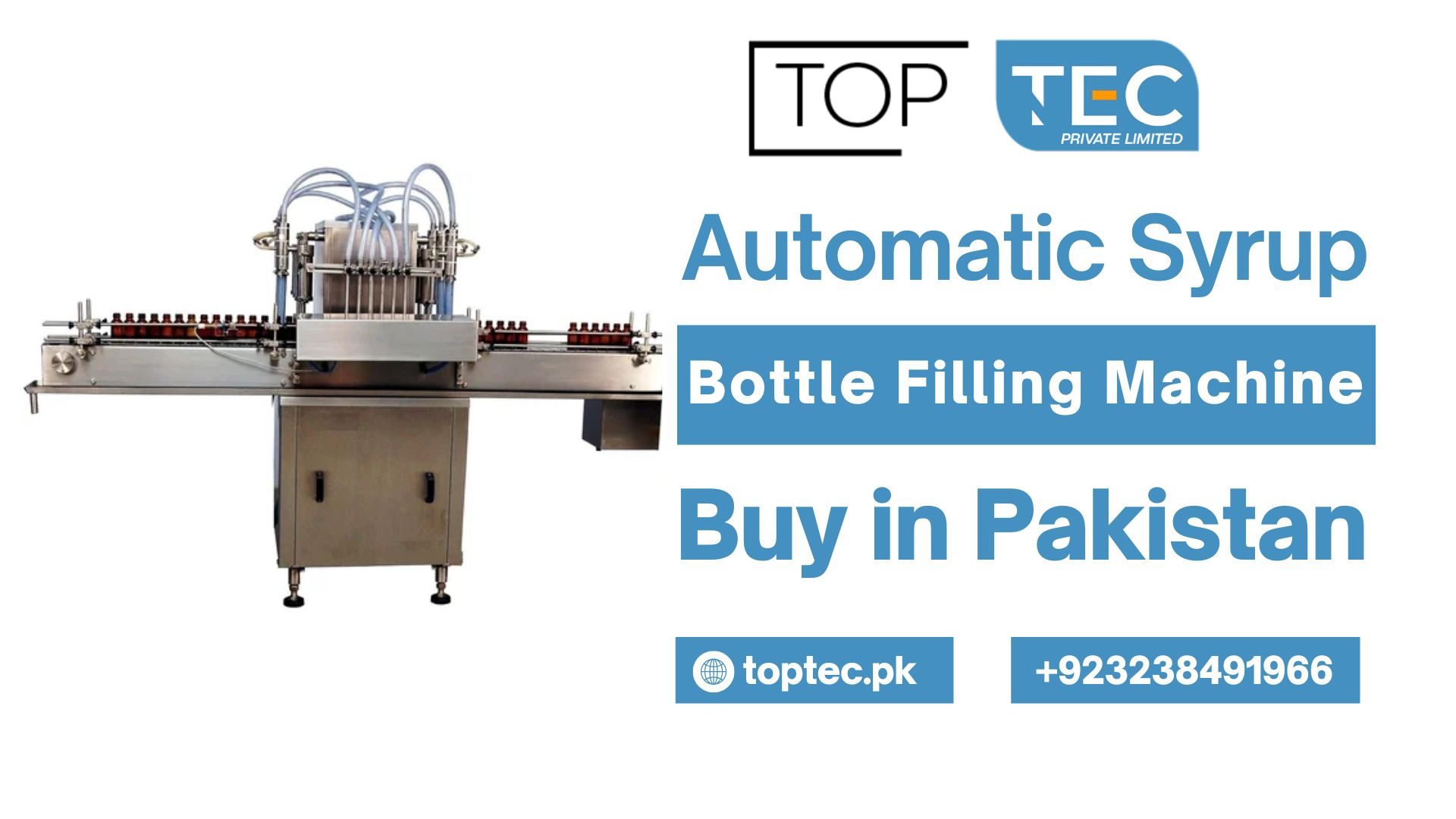
Filling machine: 4, 6, or 8-head piston filler as the production anchor. At 6,000 BPH, a 6-head machine running at appropriate cycle speed is typical.
Nozzle configuration: Diving nozzles with anti-drip (suck-back) mechanisms are standard at this level. Fixed nozzles are a cost-cutting measure that creates quality problems with most pharmaceutical syrups.
Capper: Rotary or inline capper matched to the filler throughput. Child-resistant closure capability if required by your products.
Induction sealer: For products requiring foil tamper-evident seals under caps. Positioned between filler and capper.
Labeler: Single or double-side labeling machine with servo-driven label application for consistent placement.
Batch coder: Inkjet or laser coding for batch number, manufacturing date, and expiry date.
Inspection: Fill level detection, cap presence verification, label verification. At minimum, photoelectric sensors for critical checks.
Filling Head Count vs. Throughput
For the 4,000-8,000 BPH range:
4-head piston filler:
- Theoretical: 4,000-6,000 BPH (depending on fill volume and cycle speed)
- Realistic: 3,200-5,000 BPH
- Good for: 100mL and 200mL fills, moderate viscosity products
6-head piston filler:
- Theoretical: 6,000-9,000 BPH
- Realistic: 4,800-7,500 BPH
- Good for: Wide fill volume range, higher throughput requirements
8-head piston filler:
- Theoretical: 8,000-12,000 BPH
- Realistic: 6,400-10,000 BPH
- Good for: High volume pharmaceutical production
High-Speed Automatic Models — 8,000 to 12,000 BPH
Who Needs This Level
At 8,000-12,000 BPH, you’re looking at high-volume pharmaceutical manufacturing — major pharmaceutical companies, large contract manufacturers, and export-focused operations producing high-volume products.
Equipment at this throughput level is significantly more complex and expensive. Rotary filling systems (continuous motion rather than intermittent) are common at the high end of this range because intermittent (stop-start) motion becomes a throughput limiter at very high speeds.
Rotary vs. Linear at High Speed
Most syrup filling machine units at moderate speeds (up to ~6,000 BPH) use linear or inline filling — bottles stop under the nozzles, are filled, then advance. This intermittent motion has a speed ceiling because bottles must fully stop and stabilize before filling begins.
At higher speeds, rotary filling becomes advantageous. Bottles move continuously on a rotating turret. Nozzles move with the bottles through the fill arc, then retract as bottles transfer to the next station. Continuous motion eliminates the stop-start cycle time limitation.
High-speed rotary automatic syrup filler systems can achieve 10,000-15,000 BPH and higher with appropriate product and bottle characteristics. They also cost substantially more and require more specialized maintenance.
For most Pakistani pharmaceutical manufacturers currently planning their capacity, rotary filling at 10,000+ BPH is beyond immediate requirements. A good linear or intermittent automatic line at 6,000-8,000 BPH is more appropriate for most operations.
The Filling Technology Decision — Piston, Peristaltic, or Gravity?
Regardless of whether you’re buying semi-automatic or fully automatic equipment, the filling mechanism determines whether the machine can actually handle your product accurately. This decision deserves more attention than it typically gets when companies decide to Buy Syrup Filling Machine equipment.
Piston Filling — The Right Choice for Most Pharmaceutical Syrups
A piston filler is a true volumetric machine. The fill volume is physically determined by the piston stroke — the distance the piston travels in the cylinder. This mechanical definition of volume means:
- Fill volume doesn’t change with product temperature
- Fill volume doesn’t change as the supply tank empties
- Fill volume doesn’t change with moderate viscosity variation
- Fill accuracy is consistent across the entire batch
For pharmaceutical syrups — including high-viscosity suspensions, thick medicated syrups, and products where fill accuracy is a critical quality attribute — piston filling is the correct technology. Period.
Typical piston filler accuracy: ±0.5% or better (i.e., ±0.5mL on a 100mL fill)
Peristaltic Filling — Specific Applications Only
Peristaltic automatic syrup filler systems use rotating rollers to squeeze flexible tubing, pushing product forward. The unique advantage: product only contacts the tubing interior, never metal pump components. This matters for:
- Products where zero metal contact is required
- Sterile filling where a disposable, pre-sterilized flow path is needed
- Very potent compounds where containment is critical
The limitation: tubing wears. As the tubing deforms with use, fill volume drifts. Tubing replacement intervals must be validated and strictly followed.
For routine pharmaceutical syrup production at volume, piston filling is generally more appropriate than peristaltic. Consider peristaltic only when its specific advantages are genuinely needed.
Gravity Filling — Rarely Appropriate for Pharmaceutical Syrups
Gravity filling (timed valve opening) depends on head pressure and product viscosity — both of which vary. The accuracy limitations (typically ±3-5%) are rarely acceptable for pharmaceutical products.
If a supplier proposes gravity filling for your pharmaceutical syrup, ask specifically how they address viscosity variation across temperature range and how they address fill volume drift as the supply tank empties. The honest answer is that gravity filling doesn’t address these issues well — which is why it’s not appropriate for most pharmaceutical applications.
Specifications to Evaluate Before You Buy Syrup Filling Machine Equipment
When you’re ready to Buy Syrup Filling Machine equipment and you’re talking to suppliers, these are the specifications worth spending time on:
Fill Volume Range and Accuracy
What’s the minimum and maximum fill volume the machine handles? What’s the stated accuracy? How is this accuracy specified — as percentage or absolute volume? At what product viscosity was it measured?
Get fill accuracy commitments in writing and understand the test conditions they’re based on.
Viscosity Range
What viscosity range is the machine designed to handle? What’s the maximum viscosity the piston, tubing, or valve system can handle at your operating conditions?
If you make products ranging from thin aqueous syrups (50 cP) to thick suspensions (1,000+ cP), verify the machine handles this full range without major equipment changes.
Changeover Time
How long does it take to change from one product to another, or from one bottle size to another? For operations filling multiple products, changeover time directly affects productive capacity.
Quick-change tooling, CIP compatibility, and documented changeover procedures are what make changeover time reasonable.
Material of Construction
For pharmaceutical products, product contact surfaces must be:
- Stainless steel 316L for all wetted metal components
- FDA-approved silicone or PTFE for all seals and gaskets
- Smooth, crevice-free surfaces with no dead legs where product accumulates
Request a material of construction declaration as part of your purchase documentation.
CIP Compatibility
Can the filling machine be cleaned in place, or does it require full disassembly for cleaning? For pharmaceutical GMP compliance, CIP compatibility dramatically reduces changeover time and simplifies cleaning validation.
Control System
Modern automatic syrup filler equipment uses PLC (Programmable Logic Controller) control with HMI (Human-Machine Interface) touchscreen operation. The HMI should allow:
- Fill volume adjustment without tools
- Speed adjustment
- Alarm display and history
- Recipe storage for different products
- Data output for batch records
For GMP pharmaceutical applications, electronic data records from the filling machine support batch documentation. Understand what data the control system captures and how it can be exported.
GMP Validation — What You’ll Need After Installation
When you Buy Syrup Filling Machine equipment for pharmaceutical use, the purchase is just the beginning. Before the machine runs production batches, it must be qualified.
IQ/OQ/PQ Documentation
Installation Qualification (IQ): Verifying the machine was installed as specified. Utilities connected correctly. Materials of construction verified against purchase specification. All required documentation on file.
Operational Qualification (OQ): Testing that the machine operates within specified parameters. Fill volume accuracy across the operating range. Speed verification. Alarm functions. CIP cycle effectiveness. Temperature uniformity (if applicable).
Performance Qualification (PQ): Three consecutive batches (typically) demonstrating that the machine consistently produces acceptable product under actual production conditions. Fill accuracy across entire batches, at beginning, middle, and end of each batch.
Ask suppliers what IQ/OQ/PQ support they provide. Quality suppliers provide documentation templates and can support protocol development. This is particularly important for operations working toward WHO prequalification or export market registration.
Process Validation
Beyond equipment qualification, the filling process itself must be validated for each product — demonstrating that the combination of machine settings, product characteristics, and process controls consistently produces filled product meeting specifications.
TOPTEC PVT. LTD — Supporting Your Filling Operation
The syrup filling machine generates the most discussion, but the quality infrastructure around it determines whether the filling operation actually meets GMP standards.
TOPTEC PVT. LTD manufactures laboratory furniture right here in Pakistan. For pharmaceutical liquid manufacturers, TOPTEC provides the physical infrastructure that quality operations require:
Cleanroom furniture — Stainless steel tables, trolleys, and seating for filling areas requiring controlled environment conditions. TOPTEC’s stainless steel furniture has smooth, non-particle-generating surfaces that don’t compromise the cleanliness of your filling environment.
Laboratory workbenches — For in-process QC checks associated with the filling operation. Fill volume verification, in-process testing, documentation completion. Chemical-resistant countertops in epoxy resin, stainless steel, or phenolic resin.
Anti-vibration tables — For the analytical balances used to verify fill weights during production. Balance performance is affected by vibration from nearby machinery. A proper anti-vibration table from TOPTEC protects balance accuracy.
Pass boxes — For transferring samples between the filling area and QC laboratory. Static and dynamic configurations available.
Fume hoods — For handling chemical reagents in the QC laboratory associated with your filling operation.
Chemical storage cabinets — For organized, appropriate storage of cleaning agents, sanitizers, and QC reagents.
Why Local Manufacturing Matters for Pakistani Pharma Companies
When companies Buy Syrup Filling Machine equipment, they often think carefully about the machine but less carefully about the supporting infrastructure. Then they import laboratory furniture from abroad — paying freight, customs duties, and agent margins — on top of the import costs already associated with the filling machine itself.
TOPTEC manufactures in Pakistan. No import costs, no 12-week delivery waits, genuine customization to your specific facility layout, and after-sales support that’s actually accessible when something needs attention.
For a pharmaceutical company building or upgrading a liquid manufacturing facility in Pakistan, being able to source filling line supporting infrastructure locally — from a manufacturer that understands GMP requirements and delivers on practical timelines — is a genuine operational advantage.
TOPTEC’s complete range covers everything except the filling machine itself: workbenches, cleanroom furniture, fume hoods, biological safety cabinets, laminar flow hoods, pass boxes, chemical storage, anti-vibration tables, sinks and fixtures, and shelving systems.
Making the Final Decision
When you’re ready to Buy Syrup Filling Machine equipment, here’s the decision sequence that actually works:
Step 1 — Calculate genuine throughput requirements. Current daily requirement ÷ 0.80 (efficiency factor) ÷ shift hours = required BPH. Add 20-30% for growth headroom.
Step 2 — Assess your products. What viscosity range? Suspensions or solutions? Temperature-sensitive? High-value API requiring accurate dosing?
Step 3 — Determine automation level. Semi-automatic or fully automatic based on throughput calculation and operator availability.
Step 4 — Select filling technology. Piston for pharmaceutical syrups (almost always). Peristaltic only if specific advantages are needed.
Step 5 — Define GMP requirements. What documentation do you need? What markets are you selling to? What level of validation support does the supplier provide?
Step 6 — Evaluate total cost. Purchase price, installation, qualification costs, training, ongoing maintenance, spare parts, service support availability in Pakistan.
Step 7 — Plan the complete line. Bottle handling, filling, sealing, capping, labeling, coding, inspection. Match throughput across all components.
Step 8 — Plan the supporting infrastructure. Laboratory furniture for QC, cleanroom furniture for the filling area — source locally from TOPTEC to avoid import complications.
Final Thoughts
The decision to Buy Syrup Filling Machine equipment is one of the most impactful capital decisions a pharmaceutical liquid manufacturer makes. The right machine, properly sized, correctly validated, and well-maintained, pays for itself through reduced labor costs, improved fill accuracy, lower rejection rates, and the regulatory confidence that comes from a properly documented and controlled filling process.
The wrong machine — whether too small, too large, wrong filling technology, or inadequate for your regulatory requirements — creates daily operational frustrations and often leads to early replacement at additional cost.
Do the homework upfront. Understand your products and production requirements. Evaluate automatic syrup filler options against those requirements rather than against price alone. And make sure the infrastructure around your filling line — from the cleanroom furniture to the QC workbenches — matches the quality level of the machine you’re investing in.
TOPTEC PVT. LTD is ready to support Pakistani pharmaceutical manufacturers with the laboratory and production furniture infrastructure that quality operations require — locally manufactured, practically priced, and genuinely supported.
