

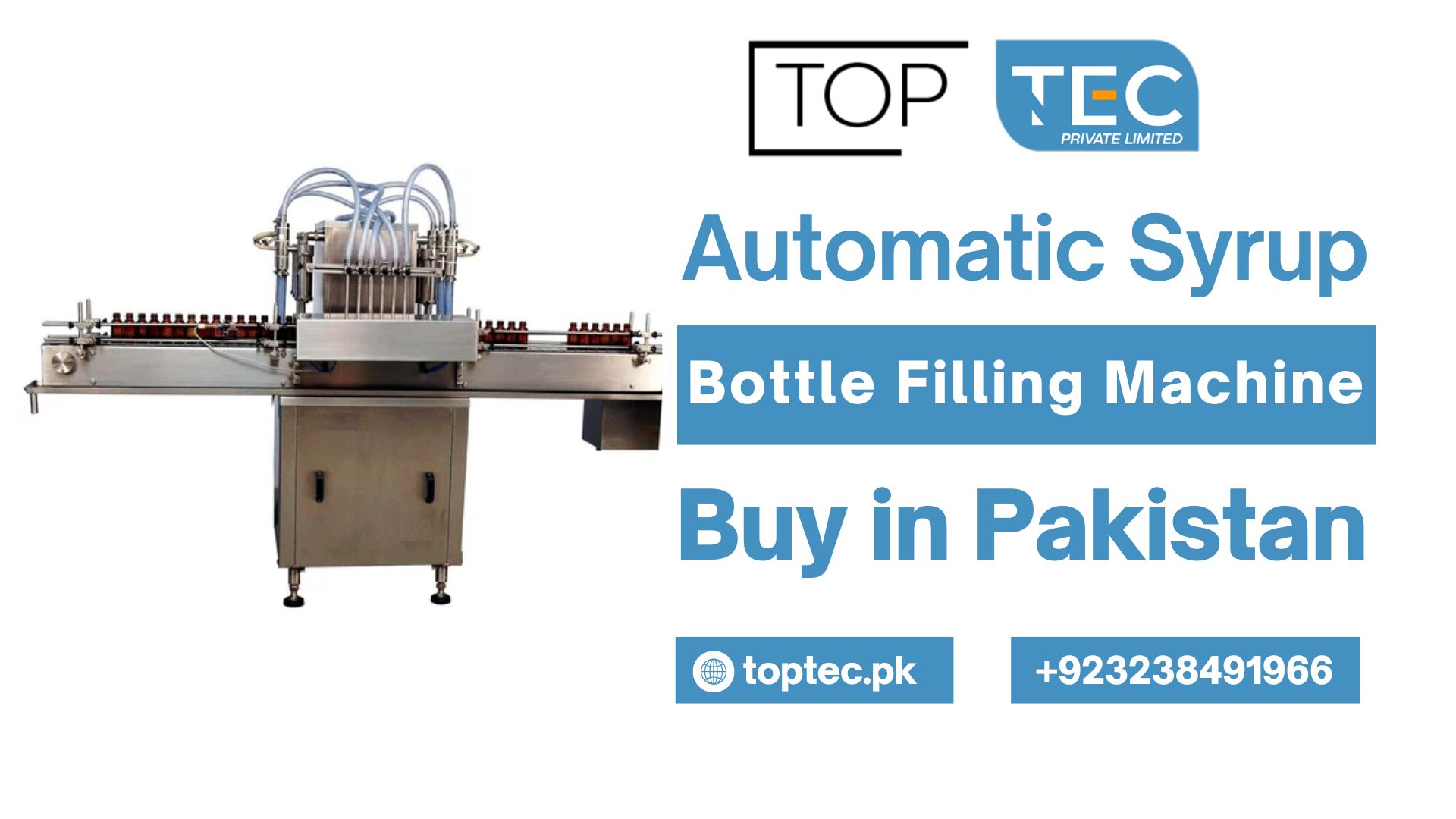
Do you need Automatic Syrup Bottle Filling Machine? Walk into a small pharmaceutical company or herbal syrup manufacturer in Pakistan — not the large multinationals with automated lines, but the mid-sized operations producing 2,000 to 5,000 bottles a day — and you’ll often see the same scene. Workers standing at benches, filling bottles manually or with semi-automatic equipment, struggling with inconsistent volumes, spillage, and a rejection rate that nobody’s happy about but everyone’s learned to tolerate.
I visited one such facility in Lahore about two years ago. Three workers were filling 100mL syrup bottles. Their line manager told me their target was 1,500 bottles per shift. They were actually achieving about 900 on a good day. Fill volumes varied by as much as ±5mL — technically a failure of their own specification. And one worker spent a significant portion of her time wiping down bottles because of drips and spills.
Six months later, they’d installed a semi-automatic syrup bottle filling machine. Same team, smaller crew, but 2,100 bottles per shift. Fill accuracy within ±0.5mL. Almost zero spillage.
The technology to solve this problem isn’t exotic or unaffordable. But choosing the right type of automatic syrup filler for your specific product, your volumes, and your regulatory environment requires understanding what’s actually available and how each filling technology actually works.
That’s what this article is about.
Why Syrup Filling Is More Complicated Than It Looks
Filling a bottle with liquid seems straightforward. Open a valve, let liquid in, close valve, move to next bottle. But achieving consistent, accurate, contamination-free fills at production speeds across thousands of bottles per batch is where the engineering gets interesting.
Syrups present specific challenges that make filling more demanding than filling water or simple solutions:
Viscosity variation: A simple sugar syrup might be 50-100 cP at room temperature. A thickened pediatric suspension might be 500-2000 cP. High-viscosity products flow slowly and resist pumping. The filling technology that handles one of these well might completely fail with the other.
Temperature dependence: Viscosity changes with temperature. A syrup that fills beautifully at 25°C in summer might be significantly thicker at 18°C in winter, changing fill rates and accuracy if the system doesn’t compensate.
Suspension settling: Many pharmaceutical syrups are suspensions — the active ingredient is dispersed as particles rather than dissolved. These particles settle. If the supply tank isn’t continuously agitated, bottles filled at the start of a batch have different drug content than bottles filled at the end.
Foaming: Some syrups — particularly those containing surfactants, proteins, or certain excipients — foam aggressively when agitated or when liquid hits a surface. Foam in a filling machine creates inaccurate fill volumes and messy product on bottle exteriors.
GMP requirements: For pharmaceutical products, every aspect of filling must be documented, validated, and capable of being cleaned to defined standards. This eliminates some filling technologies that might otherwise be appropriate.
Understanding these challenges helps you evaluate whether a given syrup bottle filling machine type will actually work for your specific product.
Technology 1 — Piston Filling (Volumetric)
The piston filler is the most widely used automatic syrup filler in pharmaceutical manufacturing. Understanding how it works explains why.
The Basic Mechanism
A piston moves back and forth inside a precision-machined cylinder. On the backward stroke (piston retracting), the product valve opens to the supply tank and product is drawn into the cylinder. On the forward stroke (piston advancing), the product valve closes, the nozzle valve opens, and the product is pushed out of the cylinder through the filling nozzle into the bottle.
The fill volume equals the cylinder volume displaced during the forward stroke. Change the stroke length, and you change the fill volume. The fill volume is physically determined by the mechanical stroke — it doesn’t depend on timing, pressure, or viscosity the way other methods do.
This is what makes piston filling the dominant technology for pharmaceutical syrups: the fill volume is mechanically defined and mechanically consistent.
Why This Is a True Volumetric Filling Machine
A piston filler is a true volumetric filling machine in the most literal sense. You’re literally measuring a defined volume of liquid with each stroke. If the cylinder has a 100mL stroke volume and the piston completes that stroke, 100mL of product goes into the bottle — regardless of whether the product is thick or thin, warm or cool, foamy or not.
This volume consistency — not just accuracy on average, but accuracy on every individual fill — is critical for pharmaceutical products where every bottle must contain the labeled dose within a tight tolerance.
Practical Accuracy
Well-designed pharmaceutical piston fillers achieve fill accuracy of ±0.5% or better — meaning a 100mL fill is consistently between 99.5mL and 100.5mL. This is substantially better than what timing-based or gravity-based systems achieve with viscous or variable-viscosity products.
Handling Different Viscosities
Piston fillers handle a wide viscosity range — from thin aqueous solutions to thick gels — because the piston physically pushes the product through the nozzle. The product doesn’t need to flow of its own accord; the mechanical force of the piston moves it.
Very thick products (above approximately 5,000 cP) may need larger diameter nozzles and slower filling speeds to avoid excessive pressure on the mechanical components. But the operating range is much wider than gravity or time-pressure filling.
Nozzle Design
The filling nozzle connects the piston cylinder to the bottle. Two design features matter enormously for product quality:
Diving nozzles: The nozzle enters the bottle and rises as filling progresses, keeping the nozzle tip below the liquid surface throughout filling. This prevents splashing, dramatically reduces foaming, and keeps the bottle exterior clean. For pharmaceutical syrups — where clean bottle exteriors are important for labeling adhesion and appearance — diving nozzles are strongly preferred.
Anti-drip (suck-back) mechanisms: At the end of each fill, the nozzle must stop dispensing cleanly without dripping. Anti-drip mechanisms either use a spring-loaded valve that closes positively at fill completion, or a brief reverse piston movement (suck-back) that pulls liquid back from the nozzle tip. Without this, product drips onto the bottle exterior and accumulates on the machine — creating cleaning problems and cross-contamination risk.
Number of Heads
A single-head piston filler has one cylinder and one nozzle — fills one bottle at a time. Multi-head fillers have multiple cylinders operating simultaneously:
- 2-head: 1,000-3,000 bottles/hour
- 4-head: 3,000-8,000 bottles/hour
- 6-head: 6,000-15,000 bottles/hour
- 8+ head: Higher volumes, typically continuous rotary filling
For most mid-sized Pakistani pharmaceutical operations, a 4-head or 6-head syrup bottle filling machine with piston technology covers the production volume requirement while keeping investment and complexity manageable.
Cleaning Considerations
Piston fillers for pharmaceutical use must be cleanable to GMP standards. Look for:
- CIP (Clean-in-Place) compatibility: Cleaning solution can be circulated through the system without full disassembly
- Tool-free disassembly: Product contact parts remove without tools for manual cleaning where CIP can’t reach
- Smooth internal surfaces: No threads, crevices, or dead legs where product accumulates
- Gasket materials: FDA-approved silicone or PTFE for all product-contact seals
Technology 2 — Peristaltic Filling
The peristaltic automatic syrup filler works on a completely different principle from piston filling. Instead of a cylinder and piston, it uses rotating rollers that squeeze flexible tubing to push product through.
How Peristaltic Filling Works
A series of rollers mounted on a rotating head compress flexible tubing against a curved track. As each roller passes, it squeezes the tubing, pushing a slug of liquid forward. The next roller catches the tubing behind the first, preventing backflow. The result is a continuous wave of product moving through the tube in the direction of roller rotation.
The fill volume depends on the tubing’s internal diameter and the number of roller revolutions. To change fill volume, you change the number of revolutions or the tubing diameter.
The Key Advantage — No Product Contact With the Pump
In a peristaltic system, product only ever contacts the inside of the flexible tubing. It never touches the pump rollers, bearings, or any metal pump components. This has significant implications:
For sterile products: The tubing can be pre-sterilized by gamma irradiation or autoclaving and is essentially a single-use sterile flow path. Product sterility is maintained without requiring the pump mechanism itself to be sterilized.
For potent or toxic compounds: The product is fully contained within the tubing. There’s no pump mechanism to clean that had product contact. Replace the tubing, and the pump is ready for the next product.
For sensitive biologics: Peristaltic filling is gentle — the rolling action creates minimal shear stress on the product. This matters for biologics where protein denaturation from shear is a concern.
Limitations of Peristaltic Filling
Tubing wear: This is the fundamental limitation. The continuous squeezing action wears the tubing over time. As the tubing wall becomes thinner and loses its elastic recovery, the fill volume changes. You’re essentially changing the calibration of the system as the tubing ages.
For a syrup bottle filling machine running production batches, this means tubing must be replaced on a defined schedule — not based on appearance, but based on actual fill volume verification. In pharmaceutical GMP environments, this requires documented tubing change intervals and fill volume checks.
Cost of tubing: Pharmaceutical-grade peristaltic tubing (silicone or fluoropolymer, free of extractables that could contaminate product) isn’t inexpensive. For high-volume operations, tubing replacement costs accumulate.
Viscosity limitations: Peristaltic pumps handle thin to medium viscosity products well. For very thick syrups (above approximately 1,000-2,000 cP), the rollers may struggle to adequately squeeze product through the tubing, and tube wear accelerates. Piston filling is generally better for high-viscosity pharmaceutical syrups.
Accuracy: Peristaltic filling typically achieves ±1-2% fill accuracy — adequate for many applications but generally not as tight as piston filling for variable-viscosity pharmaceutical products.
When Peristaltic Filling Is the Right Choice
- Small-scale or laboratory-scale filling (R&D, clinical trial batches)
- Sterile filling where a simplified sterile flow path is important
- Products where zero metal contact with product is required
- Filling of potent or highly active compounds where containment is important
- Flexible filling of multiple small-volume products with quick product changeover (just change the tubing)
For routine commercial pharmaceutical syrup production at scale, peristaltic filling is less common than piston filling. For specialty applications where its specific advantages matter, it’s the right choice.
Technology 3 — Gravity Filling (Time-Pressure Filling)
Gravity filling is the simplest filling technology. It’s also the most limited — and understanding its limitations explains why it’s rarely appropriate for pharmaceutical syrup production.
How Gravity Filling Works
Product is held in an elevated supply tank. A valve beneath the tank opens for a timed period, allowing product to flow by gravity into the bottle below. Close the valve after the set time period, and in theory a consistent volume has been dispensed.
In practice, the “in theory” part is where problems emerge.
The Fundamental Problem — Volume Depends on More Than Time
The volume dispensed in a given time period depends on:
- Liquid head height: As the supply tank empties, head pressure decreases, flow rate decreases, and volume per unit time decreases. The first bottle in a batch receives more product than the last if the tank level drops significantly.
- Product viscosity: Thicker products flow more slowly than thin ones. Temperature changes change viscosity, which changes flow rate, which changes fill volume. A syrup formulation that fills accurately at 25°C may significantly under-fill or over-fill at 20°C.
- Nozzle condition: Any partial blockage, product buildup, or nozzle wear changes the flow rate and therefore the fill volume.
These dependencies mean that gravity filling is fundamentally a timing-based approximation rather than a true volumetric filling machine. It’s appropriate where:
- Product viscosity is low and consistent
- Product temperature is controlled and stable
- Fill accuracy requirements are not tight (±2-3% might be acceptable)
- The application is non-pharmaceutical (food service, cleaning products, cosmetics)
Can Gravity Filling Ever Be Used for Pharmaceutical Syrups?
Rarely, and with significant limitations. Simple sugar syrups with very low, consistent viscosity — something like a flavored simple syrup — might be fillable with gravity filling if the product temperature and tank level are carefully controlled. But any suspension, any high-viscosity product, any product where temperature varies during the production run — these all present problems that gravity filling can’t reliably handle.
For pharmaceutical products where fill accuracy is a critical quality attribute and where regulatory documentation is required, a gravity syrup bottle filling machine is almost never the appropriate choice. Piston filling provides the accuracy and consistency that pharmaceutical GMP requires.
Comparing the Three Technologies — A Practical Summary
| Feature | Piston (Volumetric) | Peristaltic | Gravity |
|---|---|---|---|
| Fill accuracy | ±0.5% or better | ±1-2% | ±2-5% |
| Viscosity range | Wide (up to 5,000+ cP) | Medium (up to ~2,000 cP) | Low (<100 cP) |
| Product contact (non-tubing) | Yes (stainless steel) | No (tubing only) | Yes |
| Sterile applications | With CIP/SIP | Yes (disposable tubing) | Limited |
| GMP compliance | Excellent | Good | Poor for pharma |
| Production speed | High | Medium | Medium |
| Maintenance | Piston seals | Tubing replacement | Simple |
| Cost | Medium-high | Medium | Low |
| Best for | Pharmaceutical syrups | Sterile/potent products | Non-pharma liquids |
Integrating the Filler Into a Complete Line
A syrup bottle filling machine — regardless of whether it uses piston, peristaltic, or gravity technology — doesn’t operate in isolation. It’s part of a production line, and the performance of the line depends on all components working together.
Upstream — Bottle Handling
Bottles arrive from storage, need to be rinsed (air or water rinse to remove dust and debris), and fed to the filling station upright and at consistent spacing. Bottle rinsers, unscramblers, and conveyor systems upstream of the filler affect how consistently bottles arrive at the fill nozzles.
If bottles arrive at the filler inconsistently — sometimes too fast, sometimes too slow, sometimes tilted — fill quality degrades. A well-matched conveyor and bottle-handling system feeding the filler at consistent intervals is as important as the filler itself.
Downstream — Capping and Sealing
After filling, bottles move to capping. For a syrup bottle filling machine on a pharmaceutical line, the capper needs to:
- Apply caps at the correct torque (too loose means caps back off; too tight means caps crack or become difficult for patients to open)
- Handle child-resistant closures if required by your product
- Keep pace with the filler output speed
Induction heat sealing (applying a foil seal under the cap for tamper evidence) typically occurs between filling and capping, or between capping and labeling.
The Complete Line
A complete automatic syrup filler line for pharmaceutical production typically includes:
- Bottle unscrambler and conveyor
- Bottle rinser (air or water)
- Filling machine (piston, peristaltic, or gravity)
- Induction sealer (for foil-sealed products)
- Capping machine
- Labeling machine
- Batch coding (inkjet or laser)
- Inspection (fill level, cap presence, label placement)
- Packaging and cartoning
Matching the throughput of each component to the others — so no single station becomes a bottleneck — determines the overall line efficiency.
GMP Validation Requirements for Pharmaceutical Fillers
For pharmaceutical filling in Pakistan — whether operating under DRAP requirements or pursuing WHO prequalification — the automatic syrup filler must be validated before routine production use.
IQ/OQ/PQ
Installation Qualification (IQ): Documenting that the machine was installed correctly — received as specified, installed per manufacturer requirements, connected to appropriate utilities, with all documentation on file.
Operational Qualification (OQ): Testing that the machine operates within specified parameters — fill volume accuracy across the operating range, fill speed, alarm functions, CIP cycle effectiveness.
Performance Qualification (PQ): Demonstrating consistent performance during actual production conditions — filling accuracy across a full batch, at the beginning, middle, and end of the batch, with different operators, over multiple consecutive batches.
Fill Volume Validation
For a volumetric filling machine using piston technology, validation of fill accuracy typically involves:
- Filling sample bottles at defined intervals during a production run (every 15-30 minutes)
- Weighing filled containers on a calibrated analytical balance
- Converting weight to volume using product density
- Confirming all results fall within defined acceptance criteria (typically ±1-2% depending on fill volume and regulatory requirements)
Cleaning Validation
The filling machine must be cleaned between products and, in many cases, between batches of the same product. Cleaning validation demonstrates that the cleaning procedure reliably reduces product residue, cleaning agent residue, and microbiological contamination to acceptable limits.
TOPTEC PVT. LTD — Manufacturing Support for Your Filling Operation
The syrup bottle filling machine itself gets the most attention in production discussions. But the laboratory and production infrastructure around it — QC testing equipment, laboratory furniture, workbenches for in-process checks — is equally important for maintaining product quality.
TOPTEC PVT. LTD manufactures laboratory furniture right here in Pakistan. For pharmaceutical manufacturing companies operating syrup filling lines, TOPTEC provides infrastructure that supports quality operations:
Laboratory workbenches — For in-process QC activities, fill volume verification, and documentation associated with filling line operations. Chemical-resistant countertops in epoxy resin, stainless steel, or phenolic resin appropriate for pharmaceutical environments.
Anti-vibration tables and instrument benches — For the analytical balances used to verify fill volume during production, and for other sensitive instruments used in QC testing.
Cleanroom furniture — Stainless steel tables, trolleys, and seating for filling areas that require controlled environment conditions. Smooth, non-particle-generating surfaces that don’t undermine cleanliness levels.
Fume hoods — For handling chemical reagents used in QC testing associated with filled product.
Pass boxes — For transferring samples between the filling area and QC laboratory without compromising environmental integrity of either space.
Chemical storage cabinets — For organized, appropriate storage of cleaning agents, sanitizers, and chemical reagents associated with the filling operation.
Why TOPTEC Makes Sense
Pharmaceutical companies in Pakistan running syrup filling operations face a practical challenge: regulatory requirements demand international-standard laboratory infrastructure, but importing everything adds significant cost.
TOPTEC manufactures locally. No import freight, no customs duties, no 12-week delivery wait. Customization to your specific facility layout is straightforward — not a catalog limitation. After-sales support is accessible in Pakistan. And pricing reflects the actual manufacturing cost without layers of international procurement overhead.
When a Pakistani pharmaceutical company invests in a quality automatic syrup filler for their production line, the surrounding laboratory and production infrastructure should match that investment. TOPTEC provides that infrastructure locally, at competitive pricing, with practical support.
Practical Buying Advice
If you’re evaluating syrup bottle filling machine options for your facility, here’s what I’d recommend thinking through before talking to any supplier:
Know your product viscosity — across temperature range: Test your product viscosity at the minimum and maximum temperatures you’ll encounter in production. This single specification eliminates technologies that won’t work for your product.
Calculate your actual required throughput: Don’t spec to aspirational production volumes. Calculate what you genuinely need per shift, factor in 80% realistic line efficiency, and size accordingly. An over-specified machine costs more to buy and maintain than necessary.
Think about the complete line: A filling machine that outpaces your capper creates a bottleneck. A filling machine that your bottle rinser can’t feed consistently creates stoppages. Evaluate the complete line, not just the filler.
Ask specifically about validation support: For pharmaceutical GMP applications, does the supplier provide IQ/OQ/PQ documentation templates? Can they support cleaning validation protocol development? This isn’t optional — it’s a requirement.
Verify local service capability: A filling machine that stops working and can’t be serviced locally costs you production days. Before purchasing any automatic syrup filler, verify that the supplier or their representative has qualified service engineers in Pakistan with parts availability.
Final Thoughts
The right syrup bottle filling machine for your operation depends on your product, your volume, your regulatory requirements, and your budget. Piston filling offers the best accuracy and consistency for pharmaceutical syrups across a wide viscosity range — it’s the dominant technology for good reasons. Peristaltic filling offers unique advantages for sterile and potent products where product containment and simplified sterile flow paths matter. Gravity filling serves limited non-pharmaceutical applications where accuracy requirements are relaxed.
Get the technology match right, integrate it into a properly matched complete line, validate it according to applicable GMP requirements, and operate it with properly trained staff following documented procedures.
And make sure the laboratory and production infrastructure around your automatic syrup filler — including quality laboratory furniture from TOPTEC PVT. LTD — supports the quality operation you’re building.
Pakistan’s pharmaceutical industry is growing. The production standards expected by regulatory authorities — DRAP, WHO, and export market regulators — are increasing. Investing in proper filling technology and proper laboratory infrastructure isn’t just good practice. It’s what positions your facility for the market your products are heading toward.
