

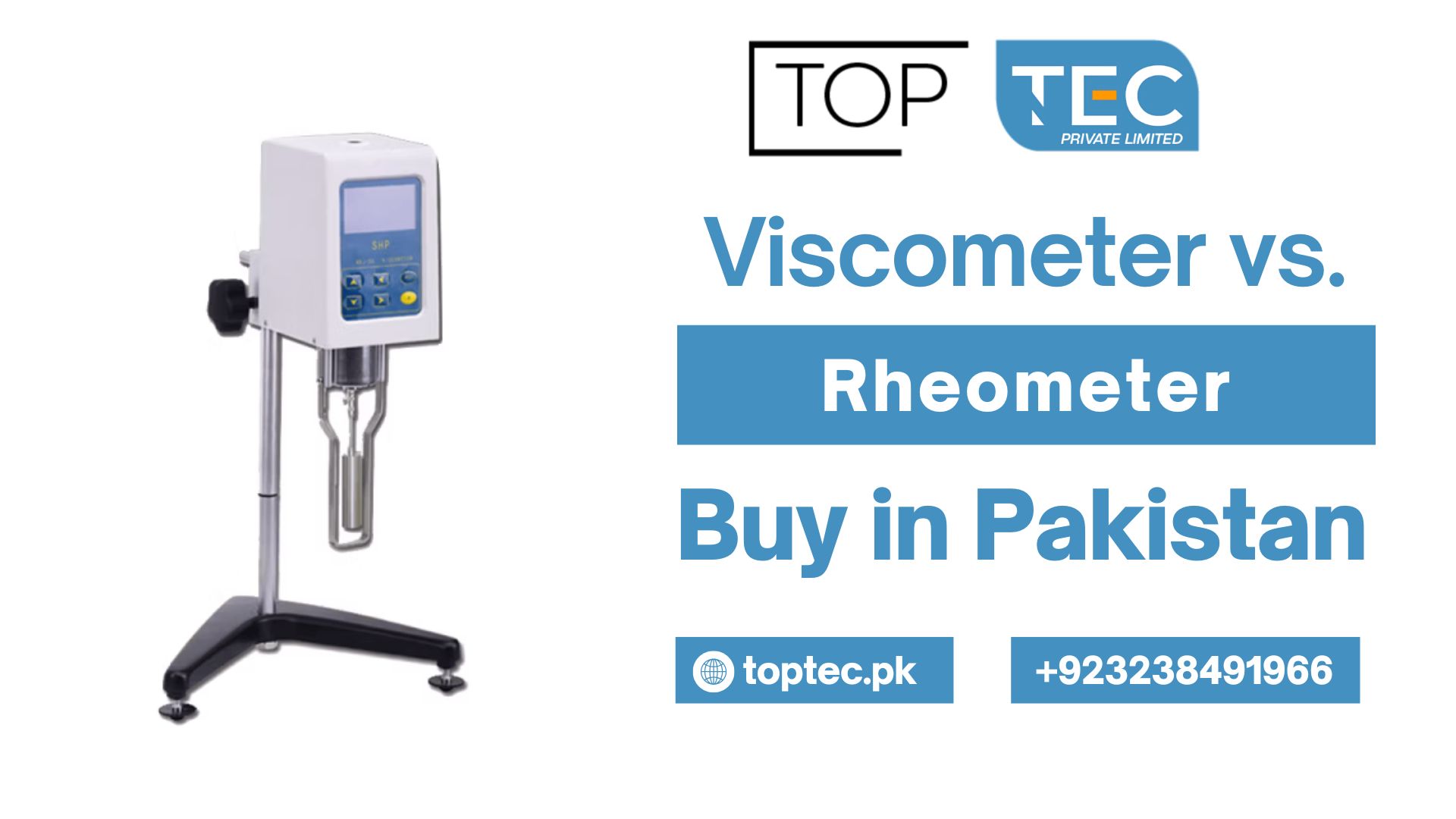
Compare viscosity and rheology instruments by test capability, sample type, application, cost and QC requirements. Learn which option fits your laboratory.
A cough syrup that pours well in winter may become noticeably thinner during summer. A cream can remain firm in its container but spread easily once rubbed onto the skin. Paint should move smoothly under a brush, yet stop running after it reaches the wall.
These products cannot always be described by one viscosity reading.
That is the real Viscometer vs. Rheometer decision. Do you only need a repeatable viscosity value at fixed conditions, or do you need to understand how the product behaves during mixing, pumping, filling, storage and use?
Both Viscometer and Rheometer instruments measure material flow, but they do not provide the same depth of information. Choosing correctly can save money, shorten testing time and produce data that actually answers the laboratory’s question.
Why Viscometer and Rheometer Are Often Confused
Both instruments may use a rotating spindle, cup, cone or plate. They may even look similar when placed on a laboratory bench. That visual similarity is one reason buyers sometimes assume the difference is mainly price.
It is not.
The Viscometer vs. Rheometer distinction is mostly about control and information. A viscometer usually measures resistance to flow under selected conditions. A rheometer can control stress, shear rate, strain, frequency and temperature while studying both flow and structural deformation.
There is some overlap. An advanced rotational viscometer may produce a basic flow curve, while a simple rheometer can perform routine viscosity tests. The correct choice therefore depends on the method and sample—not just the instrument name printed on the front panel.
What Does a Viscometer Measure?
A viscometer measures a fluid’s resistance to flow. In many routine laboratories, it is used to determine whether a batch falls within a predefined viscosity range.
For example, a syrup specification may require a result between 1,200 and 1,500 mPa·s at 25°C using a particular spindle and speed. If that is the complete testing requirement, the Viscometer vs. Rheometer question may have a simple answer: a suitable rotational viscometer is enough.
Common viscometer types include:
Rotational Viscometer
A spindle rotates in the sample at a selected speed. The instrument measures the torque required to maintain that movement and calculates apparent viscosity.
It is commonly used for:
- Pharmaceutical syrups
- Suspensions
- Lotions
- Creams
- Paint
- Detergents
- Oils
- Food products
Rotational units are popular because they are relatively easy to operate and can test a broad viscosity range by changing the spindle and speed.
Capillary Viscometer
A liquid flows through a narrow capillary under gravity. The time required to pass between two marks is used to calculate kinematic viscosity.
This method is best suited to transparent Newtonian liquids such as solvents, light oils and dilute polymer solutions.
Falling-Ball Viscometer
The speed at which a ball falls through a sample is related to its viscosity. It is useful for certain transparent liquids but is less suitable for opaque or particle-containing products.
Flow Cup
The time taken for a liquid to drain through an opening is measured. Flow cups are common in coatings and printing laboratories where a quick production check is more important than detailed rheological analysis.
This is one reason Viscometer and Rheometer equipment should not be treated as direct substitutes. A routine flow cup and a research rheometer may both produce information related to flow, but their measurement control and intended uses are very different.
What Does a Rheometer Measure?
A rheometer examines how a material flows and deforms when carefully controlled forces are applied. It can study simple liquids, but its real strength is the analysis of structured, non-Newtonian materials.
The Viscometer vs. Rheometer difference becomes clear when a laboratory needs to measure:
- Yield stress
- Thixotropy
- Structural recovery
- Shear-thinning behaviour
- Shear-thickening behaviour
- Storage modulus
- Loss modulus
- Creep and recovery
- Stress relaxation
- Gel strength
- Temperature-dependent transitions
Common rheometer geometries include:
Cone-and-Plate
A shallow cone rotates over a flat plate with a small sample held in the gap. This geometry provides a well-defined shear rate and uses little sample.
It works well for homogeneous creams, liquids, polymer solutions and formulations without large particles.
Parallel Plate
The sample is loaded between two flat plates. This arrangement is suitable for gels, pastes, semi-solids and materials containing particles that may not fit within a narrow cone-and-plate gap.
Concentric Cylinder
The sample occupies the space between an inner rotating cylinder and an outer cup. It is commonly used for low- and medium-viscosity liquids.
Vane Geometry
A vane is inserted into the sample with minimal disruption. It is particularly useful for structured suspensions, gels and products with measurable yield stress.
A useful way to think about Viscometer and Rheometer testing is this: the first often checks whether a batch meets a number, while the second helps explain why a material behaves the way it does.
Viscometer vs. Rheometer: Direct Comparison
The practical capabilities of Viscometer and Rheometer systems can be compared as follows:
| Feature | Viscometer | Rheometer |
|---|---|---|
| Main purpose | Routine viscosity measurement | Detailed flow and deformation analysis |
| Typical result | One or several viscosity values | Flow curves, yield stress and viscoelastic data |
| Shear-rate control | Limited to moderate | Precise and wide-ranging |
| Stress control | Limited or unavailable | Available |
| Oscillatory testing | Usually unavailable | Available |
| Yield-stress testing | Approximate on some models | Controlled measurement |
| Viscoelastic testing | No | Yes |
| Temperature programs | Basic or optional | Advanced ramps and profiles |
| Operator training | Basic to moderate | Moderate to advanced |
| Method development | Relatively simple | More involved |
| Purchase cost | Lower | Higher |
| Typical use | Production and routine QC | R&D, troubleshooting and advanced QC |
A rheometer is more capable, but greater capability is not always necessary. An instrument should be selected because it answers the test objective—not because it has the longest feature list.
Understanding Non-Newtonian Behaviour
The Viscometer vs. Rheometer choice matters most when the sample’s apparent viscosity changes with force, speed or time.
Shear-Thinning Materials
A shear-thinning product becomes less viscous as shear rate increases.
Common examples include:
- Pharmaceutical suspensions
- Shampoo
- Ketchup
- Paint
- Creams
- Polymer solutions
This behaviour is often intentional. A pharmaceutical suspension should be thick enough during storage to slow particle settling, but it should become easier to pour after shaking.
Shear-Thickening Materials
A shear-thickening product becomes more viscous as shear rate increases. This behaviour may occur in concentrated particle suspensions and can create unexpected pumping or mixing difficulties.
Yield Stress
Some products behave like soft solids until a minimum force is applied. That minimum force is known as yield stress.
Yield stress helps determine whether:
- Particles remain suspended
- A gel holds its shape
- A cream stays in place
- Product begins moving through a pump
- A semi-solid can be squeezed from a tube
Thixotropy
Thixotropic products become less viscous while being sheared and gradually rebuild their structure after the force is removed.
This matters during manufacturing because a product may be mixed, pumped and filled before being stored. If it does not recover its structure, stability or application performance may change.
Viscoelasticity
Viscoelastic products show both liquid-like and solid-like behaviour. Rheometers study this through oscillatory tests.
Two common results are:
- Storage modulus (G′): The elastic or solid-like component
- Loss modulus (G″): The viscous or liquid-like component
These values are useful when evaluating gels, creams, pastes, polymer formulations and soft pharmaceutical products.
Applications for Viscometer and Rheometer Instruments
Pharmaceutical Products
In pharmaceutical testing, the Viscometer vs. Rheometer choice depends on dosage form and development stage.
Simple oral solutions and syrups may only need a routine viscosity result at a controlled temperature. Suspensions, however, may require investigation of shear thinning, yield stress and structural recovery.
Creams and ointments are even more complex. Their performance may depend on:
- Spreadability
- Extrusion from a tube
- Stability during storage
- Recovery after application
- Resistance to phase separation
In pharmaceutical development, Viscometer and Rheometer methods often complement each other. Rheological testing helps researchers understand the formulation, while a simpler rotational method may later be validated for routine batch release.
Cosmetics and Personal Care
Shampoo, toothpaste, lotions, conditioners and facial gels must be stable in the package but easy to dispense and apply.
A viscometer may support routine consistency checks. A rheometer can compare product structure, pumping behaviour and recovery after application.
Food and Beverage
Sauces, yoghurt, mayonnaise, chocolate and dairy products often display non-Newtonian behaviour. Texture and mouthfeel may depend on flow properties that one viscosity reading cannot fully describe.
Paint, Ink and Coatings
Paint needs to remain stable in its container, move under a roller and level after application without dripping. A rheometer can measure behaviour across the shear conditions found during storage, mixing and application.
Polymers and Adhesives
Polymer solutions, sealants and adhesives may undergo complex changes with temperature, curing time and deformation. Advanced rheological tests are often needed for product development and process optimisation.
Oils and Lubricants
Many simple oils can be assessed using capillary or rotational methods. More advanced testing may be required for greases, additives and lubricants exposed to changing temperatures and stresses.
Viscometer vs. Rheometer Selection Guide
Before buying Viscometer and Rheometer equipment, write down the exact question the test must answer. This step prevents a common purchasing problem: selecting an advanced instrument and later discovering that the routine laboratory only needs a basic release test.
Choose a Viscometer If:
- A specification requires one viscosity value
- The spindle, speed and temperature are already defined
- The material is Newtonian or moderately non-Newtonian
- Testing must be fast and easy to repeat
- The instrument will mainly support production QC
- Operator training time needs to remain short
- The laboratory has a limited budget
- Existing validated methods use a capillary or rotational system
Choose a Rheometer If:
- Viscosity changes substantially with shear rate
- Yield stress must be measured
- Structural recovery is important
- Gel strength needs to be compared
- Oscillatory testing is required
- Processing conditions need to be simulated
- Temperature ramps or curing studies are necessary
- Product failures cannot be explained by a routine viscosity result
- The instrument will support formulation development
A Quick Decision Test
The Viscometer vs. Rheometer decision can often be narrowed down with three questions:
- Do you need one repeatable QC value?
Start with a viscometer. - Do you need to know how the material changes during pumping, spreading or storage?
Consider a rheometer. - Do you need both development data and a simple release test?
Use rheometry during development, then establish a practical viscometer method for routine QC.
This combined approach can reduce routine testing time without losing the deeper product understanding gained during development.
Test Conditions Must Be Controlled
Even a premium instrument gives poor data if the method is vague. In every Viscometer vs. Rheometer method, control the following variables.
Temperature
Most liquids become less viscous as temperature rises. Even a difference of 1°C may noticeably affect a thick syrup or polymer solution.
The method should define:
- Target temperature
- Permitted tolerance
- Equilibration time
- Temperature-control system
- Position of the temperature probe
Spindle or Geometry
Results obtained with different spindles, cones or plates may not be directly comparable. The selected geometry and relevant dimensions should be included in the test method.
Speed, Shear Rate or Stress
A result at 10 rpm should not be compared casually with one recorded at 100 rpm. This is particularly important for shear-thinning products.
Sample Preparation
Mixing, shaking, settling, entrapped air and storage history can all change results. Sample preparation should be standardised.
Loading Technique
Overfilling, underfilling or trapping air beneath a plate affects the measurement. Operators need practical training rather than relying only on written instructions.
Measurement Time
Some products continue changing while under shear. The method should define when the reading is recorded and whether equilibrium must be reached first.
Standards, Qualification and Data Integrity
Methods for Viscometer and Rheometer testing may refer to:
- USP
<911>for capillary viscosity - USP
<912>for rotational viscosity - European Pharmacopoeia viscosity methods
- ASTM D2196 for rotational testing of non-Newtonian materials
- ISO 3219 for rotational and oscillatory rheological methods
Always verify the current version and the applicable product monograph before finalising a procedure.
Routine performance controls should include:
- Instrument levelling
- Zero verification
- Checks with certified viscosity standards
- Temperature-probe calibration
- Spindle and geometry inspection
- Gap verification where applicable
- Preventive maintenance
- Software access control
- Audit-trail review in regulated systems
Qualification should demonstrate that the instrument is installed correctly, operates within approved limits and performs reliably with suitable standards or representative samples.
Cost and Total Ownership
The Viscometer vs. Rheometer cost comparison should include more than the purchase price.
A rheometer may require:
- Extra geometries
- Dedicated temperature-control accessories
- Advanced software
- Specialist training
- More detailed qualification
- Longer method-development time
- Higher servicing costs
A viscometer is generally less expensive and easier to maintain. That makes it a sensible choice for frequent routine testing.
The cheaper option is not always the better value, though. If a laboratory repeatedly investigates unstable gels or filling problems that routine viscosity data cannot explain, the additional information from a rheometer may prevent expensive formulation and production failures.
Common Selection Mistakes
A frequent Viscometer vs. Rheometer mistake is buying equipment before defining the method.
Other common errors include:
- Ignoring temperature control
- Comparing results from different spindles
- Reporting viscosity without speed or shear conditions
- Selecting a geometry unsuitable for the sample particles
- Failing to control the sample’s mixing history
- Allowing air bubbles to remain in creams and gels
- Using too little or too much sample
- Testing a settling suspension after inconsistent waiting periods
- Overlooking software data-integrity requirements
- Forgetting cleaning and cross-contamination controls
- Buying equipment without local servicing or spare parts
The instrument should fit the product, workflow and quality system.
Laboratory Furniture from TOPTEC PVT. LTD
Reliable measurements also depend on the physical environment around the instrument. Viscometer and Rheometer systems need stable, level benches located away from heavy vibration, direct sunlight, heat sources and strong HVAC airflow.
TOPTEC PVT. LTD manufactures laboratory furniture in Pakistan for pharmaceutical, industrial, educational and research facilities. Suitable products include:
- Stable instrument benches
- Anti-vibration tables where required
- Chemical-resistant laboratory workbenches
- Sample-preparation tables
- Reagent and equipment cabinets
- Laboratory sinks and fixtures
- Chemical-storage cabinets
- Fume hoods
- Cleanroom furniture
- Shelving systems
TOPTEC can manufacture furniture according to the instrument footprint, weight, operator working height, cable routing and storage needs. Local production offers shorter lead times, practical customisation and easier after-sales support than imported laboratory furniture.
A well-planned workstation should provide enough room for the instrument, computer, temperature-control unit, samples and cleaning accessories without crowding the operator.
Frequently Asked Questions
Can Viscometer and Rheometer results be compared directly?
Only when the test conditions are genuinely comparable. Geometry, temperature, shear rate, measurement time and sample preparation all influence the result. A spindle reading at a stated rpm may not match data from a controlled-shear test.
Can a rotational viscometer test non-Newtonian products?
Yes. Measuring at several speeds can show basic shear-dependent behaviour. However, it may not provide the precise stress control, low-shear capability or oscillatory modes available from a rheometer.
Is a rheometer always more accurate?
Not necessarily. Accuracy depends on the instrument, geometry, method and sample handling. A properly maintained viscometer can be highly repeatable for a defined QC method.
Which option is better for pharmaceutical syrup?
A rotational viscometer is usually adequate for routine syrup testing. A rheometer may be useful during development if pourability, suspension stability or filling behaviour requires deeper investigation.
Which option is better for creams and gels?
Routine cream QC may use a viscometer, but formulation development often benefits from yield-stress, thixotropy and oscillatory measurements.
Do these instruments require an anti-vibration table?
Not every model requires one, but the bench must be stable and level. An anti-vibration surface may be helpful where nearby machinery or foot traffic affects sensitive measurements.
Final Thoughts on Viscometer and Rheometer Selection
A sound Viscometer vs. Rheometer decision starts with the sample and the question behind the test. If the laboratory only needs a repeatable viscosity value under fixed conditions, a viscometer is often the practical choice. If the objective is to understand yield stress, recovery, gel structure or behaviour across changing shear conditions, a rheometer offers the required control.
When Viscometer and Rheometer methods are developed carefully, the two instruments can work together rather than compete. Use advanced rheology to understand the formulation, then create a simpler routine method where appropriate.
