

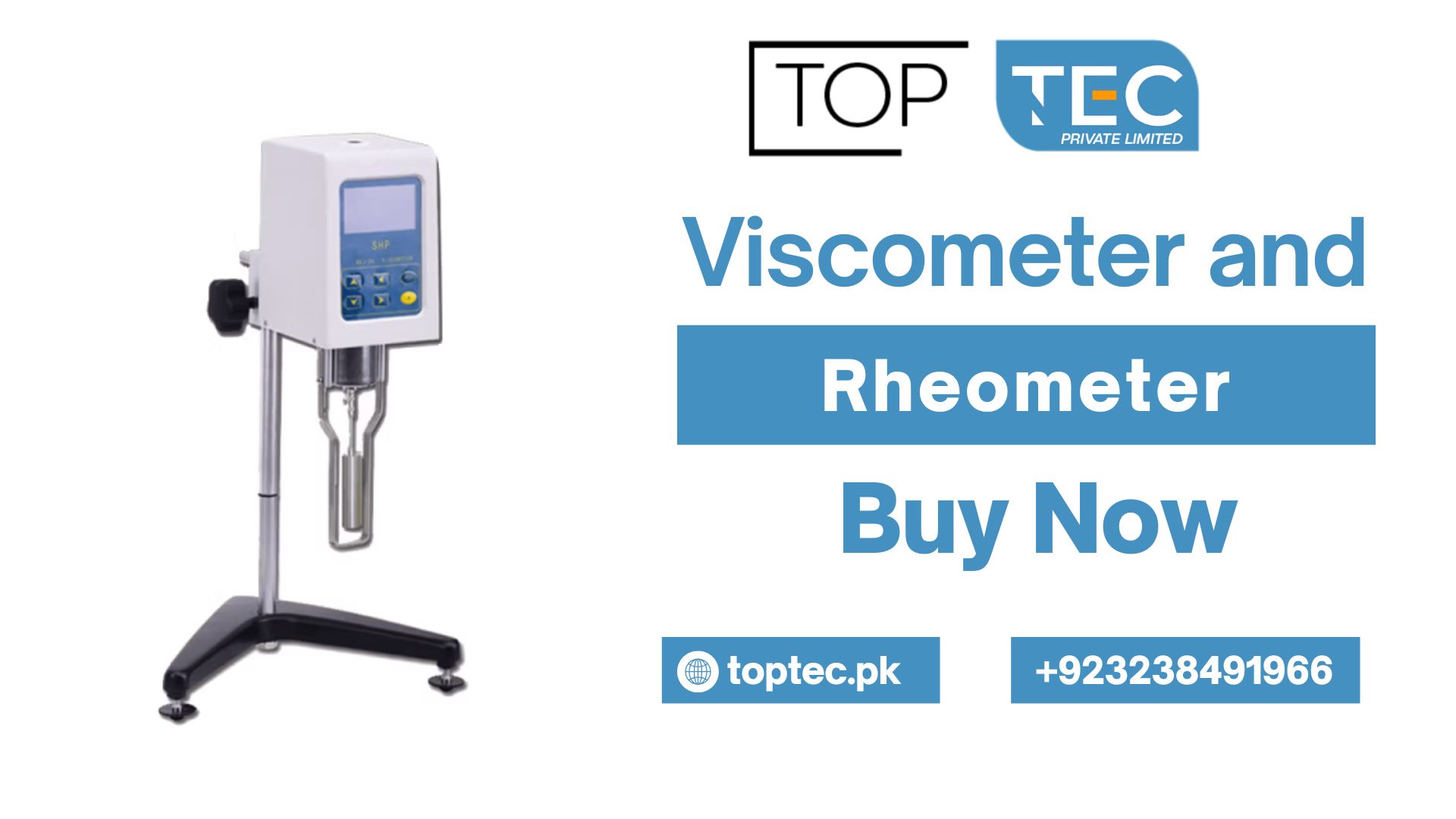
Understand the Viscometer vs. Rheometer comparison, including working principles, test capabilities, applications, costs and selection criteria.
A syrup may pour smoothly when the bottle is tilted but become thicker while sitting on a shelf. A cream can hold its shape in a jar yet spread easily when rubbed onto the skin. Paint appears thick in the container, flows under a brush and then stops running after application.
These materials cannot always be described by one viscosity number.
That is why the Viscometer vs. Rheometer choice deserves more thought than it usually receives. A viscometer is often sufficient for routine viscosity checks, especially when the test conditions are fixed. A rheometer goes further by showing how a material responds to different forces, speeds, temperatures and deformation patterns.
The right instrument depends on the sample, the purpose of testing and how much information is genuinely required.
What Is Viscosity?
Viscosity describes a fluid’s resistance to flow. Water has relatively low viscosity and moves easily. Honey, glycerine and thick pharmaceutical syrups have higher viscosity, so they flow more slowly.
For a simple Newtonian fluid:
Viscosity = Shear stress ÷ Shear rate
Shear stress is the force applied across a unit area of material. Shear rate describes how quickly adjacent layers move relative to one another.
For Newtonian fluids, viscosity remains essentially constant at a fixed temperature even when the shear rate changes. Water and many light oils behave approximately this way.
Non-Newtonian materials are different. Their apparent viscosity changes with shear rate, time or deformation history. Examples include:
- Pharmaceutical suspensions
- Creams and ointments
- Gels
- Toothpaste
- Paint
- Shampoo
- Ketchup
- Polymer solutions
- Adhesives
- Cosmetic emulsions
This difference between simple and complex flow behaviour is central to instrument selection.
What Is a Viscometer?
A viscometer measures viscosity under defined test conditions. It is generally used when the laboratory needs a reliable numerical result for routine quality control, product comparison or specification testing.
The instrument may measure how quickly a liquid passes through a tube, how fast an object falls through it or how much resistance a rotating spindle experiences.
In practical Viscometer vs. Rheometer discussions, the viscometer is usually the simpler option. It often provides one viscosity value—or a limited set of values—at specified temperatures and test speeds.
Common Types of Viscometers
Rotational Viscometer
A spindle rotates in the sample at a selected speed. The instrument measures the torque needed to maintain that rotation and converts it into viscosity.
Rotational units are widely used for:
- Syrups
- Suspensions
- Creams
- Lotions
- Paint
- Food products
- Detergents
- Oils
A basic rotational model can test several spindle speeds, making it possible to observe limited non-Newtonian behaviour. However, it usually offers less precise shear control and fewer advanced test modes than a rheometer.
Capillary Viscometer
The time required for a known liquid volume to flow through a narrow capillary under gravity is measured. Kinematic viscosity is calculated from flow time and the instrument constant.
Capillary methods work well for Newtonian liquids such as:
- Solvents
- Light oils
- Transparent chemical liquids
- Dilute polymer solutions
They are generally unsuitable for samples containing large suspended particles or materials that do not flow consistently through a narrow tube.
Falling-Ball Viscometer
A ball falls through a sample under gravity. Its falling speed is related to the sample’s viscosity.
This method can be useful for transparent Newtonian liquids but is less appropriate for opaque, highly structured or rapidly settling products.
Flow Cup
A defined liquid volume drains through an opening at the bottom of a cup. The flow time provides an empirical viscosity result.
Flow cups are common in coatings, inks and industrial production checks. They are convenient but provide less detailed information than controlled rotational measurements.
What Is a Rheometer?
A rheometer measures how a material flows and deforms under carefully controlled forces. It can control shear stress, shear rate, strain, frequency and temperature while recording the material’s response.
A rheometer may determine:
- Viscosity across a broad shear-rate range
- Yield stress
- Thixotropy
- Viscoelasticity
- Storage modulus
- Loss modulus
- Creep and recovery
- Stress relaxation
- Structural recovery
- Temperature-dependent transitions
- Gel formation
- Flow behaviour under simulated processing conditions
The Viscometer vs. Rheometer distinction is therefore not simply “basic instrument versus expensive instrument.” It is a question of measurement depth. The first is suitable for many routine viscosity tests; the second is designed to characterise complex material behaviour.
Common Rheometer Geometries
Cone-and-Plate
A shallow cone rotates over a flat plate with the sample held in a narrow gap. This geometry provides a well-defined shear rate and requires a small sample volume.
It works well for homogeneous liquids, creams, polymer solutions and formulations without large particles.
Parallel Plate
The sample is placed between two flat circular plates. Parallel plates are useful for semi-solids, gels, pastes and materials containing particles too large for a narrow cone-and-plate gap.
Concentric Cylinder
The sample fills the space between an inner cylinder and an outer cup. This arrangement is suitable for low- to medium-viscosity liquids and can reduce evaporation when a suitable cover is used.
Vane Geometry
A vane is inserted into a structured material with minimal disruption. It is useful for suspensions, gels and samples where loading with a standard spindle or plate could destroy the original structure.
Viscometer vs. Rheometer: Side-by-Side Comparison
The following table summarises the practical differences:
| Feature | Viscometer | Rheometer |
|---|---|---|
| Main purpose | Routine viscosity measurement | Complete flow and deformation analysis |
| Typical output | One or several viscosity values | Flow curves, moduli, yield stress and recovery data |
| Shear control | Limited to moderate | Precise and wide-ranging |
| Oscillatory testing | Usually unavailable | Available |
| Viscoelastic testing | No | Yes |
| Yield stress testing | Approximate on some models | Controlled and detailed |
| Temperature programs | Basic or optional | Advanced ramps and controlled profiles |
| Sample complexity | Simple to moderately complex | Simple, complex and structured materials |
| Operator training | Basic to moderate | Moderate to advanced |
| Method development | Relatively straightforward | More detailed |
| Purchase cost | Lower | Higher |
| Typical role | Production and routine QC | R&D, troubleshooting and advanced QC |
This Viscometer vs. Rheometer comparison shows why both instruments remain useful. A rheometer offers more information, but buying more capability than the laboratory needs can add unnecessary cost, training and validation work.
How Non-Newtonian Materials Behave
The Viscometer vs. Rheometer question becomes more important when the product does not behave like water or mineral oil.
Shear-Thinning Behaviour
A shear-thinning material becomes less viscous as shear rate increases. Examples include:
- Pharmaceutical suspensions
- Shampoo
- Paint
- Ketchup
- Many creams and lotions
This behaviour can be desirable. A suspension should remain reasonably thick while stored to slow sedimentation, but it should pour easily when the patient shakes and tilts the bottle.
A single viscosity value at one spindle speed does not describe the complete behaviour. A flow curve across several shear rates provides a clearer picture.
Shear-Thickening Behaviour
A shear-thickening material becomes more viscous as shear rate increases. Concentrated particle suspensions sometimes behave this way.
Although less common in routine pharmaceutical formulations, it can cause unexpected pumping, mixing or filling problems.
Yield Stress
Some materials do not begin to flow until the applied stress exceeds a certain point. That point is called yield stress.
Yield stress can affect:
- Whether particles remain suspended
- Whether a cream stays on the skin
- Whether a gel holds its shape
- Whether a product moves through a pump
- How easily a product starts flowing during filling
Thixotropy
A thixotropic material becomes less viscous while it is being sheared and gradually rebuilds its structure after the force is removed.
This matters when a product is mixed, pumped, filled and then stored. A good formulation may need to flow easily during manufacturing yet recover enough structure afterward to remain stable.
Viscoelasticity
Viscoelastic materials show both liquid-like and solid-like behaviour. Gels, creams, polymer solutions and soft solids often fall into this category.
Rheometers assess viscoelasticity through oscillatory testing, where a small back-and-forth deformation is applied without forcing the sample into continuous flow.
Two important results are:
- Storage modulus (G′): Indicates elastic or solid-like behaviour
- Loss modulus (G″): Indicates viscous or liquid-like behaviour
These measurements help formulation scientists study stability, texture and structural strength.
Viscometer vs. Rheometer Selection Guide
The best instrument is not necessarily the one with the most features. It is the one that answers the laboratory’s actual questions with suitable accuracy and repeatability.
Choose a Viscometer When:
- A routine viscosity value is needed for batch release
- The product specification identifies a defined spindle, speed and temperature
- Samples are Newtonian or only moderately non-Newtonian
- Testing must be quick and straightforward
- Operators have limited rheology training
- The laboratory needs a cost-effective QC solution
- Existing validated methods already use a rotational or capillary instrument
Choose a Rheometer When:
- Viscosity changes significantly with shear rate
- Yield stress must be measured
- Structural recovery after mixing or pumping matters
- Gel strength or viscoelasticity needs to be studied
- The laboratory is developing a new formulation
- Process conditions must be simulated
- Temperature-dependent behaviour is important
- Product failures cannot be explained by one viscosity value
- Detailed flow curves are required
A useful rule is simple: if the question is “Does this batch meet its viscosity specification?” a viscometer may be enough. If the question is “Why does this product behave differently during mixing, filling or application?” a rheometer is usually more informative.
Pharmaceutical Applications
In pharmaceutical work, the Viscometer vs. Rheometer decision depends strongly on dosage form and development stage.
Oral Syrups and Solutions
Simple oral liquids may only require routine viscosity measurement at a controlled temperature. A rotational instrument is often suitable.
Temperature control is particularly important because the viscosity of sugar-based syrups can change noticeably with only a small temperature difference.
Suspensions
Suspensions require a balance between pourability and physical stability. A product that is too thin may settle quickly. One that is too thick may be difficult to shake, pour or fill accurately.
Routine QC may use a rotational instrument, while development work may need flow curves, yield stress and thixotropic recovery data.
Creams and Ointments
Semi-solids are structurally complex. Their performance depends on spreading, extrusion from a tube, recovery after application and resistance to phase separation.
A single viscosity reading can be useful for QC, but detailed formulation comparison generally benefits from rheological testing.
Gels
Gel products are often better characterised through oscillatory tests. Storage modulus, loss modulus and gel-strength measurements can reveal differences that are not obvious from visual inspection.
Injectable Formulations
Some injectable products, particularly concentrated biologics, may have viscosity that affects syringeability, filtration and administration force. Both low-shear and high-shear behaviour may be relevant.
Routine QC or Product Development?
For production laboratories, the Viscometer vs. Rheometer choice often comes down to how the data will be used.
A quality-control laboratory usually needs methods that are:
- Easy to train
- Fast to perform
- Repeatable between analysts
- Supported by clear acceptance limits
- Easy to verify and maintain
A rotational viscometer often fits this role well.
An R&D laboratory deals with different questions. Formulators may need to compare polymers, evaluate emulsion stability, study pumpability or understand why a product changed after storage. A rheometer provides the broader data needed for this work.
Some pharmaceutical companies use both: a rheometer during development to understand the product, followed by a simpler viscometer method for routine batch release.
Test Conditions That Must Be Controlled
No matter which instrument is selected, viscosity and rheology results depend heavily on the test conditions.
Temperature
Temperature is one of the largest sources of variation. As temperature rises, most liquids become less viscous.
Methods should define:
- Target temperature
- Permitted tolerance
- Equilibration time
- Temperature-control device
- Where temperature is measured
Spindle or Geometry
The spindle, cone, plate, cup or cylinder must be appropriate for the sample and viscosity range. A method is incomplete if it states only the result without identifying the geometry.
Speed, Shear Rate or Stress
A rotational result at 10 rpm cannot automatically be compared with one measured at 100 rpm, especially for non-Newtonian materials.
Sample Preparation
Mixing history, trapped air, settling, storage time and loading technique all affect results. A sample shaken aggressively may behave differently from one transferred gently.
Measurement Time
Some structured materials continue changing while under shear. The method should specify the time allowed before recording the result.
Standards, Verification and Data Integrity
The Viscometer vs. Rheometer selection should also consider the standard or pharmacopoeial method the laboratory must follow.
Frequently referenced standards include:
- USP
<911>for viscosity by capillary methods - USP
<912>for rotational methods - European Pharmacopoeia viscosity methods
- ASTM D2196 for rotational viscosity testing
- ISO 3219 for rotational and oscillatory rheological methods
Always verify the current edition and the product’s individual monograph before developing a method.
Routine performance controls may include:
- Instrument levelling
- Zero checks
- Verification with certified viscosity standards
- Temperature-probe calibration
- Spindle or geometry inspection
- Gap verification
- Preventive maintenance
- Software access control and audit trails where required
Electronic data should be managed according to the facility’s data-integrity procedures. A handwritten value copied from the display may be acceptable in some systems, but regulated laboratories increasingly require secure electronic records.
Cost and Total Ownership
The Viscometer vs. Rheometer cost difference includes more than the initial purchase price.
A rheometer may require:
- Additional geometries
- Dedicated temperature-control systems
- More advanced software
- Higher operator-training costs
- More complex qualification
- Specialist servicing
- Greater method-development time
A viscometer generally costs less to purchase, operate and maintain. For routine tests, that simplicity is valuable.
However, a cheaper instrument becomes expensive if it cannot answer the problem the laboratory is facing. Repeated batches of unstable cream, poorly pourable suspension or inconsistent gel may justify the deeper information from a rheometer.
Common Selection Mistakes
One common Viscometer vs. Rheometer mistake is assuming that a more expensive instrument automatically provides better routine results. Advanced equipment still needs a suitable method, trained analysts and controlled sample preparation.
Other mistakes include:
- Selecting an instrument before defining the test objective
- Ignoring temperature control
- Comparing values obtained with different spindles or geometries
- Using an unsuitable sample volume
- Testing suspensions without controlling settling time
- Allowing air bubbles to remain in creams or gels
- Reporting viscosity without speed or shear conditions
- Choosing a geometry with a gap smaller than the sample particles
- Forgetting cleaning and cross-contamination requirements
- Buying software without checking data-integrity features
The instrument should fit the product and the method—not the other way around.
Laboratory Furniture from TOPTEC PVT. LTD
The Viscometer vs. Rheometer decision addresses the instrument, but dependable measurements also require a stable and properly organised laboratory environment.
TOPTEC PVT. LTD manufactures laboratory furniture in Pakistan for pharmaceutical, industrial, educational and research facilities. Suitable furniture for viscosity and rheology laboratories includes:
- Stable instrument benches
- Anti-vibration tables where required
- Chemical-resistant laboratory workbenches
- Mobile and fixed storage cabinets
- Reagent shelving
- Laboratory sinks and fixtures
- Fume hoods for solvent handling
- Chemical-storage cabinets
- Cleanroom furniture
- Sample-preparation tables
A stable, level work surface is especially important for rotational instruments. The bench should be positioned away from heavy machinery, direct HVAC airflow, heat sources and regular foot traffic.
TOPTEC can manufacture benches according to the instrument footprint, working height, load, cable routing and storage requirements. Local manufacturing provides shorter lead times, easier customisation and accessible after-sales support without the additional freight and customs costs attached to imported laboratory furniture.
Final Thoughts
The Viscometer vs. Rheometer question is best answered by starting with the product and the decision the test needs to support.
Choose a viscometer when you need a dependable viscosity value under fixed, repeatable conditions. Choose a rheometer when you need to understand shear dependence, yield stress, thixotropy, viscoelasticity or process-related behaviour.
For many pharmaceutical facilities, the most practical arrangement is not one instrument replacing the other. A rheometer supports formulation development and troubleshooting, while a rotational viscometer provides a straightforward method for routine quality control.
Whichever route you take, control the temperature, define the test geometry, standardise sample preparation and verify the instrument regularly. For stable instrument benches, chemical-resistant workstations and complete laboratory furniture manufactured in Pakistan, contact TOPTEC PVT. LTD.
