

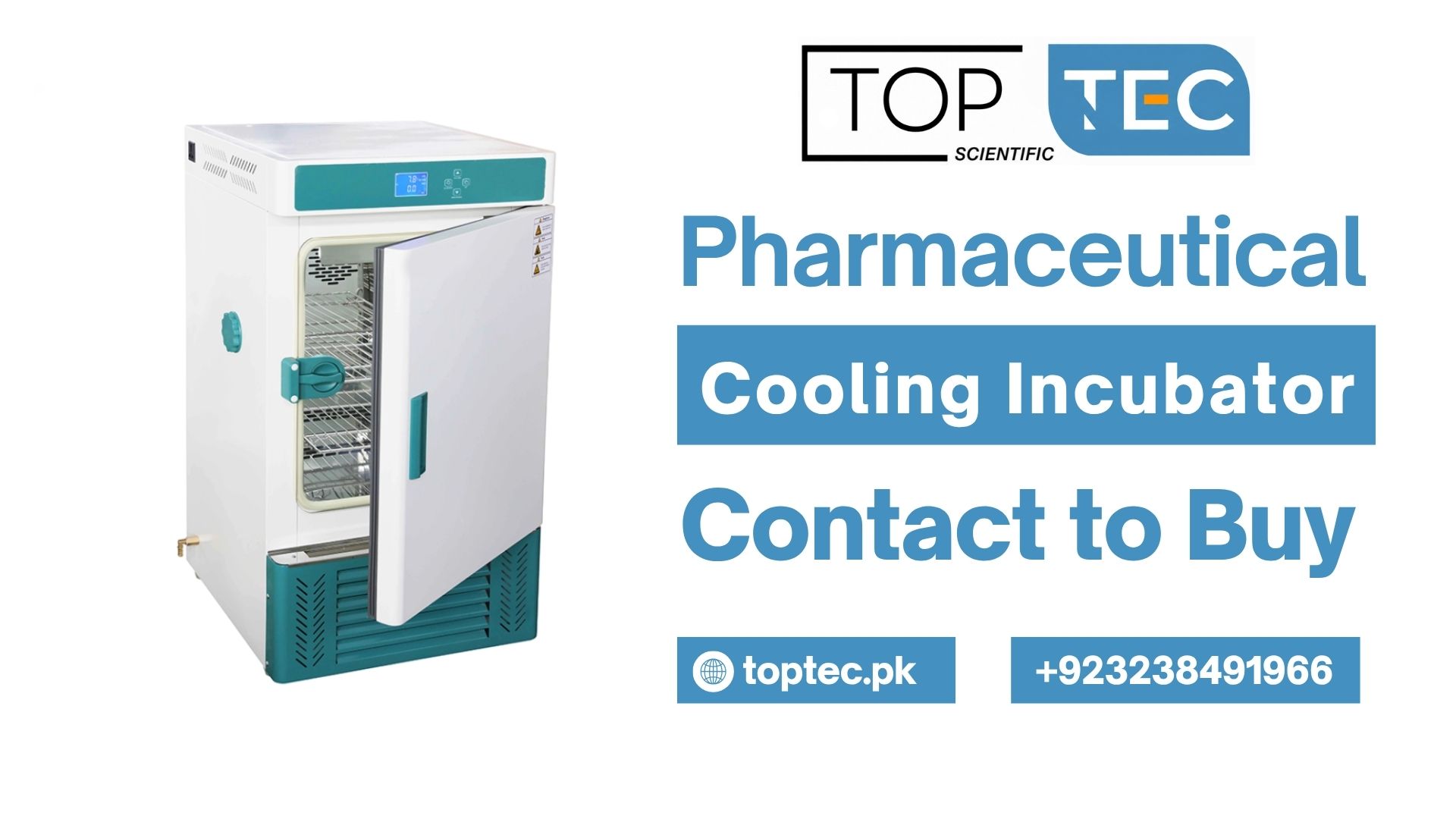
Buy Pharmaceutical Cooling Incubator from TOPTEC Scientific. There’s a moment in every pharmaceutical lab’s life when cutting corners on temperature-controlled equipment costs them something far more expensive than the equipment itself — failed batches, compromised formulations, and invalidated studies. If you work in drug development, quality control, or biopharmaceutical research, you already know that keeping your samples at exactly the right temperature isn’t a nice-to-have. It’s the whole game.
And that’s exactly where a good pharmaceutical cooling incubator earns its keep every single day.
In this article, we’re going to break down everything you need to know before you Buy Cooling Incubator equipment for your pharmaceutical lab — what it does, why freeze-thaw testing needs one, how to choose the right specs, and why sourcing from a trusted local manufacturer like TOPTEC Scientific in Pakistan makes real-world sense for labs across the country.
Let’s get into it.
What Is a Cooling Incubator — And Why Is It Different From a Regular One?
This is the first question most people ask, and it’s a fair one.11 A **cooling incubator**, also known as a **refrigerated incubator**, is an incubator that is capable of both heating and cooling. This temperature-controlled system enables samples to be incubated or stored both above and below ambient temperature.
That distinction matters more than most people realise. A standard incubator is basically a controlled oven — it only heats. A low temperature incubator, by contrast, can swing in both directions. You can take your sample from 25°C down to 4°C or even below zero, all within a controlled, programmable environment. 17In contrast to normal incubators, which only offer a warm atmosphere, refrigerated incubators may chill samples or specimens to particular temperatures, making them important in a wide range of scientific and industrial applications.
For pharmaceutical work — particularly stability testing and freeze-thaw cycling — that bidirectional capability is absolutely essential.16 A **refrigerated incubator** is a temperature-controlled chamber that provides a stable biological and chemical research environment. Depending on research needs, these incubators maintain temperatures below or above ambient room temperature.
In short: if you’re still using a standard incubator for pharmaceutical formulation work, you are working with the wrong tool.
Why Pharmaceutical Labs Specifically Need a Cooling Incubator
Pharmaceutical labs deal with compounds, biologics, and formulations that are incredibly sensitive to temperature fluctuations. A few degrees in the wrong direction — and you’re not just looking at inaccurate data, you’re looking at degraded product, invalid batches, and potentially dangerous outcomes if the product ever reaches patients.18 A **refrigerated incubator** is a specialized laboratory equipment designed to control temperature, humidity, and sometimes CO2 levels, at conditions lower than the ambient temperature. It is essential for experiments that require a stable and precise environment, playing a critical role across various research fields such as microbiology, cell culture, and pharmaceuticals.
Here’s what pharmaceutical labs specifically rely on a low temperature incubator for:
1. Drug Stability Studies
This is probably the most common use. Regulatory bodies require pharmaceutical manufacturers to prove that their formulations remain stable under various temperature conditions over time. The cooling incubator simulates those storage conditions — refrigerated, frozen, or ambient — with the precision that stability protocols demand.
2. Freeze-Thaw Testing
1 Substances such as ointments and emulsions for pharmaceutical or cosmetic purposes are subjected to thermal stability tests. This isn’t optional — it’s a regulatory checkpoint for many product categories. 2 Pharmaceutical compositions are subjected to freeze-thaw cycle testing to determine stability, phase separation, or precipitation or crystallization under high and low temperature conditions. Freeze-thaw testing is conducted by exposing the compositions to freezing temperatures (−20°C) for at least 8 hours, and then samples are kept at 25°C for at least 8 hours. This process is referred to as one freeze-thaw cycle.
A proper refrigerated incubator automates this cycling, ensuring it’s reproducible and documentable — both critical for regulatory submission.
3. Microbiology & Bioburden Testing
1 Cooling incubators are used in various sectors and areas of microbiology, such as in pharmaceutical and medical research, in the food industry, and in environmental monitoring.
4. Cell Culture Research
12 **Refrigerated incubators** provide a constant cold temperature environment to either promote or prevent growth in cell and tissue cultures.
5. Enzyme Studies and Fermentation
12 These types of incubators are ideal for a variety of applications including BOD determinations, plant and insect studies, fermentation studies, bacterial culturing, water pollution testing, and enzyme digestion studies.
When you Buy Cooling Incubator equipment for your pharmaceutical facility, you’re essentially investing in the credibility and reproducibility of your entire testing workflow.
Understanding Freeze-Thaw Testing in Depth
Let’s spend a moment here because freeze-thaw testing is frequently misunderstood — even by experienced lab professionals.
The purpose isn’t just to see whether your product survives freezing. It’s to evaluate how repeated temperature cycling affects physical characteristics like viscosity, particle distribution, phase separation, and chemical stability.6 A formulation may be subjected to tests of differential scanning calorimetry (DSC), accelerated thermal stability, light stability, freeze-thaw stability, oscillation stability, long-term stability, dilution stability, and/or high temperature stability.
Each of those tests demands different temperature conditions and durations. Without a reliable low temperature incubator, you simply cannot run these protocols consistently or get results that hold up to regulatory scrutiny.2 Samples are subjected to at least 1 to 5 freeze-thaw cycles and the samples are analyzed visually for particles or crystals. That seemingly simple analysis requires your incubator to perform flawlessly every single cycle — no temperature drift, no hot spots, no inconsistent cycling. 11 The tests involve generating temperatures below zero °C and above 20°C and alternating between them.
And here’s the regulatory part that catches many smaller labs off guard:11 The guidelines for Good Laboratory Practice (GLP) and Good Manufacturing Practice (GMP) regulate the applications that are carried out with cooling incubators. In the pharmaceutical industry, the requirements of GLP and GMP are described in FDA Regulation 21 CFR Part 11. They regulate how to handle measuring instruments, which must be calibrated and tested at specific intervals.
If you’re planning to Buy Cooling Incubator equipment for a facility that deals with regulatory submissions — whether FDA, WHO, or DRAP (Drug Regulatory Authority Pakistan) — you need a unit that supports data logging, alarm management, and calibration documentation. These are non-negotiable.
Key Features to Look for When You Buy Cooling Incubator Equipment
Not all refrigerated incubator units are created equal. Here’s what actually matters when you’re evaluating options:
✅ Temperature Range
10 Advanced cooling technology in refrigerated incubators guarantees consistent temperature ranges, often spanning from -10°C to +100°C. This flexibility supports a wide range of experimental needs, from low-temperature incubation to higher temperature cultures.
For pharmaceutical freeze-thaw work specifically, you want a unit capable of going down to at least -20°C. If you’re working with biologics or monoclonal antibodies, you may need even lower.
✅ Temperature Uniformity
12 Cooled incubators should feature a heavy-duty refrigeration system designed to optimize air flow and temperature uniformity, a programmable controller with audible and visual alarms, a well-insulated cabinet, and precise temperature control and uniformity.
Uniformity isn’t just about the average temperature — it’s about consistency at every single point within the chamber. A low temperature incubator with poor spatial uniformity will give you different results depending on where your sample sits. That’s a data integrity nightmare.
✅ Cooling Technology
16 Cooling systems use compressor-based or thermoelectric cooling (Peltier effect) to maintain a consistent low temperature.
Compressor-based systems are generally preferred for pharmaceutical applications because they can reach lower temperatures more reliably and hold them more stably under load.
✅ Programmable Cycling
For freeze-thaw testing, you don’t want to manually adjust your cooling incubator every few hours. A programmable controller allows you to set up complex temperature profiles — including the exact cycling protocols required by your SOPs — and walk away with confidence.16 Programmable refrigerated incubators are equipped with advanced automation and data logging.
✅ GLP/GMP Compliance Features
Alarms, audit trails, data logging, and calibration ports are essential for any pharmaceutical lab. 1In the pharmaceutical industry, the requirements of Good Laboratory Practice (GLP) and Good Manufacturing Practice (GMP) are described in FDA Regulation 21 CFR Part 11. They regulate how to handle measuring instruments, which must be calibrated and tested at specific intervals.
✅ Capacity and Footprint
16 Compact refrigerated incubators are ideal for small labs and low-volume samples. Large-capacity incubators are designed for high-volume research applications.
Think about your current workflow — and the one you’ll have in two years. Buying undersized saves money today and costs you tomorrow.
Types of Cooling Incubators Available for Pharmaceutical Labs
When you go to Buy Cooling Incubator equipment, you’ll encounter several configurations. Understanding which type fits your use case prevents expensive mistakes.
1. Standard Refrigerated Incubator (Bench-Top)
Great for smaller labs, R&D departments, and quality control teams running routine stability checks. 16Compact refrigerated incubators are ideal for small labs and low-volume samples. These sit on your workbench, don’t require special installation, and are easy to validate.
2. Large-Capacity Floor-Standing Refrigerated Incubator
For production-level pharmaceutical facilities or contract labs handling multiple projects simultaneously. 16Large-capacity incubators are designed for high-volume research applications.
3. Programmable BOD Incubator (Biochemical Oxygen Demand)
17 **Refrigerated incubators**, also known as **low temperature incubators**, are incubators intended to keep temperatures at or below ambient. These incubators are also ideal in maintaining a temperature of 20°C, which is required for a test known as Biochemical Oxygen Demand (BOD).
These units double as environmental testing equipment, making them especially useful for labs that cover both pharmaceutical and environmental testing scopes.
4. Reach-In Climate Chambers with Humidity Control
When your stability protocols require both temperature and relative humidity (RH) control, you need a step up from a standard low temperature incubator. ICH-compliant stability chambers fit this niche perfectly — especially relevant for DRAP submissions in Pakistan.
Common Pharmaceutical Applications at a Glance
Here’s a quick-reference summary of where a cooling incubator finds daily use in pharmaceutical and biomedical labs:
| Application | Required Temperature Range | Notes |
|---|---|---|
| Accelerated Stability Studies | 25°C–40°C | ICH Q1A guidelines |
| Freeze-Thaw Cycling | -20°C to +25°C | Multiple programmable cycles |
| Refrigerated Drug Storage Testing | 2°C–8°C | Vaccine and biologic products |
| Microbiology / Bioburden | 20°C–35°C | Controlled, contamination-free |
| Enzyme & Fermentation Studies | 4°C–37°C | Biochemical applications |
| Cell Culture Research | 37°C + CO2 | Specialized units with CO2 control |
If you work across multiple categories, investing in a programmable refrigerated incubator with a wide operating range is almost always the smarter choice over buying separate units for each application.
Why Pakistani Pharmaceutical Labs Should Buy Laboratory Furniture & Equipment Locally
Here’s something that doesn’t get discussed enough in Pakistan’s pharmaceutical sector: the real cost of importing laboratory equipment.
Yes, international brands have name recognition. But when you factor in:
- Import duties and customs clearance delays
- Extended lead times (often 8–16 weeks)
- Currency fluctuation risk on USD-denominated purchases
- Limited local service and spare parts availability
- High calibration and validation service costs
…the economics shift dramatically in favor of sourcing from quality local manufacturers.
That’s where TOPTEC Scientific comes in — and why more and more pharmaceutical, research, and clinical laboratories across Pakistan are choosing to Buy Laboratory Furniture and laboratory equipment directly from them.
About TOPTEC Scientific — Pakistan’s Trusted Lab Equipment Manufacturer
TOPTEC Scientific is a proudly Pakistani manufacturer based in Lahore, producing a comprehensive range of laboratory furniture, equipment, and controlled environment solutions for pharmaceutical, medical, food, and research industries.
They don’t assemble imported kits with local labels. TOPTEC Scientific actually manufactures its products in Pakistan — with proper quality control, local material sourcing where applicable, and technical teams that understand the specific regulatory landscape of Pakistani labs, including DRAP, WHO-GMP, and ISO compliance requirements.
When you choose to Buy Laboratory Furniture from TOPTEC Scientific, you’re getting:
🔬 Local Manufacturing Quality Every unit is built, tested, and quality-checked before it leaves the facility. No mystery components from third-party importers.
💰 Competitive Pakistani Pricing No import overhead means better value for equivalent or superior specifications. Your budget goes further with a local manufacturer.
⚙️ After-Sales Support That Actually Shows Up When something needs servicing, calibration, or validation, TOPTEC’s technical team is locally accessible. No waiting weeks for an overseas service agent.
📋 Compliance-Ready Equipment TOPTEC understands what Pakistani pharmaceutical labs need for DRAP submissions, GMP audits, and international regulatory alignment. Their equipment is designed with that context in mind.
🏭 Custom Configuration Options Need a specific chamber size? Particular temperature range? Custom shelving configuration? TOPTEC can work with you — something no international manufacturer’s standard product catalog can offer.
When pharmaceutical companies, university research labs, hospital diagnostic centers, and food testing facilities across Pakistan Buy Laboratory Furniture and equipment from TOPTEC Scientific, they’re choosing a partner that speaks the same regulatory language they do and can deliver without the drama of cross-border procurement.
What Else Can You Buy Laboratory Furniture From TOPTEC Scientific?
TOPTEC’s product range extends well beyond cooling incubators. When you decide to Buy Laboratory Furniture for a full lab setup, they can supply and install an entire ecosystem of laboratory infrastructure, including:
- Laboratory Workbenches & Benching Systems — Epoxy resin, stainless steel, and phenolic resin tops for various chemical resistance requirements
- Fume Hoods & Ducted Exhaust Systems — For chemical handling and volatile compound work
- Laminar Flow Hoods & Biosafety Cabinets — For sterile processing environments
- Storage Cabinets — Chemical storage, flammable material cabinets, and secure drug storage
- Stainless Steel Lab Tables — For pharmaceutical and clinical environments demanding hygienic surfaces
- Overhead Service Carriers & Utility Systems — For organized lab infrastructure
The ability to source all of this from one local manufacturer dramatically simplifies project management for new lab builds, facility upgrades, and pharmaceutical plant expansions.
How to Choose the Right Cooling Incubator for Your Lab — A Practical Checklist
Before you Buy Cooling Incubator equipment, run through this checklist:
□ What is your required temperature range? Most pharmaceutical stability work needs at minimum: -20°C to +60°C. Confirm your lowest required setpoint before ordering.
□ What volume of samples will you process? Measure your typical sample load and add 30% for growth. Undersized equipment always becomes a bottleneck.
□ Do you need programmable cycling? For freeze-thaw testing, a programmable low temperature incubator is mandatory — not optional.
□ What are your data logging and documentation requirements? GMP-compliant facilities need audit trail-capable equipment. Confirm this feature before purchasing.
□ Do you need humidity control as well? Standard cooling incubator units control temperature only. If your protocols specify RH control, you need a stability chamber, not a standard refrigerated incubator.
□ What is your power infrastructure? Confirm voltage, phase, and amperage requirements before delivery. This sounds basic — but it’s a common oversight.
□ What is your validation timeline? If you need IQ/OQ/PQ documentation, discuss this with your supplier upfront. TOPTEC Scientific can support this process for locally supplied equipment.
Final Word — Stop Compromising on Temperature Control
If your pharmaceutical lab is still relying on a domestic refrigerator, a standard incubator, or worse — ambient room temperature for stability samples — you’re building your entire quality system on a shaky foundation. Regulatory expectations are tightening. DRAP inspections are becoming more rigorous. And the global pharmaceutical market demands validated, documented data.
The cooling incubator isn’t a luxury purchase. It’s a core piece of laboratory infrastructure — as essential as your analytical balance or your HPLC system.16 Considering factors like temperature stability, contamination control, energy efficiency, and capacity, you can invest in a high-performance incubator that meets your laboratory’s needs.
Whether you need a compact bench-top refrigerated incubator for a small QC lab, a large-capacity low temperature incubator for a full pharmaceutical stability suite, or a complete laboratory infrastructure fit-out — TOPTEC Scientific has the products, the expertise, and the local support structure to make it happen.
Don’t let procurement headaches, import delays, or overpriced foreign equipment hold your lab back. Buy Cooling Incubator units and Buy Laboratory Furniture from Pakistan’s most capable laboratory manufacturer.
📞 Contact TOPTEC Scientific Today
TOPTEC Scientific House # 51, Block E, Street # 8, Fathe Abad Academy Road, Nearby Shair Paioo Bridge, Lahore Cantt, Pakistan 🌐 Visit: toptec.pk
Whether you’re ready to Buy Cooling Incubator equipment for your pharmaceutical facility, want to explore options for a refrigerated incubator or low temperature incubator unit, or are planning a full lab setup and need to Buy Laboratory Furniture from a trusted local source — reach out to the TOPTEC Scientific team today. They will guide you to the right solution for your specific application, budget, and compliance requirements.
