

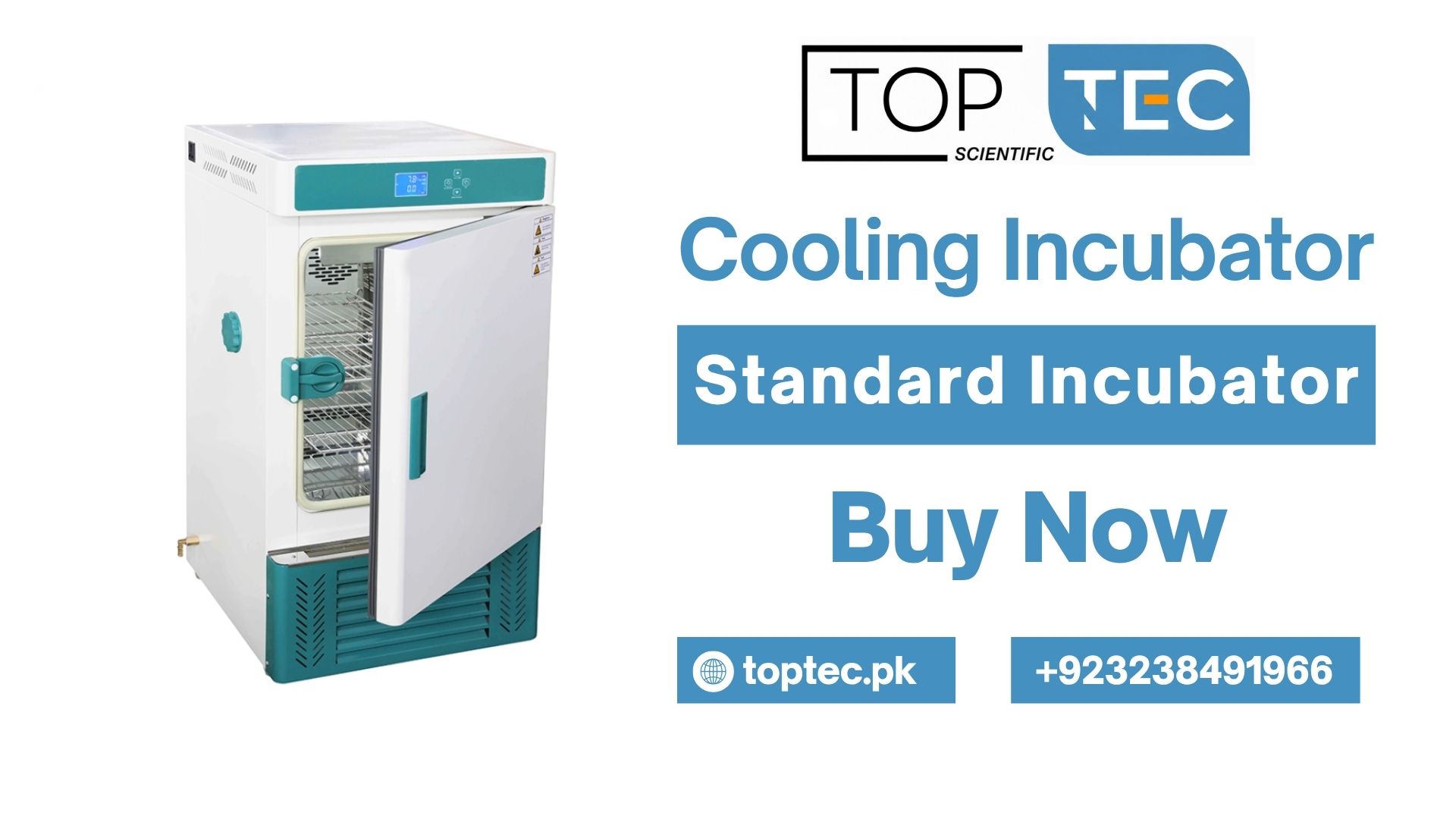
Should you buy Cooling Incubator? Walk into any working research lab, pharmaceutical facility, or microbiology department, and you’ll almost always find at least one incubator running. It’s practically a universal piece of lab equipment. But here’s the thing most people outside of lab settings don’t realise — not all incubators are built the same, and choosing the wrong one for your specific application can seriously compromise your results.
The debate between a standard incubator and a cooling incubator is one that comes up repeatedly — especially as labs in Pakistan grow more sophisticated in their testing protocols and regulatory requirements. And yet, so many purchasing decisions still get made based on price alone, without a real understanding of what these two types of equipment can and can’t do.
In this article, we’re going to lay it all out clearly. We’ll compare a refrigerated incubator against a standard unit side by side, explain exactly when you need each type, break down the key technical differences, and help you understand why — when the time comes to Buy Cooling Incubator equipment for your lab — choosing a trusted local manufacturer like TOPTEC Scientific in Pakistan is the smartest decision you can make.
Let’s get into the detail.
First Things First — What Does a Standard Incubator Actually Do?
To understand the difference, you need to start with what a standard incubator is designed to accomplish.4 A regular lab incubator is meant for general microbiology or cell-culture work, typically operating at around 37°C with heating only capability. That’s it. Heat goes in, temperature is maintained, and the environment inside the chamber stays controlled — as long as you’re working at or above the ambient room temperature. 5 A standard laboratory incubator can only heat. It holds temperatures above the room, typically from about ambient +5°C upwards.
Here’s where that creates a real problem in practice. 5If you need 20°C or 25°C in a lab that sits at 21°C in summer, no amount of specification on a heating-only incubator will get you there. You need a cooled model.
That single limitation rules standard incubators out of an enormous range of modern laboratory applications — particularly anything in pharmaceutical stability testing, environmental research, or biochemical work.
So What Exactly Is a Cooling Incubator?
A cooling incubator — also called a refrigerated incubator or low temperature incubator — is fundamentally different in capability and design.14 Unlike standard incubators, which only provide heating, refrigerated incubators can heat and cool samples, maintaining the consistent conditions required for microbiological cultures, pharmaceutical stability testing, food safety analysis, and environmental studies. 14 A refrigerated incubator is a temperature-controlled chamber that provides a stable biological and chemical research environment. Depending on research needs, these incubators maintain temperatures below or above ambient room temperature.
That bidirectional temperature control is the defining characteristic that separates a low temperature incubator from every standard heating-only unit on the market. And it’s what makes a refrigerated incubator essential for any lab doing serious, regulated scientific work.16 The dual capability to cool and heat allows for a versatile range of applications, from culturing microorganisms at low temperatures to conducting stability assays for pharmaceuticals. This makes refrigerated incubators indispensable in research and industrial settings.
Cooling Incubator vs. Standard Incubator — A Detailed Head-to-Head Comparison
Let’s stop being vague and get specific. Here’s how these two types of incubators compare across every dimension that matters for lab decision-making.
1. Temperature Range
This is the most fundamental difference and the one that should drive your purchasing decision first.
Standard Incubator: Operates from approximately ambient +5°C upward. For most labs, that means a practical working range of roughly 25°C to 80°C. Nothing below room temperature is possible.
Cooling Incubator / Refrigerated Incubator:15 Refrigerated incubators offer a temperature range typically from as low as 0°C to 60°C, with precise control mechanisms ensuring stability necessary for sensitive experiments.
Higher-specification low temperature incubator units used in pharmaceutical freeze-thaw testing can go significantly lower — down to -20°C or below — depending on the cooling mechanism used.1 High-stability temperature control across a broad range typically allows for setpoints from -10°C to +60°C in heated and cooled incubators.
Winner for pharmaceutical and regulated lab work: The cooling incubator, every single time.
2. Cooling Technology — How Does It Actually Work?
Standard incubators have no cooling mechanism at all. They rely entirely on resistive heating elements and convection air circulation. Nothing more.
A refrigerated incubator requires active cooling to deliver that bidirectional temperature control. 2There are two main cooling mechanisms for refrigerated incubators. The conventional type is vapor compressor technology, which uses a circulating liquid refrigerant to cool the incubator.
The second option is Peltier (thermoelectric) cooling. 2Peltier cooling technology does not contain moving parts, which circumvents problems of mechanical wear and tear and reduces the probability of system failure. In general, it also extends the life of the refrigerated incubator and reduces the ongoing maintenance costs compared to vapor compression technology.
For most pharmaceutical applications, compressor-based cooling is preferred because of its ability to reach and sustain lower temperatures reliably. 8Cooling in incubators is achieved by either a compressor or thermoelectric device. A compressor allows your incubator to reach temperatures down to 0°C or lower. A thermoelectric device uses less energy and does not use any refrigerants in their cooling process.
Meanwhile, 7cooled incubators with thermoelectric cooling are used primarily in the food industry and microbiology. Because of their low energy consumption, cooled incubators with thermoelectric cooling are particularly well suited for incubation at temperatures between room temperature and 37°C as well as for lowering the temperature to refrigeration levels of 4°C.
3. Temperature Uniformity & Stability
This is an area where the difference between a budget standard incubator and a properly engineered refrigerated incubator becomes very visible — and very consequential for your data.5 Uniformity and stability are different numbers and buyers routinely confuse them. Stability is how steady one point stays over time. Uniformity is how much the temperature varies between the corners and the middle. Uniformity is the one that ruins a run.
A standard incubator without forced air circulation can have significant spatial temperature variation — meaning the sample on the top shelf is at a different temperature to the one on the bottom shelf. For routine microbiology at 37°C, this might not matter much. For regulated pharmaceutical work? It’s a serious data integrity issue.11 The impressively consistent temperature across all racks in properly designed refrigerated incubators is a result of double-sided horizontal air flow. The air is sucked backward into the double rear wall by a fan. In the rear of the incubator, which is not part of the usable space, the air is reconditioned and adjusted to the set temperature before it is directed to the sides through the perforated side walls and back into the usable space. This double-sided horizontal air flow achieves homogeneous and stable temperatures.
4. Applications — Where Each Type Works Best
Standard Incubator — Best For:
- Routine microbiology at 37°C
- Basic bacterial and yeast culture work
- Hatching, germination, and general biology experiments
- Educational lab settings
3 Standard incubators are commonly used for applications such as microbiology and general laboratory testing.
Refrigerated Incubator / Low Temperature Incubator — Best For:11 Cooling incubators are used in various sectors and areas of microbiology, such as in pharmaceutical and medical research, in the food industry, and in environmental monitoring. 1 This dual-function capability is essential for applications such as cold-temperature enzyme kinetics, the storage of temperature-sensitive reagents, and delicate microbial or tissue incubations. 1 Pharmaceutical stability testing — both accelerated and long-term stability studies — requires precise temperature control for cGMP compliance. 12 Refrigerated incubators provide precise temperature control for reliable results in pharma, food, cosmetics, and microbiology research.
So if your lab operates across any of these verticals — pharmaceutical QC, food safety, environmental testing, or clinical microbiology — the refrigerated incubator is not an optional upgrade. It’s the baseline requirement.
5. Control Systems & Programmability
Standard Incubators: Most standard units offer simple dial or basic digital controls. Set the temperature, leave it running. No complex programming required — because no complex temperature cycling is possible.
Refrigerated Incubator / Cooling Incubator:17 Modern refrigerated incubators offer features such as programmable temperature settings, humidity control, and CO2 regulation, catering to a wide range of cell culture and microbiology applications. 16 Benefits of using refrigerated incubators include temperature versatility — maintaining stable temperatures both above and below ambient levels — enhanced reproducibility through consistent conditions, safe storage for biological samples, cultures, and chemical compounds, and automated data logging features that automatically track environmental conditions, facilitating compliance with regulatory standards.
That last point — automated data logging — is critically important for pharmaceutical and GMP-regulated labs. A standard incubator simply doesn’t offer this as a standard feature.
6. GMP & Regulatory Compliance Capability
Here’s the difference that often gets overlooked entirely until a lab gets hit with a regulatory audit.
Standard incubators are not built with GMP compliance as a design priority. They lack the documentation, alarm management, calibration ports, and data logging features that regulated industries require.
A properly specified refrigerated incubator or low temperature incubator, by contrast, is designed with compliance built in. 14By safeguarding sample integrity through controlled thermal environments, refrigerated incubators enable researchers to conduct reproducible experiments, comply with regulatory standards, and optimize long-term storage conditions.15 Safety features such as over-temperature alarms and secure door locks are important to ensure both the protection of research samples and laboratory safety.
For any laboratory operating under FDA, WHO-GMP, or DRAP guidelines — this isn’t a conversation about preferences. It’s a regulatory requirement.
7. Energy Efficiency
Standard incubators are relatively simple devices — resistive heating elements and basic controls don’t consume enormous amounts of power.
Cooling incubators require more energy to run their refrigeration systems, but modern units are increasingly efficient. 15Modern refrigerated incubators are designed for energy efficiency, significantly reducing operational costs and contributing to more sustainable research practices.12 Models that rely on thermoelectric cooling technology are not only energy-efficient, but also eliminate the need for conventional compressors and refrigerants.
8. Cost Comparison
Let’s be transparent about this. A refrigerated incubator or low temperature incubator costs more than a standard heating-only unit. That’s just reality.
But framing it purely as a cost question misses the point entirely. The real question is: what does it cost you to use the wrong equipment?
- Failed batch investigations
- Invalidated stability studies
- Regulatory non-compliance findings
- Rejected regulatory submissions
- Wasted reagents, compounds, and time
When you see it that way, the price premium of a proper cooling incubator looks much more like what it actually is — a cost-avoidance investment. That’s why when pharmaceutical labs, research institutions, and clinical facilities decide to Buy Cooling Incubator equipment, the price comparison with a standard incubator quickly becomes irrelevant.
Quick Comparison Table — Cooling Incubator vs. Standard Incubator
| Feature | Standard Incubator | Cooling Incubator / Refrigerated Incubator |
|---|---|---|
| Temperature Range | Ambient +5°C to ~80°C | -20°C to +60°C (bidirectional) |
| Cooling Capability | ❌ None | ✅ Yes (Compressor or Peltier) |
| Temperature Uniformity | Moderate | High (forced air circulation) |
| GMP/GLP Compliance Features | Limited | Full (alarms, logging, calibration) |
| Programmable Cycling | Basic | Advanced multi-step programming |
| Data Logging | Rarely standard | Built-in standard feature |
| Pharmaceutical Stability Use | ❌ Not suitable | ✅ Fully suitable |
| Freeze-Thaw Testing | ❌ Not possible | ✅ Fully capable |
| BOD Testing | ❌ Not possible | ✅ Fully capable |
| Energy Efficiency | High (heating only) | Modern units: efficient |
| Best For | Routine microbiology | Pharma, food, research, environmental |
When Should You Absolutely Buy Cooling Incubator Instead of Standard?
Not every lab needs a low temperature incubator. A university microbiology teaching lab running routine bacterial cultures at 37°C doesn’t need one. A high school science lab certainly doesn’t.
But if any of the following applies to your operation, then you need to Buy Cooling Incubator equipment — not a standard unit:
✅ You perform pharmaceutical drug stability testing14 Refrigerated incubators play a crucial role in pharmaceutical research by maintaining stable temperature conditions required for drug formulation studies.
✅ You work with temperature-sensitive biological materials below ambient temperature8 If a temperature at or below 30°C is needed, your best choice will be a low temperature or refrigerated incubator.
✅ You need BOD (Biochemical Oxygen Demand) testing capability4 A BOD incubator is specifically designed for water-waste testing via the biochemical oxygen demand method, with precise temperature control (often around 5°C to 50°C, maintained with ±0.5°C accuracy) and cooling plus heating capability.
✅ You work in food safety and quality testing14 Food safety and quality testing — monitoring bacterial contamination and shelf-life — demands precise refrigerated incubation.
✅ Your lab is subject to GMP, GLP, or regulatory audits Any regulated lab that expects to pass an audit with a standard heating-only incubator in place of proper temperature-controlled equipment is taking a serious compliance risk.
✅ You culture psychrophilic or cold-adapted microorganisms Some microorganisms grow best at temperatures well below 37°C. A standard incubator simply cannot support this work at all.
The Difference Between a Refrigerated Incubator and a Lab Refrigerator
People ask this all the time — and it’s a fair question, because both involve cooling. But they’re entirely different pieces of equipment.1 A laboratory refrigerator is designed for storage and lacks the precise heating elements and sophisticated PID controllers found in an incubator.
A refrigerated incubator is actively temperature-controlled in both directions with a level of precision that a storage refrigerator cannot match. It has programmable control systems, uniformity-optimised airflow, calibration capabilities, and compliance documentation support. A lab refrigerator just keeps things cold and static.
If you’re using a lab fridge as a substitute for a proper cooling incubator, you’re not getting the uniformity, programmability, or documentation capability your protocols actually require.
Why Pakistani Labs Should Think Carefully About Where They Buy Cooling Incubator Equipment
This is a conversation that’s worth having directly.
The default assumption in many Pakistani labs — especially university labs and smaller pharmaceutical QC departments — is that imported branded equipment is automatically better than locally manufactured alternatives. That assumption deserves to be seriously questioned.17 The rising focus on biomedical research, drug discovery, and biotechnology applications is fueling the demand for refrigerated incubators, especially in emerging markets where healthcare infrastructure is expanding rapidly.
Pakistan is squarely in that growing market. Labs are expanding, regulatory standards are tightening, and DRAP compliance requirements are becoming more stringent. Laboratories that were getting away with minimal equipment five years ago are now under real pressure to upgrade — and to upgrade with documented, validated equipment.
Here’s the economic reality of importing a refrigerated incubator from an international brand into Pakistan:
- Import duties and taxes add significantly to the landed cost
- Lead times of 8–16 weeks or more create procurement headaches
- Currency risk on USD-denominated purchases fluctuates the final price
- After-sales service is either unavailable locally or prohibitively expensive
- Spare parts can take weeks or months to source and import
- Calibration and validation support from the original manufacturer often requires international service visits
Now compare that against buying locally from TOPTEC Scientific — a Pakistani manufacturer that actually produces laboratory equipment and laboratory furniture right here in Pakistan.
About TOPTEC Scientific — Proudly Pakistani, Professionally Built
TOPTEC Scientific is a Lahore-based manufacturer of laboratory equipment and furniture, serving pharmaceutical, medical, food industry, research, and educational laboratories across Pakistan.
The key word there is manufacturer. Not importer. Not reseller. Not an assembler of foreign-labelled kits. TOPTEC Scientific designs, engineers, and manufactures its products in Pakistan — with quality control at every stage of production and a deep understanding of what Pakistani labs actually need for their regulatory environment.
When you choose to Buy Cooling Incubator equipment or Buy Laboratory Furniture from TOPTEC Scientific, here’s what that decision actually delivers:
🏭 Local Manufacturing — Real Quality Control
Every unit manufactured by TOPTEC goes through quality inspection before it leaves the facility. You’re not getting equipment that’s been shipped halfway around the world in a container and then delivered to your door.
💰 Competitive Pricing — No Import Premium
When you remove import duties, freight costs, and currency conversion risk from the equation, the cost difference between locally manufactured equipment and imported alternatives becomes very significant — often in the range of 20–40% depending on the product.
⚙️ After-Sales Support That’s Actually There
When you need service, calibration, or technical support for equipment you bought from TOPTEC Scientific, you call their team — in Pakistan, in your time zone, speaking your language. A service technician can physically reach your facility. That’s something no international brand’s support structure can realistically offer to a lab in Lahore or Karachi.
📋 DRAP & GMP-Aligned Equipment
TOPTEC understands the Pakistani regulatory landscape — DRAP inspections, WHO-GMP requirements, and local compliance expectations. Their equipment is designed with that operational context built in, not bolted on as an afterthought.
🔧 Custom Configuration
Need a specific chamber volume? Particular shelving arrangement? A specific temperature range for your exact stability protocol? TOPTEC can work with your requirements. Standard international product catalogs can’t do that.
What Else Can You Buy Laboratory Furniture & Equipment from TOPTEC Scientific?
If you’re outfitting a full laboratory, upgrading an existing facility, or expanding a pharmaceutical manufacturing plant, TOPTEC Scientific can supply the complete laboratory infrastructure you need — not just incubators.
When you Buy Laboratory Furniture from TOPTEC Scientific, their range includes:
- Laboratory Workbenches — Epoxy resin, stainless steel, and phenolic resin work surfaces for chemical resistance in various environments
- Fume Hoods — Ducted and recirculating fume cupboards for chemical handling and volatile compound work
- Laminar Flow Hoods & Biosafety Cabinets — For sterile product handling and microbiological work
- Stainless Steel Lab Tables — Hygienic surfaces for pharmaceutical and clinical environments
- Chemical Storage Cabinets — For flammable material storage, corrosive chemical storage, and controlled drug storage
- Overhead Service Carriers — For organized lab service infrastructure and utility routing
- Cooling Incubators & BOD Chambers — For pharmaceutical stability, environmental testing, and microbiology
The ability to Buy Laboratory Furniture and controlled environment equipment from a single trusted local manufacturer simplifies everything — procurement, installation, validation, and ongoing service support.
How to Choose the Right Cooling Incubator for Your Lab — Practical Guidance
Once you’ve made the decision to Buy Cooling Incubator equipment for your facility, these are the practical factors to evaluate before finalizing your specification:
Step 1 — Define Your Required Temperature Range
This is the first and most critical question. If you need temperatures below ambient room temperature, you need a refrigerated incubator — full stop. Define your lowest required setpoint, your highest required setpoint, and whether you need programmable cycling between the two.
Step 2 — Determine Your Chamber Volume
Think about your current sample load — and then add at least 25–30% for growth. Undersized equipment becomes a workflow bottleneck surprisingly quickly. 12High-capacity, small-volume, under-counter, portable and benchtop models are available with a variety of features including WiFi, programmability, colour touch screens, and combination heating and cooling capability.
Step 3 — Decide on Cooling Technology
For pharmaceutical work with temperatures below 4°C, compressor-based cooling is generally required. For less demanding applications between 4°C and 30°C, a Peltier-cooled low temperature incubator may be sufficient and more energy-efficient.
Step 4 — Confirm GMP Documentation Requirements
If your lab operates under any form of regulatory oversight, you need to confirm upfront that the cooling incubator you’re purchasing supports IQ/OQ/PQ validation protocols, has calibration ports, and provides compliant data logging.
Step 5 — Check Humidity Control Requirements
A standard refrigerated incubator controls temperature only. If your protocols require both temperature and relative humidity control, you need a dedicated stability chamber — not just a cooling incubator.
Step 6 — Evaluate After-Sales Support
4 Choosing the right one matters because your test accuracy, equipment lifespan and lab costs depend on matching use-case to machine. And part of that equation is making sure that when something needs calibration or service, support is actually accessible.
The Bottom Line — Know the Difference, Make the Right Choice
Let’s bring this back to the essential point.
A standard incubator is a capable, useful piece of lab equipment — for the applications it’s designed for. It heats. It maintains temperature. It does its job well within a narrow and specific range of use cases.
A cooling incubator — whether you call it a refrigerated incubator, a low temperature incubator, or a BOD incubator — is a fundamentally more capable instrument. 14A refrigerated incubator is a critical tool in scientific research, offering precise temperature control for various laboratory applications. It gives you control in both directions, supports complex programmable protocols, enables GMP-compliant documentation, and opens up a dramatically wider range of applications.14 Many biological and chemical processes are highly temperature-sensitive, and even slight fluctuations can compromise experimental accuracy. That reality alone makes the case for investing in proper refrigerated incubation capability for any serious laboratory.
If you’re running a pharmaceutical lab, a food testing facility, an environmental monitoring lab, or any research environment where precise, documented, bidirectional temperature control matters — you need a cooling incubator, and you need to Buy Cooling Incubator equipment that’s properly specified for your actual protocols.
And if you’re in Pakistan — don’t default to expensive imports. Buy Cooling Incubator units and Buy Laboratory Furniture from a manufacturer who understands your regulatory environment, can support your equipment locally, and can deliver quality without the import premium.
