

If you’re in the pharmaceutical business in Pakistan — or running a research lab, a nutraceutical operation, or a food processing facility — at some point the question of tablet coating comes up. And when it does, the next question is almost always: where do I actually get reliable equipment that doesn’t cost a fortune to import and doesn’t take three months to arrive?
That’s exactly what this article is about.
We’re going to walk through everything you need to know about film coating pans — what they are, how they work, what to look for when buying one, and why TOPTEC Scientific has become a go-to source for this equipment right here in Pakistan. Whether you’re looking to buy film coating pan equipment for a small R&D setup or scaling up to a full production line, there’s a lot to cover. Let’s get into it.
What Is a Film Coating Pan, and Why Does It Matter?
A film coating pan is a piece of pharmaceutical or food processing equipment used to apply a thin, uniform coating onto tablets, pills, pellets, capsules, or similar solid dosage forms. The coating can serve several purposes depending on the application:
- Protection — shielding the tablet core from moisture, light, or oxygen
- Taste masking — covering bitter or unpleasant-tasting active ingredients
- Modified drug release — controlling how and where in the digestive tract the drug is released
- Improved appearance — making tablets look professional and identifiable
- Easier swallowing — smooth-coated tablets are much easier to take than uncoated ones
The equipment itself consists of a rotating pan (or drum), a spray system for applying the coating solution, and an airflow system for drying the coating as it’s applied. Sounds simple in concept — and in some ways it is — but getting a truly uniform, defect-free coating requires well-designed equipment and a properly optimized process.
When you buy film coating pan equipment that’s poorly designed or inconsistently manufactured, you end up with coating defects — picking, sticking, orange peel texture, logo bridging, uneven color — that either require rework or, worse, result in batch failures. That’s expensive in any operation.
Types of Coating Pans Available
Before deciding to buy film coating pan equipment, you need to understand what types are available and which one suits your specific application. They’re not all the same.
Standard (Non-Perforated) Coating Pans
The traditional design — a solid rotating pan where tablets tumble as the coating is sprayed. Airflow for drying passes over the tablet bed rather than through it. These work for sugar coating applications and are simpler in design. They’re less efficient for film coating because drying is slower, but they have their place.
Perforated Coating Pan
This is the modern standard for pharmaceutical film coating. A perforated coating pan has a drum with holes or perforations across its surface. Air is forced through the perforations and directly through the tablet bed, dramatically improving drying efficiency.
The advantages of a perforated coating pan over solid pan designs include:
- Faster processing times due to more efficient drying
- Better uniformity of coating across the batch
- Gentler handling of tablets — reduced attrition and breakage
- Suitable for aqueous coating systems (water-based coatings) because of superior drying capacity
- More consistent results batch to batch
For modern pharmaceutical film coating operations, the perforated coating pan is the equipment of choice. If you’re setting up a new operation or upgrading from an older solid pan, this is where you should be looking.
Lab Scale Coating Pans
Designed for small batch sizes — typically used in R&D, formulation development, quality control, and university or research laboratory settings. Lab scale equipment lets you develop and optimize coating processes on small quantities before committing to full production runs.
Lab scale film coating pans are also used in teaching environments where pharmacy and pharmaceutical science students learn coating processes without needing full production equipment.
Pilot Scale Coating Pans
The middle ground between lab scale and full production. Pilot scale equipment is used for scale-up studies — understanding how a process developed at lab scale translates to larger batch sizes before full production investment.
Production Scale Coating Pans
High-capacity equipment for commercial manufacturing. These handle large batch sizes and are designed for continuous, high-throughput operation in regulated pharmaceutical manufacturing environments.
Film Coating Pan vs. Industrial Coating Machine: Understanding the Difference
People sometimes use these terms interchangeably, but there are meaningful distinctions worth understanding.
A film coating pan — whether lab scale or production scale — is specifically designed for coating solid dosage forms like tablets and pellets. The geometry of the pan, the spray system, and the airflow are all optimized for this specific task.
An industrial coating machine is a broader category that encompasses coating equipment used across various industries — food processing, confectionery, chemical manufacturing, agriculture (seed coating), and more. When someone refers to an industrial coating machine in the pharmaceutical context, they typically mean production-scale tablet coating equipment with GMP-compliant design features.
For pharmaceutical manufacturers, the key characteristics of an industrial coating machine include:
- Larger batch capacities suitable for commercial production volumes
- GMP-compliant construction — smooth surfaces, minimal dead zones, easy clean-in-place capability
- Validated and reproducible process parameters
- Integration with process analytical technology (PAT) tools for real-time monitoring
- Robust control systems with data logging for regulatory compliance
Whether you’re looking at a lab scale film coating pan or a full industrial coating machine, the fundamental principles are the same — it’s the scale, capacity, and regulatory requirements that differ.
Key Features to Look for When You Buy Film Coating Pan Equipment
Not all coating pans are built the same. Here’s what to evaluate before you commit to a purchase.
Pan Geometry and Design
The shape and angle of the pan affects how tablets move and tumble during the coating process. A well-designed pan ensures that every tablet in the batch receives the same exposure to the spray and the same drying conditions. Poor pan geometry leads to uneven coating — some tablets get too much coating, others too little.
Spray System
The coating solution is delivered through a spray gun system positioned inside the pan. Look for:
- Adjustable spray guns that can be repositioned based on batch size and pan loading
- Consistent droplet size distribution — this directly affects coating uniformity
- Easy disassembly for cleaning and maintenance
- Nozzle quality that prevents clogging with aqueous formulations
Air Handling System
For a perforated coating pan, the air handling system is critical. You need:
- Controllable inlet air temperature and volume
- Effective exhaust system to remove moisture-laden air
- HEPA filtration on inlet air in pharmaceutical environments
- Adequate airflow capacity for aqueous coating systems, which require more drying energy than solvent-based systems
Pan Speed Control
Variable speed control of the pan rotation is essential. Different tablet sizes, shapes, and coating formulations require different pan speeds to achieve optimal tablet movement without causing damage. A quality coating pan gives you precise, reproducible speed control.
Control System
Modern coating pans come with programmable control systems that let you set and monitor process parameters — inlet air temperature, exhaust air temperature, pan speed, spray rate, atomization air pressure. More sophisticated systems log these parameters for process documentation and regulatory compliance.
Material of Construction
Pharmaceutical coating equipment should be made from 316L stainless steel or equivalent pharmaceutical-grade material. All product-contact surfaces should be polished to appropriate Ra values to prevent contamination and facilitate cleaning.
Batch Size Flexibility
Particularly important for lab and pilot scale equipment — can the pan handle a range of batch sizes, or is it optimized for a single fill volume? Equipment that handles a wider range of batch sizes gives you more flexibility for development work.
The Film Coating Process: A Quick Overview
Understanding the process helps you understand what the equipment needs to do.
Step 1: Pan Loading
Tablets are loaded into the coating pan. The fill volume affects how the tablets move and tumble, so it needs to be within the design range of the equipment.
Step 2: Pre-Warming
The pan is set rotating and warm inlet air is introduced to bring the tablet bed temperature up to the target coating temperature. Starting to spray on cold tablets causes moisture to condense on the surface, leading to picking and sticking defects.
Step 3: Coating Application
The spray system applies the coating solution — typically a polymer solution in water or a solvent — at a controlled rate. The coating is applied intermittently or continuously while the drying air removes the solvent or water.
Step 4: Drying
As coating continues, drying air maintains the tablet bed at the appropriate temperature and removes evaporated moisture. The balance between spray rate and drying capacity determines the quality of the coating film.
Step 5: Cooling
After coating is complete, the tablet bed is gradually cooled before the tablets are discharged from the pan.
Step 6: Discharge and Inspection
Tablets are discharged from the pan and inspected for coating quality. A properly optimized process with well-designed equipment should consistently produce tablets that are uniform in color, free from defects, and within specification for coating weight gain.
Why Pakistani Labs and Pharma Companies Should Buy Locally
Here’s a point that doesn’t get made often enough in Pakistan’s pharmaceutical and research sectors: importing laboratory equipment and pharmaceutical processing equipment has real, ongoing costs that go beyond the purchase price.
Import duties and customs costs — every piece of imported equipment carries these additional fees. They can add a significant percentage to the total cost.
Shipping and freight — international freight is expensive, especially for heavy equipment like coating pans.
Lead times — ordering from an overseas manufacturer often means waiting weeks or months. If your production schedule or research timeline is waiting on equipment, that delay has a cost too.
After-sales support — when something needs attention on an imported machine, getting support from an overseas manufacturer is slow and often unsatisfying. Spare parts take time to arrive. Technical guidance comes across time zones and language barriers.
Currency risk — when equipment is priced in foreign currency, exchange rate fluctuations between order and delivery can change your effective cost.
All of this makes a compelling case for sourcing from a local manufacturer when quality equipment is available domestically. And in Pakistan, TOPTEC Scientific is manufacturing exactly that.
TOPTEC Scientific: Where to Buy Film Coating Pan Equipment in Pakistan
TOPTEC Scientific is a Pakistani manufacturer producing laboratory furniture and scientific equipment domestically. Their product range is broad — covering laboratory furniture, fume hoods, laminar flow cabinets, safety equipment, and pharmaceutical processing equipment including film coating pans.
If you’re looking to buy film coating pan equipment in Pakistan without the complications of importing, TOPTEC Scientific is the straightforward answer.
Here’s what makes them worth your consideration:
Manufactured in Pakistan
This isn’t reselling or distributing imported equipment. TOPTEC Scientific manufactures their equipment in Pakistan. That means:
- No import duties on the equipment you buy
- No international freight costs
- Faster delivery on domestic timelines
- Spare parts and components available locally
- Technical support from people who are actually in Pakistan
Film Coating Pan Range
TOPTEC Scientific offers film coating pans across different scales:
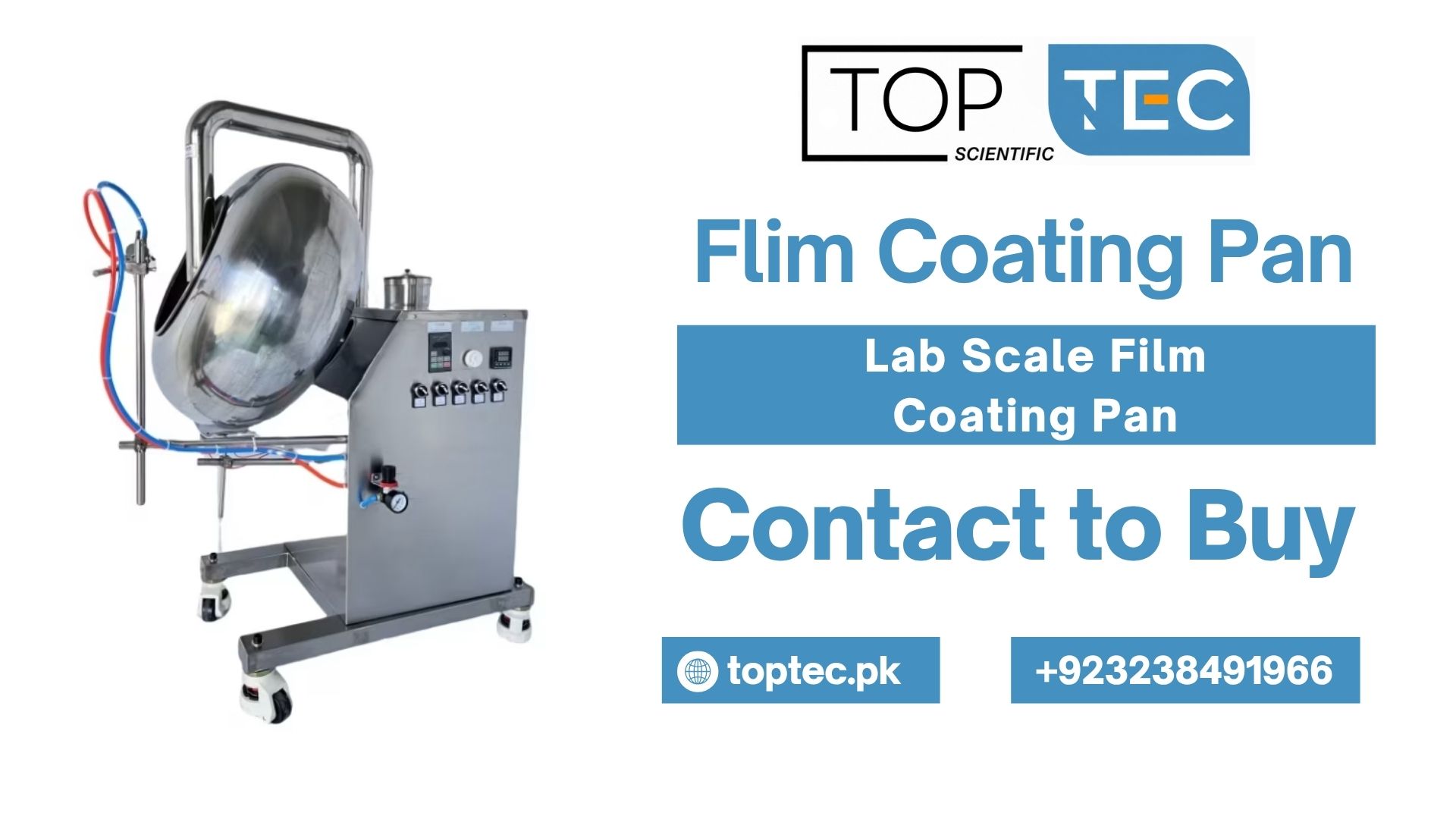
Lab Scale Film Coating Pans — for R&D, formulation development, and small batch work. Ideal for universities, research institutions, and pharmaceutical companies developing new products.
Pilot Scale Film Coating Pans — for scale-up studies and process development between lab and full production.
Production Scale Film Coating Pans — for commercial manufacturing operations requiring larger batch capacities and GMP-compliant design.
Their perforated coating pan designs incorporate the airflow-through-the-bed principle that modern pharmaceutical film coating requires. If you need to run aqueous coating systems — which most modern pharmaceutical operations do — a properly designed perforated coating pan from TOPTEC Scientific gives you the drying capacity to make that work effectively.
Tablet Coating Pan Options
For pharmaceutical manufacturers, TOPTEC Scientific’s tablet coating pan equipment is designed with pharmaceutical production in mind:
- Stainless steel construction appropriate for pharmaceutical environments
- Smooth, easily cleanable interior surfaces
- Variable speed pan drive
- Integrated spray systems
- Air handling with appropriate inlet and exhaust design
- Control systems that allow process parameter setting and monitoring
Whether you’re producing film-coated tablets for a domestic pharmaceutical brand or coating tablets for export, a properly specified tablet coating pan from a local manufacturer gives you the process control you need.
Industrial Coating Machine Capabilities
For larger operations, TOPTEC Scientific’s industrial coating machine options scale up to handle production volumes appropriate for commercial pharmaceutical manufacturing. These larger units maintain the same engineering principles as the lab scale equipment — proper pan geometry, effective airflow, reliable spray systems — at production scale.
Customization
Because TOPTEC Scientific manufactures locally, customization is genuinely possible. If your application requires a specific pan size, a particular control system configuration, or modifications to the standard design, those conversations are much more productive with a local manufacturer than with an overseas supplier who may not be willing to accommodate changes for a single unit order.
Technical Support
After-sales support from TOPTEC Scientific means you’re getting help from people who are in the same country, speak the same language, and can actually come to your facility if needed. That’s not something you get when your equipment comes from a manufacturer based overseas.
Who Needs to Buy Film Coating Pan Equipment?
Let’s be specific about who actually benefits from this equipment, because it’s a broader market than people sometimes realize.
Pharmaceutical Manufacturers
This is the primary market. Any pharmaceutical company producing coated tablets — which is the majority of solid dosage form manufacturers — needs reliable coating equipment. Whether you’re a large established company or a newer entrant to the market, the need for a quality tablet coating pan is the same.
Pharmaceutical R&D Departments
Even large manufacturers that already have production-scale coating equipment often need dedicated lab scale units for formulation development and stability studies. A lab scale perforated coating pan in the R&D department means development work happens on appropriate-scale equipment rather than tying up production machinery.
Contract Research Organizations (CROs)
CROs in Pakistan’s growing pharmaceutical services sector need flexible, reliable coating equipment that can handle a variety of client formulations. Lab and pilot scale equipment is particularly relevant here.
Universities and Pharmacy Colleges
Pharmacy programs need teaching equipment that represents what students will encounter in industry. A lab scale film coating pan gives students hands-on experience with coating processes — and when they graduate and enter the industry, they’re not starting from zero on this skill.
Nutraceutical and Supplement Manufacturers
The nutraceuticals sector uses tablet coating for many of the same reasons pharmaceuticals do — taste masking, moisture protection, appearance. As Pakistan’s nutraceutical market grows, so does the need for appropriate processing equipment.
Food Processing and Confectionery
Sugar panning and chocolate coating use similar equipment principles. Food industry operators looking for a domestic industrial coating machine supplier are also well served by TOPTEC Scientific’s range.
Pricing Considerations: What Affects the Cost?
When you buy film coating pan equipment, the price will vary based on several factors. Understanding these helps you have better conversations with suppliers and make more informed decisions.
Scale and capacity — Lab scale units are more affordable than production scale. Pilot scale sits in between. If your actual needs are lab scale, don’t pay for production capacity you won’t use.
Pan size — Within a given scale, larger pans cost more. Match the pan size to your typical batch requirements.
Control system sophistication — Basic manual controls are less expensive than fully programmable, data-logging systems. For GMP pharmaceutical environments, the more sophisticated system may not be optional. For research work, simpler may be sufficient.
Material specifications — Standard stainless steel construction is appropriate for most applications. Special alloys or surface treatments for specific chemical compatibility requirements add cost.
Air handling capacity — Higher airflow systems capable of handling aqueous coatings cost more than systems designed only for solvent-based coatings. If you’re doing aqueous coating, you need the capacity — don’t compromise here.
Spray system — Number of spray guns, gun quality, and automation level all affect pricing.
Local vs. imported — As discussed, buying from TOPTEC Scientific rather than importing eliminates import duties, shipping costs, and the uncertainty of international procurement. The net cost comparison often favors the local option significantly.
Questions to Ask Before You Buy Film Coating Pan Equipment
Whether you’re buying from TOPTEC Scientific or evaluating any other supplier, these questions will help you make a better decision:
What batch sizes will the equipment handle? Make sure the equipment covers your current needs and leaves reasonable room for growth.
Is the pan perforated or solid? For modern film coating with aqueous systems, you want a perforated coating pan.
What’s the airflow capacity? Aqueous coatings require significantly more drying capacity than solvent-based. Confirm the air handling system is adequate.
What materials are used in construction? Product-contact surfaces should be appropriate for pharmaceutical or food use.
What spray system is included? How many guns? What nozzle type? How is spray rate controlled?
What control systems are available? Do you need data logging for GMP compliance? Is the control system upgradeable?
What after-sales support is available? Spare parts, service, technical guidance — who provides these and how quickly?
Is customization possible? If your application has specific requirements, can the manufacturer accommodate them?
What’s the delivery timeline? For a local manufacturer like TOPTEC Scientific, this should be dramatically shorter than an overseas supplier.
Maintenance Tips for Your Film Coating Pan
Once you’ve made the investment and your equipment is running, protecting that investment through proper maintenance makes sense.
Clean thoroughly after every batch. Coating residues that dry in the pan or spray system cause contamination of subsequent batches and can be very difficult to remove if allowed to build up. Follow your validated cleaning procedure every time.
Inspect spray nozzles regularly. Nozzles wear over time and can partially clog. Worn or partially blocked nozzles create inconsistent droplet patterns that show up as coating defects. Replace nozzles on schedule.
Check pan drive and seals. The pan rotation mechanism and seals should be inspected regularly. Unusual vibration or noise is an early warning sign that something needs attention.
Calibrate temperature sensors. The inlet and exhaust air temperature readings drive critical process decisions. Calibrate these sensors on a regular schedule.
Maintain the air handling system. Filters in the inlet air system need regular replacement. A clogged filter reduces airflow and affects drying performance.
Keep records. Document maintenance activities, calibration records, and any equipment issues. This documentation is required in GMP environments and is good practice everywhere.
Final Thoughts
The decision to buy film coating pan equipment — whether a lab scale unit for development work or a production scale industrial coating machine for commercial manufacturing — is an investment in your operation’s capability and product quality.
Getting that decision right means choosing equipment that’s properly designed for your application, built to appropriate quality standards, and supported by a supplier who will actually be there when you need help.
For pharmaceutical companies, research institutions, universities, and nutraceutical manufacturers in Pakistan, TOPTEC Scientific brings together local manufacturing, genuine engineering capability, and the kind of after-sales support that you can only get from someone who’s actually in the same country.
Their range of tablet coating pan and perforated coating pan equipment covers lab scale through production scale. Their industrial coating machine options serve larger manufacturing operations. And because everything is manufactured in Pakistan, you’re not adding import costs, customs delays, or time zone barriers to your procurement process.
If coating quality matters to your operation — and it should — the equipment you use matters just as much as the formulation. Start with a conversation with TOPTEC Scientific and see what the right equipment for your specific needs actually looks like.
