

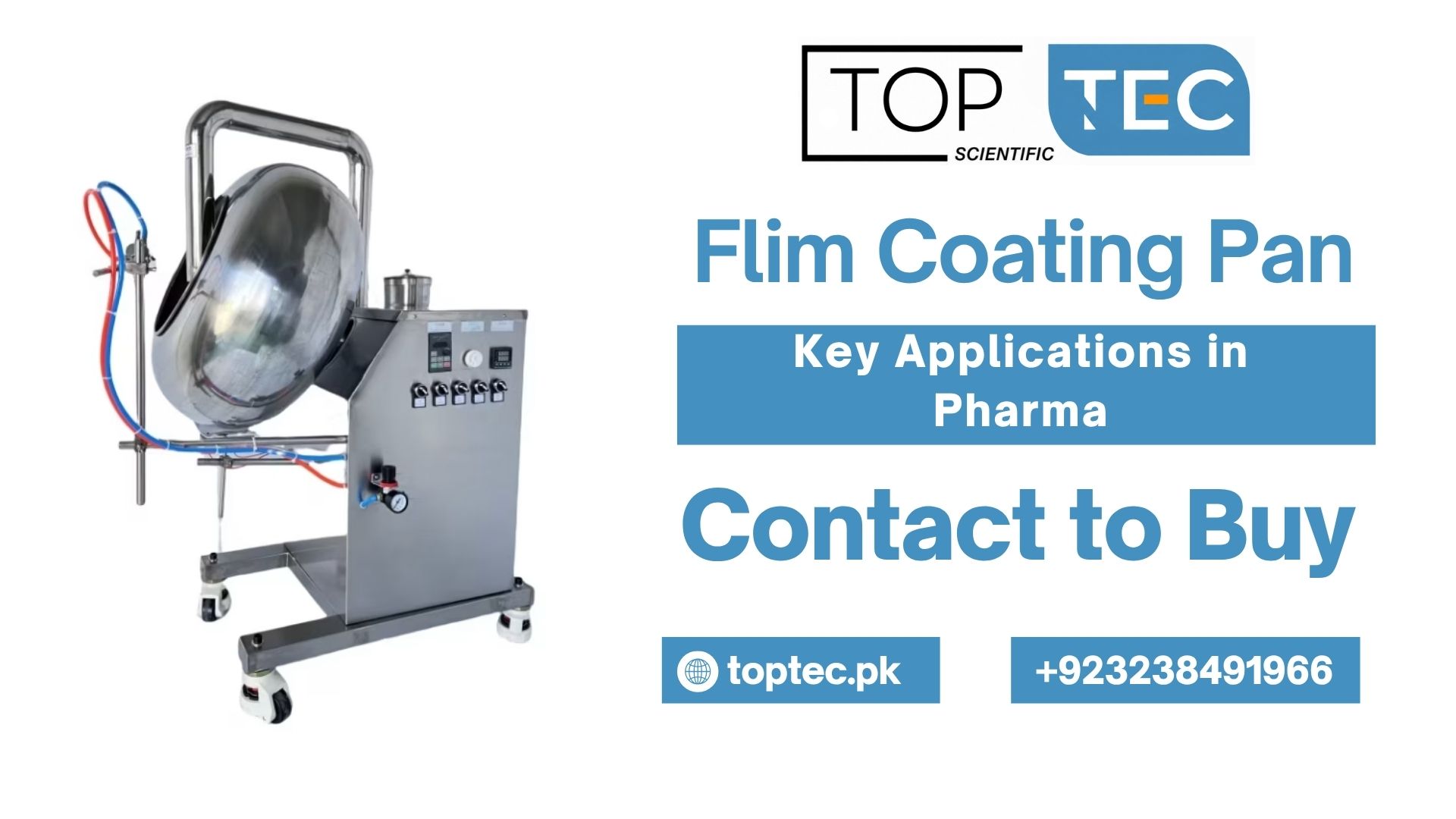
Walk through any commercial tablet manufacturing facility and you’ll find it somewhere in the production sequence — usually in its own dedicated room, often behind a viewing window, rotating steadily while a fine mist of coating solution settles evenly across thousands of tablet cores tumbling inside it.
The film coating pan is one of those pieces of pharmaceutical equipment that looks deceptively simple from the outside. A rotating drum, some spray guns, an airflow system. How complicated can it be?
Considerably more complicated than it looks, as anyone who’s spent time troubleshooting coating defects will tell you quickly.
Achieving a uniform, defect-free film coat across an entire batch of tablets — consistently, batch after batch, across different formulations and different environmental conditions — requires equipment engineering that’s far more sophisticated than the rotating drum appearance suggests. And understanding that engineering is exactly what helps pharmaceutical manufacturers make better decisions about specifying, operating, and troubleshooting their coating equipment.
This guide covers what a film coating pan actually is, how it works mechanically and aerodynamically, the critical differences between equipment configurations, and where industrial coating machine equipment fits into the broader pharmaceutical manufacturing picture.
What Is a Film Coating Pan? The Basic Definition and Purpose
A film coating pan — also called a tablet coating pan or coating drum — is pharmaceutical manufacturing equipment designed to apply a thin, uniform polymer film coat to tablet cores. The coated film modifies the tablet’s properties in ways that serve specific pharmaceutical, functional, or aesthetic purposes.
The word “film” distinguishes this equipment from older sugar coating technology. Film coating applies a thin — typically 2-5% weight gain — polymer-based coating that dries relatively quickly through evaporation of the coating solution’s solvent system (water or organic solvents). Sugar coating, by contrast, builds up multiple thick layers of sucrose solution, producing a much thicker coat with a much longer process time.
Modern pharmaceutical manufacturing has almost entirely moved to film coating because it’s faster, more reproducible, produces less weight gain, and can be engineered to provide specific functional properties that sugar coatings cannot.
Why Tablets Get Coated
Before getting into how the equipment works, understanding why tablets get coated clarifies what the coating process is trying to achieve — and therefore what performance characteristics matter in coating equipment.
Taste and Odor Masking: Many pharmaceutical APIs taste bitter, metallic, or unpleasant. A film coat completely encapsulating the tablet core prevents the API from contacting taste receptors during swallowing. For pediatric medications and any products where patient compliance depends on palatability, taste masking is a primary coating objective.
Swallowing Ease: Smooth, coated tablets are physically easier to swallow than uncoated cores. The coating reduces friction in the esophagus and reduces the tendency of the tablet to stick to the throat — significant for elderly patients and anyone with swallowing difficulties.
Moisture and Light Protection: Some APIs are chemically sensitive to moisture or light exposure. A properly formulated film coat provides a barrier between the API in the tablet core and the external environment, improving chemical stability and extending shelf life.
Enteric Coating: Specific polymer systems — typically methacrylic acid copolymers — remain intact in the acidic environment of the stomach but dissolve in the more neutral pH of the small intestine. This protects acid-labile APIs from gastric degradation and protects the gastric mucosa from APIs that cause gastric irritation.
Modified Release: Controlled-release film coatings slow the rate of drug release from the tablet over an extended period — enabling once-daily dosing for drugs that would otherwise require multiple daily administrations.
Branding and Identification: Distinctive color, shape, and appearance created by film coating helps patients identify their medications and provides brand differentiation in the commercial marketplace.
Separation of Incompatible Components: In some formulations, active ingredients that are chemically incompatible are manufactured in separate tablet cores, one of which is film-coated as a barrier, before being compressed together in a multilayer or press-coated tablet.
Each of these coating objectives places different demands on the coating formulation and the coating equipment. Understanding your specific coating objective helps you specify the right tablet coating pan configuration.
How a Film Coating Pan Works — The Mechanics
The coating process looks straightforward from the outside but involves careful control of several interacting process variables. Here’s what’s actually happening:
The Basic Cycle
Tablet cores are loaded into the coating pan — a perforated or solid-walled drum — which rotates at a controlled speed. The rotation causes the tablets to tumble in a characteristic “waterfall” cascade pattern, repeatedly cycling from the top of the tablet bed to the bottom and back.
Coating solution is sprayed from spray guns positioned above or within the tablet bed. The spray pattern from each gun covers a defined area of the cascading tablet surface. As tablets pass through the spray zone, they receive a fine mist of coating solution on their surfaces.
Heated process air flows through the pan — in perforated pan designs, through the tablet bed — evaporating the solvent from the coating solution deposited on tablet surfaces. This evaporation is what converts the wet deposited droplets into a solid film coating on the tablet surface.
This spray-and-dry cycle repeats continuously throughout the coating process. Each pass through the spray zone adds an incremental amount of coating. Over hundreds or thousands of passes, the coating builds up to the target weight gain — typically measured as percentage increase in tablet weight relative to the uncoated core.
The Aerodynamics Are Critical
The airflow management in a film coating pan is as important as the spray system for achieving coating quality. Understanding why requires thinking about what happens when coating solution hits a tablet surface.
When a coating solution droplet lands on a tablet surface, two things must happen in sequence: the droplet must spread and coalesce with adjacent droplets to form a continuous film, and then the solvent must evaporate to solidify that film before the tablet touches another tablet surface.
If evaporation is too slow — inadequate airflow, high humidity in the process air, excessive spray rate — tablets arrive at the next surface contact with incompletely dried coating. The wet surfaces stick together, producing agglomerates and picking defects.
If evaporation is too fast — excessive airflow, very low humidity, high temperature — droplets dry before they properly coalesce with adjacent material. The result is rough, orange-peel texture or spray drying artifacts where droplets dry in the air before reaching tablet surfaces.
The balance between spray rate and drying rate — controlled through process air temperature, air volume, exhaust air humidity monitoring, and spray system parameters — is the fundamental control challenge in film coating. Good industrial coating machine design makes achieving and maintaining this balance achievable across a range of operating conditions.
Perforated Coating Pan vs. Conventional Pan — The Critical Difference
This is the specification decision that matters most when pharmaceutical manufacturers are selecting coating equipment. The two main configurations — perforated coating pan and conventional solid-wall pan — have fundamentally different airflow characteristics that determine their suitability for different applications.
Conventional (Non-Perforated) Coating Pans
The original and still-used configuration for specific applications. A solid stainless steel drum rotates on its horizontal axis. Process air enters through one end of the pan and exits through the other — or is directed across the tablet bed surface by baffles — without passing directly through the tablet bed.
The indirect airflow means the drying efficiency of conventional pans is lower than perforated coating pan designs. This makes them more appropriate for aqueous sugar coating — where drying efficiency requirements are less stringent — than for modern polymer film coating where process efficiency and throughput matter.
Conventional pans are still used for some specialty applications and remain appropriate for small-scale or batch coating where the indirect airflow characteristics suit the specific coating formulation.
Perforated Coating Pans
The dominant design in modern pharmaceutical film coating. The drum wall has perforations — thousands of small holes — through which process air flows directly through the tablet bed. Air typically enters through the front face or through an inlet airflow manifold, passes through the tablet bed, and exits through the perforations on the opposite side into an exhaust plenum.
This through-the-bed airflow produces dramatically higher drying efficiency than conventional pan designs. The process air contacts the tablet surface directly, efficiently removing solvent vapor from the tablet bed. This efficiency advantage translates into:
Higher spray rates: More coating solution can be applied per unit time because the drying capacity keeps pace with the spray rate.
Shorter process times: The same target weight gain is achieved in less time due to higher throughput capability.
Better coating uniformity: The through-bed airflow creates more consistent tablet bed conditions throughout the coating run, reducing local variation in spray exposure and drying rate.
Aqueous coating capability: The drying efficiency of the perforated coating pan makes aqueous film coating (using water rather than organic solvents as the coating vehicle) practically viable at commercial scale — important because aqueous coating eliminates the explosion-proof requirements, solvent recovery systems, and environmental considerations of organic solvent-based coating.
Modern pharmaceutical industrial coating machine equipment almost universally uses perforated drum designs for production-scale film coating. The efficiency and coating quality advantages make conventional pans obsolete for most modern pharmaceutical film coating applications.
The Spray System — Where Coating Quality Is Directly Determined
The spray system is where coating solution is converted into the fine droplets that land on tablet surfaces. Its design and operation directly determine coating uniformity, coating quality, and the defect profile of the coated product.
Spray Guns
Two-fluid spray guns are the standard for pharmaceutical tablet coating. Compressed air and coating solution are mixed at the gun tip — the coating solution is atomized into fine droplets by the compressed air stream. The droplet size, spray pattern width, and spray rate are controlled through:
Liquid flow rate: Controlled by a peristaltic pump that delivers coating solution to the spray guns at a defined, adjustable rate. The pump speed is one of the primary process control parameters.
Atomizing air pressure: Higher atomizing air pressure produces finer droplets but can also cause spray drying — droplets drying before reaching tablet surfaces. The right atomizing pressure balances droplet fineness with adequate droplet size for surface wetting.
Fan air pressure: Controls the width of the spray pattern from each gun. Appropriate fan air pressure spreads the coating solution across the target area of the tablet bed.
Gun-to-bed distance: The distance from the spray gun tip to the tablet bed surface affects droplet size when it reaches tablets (evaporation during flight) and the area of the bed covered by each gun. Optimizing this distance for specific coating formulations is part of process development.
Spray Gun Number and Positioning
The number of spray guns and their positioning across the tablet bed determines the uniformity of coating solution distribution across the bed. Insufficient spray coverage creates areas of the bed that receive less coating per pass through the spray zone — producing coating weight non-uniformity across the batch.
Modern perforated coating pan equipment for large-scale production uses multiple spray guns arranged in a linear array spanning the width of the tablet bed. The number of guns scales with the pan diameter — larger pans require more guns to maintain equivalent spray coverage per unit bed area.
Peristaltic Pump Systems
Multi-channel peristaltic pumps deliver coating solution to multiple spray guns simultaneously, ensuring consistent flow rate to each gun. Peristaltic pump design is particularly suitable for pharmaceutical coating solution delivery because the liquid contacts only the silicone tubing — not the pump mechanism — simplifying cleaning and preventing contamination.
Process Air Management — The Engineering That Makes Coating Work
The process air system of a tablet coating pan handles the delivery, conditioning, and exhaust of the drying air that evaporates coating solvent. This system is at least as important as the spray system for coating quality.
Inlet Air Treatment
Process air entering the coating pan needs to be conditioned — filtered, heated, and sometimes dehumidified — to provide consistent drying conditions. Humidity variation in inlet process air is a major cause of coating process variability between different days and seasons. Pharmaceutical-grade industrial coating machine equipment incorporates inlet air dehumidification to maintain consistent process air humidity regardless of ambient conditions.
HEPA filtration of inlet process air prevents particulate contamination of the coating atmosphere. For GMP pharmaceutical coating, HEPA filtration of process air is standard.
Airflow Volume and Direction
The volume of process air delivered to the film coating pan — measured in cubic meters per hour — determines the available drying capacity. More airflow means more solvent evaporation capacity, allowing higher spray rates and faster coating.
But airflow volume isn’t the only important parameter. The direction and distribution of airflow through the tablet bed determines whether drying is uniform across the entire bed or concentrated in specific areas. Good perforated coating pan engineering distributes process airflow uniformly across the full drum width, ensuring consistent drying conditions throughout the tablet bed.
Exhaust Air Monitoring
The exhaust air leaving the coating pan carries evaporated solvent and provides important process information. Exhaust air temperature and humidity can be monitored to assess drying conditions in real time. Modern film coating pan systems use exhaust air parameters as process control feedback — adjusting spray rate or air conditions to maintain optimal coating conditions throughout the run.
Exhaust Air Treatment
For aqueous coating, the exhaust air contains water vapor and particulate coating material — proper exhaust air filtration prevents coating powder from contaminating the exhaust air handler and exhausting into the environment. For solvent-based coating, organic solvent vapor in the exhaust requires either recovery or incineration before release, and the complete coating system must be explosion-proof.
Pan Design Features That Affect Coating Performance
Within the broad category of perforated coating pan equipment, several design features significantly affect coating performance:
Drum Geometry and Baffles
The internal geometry of the coating drum — the drum shape, the presence and design of mixing baffles, and the angle at which the drum is mounted — affects tablet bed behavior. Good tablet bed cascade characteristics — smooth, consistent tumbling that exposes all tablet surfaces uniformly to the spray zone — require careful drum geometry design.
Internal baffles promote tablet mixing and prevent preferential coating of tablets on the outside of the bed cascade. Baffle design is a competitive differentiator among tablet coating pan manufacturers — well-designed baffles improve coating uniformity without causing tablet breakage or excessive attrition.
Pan Angle and Speed
The drum is typically mounted at an angle from horizontal — usually 0-25° adjustable depending on the design. The pan angle affects the tablet bed depth and the cascade pattern. Combined with rotation speed, these parameters control how long tablets spend in the spray zone relative to the non-spray zone during each rotation — directly affecting the uniformity of coating deposition per pass.
Perforation Design
The size, shape, and distribution of perforations in the drum wall affects airflow distribution and tablet flow behavior. Perforations must be large enough to allow adequate airflow but small enough that tablet cores don’t fall through or wedge in the perforations. The perforation pattern must distribute across the drum surface in a way that provides uniform airflow throughout the tablet bed.
Industrial Coating Machine Scale — From Lab to Production
Industrial coating machine equipment for pharmaceutical tablet coating spans a wide range of scales, each appropriate for different production contexts:
Laboratory and Pilot Scale Coating Equipment
Small-scale coating equipment for pharmaceutical development work — typically 1-15 kg batch capacity. Used during formulation development to evaluate coating formulations, develop coating processes, and generate clinical trial material.
Laboratory tablet coating pan equipment needs to be representative of larger-scale production equipment — the coating process parameters developed at small scale should translate to production scale with minimal adjustment. This “scalability” is a design criterion for quality laboratory coating equipment.
Pilot Scale Equipment
Intermediate scale — typically 10-50 kg — bridging laboratory development and full production scale. Used for process validation activities, scale-up studies, and production of first commercial batches before investment in full production-scale equipment.
Production Scale Equipment
Full production-scale film coating pan equipment typically ranges from 50 kg to several hundred kilograms batch capacity for standard solid-dose pharmaceutical manufacturing. Large-scale industrial coating machine equipment for high-volume production may have even larger capacity.
Production-scale coating equipment incorporates comprehensive process control systems — recipe management for multiple products, real-time process parameter monitoring, data logging for GMP batch records, and integrated weight monitoring systems.
Critical Process Parameters — What Gets Controlled
Understanding the process parameters that are controlled during film coating pan operation helps you evaluate equipment control system capability:
Pan speed (RPM): Determines tablet cascade characteristics and exposure time in the spray zone.
Process air inlet temperature: The primary drying capacity control parameter. Higher inlet temperature means more drying capacity — allowing higher spray rates.
Process air volume (airflow rate): The secondary drying capacity control. More airflow means more solvent evaporation capacity.
Spray rate: The rate at which coating solution is delivered to the tablet bed. Must be balanced against drying capacity to avoid under- or over-drying.
Atomizing air pressure: Controls droplet size from the spray guns.
Exhaust air temperature: Often used as a process feedback parameter — maintaining consistent exhaust temperature by adjusting inlet temperature or spray rate.
Coating solution concentration: Higher concentration means more solid film deposited per unit liquid volume — fewer spray passes needed for the same weight gain, but higher viscosity that affects atomization.
Modern perforated coating pan control systems allow all of these parameters to be programmed into product recipes, reproduced automatically from batch to batch, and logged continuously for GMP batch record documentation.
Coating Defects — What Goes Wrong and Why
Understanding coating defects helps in troubleshooting and in evaluating whether equipment design choices affect your defect profile:
Picking and Sticking: Tablets picking up material from each other’s surfaces, creating surface defects. Caused by inadequate drying — spray rate exceeding drying capacity. Solution: reduce spray rate or increase drying capacity.
Orange Peel Surface: Rough, textured coating surface. Caused by spray drying — droplets drying before reaching tablet surfaces and depositing as dry particles. Solution: reduce atomizing air pressure, move guns closer, increase solution temperature.
Bridging: Coating fills the tablet’s embossed letters or score lines, obscuring them. Caused by excessive spray rate, coating solution viscosity too high, or insufficient pan speed.
Blistering: Small blisters or bubbles in the coating film. Caused by coating solution penetrating the tablet core and solvent vapor trying to escape through the coat. Solution: adjust coating film composition or reduce coating rate.
Color Variation: Uneven color distribution across the tablet batch. Caused by spray distribution non-uniformity or tablet bed segregation — heavier tablets not mixing adequately with lighter ones.
Twinning: Two tablets fusing together through the coating film. Caused by excessive spray rate relative to pan speed and drying capacity — particularly problematic with flat-faced tablets.
A well-designed tablet coating pan with good airflow management, appropriate spray system configuration, and adequate control system capability minimizes the frequency and severity of these defects. But process understanding and proper parameter management remain important regardless of equipment quality.
GMP Requirements for Film Coating Equipment
Pharmaceutical film coating pan equipment in Pakistan operates under DRAP GMP requirements that establish specific expectations:
Contact Surface Specification: All product-contact surfaces — drum interior, spray gun components, coating solution delivery components — must be pharmaceutical-grade materials. SS316L for stainless steel components, pharmaceutical-grade polymers for tubing and seals.
Equipment Qualification: IQ/OQ/PQ qualification before the equipment enters GMP production use. Documentation confirming installation correctness, operational performance within specification, and consistent production of coated tablets meeting quality specifications.
Cleaning Validation: Demonstration that the cleaning procedure removes previous product residue to acceptable levels between products. Equipment design — accessibility of all surfaces, complete drainage, no dead legs — significantly affects cleaning validation success.
Batch Documentation: Process parameter logging throughout the coating run, providing the batch record data that demonstrates the coating process was controlled within validated parameters.
Environmental Controls: Coating rooms require appropriate HVAC systems maintaining temperature and humidity within ranges that support consistent coating processes and protect hygroscopic tablet cores and coating materials.
TOPTEC Scientific — Building the Complete Coating Environment
When pharmaceutical manufacturers invest in film coating pan equipment, the surrounding production environment — the furniture, the workflow infrastructure, the cleanroom systems — needs to match the specification of the coating equipment.
TOPTEC Scientific is a Pakistan-based manufacturing company producing high-specification laboratory furniture and cleanroom equipment for pharmaceutical manufacturing facilities throughout Pakistan. Everything they manufacture is produced locally — with direct technical support, no import delays, and pricing that reflects local manufacturing economics.
For pharmaceutical facilities with tablet coating operations, TOPTEC Scientific provides the complete surrounding infrastructure:
Pharmaceutical-Grade Stainless Steel Workbenches
The coating area needs properly specified work surfaces for in-process operations — coating solution preparation, tablet sampling during coating, in-process weight checks, and documentation management. TOPTEC Scientific manufactures SS304 and SS316 workbenches with seamless welded construction and pharmaceutical-grade surface finishes appropriate for coating room environments.
Coating Solution Preparation Stations
Coating solutions are prepared before coating runs — dissolving polymer, dispersing pigments, adding plasticizer, measuring and mixing all components to defined specifications. Dedicated preparation stations with appropriate mixing capability, weighing stations, and properly specified surfaces for coating solution handling support this upstream activity consistently.
Pass-Through Systems
Tablet cores enter the coating area and coated tablets exit to the next processing step. Controlled material transfer between different environmental zones — through pass-through boxes manufactured by TOPTEC Scientific — maintains environmental integrity during these transfers.
In-Process QC Workstations
During coating runs, in-process sampling — weight gain checks, appearance evaluation, hardness testing if applicable — happens in the coating area or an adjacent sampling station. TOPTEC Scientific manufactures dedicated QC workstations with stable, cleanable surfaces and organized instrument positioning.
Mobile Stainless Steel Trolleys
Transport of tablet cores to the coating area and finished coated tablets to packaging requires properly specified pharmaceutical-grade transport equipment. TOPTEC Scientific manufactures stainless steel trolleys appropriate for pharmaceutical cleanroom environments.
Gowning Room Furniture
Personnel entering coating rooms follow pharmaceutical gowning procedures. Complete gowning room infrastructure — benches, lockers, organized storage — from TOPTEC Scientific supports consistent compliance with these procedures.
Laboratory Furniture for Coating Solution Development
In pharmaceutical development laboratories where coating formulations are developed and evaluated, chemical-resistant benches, analytical instrument workstations, and organized storage support the development activities that precede production coating operations.
The comprehensive local manufacturing capability of TOPTEC Scientific means pharmaceutical manufacturers in Pakistan can source complete coating area infrastructure — from coating room workbenches to complete facility fit-out — from a single local supplier with direct technical support and no import complications.
Choosing the Right Film Coating Pan for Your Operation
For pharmaceutical manufacturers evaluating tablet coating pan or perforated coating pan equipment, here’s a practical framework:
Define your product range: What tablet shapes and sizes will you coat? What coating types — aqueous film, organic solvent film, enteric, modified release? Different products may have different equipment requirements.
Determine your batch sizes: Your batch size determines your pan capacity requirement. Consider both current requirements and realistic growth projections.
Assess your throughput needs: How many coating batches per day or week? Higher throughput requirements favor more efficient perforated coating pan designs with higher spray rates.
Evaluate your regulatory requirements: DRAP GMP, WHO-GMP, export market requirements — these determine your documentation and qualification requirements.
Consider your facility constraints: Room dimensions, utility supply (compressed air, steam, chilled water, electrical), HVAC system capacity — these constrain your equipment options.
Plan the complete environment: Beyond the industrial coating machine itself, plan the coating room furniture, workflow infrastructure, and environmental controls — from TOPTEC Scientific — as part of the complete project.
Closing Thoughts
The film coating pan is central to tablet manufacturing quality in a way that’s sometimes underappreciated until coating problems emerge. Understanding how the equipment works — the mechanics, the aerodynamics, the spray system, the process control — helps you make better equipment decisions, develop better coating processes, and troubleshoot problems more efficiently when they occur.
The difference between a well-specified perforated coating pan with appropriate process control capability and a basic coating drum with minimal controls shows up in coating uniformity, defect rates, process development time, and regulatory compliance — not just in the equipment price.
And the complete coating environment — the surrounding furniture, workflow infrastructure, and facility fitout from TOPTEC Scientific — matters as much for your coating operation’s GMP compliance as the coating equipment itself.
Make both investments thoughtfully.
For pharmaceutical-grade laboratory workbenches, coating solution preparation stations, pass-through systems, in-process QC workstations, mobile trolleys, gowning room furniture, and complete pharmaceutical manufacturing facility infrastructure manufactured locally in Pakistan, contact TOPTEC Scientific — building the production environments Pakistan’s pharmaceutical manufacturers rely on.
