

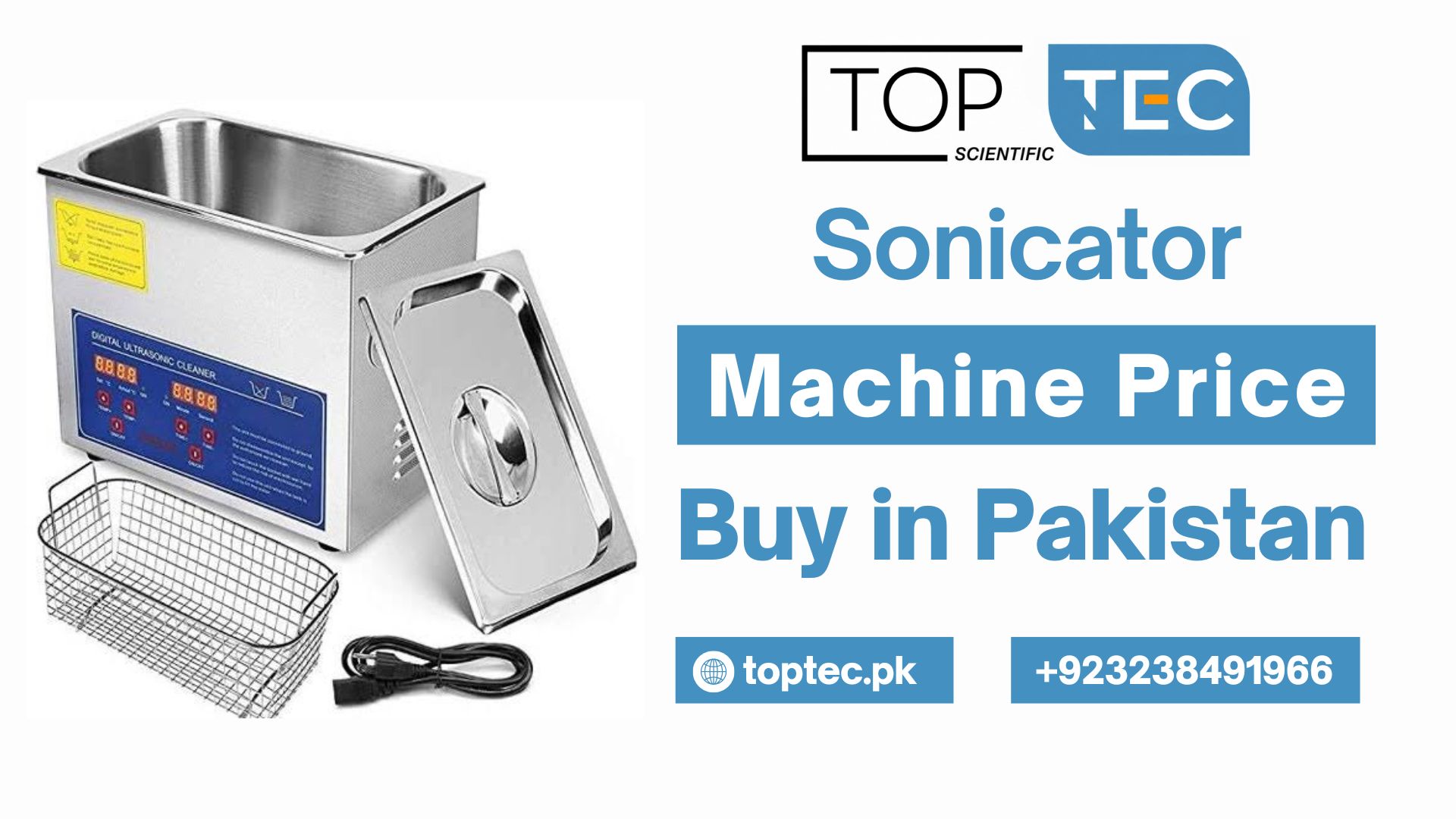
If you’ve already spent thirty minutes searching online trying to figure out where to buy Sonicator in Pakistan and what you should actually be paying, you’ve probably noticed that the information landscape is genuinely messy. Suppliers listing the same equipment at prices that are completely inconsistent with each other. Product descriptions that use “sonicator,” “ultrasonic cleaner,” “ultrasonic homogenizer,” and “ultrasonic processor” almost interchangeably. And almost nobody clearly explaining what actually makes these instruments different from each other or whether a specific product will work for your specific application.
That frustration is completely reasonable. And it’s exactly why I’m writing this guide specifically for 2026 — covering both probe and bath sonicator systems, breaking down what realistic costs look like in the Pakistani market right now, and giving you the practical information you need to make a decision you won’t regret.
We’ll also get into the laboratory furniture and infrastructure side of this — because a quality sonicator placed in a poorly set up laboratory doesn’t perform the way it should.
Starting Point — What a Sonicator Actually Does
You probably have some sense of this already, but let’s get specific because understanding the mechanism helps you make better purchasing decisions.
Sonicators use high-frequency sound waves — typically 20 kHz for probe-type instruments, sometimes higher frequencies for bath systems — to create a phenomenon called acoustic cavitation in liquid samples. Here’s what that actually means: the alternating pressure waves from the sonicator cause millions of microscopic bubbles to form and then violently collapse in the liquid. These collapses happen in microseconds and generate extraordinarily intense local conditions — extreme temperatures, pressure pulses, and shear forces in tiny localized zones.
These conditions produce effects that are impossible to achieve through conventional stirring or mixing:
Bacterial and mammalian cell membranes are disrupted, releasing intracellular proteins, nucleic acids, and other contents. Solid particles in suspension are broken down into smaller sizes — right down to the nanometer range for nanoparticle preparation applications. Immiscible liquids are forced into stable emulsions. Dissolved gases are removed from liquids. Chemical reactions are dramatically accelerated.
What matters for your purchasing decision is that different types of sonicators deliver this acoustic energy in fundamentally different ways — and that difference determines what applications each type is and isn’t suitable for.
The Fundamental Split: Probe vs. Bath
This is the decision that matters most when you’re looking to buy Sonicator in Pakistan, and it’s where the most expensive purchasing mistakes happen.
Probe Sonicators
A probe sonicator — also called an ultrasonic processor, ultrasonic homogenizer, or sonic dismembrator depending on the manufacturer — inserts a vibrating metal probe directly into the liquid sample. The probe tip vibrates with amplitudes measured in micrometers, creating intense cavitation immediately at the probe tip surface.
The energy density at the probe tip is extremely high. This concentrated energy delivery is what makes probe sonicators capable of demanding applications — cell disruption, nanoparticle synthesis, emulsification of viscous systems, DNA shearing. These are applications where bath sonicators simply don’t work, regardless of their rated power.
Direct probe contact with the sample creates considerations around cross-contamination between samples and probe cleaning requirements. Heat generation is significant — this is why most probe sonication protocols for biological samples use pulsed operation (on/off cycles) with ice cooling.
Bath Sonicators
A bath sonicator uses transducers bonded to the bottom or walls of a liquid-filled tank. Your samples sit in their containers — tubes, flasks, vials — submerged in the bath liquid. The ultrasonic energy travels through the bath water and then through the container walls into the sample.
This indirect coupling means the energy reaching your sample is significantly lower than direct probe contact would provide. For demanding applications like cell disruption, bath sonicators are inadequate — there simply isn’t enough energy getting to the sample. But for applications that don’t need intense energy — dissolving samples, deaeration, laboratory equipment cleaning, gentle cell dispersion, preparing samples for analysis — bath sonicators are entirely appropriate and far more convenient than probe systems.
Multiple samples can be processed simultaneously in a bath sonicator. No probe cleaning is required between samples. Temperature control is more straightforward.
The practical summary: If your application involves breaking cells, making nanoparticles, creating emulsions, or shearing DNA — you need a probe sonicator. If your application involves dissolving substances, cleaning glassware, degassing solvents, or gentle sample preparation — a bath sonicator is what you need and probably all you need.
Why the Probe Sonicator Cost Is What It Is
When people first look at probe sonicator cost figures versus bath sonicator prices, the difference can seem surprising. Here’s the honest explanation.
The engineering inside a probe sonicator is genuinely sophisticated. It starts with the piezoelectric transducer — a stack of precisely manufactured ceramic elements that convert electrical energy into mechanical vibration at exactly the right frequency. These transducers need to be manufactured with tight consistency, properly aged, matched to their acoustic load, and assembled with precise torque to achieve stable resonant operation.
The probe itself — typically titanium alloy for research and pharmaceutical applications — is machined to tight tolerances because the geometry of the taper and step determine the amplitude amplification factor. The probe experiences extreme mechanical stress during operation — cyclic fatigue at 20,000 cycles per second — and needs to maintain dimensional stability through thousands of hours of use.
The power electronics must track the resonant frequency of the transducer/probe system in real time, adjusting the drive frequency to maintain optimal coupling as conditions change. Basic fixed-frequency drivers don’t do this — they’re why some cheap imported probe sonicators perform inconsistently and fail early.
Digital control systems add amplitude calibration, pulse programming, process parameter monitoring, and documentation capability. These are important for research reproducibility and essential for pharmaceutical GMP applications.
All of this is reflected in the probe sonicator cost. When you see dramatically lower prices on some platforms, you’re usually looking at instruments that cut corners on one or more of these engineering elements — and those corners show up in performance inconsistency and shorter operational life.
Realistic Sonicator Machine Price Ranges for Pakistan in 2026
Let me give you honest numbers rather than vague ranges, because that’s what’s actually useful.
Bath Sonicators
Basic ultrasonic baths (1-3L, fixed frequency, simple controls):
Entry-level instruments adequate for laboratory cleaning and simple sample preparation. The sonicator machine price at this level is the most accessible in the ultrasonic equipment category. Many analytical laboratories start here for dissolution and deaeration applications.
Research-grade ultrasonic baths with temperature control:
Instruments with precise temperature control (±0.5-1°C), frequency sweep capability for even energy distribution, digital power and time control. Significantly higher sonicator machine price than basic baths but genuinely different instruments for applications where temperature consistency and treatment uniformity matter.
Ultrasonic bath processors with multiple frequency options:
For specialized applications requiring different frequency options for different sample types. Higher investment but provides flexibility not available in single-frequency instruments.
Probe Sonicators
Entry-level analog probe sonicators (50-150W):
Basic amplitude control, simple timer, minimal feedback. The lowest probe sonicator cost entry point for direct sonication capability. Adequate for non-critical applications but limited for demanding research protocols requiring precise control.
Mid-range digital probe sonicators (200-400W):
Digital amplitude control, programmable pulse cycles, actual power display, basic data output. The right specification level for most serious laboratory research applications. The ultrasonic processor price here represents meaningful but justified investment for research-grade performance.
High-specification research processors (400-750W):
Comprehensive digital control, full pulse programming, amplitude calibration, data logging, multiple probe compatibility, process documentation. The ultrasonic processor price at this level is substantial — appropriate for pharmaceutical laboratories, research institutions, and facilities where instrument reliability and documentation are regulatory requirements.
Industrial ultrasonic processors (750W+):
Scale-up and manufacturing applications. Significant capital investment. Typically requires application engineering support for proper specification.
What Import Costs Add in Pakistan
Most sonicators available in Pakistan are imported. The effective sonicator machine price in the Pakistani market includes import duties, international freight, insurance, and the margin of whoever manages the import process. These additions typically represent a meaningful percentage above the manufacturer’s home market pricing. Suppliers with established import channels and proper service infrastructure provide better effective value than opportunistic individual imports — and they’re also there when something needs attention post-purchase.
Specific Applications and What You Actually Need
Let me map specific applications common in Pakistani research and pharmaceutical facilities to the appropriate equipment type, because this is where generic guides fail most people.
Pharmaceutical Nanoparticle Preparation
Polymeric nanoparticles, lipid nanoparticles, nanosuspensions — all require probe sonication. The energy density needed for nano-scale particle size reduction is only achievable through direct probe contact. You need a digital probe sonicator with appropriate amplitude control, pulse programming, and a probe size matched to your typical processing volume.
If you’re working at development scale (1-20mL typically), a mid-range digital processor with microtip probe option is the right entry point. Scale-up to larger batches requires either a larger probe or flow-through probe configuration.
The probe sonicator cost for proper pharmaceutical nanoparticle work isn’t the place to cut corners — particle size reproducibility between batches directly affects your formulation development outcomes.
Protein Extraction from Cells
Standard procedure in molecular biology and biochemistry laboratories. Requires probe sonication to disrupt cell membranes and release intracellular proteins. The protocol specifics — pulse duration, amplitude, cycle number, buffer composition, temperature management — significantly affect protein integrity and yield.
A mid-range digital processor with cup-horn probe eliminates cross-contamination between samples (critical when processing multiple samples in sequence) and allows tube processing without direct probe contact. If you’re processing only one sample type, direct probe with careful cleaning between samples is adequate and less expensive.
HPLC Mobile Phase Preparation
Bath sonicator only. Direct probe sonication of HPLC solvents is unnecessary and creates safety concerns with volatile organics. A basic ultrasonic bath provides all the degassing capability needed for HPLC mobile phase preparation.
If you’re buying Sonicator in Pakistan specifically for HPLC mobile phase preparation and nothing else, a basic bath sonicator is all you need. Save the money.
DNA Shearing for NGS Library Preparation
Specialized application requiring exceptional reproducibility. The fragment size distribution achieved by sonication needs to be consistent between samples and between sessions. Dedicated chromatin shearing instruments — a specialized subset of probe sonicators — are designed specifically for this application with the reproducibility controls it requires.
The probe sonicator cost for dedicated DNA shearing instruments is higher than general-purpose processors but is justified by the application’s requirements. Using a general-purpose probe sonicator for NGS library preparation often produces variable fragment size distributions that compromise library quality.
Microbiological Sample Preparation
For homogenizing tissue samples or dispersing microbial aggregates for enumeration, bath sonicators provide adequate gentle treatment. For applications requiring cell disruption to release intracellular contents — enzyme assays, metabolite extraction — probe sonication is required.
Pharmaceutical Emulsion Development
Requires probe sonication for the energy density needed to create stable fine emulsions. Amplitude, pulse parameters, and processing time significantly affect droplet size distribution. A digital processor with precise amplitude control and a probe appropriate for your batch volume is the right equipment.
The Cross-Contamination Question for Probe Sonicators
This issue comes up regularly and deserves a direct answer.
When you process multiple samples with a probe sonicator, the probe tip contacts each sample directly. Between samples, residual material from the previous sample can transfer to the next if cleaning is inadequate. For some applications — biological samples of different types, pharmaceutical formulations of different compositions — this cross-contamination is a real concern.
Three approaches address this:
Thorough probe cleaning between samples: Rinse the probe in appropriate solvent (water, ethanol, or application-specific solvent), then wipe the tip with clean tissue. For most laboratory applications where the samples are similar, this is adequate.
Cup-horn probe configuration: The cup-horn sits on top of the probe tip and contains a small volume of coupling liquid. Your sample tube sits in this coupling liquid, which transmits energy through the tube wall into the sample. No direct probe-sample contact. Eliminates cross-contamination entirely. The trade-off is slightly reduced energy transfer versus direct probe contact.
Dedicated probe per sample type: In laboratories with multiple distinct sample types requiring regular processing, having dedicated probes for different sample categories — with clear labeling and storage — prevents any possibility of cross-contamination.
This consideration affects the probe sonicator cost evaluation — if cup-horn capability is important for your workflow, confirm that the instrument you’re considering supports this accessory.
What to Ask Every Supplier Before Buying
When you’re evaluating options to buy Sonicator in Pakistan, these questions reveal what you’re actually getting:
Application-specific questions: Can you recommend the appropriate probe and amplitude settings for my specific application? Suppliers who understand their instruments and the applications they serve can answer this. Those who can only describe specifications cannot.
Calibration and documentation: What calibration documentation comes with the instrument? For pharmaceutical and regulated research environments, calibration certificates and instrument qualification support are necessary. For GMP applications specifically, audit trail capability in the instrument’s control system matters.
Probe availability and cost: What replacement probes are available locally and what do they cost? Probe replacement is an ongoing operational cost — titanium probes fatigue over time, particularly at higher amplitudes. Understanding this cost before purchase is part of a complete investment assessment.
Service infrastructure: Who provides technical service if the instrument needs attention? What’s the realistic response time? For production-critical applications, local service capability matters enormously.
Warranty terms: What does the warranty cover and for how long? How are warranty claims handled — local service or international return?
Common Mistakes People Make When They Buy Sonicator in Pakistan
These come up consistently enough to be worth highlighting:
Buying a bath sonicator for applications that need a probe sonicator
Usually driven by the lower sonicator machine price of bath units. The result is an instrument that simply doesn’t work for the intended application. No bath sonicator can provide the energy density needed for efficient cell disruption or nanoparticle preparation, regardless of its power rating.
Buying undersized probe sonicators
A 50W probe sonicator processing a 50mL sample is being asked to do more than it’s designed for. Processing time extends, heat generation becomes problematic, and results are inconsistent. Match the instrument power to your typical sample volume.
Ignoring thermal management requirements
Biological samples are heat-sensitive. Processing without appropriate pulse protocols and cooling setup produces denatured proteins, degraded nucleic acids, and compromised cell viability. Understanding thermal management before purchase affects which instrument features you need — specifically, programmable pulse control.
Not planning for the complete setup
A probe sonicator needs: a stable workbench, appropriate electrical supply, adjacent space for ice cooling setup, probe cleaning station, personal protective equipment (hearing protection for operations outside a hood, eye protection). Planning this complete setup before purchase produces better outcomes than realizing the gaps after the instrument arrives.
Choosing the lowest price without understanding what it reflects
The probe sonicator cost spread between the cheapest imported instruments and properly specified research-grade systems reflects real engineering differences. Instruments at the extreme low end of the price range typically show amplitude instability, frequency drift under load, poor durability of probe attachment mechanisms, and inadequate power electronics. For research applications where result reproducibility matters, these compromises are costly.
TOPTEC Scientific — The Laboratory Infrastructure Around Your Sonicator
Here’s something worth being direct about: the laboratory environment your sonicator operates in affects both your results and your safety.
A probe sonicator on an unstable, vibrating workbench transmits vibration to surrounding instruments. Operation near sensitive balances, microscopes, or spectrophotometers degrades their performance. A workbench surface that’s not chemical-resistant deteriorates from the spills and cleaning solvents common in active sonication work. Poor laboratory organization around the sonicator station creates inefficiency in protocols that require rapid sample handling between sonication cycles and cooling steps.
TOPTEC Scientific is a Pakistan-based manufacturing company producing high-specification laboratory furniture and cleanroom equipment for research laboratories, pharmaceutical QC departments, universities, and industrial testing facilities throughout Pakistan. They manufacture locally — genuinely — which means practical advantages that matter: faster delivery without import delays, direct technical communication, local installation support, and pricing that makes sense for Pakistani laboratory budgets.
For laboratories investing in sonicator equipment, TOPTEC Scientific builds the surrounding infrastructure that makes the complete setup work properly:
Stable, Anti-Vibration Laboratory Workbenches
The workbench your sonicator sits on needs mass and construction quality to dampen the vibration generated during probe operation. TOPTEC Scientific manufactures laboratory workbenches with appropriate construction for instrument stability, chemical-resistant surface materials that withstand the cleaning solvents and occasional spills common in sonication work, and appropriate dimensions for the complete setup — instrument, sample handling area, ice bath position.
Standard workbench heights that work for normal laboratory tasks aren’t always optimal for probe sonicator operation, where sample positioning relative to the probe requires specific geometry. TOPTEC Scientific manufactures workbenches to custom dimensions when standard sizes don’t serve the application.
Fume Hoods for Solvent Sonication Work
Organic solvent sonication — common in pharmaceutical nanoparticle preparation, organic synthesis sonochemistry, and extraction applications — generates solvent vapor that presents both health and fire hazards. Conducting this work inside a properly specified fume hood is a safety requirement, not optional.
TOPTEC Scientific manufactures ducted fume hoods with appropriate airflow performance, chemical-resistant interior surfaces (typically polypropylene or epoxy resin), sash designs that accommodate sonicator probe positioning into samples inside the hood, and integrated service connections for electrical supply and other utilities.
A fume hood sized and configured appropriately for sonicator use inside it is a specific design requirement. TOPTEC Scientific‘s local manufacturing capability means they can design and build fume hoods matched to your specific sonicator setup rather than offering only standard configurations.
Dedicated Sonicator Workstations
Purpose-designed workstation configurations for ultrasonic processing — appropriate working height for ergonomic probe sonicator operation, integrated electrical supply with appropriate outlet positioning, adjacent staging area for sample organization before and after processing, organized storage for probe sets and accessories, and proper positioning for ice bath cooling setups.
TOPTEC Scientific designs custom workstation configurations for specific laboratory applications. A dedicated sonicator workstation that integrates all these elements improves both operational efficiency and result consistency by supporting proper protocol execution.
Chemical Storage and Safety Cabinets
Laboratories conducting organic solvent sonication maintain volatile solvent inventories requiring proper safety storage. TOPTEC Scientific manufactures ventilated, fire-resistant chemical storage cabinets appropriate for laboratory solvent storage, protecting personnel and meeting laboratory safety standards.
Pass-Through Systems for Regulated Environments
For pharmaceutical laboratories and GMP environments where sonicators are used within classified cleanroom areas, TOPTEC Scientific manufactures static and dynamic pass-through boxes for controlled material transfer between different environmental zones.
Laboratory Sinks and Cleaning Stations
Probe cleaning between samples requires appropriate sink facilities — properly positioned relative to the sonicator station, with appropriate drainage and chemical resistance for the cleaning solvents used. TOPTEC Scientific manufactures stainless steel sink benches configured for laboratory environments.
Sample Storage and Organization Systems
Organized sample storage before and after sonication — particularly important when processing many samples in sequence with defined protocols — requires properly specified storage systems. TOPTEC Scientific manufactures laboratory storage furniture appropriate for different sample types and storage conditions.
Complete Laboratory Fit-Out
For laboratories establishing complete new ultrasonic processing capability as part of broader laboratory development, TOPTEC Scientific provides complete laboratory furniture fit-out with consistent specification throughout — workbenches, storage, fume hoods, sinks, and specialist workstations — delivered and installed locally.
The comprehensive local manufacturing capability of TOPTEC Scientific means you’re dealing with a single supplier who can address your complete laboratory infrastructure needs, communicates directly without international logistics barriers, and provides local support when needs evolve.
Making the Decision — A Practical Framework
For readers who want a clear decision framework rather than more information to process:
Step 1: Confirm your application category
Cell disruption, nanoparticle preparation, emulsification, DNA shearing → probe sonicator required
Sample preparation, dissolving, degassing, cleaning → bath sonicator adequate
Step 2: Determine your typical sample volume
This drives probe size selection for probe sonicators and tank size for bath sonicators.
Step 3: Assess your documentation requirements
Pharmaceutical GMP, regulatory research, or academic? Documentation and calibration requirements vary significantly. Higher documentation requirements push toward higher-specification instruments with appropriate control systems.
Step 4: Evaluate total cost of ownership
Sonicator machine price + probe replacement costs over 3-5 years + calibration costs + service costs. A higher initial investment in a properly specified instrument with good local support infrastructure often represents lower total cost of ownership than a cheaper instrument with high ongoing service costs.
Step 5: Plan the complete setup
Workbench, fume hood if needed, cooling setup, probe cleaning station, PPE — before the instrument arrives.
Step 6: Verify local support capability
Before finalizing any purchase to buy Sonicator in Pakistan, confirm what after-sales support looks like in practice — not in theory.
Closing Thoughts
The decision to buy Sonicator in Pakistan — whether you’re investing in a probe sonicator for demanding cell disruption and nanoformulation work, or a bath sonicator for routine sample preparation — is one that will serve your laboratory for many years.
Getting it right means understanding which type your application actually requires, knowing what a realistic probe sonicator cost and ultrasonic processor price looks like for instruments that will actually perform as needed, evaluating suppliers against both technical specification and practical after-sales support, and planning the complete laboratory setup rather than just the instrument in isolation.
The sonicator machine price that represents genuine value is the one that accounts for appropriate specification for your application, adequate power electronics for consistent operation, documentation support that meets your regulatory requirements, probe availability and replacement costs over the instrument’s operational life, and local after-sales service when you need it.
And when you’re building the complete laboratory environment around your sonicator investment — the workbenches, fume hoods, storage systems, and complete infrastructure — TOPTEC Scientific provides locally manufactured, properly specified laboratory furniture that makes your ultrasonic processing setup genuinely effective, safe, and compliant with the standards your laboratory operates under.
Make the complete investment thoughtfully. Your research results — and your laboratory team’s safety — depend on it.
For stable laboratory workbenches, chemical-resistant fume hoods, dedicated instrument workstations, safety storage cabinets, laboratory sinks, and complete laboratory furniture manufactured locally in Pakistan, contact TOPTEC Scientific — building properly equipped laboratory environments for Pakistan’s research, pharmaceutical, and industrial science community.
