


Do you want to know how to Buy Sugar Grinder from trusted manufacturer in Pakistan? The difference between a good batch and a bad one — in confectionery manufacturing, pharmaceutical tablet coating, food processing, or industrial chemical production — often comes down to particle size consistency. Not the raw material quality. Not the formulation. The grind.
If your sugar particles are inconsistent — some too coarse, some too fine, with significant variation across a batch — you’ll see it downstream. In tablets that don’t bind properly. In icing sugar that clumps. In chocolate coatings with uneven texture. In pharmaceutical excipient blends where the sugar component behaves differently from batch to batch because its particle size distribution shifts unpredictably.
This is why choosing the right sugar grinding machine is a more consequential decision than it might initially appear. And it’s why this guide exists — to help manufacturers across Pakistan make this investment intelligently, with a clear understanding of what actually differentiates good equipment from equipment that just looks similar on paper.
Whether you’re running a small confectionery business producing 100 kg per hour or a large pharmaceutical excipient manufacturer needing 2500 kg per hour of consistent icing sugar output, the principles for evaluating this equipment are the same. Let’s work through them properly.
What Actually Happens Inside a Sugar Grinding Machine?
Before getting into specifications and pricing, understanding the basic mechanics helps you evaluate what you’re looking at when suppliers send quotations.
Raw sugar — whether cane sugar, beet sugar, or refined sucrose crystals — arrives at the grinding stage as a crystalline solid. The grinding process breaks these crystals down to target particle sizes through mechanical energy. The specific mechanism used determines the particle size distribution you can achieve, the energy efficiency of the process, and the heat generated during grinding.
Impact Grinding (Hammer Mills)
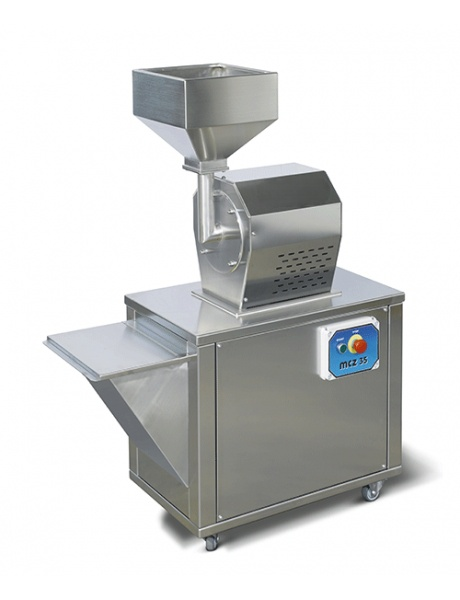
The most common mechanism for sugar powder machine applications. A rotating disc carries hardened steel hammers or pins at high speed. Sugar crystals entering the grinding chamber are struck by these hammers, shattered against a surrounding screen, and reduced to particles small enough to pass through the screen perforations.
Screen selection determines output particle size — finer screens produce finer powder. Hammer tip speed, hammer configuration, and airflow through the grinding chamber all affect particle size distribution and grinding efficiency.
Impact grinding works well for most sugar grinding applications. It’s relatively energy-efficient for the particle sizes typically required in food and pharmaceutical applications, produces manageable heat loads, and handles the slightly hygroscopic nature of sugar reasonably well.
Pin Mill Grinding
A variant of impact grinding using interlocking rows of pins on counter-rotating or single-rotating discs rather than hammers. The impact and shear forces generated by pins passing through the sugar crystal mass produces finer, more uniform particle size distributions than hammer mills at comparable energy input.
Pin mills are preferred for applications requiring very fine icing sugar or pharmaceutical-grade powdered sugar where particle size consistency is critical. They’re also gentler on heat-sensitive materials because the residence time in the grinding zone is shorter.
Air Classifier Mill Systems
More sophisticated than basic impact or pin mills, these systems integrate classification directly into the grinding process. A built-in air classifier continuously separates oversize particles and returns them to the grinding zone, while particles meeting the target size specification are carried out by the airflow. This produces much tighter particle size distributions than screen-based systems.
Air classifier mills are the right choice when your application requires very specific particle size specifications with minimal coarse fraction — pharmaceutical excipient production is the most common application where this precision matters enough to justify the higher equipment cost.
Why Stainless Steel 316 Construction Matters for Sugar Grinding
When you’re ready to buy Sugar Grinder equipment for food or pharmaceutical production, the material specification of product-contact surfaces is a fundamental question — not a detail to evaluate after you’ve made the basic buying decision.
Sugar is chemically straightforward — it’s not aggressively corrosive in the way that many pharmaceutical APIs or chemical processing materials are. But several factors make proper stainless steel specification important even for sugar grinding:
Moisture and Hygroscopicity: Sugar is hygroscopic — it absorbs moisture from the air. In a grinding operation, sugar particles have very high surface area, and that high surface area accelerates moisture absorption. In a grinding chamber made from lower-grade materials, moisture combined with fine sugar particles creates conditions for corrosion, particularly in surface imperfections and joints.
Cleaning Chemistry: Food-grade and pharmaceutical-grade cleaning protocols use alkaline and sometimes acidic cleaning agents at elevated temperatures. SS316L withstands repeated exposure to these cleaning cycles without surface degradation. SS304 is adequate for many food applications but shows accelerated corrosion in more aggressive cleaning environments.
Pharmaceutical GMP Requirements: For sugar grinding in pharmaceutical excipient production or confectionery products manufactured under pharmaceutical-grade standards, SS316L contact surfaces are typically specified as a GMP requirement. DRAP inspections of pharmaceutical manufacturing facilities specifically look at contact surface material specifications.
Food Safety Regulations: Pakistan’s food safety regulatory environment is increasingly aligned with international standards. SS316L contact surfaces in food processing equipment are the international best practice and increasingly the expected standard for export-quality food manufacturers.
Long-Term Surface Integrity: Over the operational life of a sugar grinding machine, SS316L contact surfaces maintain their smooth, cleanable finish significantly better than lower-grade alternatives. Surface degradation in grinding equipment creates rough areas where product residue accumulates, harbors microbial growth, and makes thorough cleaning progressively more difficult.
When you buy Sugar Grinder equipment and see price differences between suppliers, material specification is frequently a major contributor to that difference. Always ask specifically for material certificates confirming SS316L for product-contact surfaces — not just a claim in the brochure, but actual documentation.
Capacity Ranges — 100 kg/hr to 2500 kg/hr: Matching the Machine to Your Operation
The capacity range from 100 kg/hr to 2500 kg/hr covers an enormous spread of production scales. Understanding where your operation sits in this range — and where it’s likely to be in three to five years — is the starting point for any sensible equipment evaluation.
100–300 kg/hr Range
Small-scale production appropriate for:
- Small confectionery manufacturers producing specialty products
- Artisan food producers with premium product positioning
- Pharmaceutical compounding operations grinding small batches of sugar for specific formulations
- Research and development facilities developing new food or pharmaceutical formulations
- Small herbal medicine manufacturers using powdered sugar as an excipient
The Sugar Grinder price in Pakistan for equipment in this capacity range is the most accessible. Investment is modest relative to larger systems, and operational costs — energy consumption, maintenance requirements — are proportionally lower. If you’re a small producer starting out, this is typically the right entry point.
300–800 kg/hr Range
Mid-range capacity appropriate for:
- Established confectionery manufacturers with consistent product lines
- Biscuit and bakery ingredient suppliers
- Medium-scale pharmaceutical excipient processors
- Industrial food ingredient suppliers
This range represents the most common capacity requirement among Pakistani food and pharmaceutical manufacturers currently looking to buy Sugar Grinder equipment. The Sugar Grinder price in Pakistan in this capacity range reflects more robust mechanical systems and higher-specification drives, but remains accessible for established manufacturing businesses.
800–2500 kg/hr Range
High-capacity production appropriate for:
- Large-scale confectionery and chocolate manufacturers
- Industrial sugar processing facilities
- Large pharmaceutical excipient manufacturers
- Export-oriented food ingredient producers
- Industrial chemical manufacturers using powdered sugar as a process material
Equipment at this capacity level involves substantially more robust mechanical systems, higher-capacity dust collection and air handling, sophisticated control systems, and correspondingly higher investment. The Sugar Grinder price in Pakistan for this capacity range reflects these engineering requirements and is a meaningful capital investment justified by the production scale.
The Sugar Powder Machine Application Landscape
People who haven’t worked in food or pharmaceutical manufacturing sometimes assume sugar grinding is a single, simple application. In practice, a sugar powder machine serves a remarkably diverse range of industries and applications in Pakistan, each with somewhat different requirements:
Confectionery Manufacturing
Icing sugar for cake decorating and sugar coatings. Fondant production. Chocolate tempering and coating. Hard candy and lollipop production. Marshmallow manufacturing. In all of these applications, sugar particle size directly affects product texture, mouthfeel, and visual appearance. Consistent grinding is essential for consistent product quality.
Pharmaceutical Manufacturing
Sugar as a tablet excipient — used in direct compression tablet formulations and as a coating material. Powdered sugar in pharmaceutical syrups and suspensions. Sugar-based granulation for pediatric formulations. These pharmaceutical applications have the most demanding particle size specifications and the most rigorous GMP requirements for equipment materials and documentation.
Bakery and Food Ingredient Supply
Icing and dusting sugars for commercial bakers. Sweetener ingredient supply for processed food manufacturers. Flavored sugar products. The food ingredient supply market in Pakistan is growing alongside the organized retail food sector, creating increasing demand for consistent, food-safe powdered sugar production.
Herbal and Nutraceutical Manufacturing
Many traditional herbal formulations use sugar as a base or sweetener. Nutraceutical supplement manufacturers use powdered sugar as a carrier or excipient. These applications typically require food-grade or pharmaceutical-grade material specifications.
Industrial Applications
Some industrial chemical processes use sugar as a process material or feedstock. Fermentation industries. Agricultural product processing. These applications may have different specification requirements from food and pharmaceutical uses.
Understanding which application category your production falls into helps you specify the right sugar grinding machine — particularly around particle size targets, material specification requirements, and documentation needs.
Key Technical Specifications to Evaluate
When comparing equipment from different suppliers and assessing Sugar Grinder price in Pakistan across different options, these are the specifications that actually matter for real-world production performance:
Output Particle Size Range
What particle sizes can the machine produce, and how does this map to your product requirements? Icing sugar for consumer confectionery typically targets D90 around 100-150 microns. Pharmaceutical excipient sugar may require much tighter specifications — D90 under 50 microns with minimal coarse fraction. Make sure the machine’s capability matches your actual product requirements.
Particle Size Distribution Consistency
Not just average particle size, but the width of the distribution. A machine that produces an average of 100 microns but with a wide distribution from 20 to 400 microns is much less useful than one producing tight distribution centered around 100 microns. Ask for particle size distribution data from actual production runs, not just theoretical capability.
Throughput at Target Particle Size
Critical point: throughput and particle size are related variables in most grinding systems. A machine rated at 500 kg/hr might achieve that throughput at coarser particle sizes, but drop to 300 kg/hr when set up to achieve your target fine powder specification. Always verify throughput at your actual target particle size.
Heat Generation
Sugar begins to caramelize above approximately 160°C. Fine powder grinding generates heat through mechanical energy conversion. Quality sugar grinding machine designs manage this through controlled airflow through the grinding chamber, keeping product temperatures well below caramelization thresholds. Ask specifically about maximum product temperature during grinding.
Dust Containment and Extraction
Fine sugar powder is explosive — this is not a theoretical hazard. Sugar dust in air at concentrations above approximately 35 g/m³ forms an explosive mixture. All properly designed sugar grinding equipment incorporates effective dust containment and extraction, typically including dust collection systems rated for explosive dust. This is a safety requirement, not an optional feature.
Drive System and Motor Specification
What motor powers the grinding mechanism? Is the drive system variable speed or fixed speed? Variable speed capability allows you to adjust grinding parameters for different product specifications or to optimize performance with different sugar crystal sizes.
Screen/Classifier System
For screen-based mills, what screen sizes are available and how quickly can screens be changed? For air classifier systems, what classification parameter adjustments are available, and how are they controlled?
Cleaning and Maintenance Access
How is the grinding chamber accessed for cleaning? Can cleaning be accomplished without major disassembly? How long does a complete clean-down take? In production environments running multiple products or requiring frequent batch changeovers, cleaning time is a direct production efficiency factor.
Safety Considerations That Cannot Be Compromised
Sugar dust explosibility deserves direct discussion because it’s sometimes underappreciated in purchasing decisions for sugar powder machine equipment.
Fine sugar powder suspended in air at sufficient concentration is an explosive mixture. The minimum explosive concentration for sugar dust is relatively low — around 35 g/m³. During grinding operations, the grinding chamber and surrounding areas can easily reach concentrations in this range.
This means that properly designed sugar grinding machine equipment must include:
Enclosed Grinding Chamber: The grinding mechanism must operate in an enclosed environment that prevents dust dispersion into the surrounding area during normal operation.
Rated Dust Collection: Dust collection systems connected to the grinding chamber must be rated for handling explosive dust — this affects the design of the dust collector, the filter materials, and any associated electrical equipment.
Explosion Relief: Large grinding systems should incorporate explosion relief venting or suppression systems that direct any deflagration event safely away from personnel and equipment.
Earthing and Bonding: Fine powder grinding equipment must be properly earthed to prevent static charge accumulation that could provide an ignition source for dust explosions.
Non-Sparking Materials: Internal components of the grinding chamber — particularly hammers and liners — should be manufactured from materials that minimize spark generation on impact. Stainless steel components help here; other material choices require careful consideration.
When you buy Sugar Grinder equipment, ask specifically how these safety requirements are addressed in the equipment design. Suppliers who can give you clear, specific answers are suppliers whose engineering approach you can trust. Suppliers who are vague or dismissive about dust safety are telling you something important about their overall engineering approach.
Sugar Grinder Price in Pakistan — Understanding What Drives the Numbers
The Sugar Grinder price in Pakistan range across different capacities, specifications, and suppliers is wide — wide enough to be confusing when you’re trying to compare quotations.
Here’s an honest breakdown of what drives meaningful price differences:
Capacity: This is the most obvious driver. A 100 kg/hr machine and a 2500 kg/hr machine involve fundamentally different mechanical systems. Larger machines require heavier-duty drive systems, larger grinding chambers, higher-capacity dust collection, and more robust structural components. Price scales with capacity, though not always linearly.
Grinding Mechanism Type: Basic hammer mills sit at the accessible end of the price range for a given capacity. Pin mills cost more. Air classifier mills cost significantly more. The price premium reflects the engineering sophistication and the quality of particle size control each mechanism provides.
Material Specification: SS316L contact surface construction costs more than SS304 or lower-grade alternatives. The premium is real but modest relative to total machine cost — typically not a major driver of price differences between comparable machines. When this premium is large, it often signals that the lower-priced alternative has much thinner contact surfaces or uses lower-grade materials than claimed.
Drive and Control Systems: Variable frequency drives, PLC control systems, automated process parameter monitoring — these add cost and add operational value. Fixed-speed drives with manual controls are cheaper and adequate for some applications; variable speed and automated controls are essential for others.
Dust Collection System: A properly rated dust collection system for explosive dust handling adds meaningful cost to the complete installation. If a quotation doesn’t include a dust collection system or includes only a basic cyclone separator without proper explosive dust rating, that’s a cost you’ll need to add — and a safety requirement you can’t ignore.
Documentation: IQ/OQ protocol packages, material certificates, calibration documentation — relevant particularly for pharmaceutical applications. This documentation takes real time to produce and is reflected in pricing.
Local vs. Imported: Imported grinding equipment carries shipping, import duties, and currency exchange exposure that isn’t always visible in initial quotations but adds to total acquisition cost. Local manufacturing eliminates these additions.
TOPTEC Scientific — Your Complete Production Environment Partner
Here’s something that consistently gets overlooked when manufacturers are focused on the grinding equipment itself: the production environment around your sugar grinding machine affects safety, efficiency, and product quality directly.
Where do operators sample output for particle size verification? Where does ground sugar accumulate before packaging or transfer? What surfaces are operators working at when managing the grinding operation? Are those surfaces properly specified for food or pharmaceutical environments?
These aren’t abstract questions — they affect contamination control, operator safety, and regulatory compliance in real, practical ways.
TOPTEC Scientific is a Pakistan-based manufacturing company producing high-specification laboratory furniture and cleanroom equipment for food, pharmaceutical, nutraceutical, and industrial manufacturing facilities. Everything they make is manufactured locally in Pakistan — which means faster delivery, no import complications, local technical support, and pricing that makes sense for Pakistani manufacturing operations.
For manufacturers investing in sugar grinding capability, TOPTEC Scientific provides the surrounding production infrastructure that makes your complete operation genuinely work:
Stainless Steel Workbenches and Production Tables
Manufactured from SS304 or SS316 with seamless welded construction and fully cleanable surfaces. No wooden surfaces that absorb moisture and harbor microbial growth. No painted finishes that chip and contaminate food products. Properly specified, chemically resistant work surfaces designed for food and pharmaceutical production environments where daily cleaning with aggressive agents is standard practice.
For sugar grinding operations specifically, properly specified surrounding work surfaces matter for maintaining the hygiene standards your end products require.
Weighing and Dispensing Stations
Purpose-designed for accurate in-process weighing and material handling. Anti-vibration features improve measurement accuracy. Appropriate surface specifications maintain cleanability through heavy daily use. Ergonomic design reduces operator fatigue during repetitive weighing and dispensing operations — which matters when you’re processing hundreds of kilograms per shift.
Dust-Controlled Workstations
For operations generating significant powder dust — which sugar grinding certainly does — properly designed workstations with integrated dust management features reduce operator exposure and workplace contamination. TOPTEC Scientific manufactures ventilated workstations appropriate for powder handling environments.
Storage Systems and Mobile Trolleys
Pharmaceutical and food-grade stainless steel storage shelving and mobile trolleys for raw sugar storage, ground product intermediate storage, and in-facility transport. Properly designed for hygiene — no particle-shedding surfaces, no difficult-to-clean joints, appropriate load ratings for dense granular materials.
Pass-Through Boxes
For facilities with different environmental zones — common in pharmaceutical manufacturing where raw material areas and production cleanrooms have different environmental controls — pass-through boxes allow controlled material transfer without compromising zone integrity.
Laboratory Benches and QC Furniture
For quality control operations including particle size analysis of ground sugar output, appropriate laboratory furniture provides stable, cleanable work surfaces that support accurate analytical work. Chemical-resistant bench surfaces, organized storage, and proper lighting support the analytical work your QC team performs on finished ground sugar.
Fume Hoods and Ventilated Enclosures
Where chemical analysis or solvent-based QC methods are used, properly specified fume hoods provide operator protection and contamination control. These are relevant for pharmaceutical applications of powdered sugar where QC methods involve chemical analysis.
The practical value of sourcing this infrastructure from TOPTEC Scientific is straightforward: local manufacturer, direct communication, no import delays, local technical support, and pricing structured around what Pakistani manufacturers can actually work with.
Who Should Seriously Consider Buying Sugar Grinding Equipment Right Now?
Rather than generic advice about “any manufacturer who needs ground sugar,” let’s be specific about who is in a position where investing in dedicated grinding equipment makes clear operational and economic sense.
Confectionery manufacturers currently buying icing sugar: If you’re purchasing pre-ground icing sugar from a supplier, you’re paying for their grinding margin plus their logistics plus the inconsistency of not controlling your own particle size. Once your icing sugar consumption reaches a volume where the economics are clear, in-house grinding almost always makes sense.
Pharmaceutical manufacturers using sugar as an excipient: Pharmaceutical-grade powdered sugar needs to meet specific particle size requirements and GMP documentation standards. Controlling this in-house gives you full traceability and specification control. For pharmaceutical excipient producers, this control is part of your regulatory obligation.
Bakery ingredient suppliers: As organized retail bakery chains grow in Pakistan, demand for consistent, food-safe powdered sugar from reliable local suppliers is growing alongside it. Investment in proper grinding capability positions you to serve this market.
Export-oriented food manufacturers: International buyers — particularly those in GCC countries, European markets, and North American markets — have specific food safety expectations. SS316L contact surface sugar grinding machine equipment with proper documentation supports the food safety credentials these buyers expect.
Herbal medicine and nutraceutical manufacturers: Sugar as a vehicle or sweetener in traditional formulations. Controlled in-house grinding gives you particle size consistency that affects product quality.
Questions to Ask Before You Commit
Before you finalize any decision to buy Sugar Grinder equipment, these questions deserve clear answers from any supplier you’re seriously considering:
What particle size distribution can you demonstrate with my specific sugar grade, and do you have actual test data rather than theoretical specifications?
What is the product temperature during grinding at my target particle size and throughput rate?
How is the dust extraction system specified for explosive dust — what is its rating and certification?
What does a complete clean-down involve, and how long does it take?
What screen sizes or classifier settings are available, and what particle size does each produce?
What is the motor and drive specification, and is variable speed available?
What documentation is included — material certificates, test reports, IQ/OQ protocol templates?
What is your spare parts availability locally, and what is the realistic lead time for critical wear components like hammers, screens, and bearings?
Can you provide references from existing customers in similar production environments?
Clear, specific answers to these questions separate suppliers who genuinely understand their equipment and your application from those who are primarily focused on closing a sale.
Practical Tips for Getting the Best Value
A few observations about how to approach the Sugar Grinder price in Pakistan evaluation that don’t usually appear in equipment buying guides:
Don’t evaluate capacity in isolation from particle size requirements. The machine that achieves your target particle size at your required throughput is the right machine — not the one with the highest rated capacity.
Factor in installation and commissioning costs. These are real costs that don’t always appear in initial quotations. Local suppliers from whom you buy Sugar Grinder equipment can typically handle installation more efficiently than imported equipment requiring international technical teams.
Plan your dust collection as part of the initial investment. Don’t buy the grinding machine and defer the dust collection decision. These systems need to be specified and installed together.
Consider utility requirements early. Large grinding systems have meaningful electrical power requirements. Confirming your facility has adequate electrical supply before equipment arrives avoids expensive delays and modifications.
Budget for consumable parts. Hammers, screens, bearings — these wear and need replacement. Understanding the consumable cost over a year of production is part of honest total cost of ownership evaluation.
Wrapping Up
When you buy Sugar Grinder equipment for your food, pharmaceutical, or industrial manufacturing operation, you’re investing in the particle size consistency that determines the quality of everything produced downstream.
The Sugar Grinder price in Pakistan that makes sense for your operation is the one that accounts for the complete picture: the right capacity for your actual and near-future production requirements, proper SS316L material specification for product contact surfaces with documentation to prove it, genuine dust safety engineering, particle size capability matched to your product specifications, and after-sales support from Capsule Polisher manufacturers and equipment suppliers who will actually be there when you need them.
And when you’re building the complete production environment around your sugar powder machine — the workbenches, weighing stations, storage systems, and quality control furniture — remember that TOPTEC Scientific manufactures this infrastructure locally in Pakistan, to specifications that food and pharmaceutical production environments actually require.
The investment that serves you best is the complete investment — right equipment, right specification, right surrounding infrastructure.
