


Buy a high-performance sugar grinder for converting granulated sugar into a fine, consistent powder. Choose from capacities of 20 to 1000+ kg/hr with durable stainless steel construction. Get pricing and specifications from verified suppliers today.
Everyone focuses on the tablet press. The capsule filling line gets detailed evaluation. The coating pan specifications get debated at length. But somewhere in the middle of all that, the sugar grinding machine gets treated as a secondary consideration — something to sort out after the “important” equipment decisions are made.
And then production starts, and the problems begin.
Dust migration from an inadequately contained grinding operation contaminating adjacent workstations. Cross-contamination between products because the grinding chamber can’t be properly cleaned between batches. Particle size inconsistency causing batch-to-batch variation in tablet hardness, coating quality, or syrup clarity. DRAP inspection findings related to inadequately controlled powder handling in the sugar grinding area.
These aren’t hypothetical problems. They happen regularly in pharmaceutical manufacturing facilities where the Pharmaceutical Sugar Grinder decision was made on price alone without proper consideration of GMP compliance, dust containment, and the specific demands of pharmaceutical production environments.
This guide is for pharmaceutical manufacturers in Pakistan who are approaching this decision seriously — whether you’re specifying equipment for a new facility, replacing aging grinding equipment, or upgrading from food-grade to pharmaceutical-grade grinding capability. Let’s work through what actually matters.
Why Pharmaceutical Sugar Grinding Is Different From Food Industry Grinding
If you’ve previously purchased sugar grinding machine equipment for food production and are now equipping or upgrading a pharmaceutical facility, the difference in requirements is more substantial than it might initially appear.
Food industry sugar grinding prioritizes hygiene, throughput, and particle size achievement. These are important requirements — but pharmaceutical manufacturing adds a layer of regulatory rigor and cross-contamination control that fundamentally changes the equipment specification.
Cross-Contamination Risk
In pharmaceutical manufacturing, sugar is used alongside active pharmaceutical ingredients — drugs that have real pharmacological effects at small quantities. Cross-contamination between products isn’t just a quality problem; it’s a patient safety issue. A pharmaceutical sugar powder machine must be designed for rapid, verifiable, complete cleaning between batches. Every surface, every channel, every internal component must be accessible for cleaning validation. This design requirement affects everything about how a pharmaceutical grinding system is engineered.
Regulatory Documentation
DRAP inspectors expect to see equipment qualification documentation, cleaning validation records, and material specifications for pharmaceutical production equipment. A Pharmaceutical Sugar Grinder needs to come with IQ/OQ protocol support, material certificates for product-contact surfaces, and design documentation that supports your cleaning validation activities. Food industry grinding equipment typically comes with none of this.
Particle Size Specifications
Pharmaceutical applications often have tighter particle size specifications than food industry applications. A pharmaceutical tablet formulation calling for powdered sugar with D90 under 75 microns — or tighter — needs a sugar grinding machine capable of consistently achieving and maintaining that specification across batches. Demonstrating this capability through documented process validation is a regulatory expectation, not just good practice.
Dust Containment
In pharmaceutical facilities, dust migration from grinding operations can contaminate other pharmaceutical products in adjacent areas. This cross-contamination risk is taken very seriously by regulators. Pharmaceutical-grade sugar powder machine systems must contain dust within the grinding system rather than allowing it to migrate into the surrounding production environment.
Understanding GMP Compliance for Sugar Grinding Equipment
GMP (Good Manufacturing Practice) compliance isn’t a single specification — it’s a framework of requirements that collectively ensure pharmaceutical products are consistently produced to the quality standards they’re designed to meet.
For Pharmaceutical Sugar Grinder equipment specifically, GMP compliance translates into several concrete design and documentation requirements:
Contact Surface Material Specification
WHO-GMP guidelines and DRAP requirements specify that pharmaceutical manufacturing equipment product-contact surfaces must be smooth, non-reactive, non-absorptive, and capable of repeated cleaning and sterilization without degradation.
SS316L stainless steel is the standard material for pharmaceutical product-contact surfaces in grinding equipment. The “L” designation — low carbon — matters specifically because it maintains corrosion resistance through the welding operations involved in manufacturing grinding equipment. Standard SS316 or SS304 can develop sensitized zones around welds where carbide precipitation reduces corrosion resistance — exactly the kind of surface degradation that creates microbial harborage points in pharmaceutical equipment.
When you evaluate Sugar Grinder price in Pakistan across different suppliers, confirming SS316L specification with material certificates rather than just brochure claims is a basic due diligence requirement.
Design for Cleanability
This is where pharmaceutical sugar grinding machine design diverges most visibly from food industry equipment. GMP design for cleanability means:
No hollow sections or inaccessible spaces where product residue can accumulate between batches. Smooth interior surfaces with no rough areas, crevices, or joints where powder lodges. Minimum use of bolted connections in product-contact areas — preferably welded construction. Viewing windows and access panels that allow visual verification of cleaning. Disassembly for cleaning that can be accomplished by operators without specialized tools or extensive mechanical knowledge.
GMP inspectors specifically look for design features that make thorough cleaning difficult. Equipment that fails this test creates ongoing cleaning validation problems regardless of how well it performs its grinding function.
Dust Containment Engineering
For pharmaceutical applications, dust containment in Pharmaceutical Sugar Grinder systems goes beyond the dust extraction you’d specify for a food industry installation.
Pharmaceutical dust containment means the grinding system operates under negative pressure — the internal grinding environment is maintained at lower pressure than the surrounding room, so any leakage is inward rather than outward. This prevents pharmaceutical-grade powdered sugar from migrating into adjacent production areas.
It also means properly rated filtration on extracted air before it’s returned to the room or exhausted outside. HEPA filtration on final exhaust streams is standard for pharmaceutical grinding operations.
Equipment Qualification Support
Before any sugar powder machine can be used in validated pharmaceutical production, it must go through formal equipment qualification:
Installation Qualification (IQ): Documents that the equipment was installed correctly according to manufacturer specifications and your facility requirements. Covers utilities connections, environmental controls, safety systems, and physical installation parameters.
Operational Qualification (OQ): Verifies that the equipment operates within specified parameters across its operating range. For a Pharmaceutical Sugar Grinder, this includes demonstrating particle size achievement at different settings, verifying dust containment effectiveness, and confirming cleaning procedure adequacy.
Performance Qualification (PQ): Demonstrates that the equipment consistently produces powdered sugar meeting pharmaceutical specifications under actual production conditions across multiple batches.
Reputable Pharmaceutical Sugar Grinder suppliers provide IQ/OQ protocol templates as part of their documentation package. If a supplier cannot provide qualification documentation support, this is a significant problem for pharmaceutical applications.
Dust-Free System Design — What This Actually Means Technically
“Dust-free” is a term that gets used loosely in equipment marketing. Let’s be specific about what it actually means in engineering terms for a pharmaceutical sugar grinding machine.
Contained Grinding Chamber
A genuinely dust-contained grinding system has a fully enclosed grinding chamber with no gaps, poorly sealed access points, or areas where positive pressure during grinding can push powder into the surrounding environment. The chamber operates under slightly negative pressure — maintained by the extraction system — so any imperfection in the enclosure draws room air in rather than pushing grinding dust out.
Integrated Powder Recovery
The extracted air from the grinding chamber carries entrained fine powder particles. A properly designed system recovers this powder into the product stream rather than losing it to dust collection filter cakes. This serves two purposes: it improves yield from the grinding operation, and it removes the burden from downstream filtration systems.
Cyclone separators are the typical first stage — centrifugal separation removes the bulk of entrained powder. Fine powder that passes through the cyclone is then captured by bag filters or cartridge filters before the air stream reaches HEPA filtration for final cleaning.
HEPA Filtration on Final Exhaust
For pharmaceutical applications, the final filtration stage on exhausted air should be HEPA-rated — removing particles down to 0.3 microns with 99.97% efficiency. This ensures that even the finest powder particles don’t migrate into the surrounding environment through the exhaust air stream.
Negative Pressure Verification
Properly engineered pharmaceutical Pharmaceutical Sugar Grinder systems include pressure monitoring to verify that the intended negative pressure differential is maintained during operation. If the extraction system loses performance — due to filter loading, a blower problem, or any other cause — pressure monitoring alerts operators before dust containment is compromised.
Sealed Transfer Connections
Between the grinding chamber and downstream processing — transfer to intermediate bulk containers, direct feeding to blending or granulation equipment, or discharge to packaging — sealed transfer connections prevent dust escape at these interface points. Flexible seal connections, vacuum transfer systems, or contained discharge valves all serve this function in different equipment designs.
Particle Size Achievement in Pharmaceutical Sugar Grinding
The particle size requirements for pharmaceutical powdered sugar vary significantly depending on the application. Understanding your specific requirements before evaluating equipment is essential.
Direct Compression Tablet Formulations
Sugar used as a diluent or binder in direct compression tablet formulations typically requires controlled particle size distribution to ensure consistent flow properties and compressibility. Particle size that’s too coarse causes segregation in tablet blends. Particle size that’s too fine causes flow problems and can affect tablet hardness and friability.
Typical targets for direct compression sugar might specify D50 (median particle size) in the range of 100-200 microns with controlled coarse fraction limits — often D90 under 300 microns with minimal particles above 500 microns.
Tablet Coating Solutions
Sugar syrup for tablet coating uses dissolved sugar, so grinding particle size affects dissolution rate rather than coating properties directly. However, finer particle size improves dissolution efficiency and produces cleaner syrup solutions with lower undissolved residue.
Syrup and Liquid Formulations
Pharmaceutical syrups using powdered sugar rather than dissolved sugar require fine particle size for rapid, complete dissolution. D90 under 150 microns is typical; some specifications are tighter depending on formulation requirements.
Dry Powder Inhaler Carrier Sugar
Lactose is more commonly used in DPI formulations, but some formulations use specific grades of powdered sugar as carrier material. DPI applications have extremely tight particle size requirements — typically D90 under 100 microns with very controlled fine particle fraction — that require high-specification air classifier mill grinding systems.
Nutraceutical and Herbal Formulations
Herbal medicine formulations using sugar as excipient typically have less rigorous particle size specifications than pharmaceutical applications, but still require consistent grinding to ensure product-to-product batch uniformity.
The Sugar Grinder price in Pakistan for equipment achieving very fine, tightly controlled particle size distributions is higher than for equipment producing coarser, more variable output — and that price difference reflects the engineering required to achieve pharmaceutical-grade specification control.
Key Equipment Types for Pharmaceutical Sugar Grinding
Pharmaceutical-Grade Hammer Mills
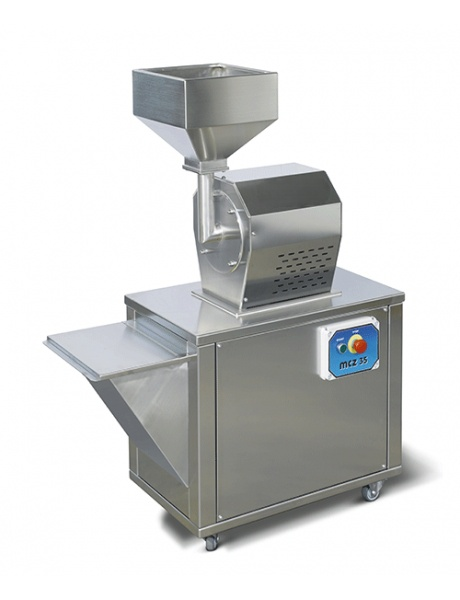
Hammer mills adapted for pharmaceutical use incorporate enclosed construction, SS316L contact surfaces, dust-tight access panels, and extraction system integration. They represent the most common Pharmaceutical Sugar Grinder configuration for general pharmaceutical sugar grinding applications.
Output particle size depends on screen selection — pharmaceutical hammer mills typically offer screen ranges from around 0.5mm down to 0.1mm perforation size, achieving product D90 values approximately in the range of 200 microns down to around 75 microns depending on specific design and sugar characteristics.
Advantages for pharmaceutical use: well-understood technology, relatively straightforward cleaning and qualification, good throughput for given machine size, manageable maintenance requirements.
Limitations: particle size distribution is wider than pin mill or classifier mill alternatives; very fine particle size specifications may not be achievable.
Pin Mills with Pharmaceutical Construction
Pin mills generate finer, more uniform particle size distributions than hammer mills at comparable energy input. Pharmaceutical-construction pin mills use SS316L contact surfaces throughout, sealed bearing systems that prevent lubricant contamination of the product zone, and integrated extraction systems.
For applications requiring powdered sugar with D90 under 100 microns and reasonable distribution uniformity, pin mills are typically the appropriate sugar grinding machine choice.
The Sugar Grinder price in Pakistan for pharmaceutical-grade pin mills is higher than hammer mill alternatives — reflecting both the more sophisticated grinding mechanism and the additional engineering required for pharmaceutical construction standards.
Air Classifier Mill Systems
The highest-specification option for pharmaceutical sugar grinding. Integrated air classification produces very tight particle size distributions because oversize particles are continuously returned to the grinding zone until they meet specification. The classifier can be adjusted to produce different target particle sizes without changing screens or mechanical components.
For pharmaceutical applications with rigorous particle size specifications, process validation requirements for particle size consistency, or formulations particularly sensitive to particle size variation, air classifier mills provide specification control that simpler grinding systems cannot match.
These systems represent the highest Sugar Grinder price in Pakistan in the pharmaceutical grinding equipment category — but for applications where particle size specification control is critical, the investment is justified by the process capability improvement.
Conical Mill (Comil) Systems
Conical mills use a rotating impeller inside a conical screen to produce controlled particle size reduction through a combination of impact and shear forces. They’re gentler than hammer mills and produce good particle size uniformity. For pharmaceutical sugar grinding applications where very fine particle size isn’t required but controlled distribution is important, conical mills are a useful alternative to consider.
Conical mills are also particularly cleanable — the simple geometry of the conical grinding chamber and the rotating impeller makes thorough cleaning relatively straightforward, which is an important advantage for pharmaceutical multi-product facilities.
Evaluating Sugar Grinder Price in Pakistan — The Pharmaceutical Perspective
When pharmaceutical manufacturers evaluate Sugar Grinder price in Pakistan, the framework needs to be different from food industry price evaluation. Several cost elements that are optional or secondary for food applications are mandatory for pharmaceutical use:
Material Certification Cost
SS316L contact surface construction with material traceability certificates costs more than unverified stainless steel construction. For pharmaceutical GMP compliance, material certificates aren’t optional — they’re required. This cost is part of the pharmaceutical equipment price, and it should be.
Qualification Documentation
IQ/OQ protocol templates, equipment design documentation, cleaning procedure development support — these take real engineering time to produce. Pharmaceutical sugar powder machine suppliers who include proper qualification documentation in their offering are reflecting that cost in their pricing. This is appropriate and necessary.
Dust Containment Engineering
Properly engineered negative pressure grinding systems with integrated HEPA filtration cost more than basic grinding equipment with simple dust extraction. The engineering required for genuine pharmaceutical dust containment is reflected in equipment pricing.
Cleanability Design Engineering
Designing a Pharmaceutical Sugar Grinder for genuine cleanability — accessible internal surfaces, minimal joints and crevices, tool-free disassembly for cleaning — requires more sophisticated mechanical design than equipment optimized purely for throughput. This design investment is reflected in the equipment cost.
Seal and Bearing Specification
Pharmaceutical-grade grinding equipment uses sealed bearing systems specifically designed to prevent lubricant migration into the product zone. These bearing assemblies are more expensive than standard industrial bearings but are necessary for pharmaceutical product protection.
When comparing Sugar Grinder price in Pakistan quotations for pharmaceutical applications, a significantly lower price almost always reflects compromises in one or more of these areas. Identifying specifically where the compromise lies — rather than assuming lower price means better value — is the appropriate analytical approach.
Building the Complete Pharmaceutical Grinding Environment
Here’s something that pharmaceutical facility managers learn through experience rather than planning guides: the production environment around your Pharmaceutical Sugar Grinder is as important to your GMP compliance as the grinding machine itself.
The areas adjacent to pharmaceutical grinding operations need to be designed and equipped to the same standard as the grinding equipment. And this is where TOPTEC Scientific becomes directly relevant to your complete pharmaceutical facility investment.
TOPTEC Scientific is a Pakistan-based manufacturing company producing high-specification laboratory furniture and cleanroom equipment for pharmaceutical facilities across the country. Everything they manufacture is produced locally — with all the practical advantages that brings for Pakistani pharmaceutical manufacturers: faster delivery without import complications, local technical support, direct manufacturer communication, and pricing that reflects local manufacturing costs.
For pharmaceutical sugar powder machine operations specifically, TOPTEC Scientific manufactures the surrounding infrastructure that makes your complete grinding area genuinely GMP-compliant:
Stainless Steel Production Workbenches
Manufactured from SS304 or SS316 with seamless welded construction and electropolished or mechanically polished surfaces appropriate for pharmaceutical environments. These provide the immediate surrounding work surfaces for the pharmaceutical grinding area — where operators manage material loading, in-process sampling, and batch documentation.
No painted surfaces that chip and contaminate pharmaceutical products. No hollow sections that trap powder between batches. No rough weld seams that defeat cleaning validation. Properly specified pharmaceutical production surfaces that withstand daily chemical cleaning without surface degradation.
Dispensing and Weighing Stations
Purpose-designed for accurate raw material dispensing and in-process quality control weighing in pharmaceutical environments. Anti-vibration design features improve measurement accuracy — important when you’re weighing pharmaceutical-grade powdered sugar for formulation accuracy. Integrated features for dust containment during dispensing operations address the powder handling challenges specific to pharmaceutical environments.
Contained Dispensing Booths
For pharmaceutical operations where contained powder dispensing is required — weighing pharmaceutical sugar under controlled conditions that minimize operator exposure and environmental contamination — TOPTEC Scientific manufactures HEPA-filtered dispensing booths providing localized ISO 5 environments for critical dispensing operations.
These are particularly relevant adjacent to grinding operations where pharmaceutical-grade powdered sugar is being dispensed into formulation batches after grinding.
Pass-Through Boxes
Static and dynamic configurations for controlled material transfer between different environmental zones in pharmaceutical facilities. Moving powdered sugar from grinding operations to formulation areas. Transferring raw sugar from warehouse to production cleanrooms. Pass-through boxes maintain environmental zone integrity during these transfers — a GMP requirement in facilities with different cleanroom grades in different areas.
Mobile Stainless Steel Trolleys
Pharmaceutical-grade transport systems for moving raw sugar, ground sugar, and equipment within production facilities. Designed for pharmaceutical environments — smooth, cleanable surfaces without particle-shedding or contamination risks. Appropriate load ratings for bulk powder transport. Maneuverable in pharmaceutical production corridors and cleanroom environments.
QC Laboratory Furniture
For quality control operations including particle size analysis of ground sugar output — microscopy, laser diffraction sample preparation, dissolution testing — properly specified laboratory furniture provides stable, cleanable, chemically resistant work surfaces that support accurate analytical work.
Chemical-resistant benches, organized storage for reference standards and analytical reagents, and appropriate working surfaces for the specific analytical methods used in pharmaceutical sugar quality control.
Gowning Room Systems
Benches, lockers, and organized storage for pharmaceutical production gowning areas. Properly designed gowning room furniture supports consistent compliance with gowning procedures — which is where contamination control begins in any pharmaceutical facility, before production personnel enter the production area.
Environmental Monitoring Furniture
Some pharmaceutical facilities require dedicated furniture for environmental monitoring activities — microbial air sampling, surface sampling, particle count monitoring — adjacent to grinding operations. TOPTEC Scientific manufactures appropriate support furniture for these monitoring activities.
The practical case for sourcing this complete infrastructure from TOPTEC Scientific is straightforward and compelling: you’re dealing with a local manufacturer who understands Pakistani pharmaceutical manufacturing requirements, delivers without import delays, provides local technical support, and prices their products in a way that makes sense for Pakistani pharmaceutical businesses.
Cleaning Validation — The Ongoing Challenge in Pharmaceutical Sugar Grinding
Cleaning validation deserves specific discussion because it’s an ongoing operational challenge for multi-product pharmaceutical facilities with sugar grinding operations, and equipment design directly affects how manageable this challenge is.
Cleaning validation for pharmaceutical grinding equipment requires demonstrating that your cleaning procedure removes product residue, cleaning agents, and microbial contamination to acceptable levels — consistently, batch after batch. The validation is typically based on swab sampling of defined internal surface areas and rinse water analysis.
What makes cleaning validation difficult or easy comes down largely to equipment design:
Surface Area: More surface area means more swab sampling points and more opportunity for residue to remain. Simpler grinding chamber geometry reduces the surface area burden.
Surface Finish: Rough surfaces — machine marks, weld imperfections, corrosion pitting — harbor residue that smooth surfaces don’t. This is why surface finish specification matters for pharmaceutical grinding equipment, not just corrosion resistance.
Access: Can all product-contact surfaces be reached for cleaning and sampling? If any surface is accessible only through awkward reach or requires significant disassembly, cleaning validation becomes more complex and cleaning reliability decreases.
Disassembly Simplicity: Complete disassembly for cleaning should be achievable by trained operators without specialized tools. Complex disassembly creates operator variability that undermines cleaning procedure reproducibility.
Material Compatibility: Cleaning agents used for pharmaceutical equipment — alkaline detergents, oxidizing agents, alcohol-based sanitizers — must be compatible with all equipment materials. SS316L contact surfaces provide broad compatibility with standard pharmaceutical cleaning chemistries.
When evaluating Pharmaceutical Sugar Grinder equipment from different suppliers, asking specifically about cleaning validation support — do they have cleaning procedure documentation? Do they have swab recovery data for their typical construction materials? Can they support your cleaning validation study with technical data? — reveals a lot about their experience with pharmaceutical applications versus food industry applications.
Practical Considerations for Pakistani Pharmaceutical Manufacturers
Pakistan’s pharmaceutical manufacturing sector operates under increasingly rigorous regulatory oversight from DRAP, with growing numbers of facilities seeking WHO-GMP certification for export market access. This regulatory environment directly shapes what pharmaceutical sugar grinding machine investments make sense.
DRAP Inspection Readiness
Sugar grinding areas are inspected as part of pharmaceutical facility GMP assessments. Equipment qualification documentation, cleaning validation records, material specifications, and environmental controls in grinding areas all come under inspection scrutiny. Investing in properly documented, genuinely GMP-compliant equipment protects your inspection readiness.
Export Market Considerations
Pharmaceutical manufacturers supplying GCC markets, African markets, or other export destinations face regulatory requirements from those market authorities in addition to DRAP. Equipment that meets WHO-GMP standards — which genuinely pharmaceutical-grade grinding equipment does — supports regulatory submissions in these export markets.
Utility Infrastructure
Large pharmaceutical grinding systems have meaningful electrical power requirements. Confirming adequate electrical supply — three-phase power at the required amperage — before equipment specification avoids expensive delays. Dust collection systems also have utility requirements that need to be incorporated in facility planning.
HVAC Integration
Pharmaceutical grinding areas need appropriate HVAC systems that maintain room pressure relationships and control temperature and humidity within specifications that protect sugar from moisture absorption during grinding. Planning HVAC requirements alongside grinding equipment specification — rather than afterward — produces better outcomes.
Local Technical Support
For pharmaceutical manufacturing operations where grinding downtime affects batch scheduling and regulatory commitments, local technical support from sugar grinding machine suppliers matters enormously. The ability to reach a local engineer who can visit your facility quickly is a real operational advantage over relying on international supplier support.
A Framework for Making This Decision
For pharmaceutical manufacturers evaluating this investment, here’s a structured approach that addresses the considerations specific to pharmaceutical applications:
Step 1: Define Your Particle Size Requirements Precisely
Not approximately — precisely. What D50, D90, and maximum particle size do your pharmaceutical formulations require? These specifications drive machine type selection. If you’re not sure, consult with your formulation development team before evaluating equipment.
Step 2: Assess Your Cross-Contamination Control Requirements
How many different products will this grinding equipment be used for? What are the potency levels of APIs used alongside sugar in your production facility? Higher cross-contamination risk means more stringent cleaning requirements and more demanding cleaning validation — which affects equipment design selection.
Step 3: Confirm Your Regulatory Documentation Requirements
What documentation does your DRAP product registration and facility GMP certification require for pharmaceutical grinding equipment? This determines your minimum qualification documentation requirements.
Step 4: Evaluate Your Capacity Requirements Honestly
Current production volumes and realistic near-term growth projections. Don’t size equipment to your aspirational capacity — size it to your realistic three-year production outlook with appropriate margin.
Step 5: Compare Total Cost of Ownership
Sugar Grinder price in Pakistan quotations evaluated against material specification quality, documentation package, dust containment engineering, cleanability design, and after-sales support capability. The lowest purchase price is rarely the lowest total cost of ownership over a pharmaceutical equipment lifecycle.
Step 6: Plan Your Complete Production Area
Surrounding workbenches, weighing stations, pass-through systems, and environmental controls — from suppliers like TOPTEC Scientific — alongside the grinding equipment itself. The complete area needs to meet GMP standards, not just the grinding machine.
Closing Thoughts
The Pharmaceutical Sugar Grinder decision is genuinely more consequential than it often gets treated in pharmaceutical facility planning. Getting it right means consistent particle size control, manageable cleaning validation, defensible GMP compliance, and smooth regulatory inspections. Getting it wrong means ongoing production problems, cleaning validation struggles, and regulatory inspection findings that create real operational and commercial problems.
The Sugar Grinder price in Pakistan that makes sense for pharmaceutical applications accounts for SS316L material specification with documentation, genuine dust containment engineering, cleanability design that supports validation, qualification documentation support, and local after-sales capability from established sugar powder machine suppliers.
And the complete investment — grinding equipment plus properly specified surrounding infrastructure from TOPTEC Scientific — is the investment that actually delivers GMP compliance rather than just checking boxes on a specification sheet.
Your pharmaceutical manufacturing operation deserves both. Make sure your investment delivers both.
